
Massive Subsidy Cost Blowout Smashes ‘Cheap’ Solar Power Myth

Where solar power generates hyperbole and myth 24 hours a day, it struggles to produce useful electricity for more than 8 hours out of every 24.

Depending where the panels are located in relation to the equator, and the angle of the Sun to the earth (think the height of summer vs the depth of winter) those panels might only produce something like their notional capacity for 4-5 hours a day. Cloudy, wet weather or a healthy snow dump destroys even that piddling output. And a hurricane or decent sized hailstones will knock them out of action, permanently.

So, when sun worshippers start mouthing off about solar ‘powering’ millions of homes, they’re clearly not talking about what happens after dark.

The other aspect of the grand solar delusion concerns cost. Now price, value and cost have different meanings to different people. Especially when someone else is paying the cost and the value lands in your lap, at their expense.

As Robert Bryce points out below, the massive and increasing costs of solar subsidies blows the ‘solar is cheap’ myth out of the water.

More Solar Silliness In The New York Times
Substack
Robert Bryce
14 September 2024

Hyping solar energy is one of America’s most renewable resources. For instance, in 1978, Ralph Nader declared that “everything will be solar in 30 years.” In 1979, President Jimmy Carter declared the US needed to capture more energy from the sun because of “inevitable shortages of fossil fuels.”

In 2011, in the New York Times, Paul Krugman claimed we are “on the cusp of an energy transformation driven by the rapidly falling cost of solar power.” In 2015, presidential candidate Hillary Clinton pledged that if elected president, she would oversee the installation of 500 million solar panels.

In 2021, the Department of Energy released a study that claimed solar “has the potential to power 40% of the nation’s electricity by 2035.” That’s a mighty big claim. Last year, solar accounted for about 5% of US electricity production. Furthermore, solar only provided about 2.2 exajoules of primary energy to the US economy out of 94.2 EJ used. The DOE also claimed solar could reach 45% of US electricity production by 2050. (That same year, President Joe Biden declared that climate change poses “an existential threat to our lives.”)

The solar hype continued last month in the pages of the New York Times with an article by David Wallace-Wells headlined, “What Will We Do With Our Free Power?” The nut graf of Wallace-Wells’ article appeared near the end when he claimed, “the exploding scale and disappearing cost of solar do mean that the energy game will now be played according to some pretty different ground rules.”

Before going further, a disclosure is in order. I understand the economics of solar. About eight years ago, we had 8.2 kilowatts of solar capacity installed on the roof of our house. Why? We got three different subsidies to do so. We now produce about 12 megawatt-hours of electricity per year and have cut our annual electricity bill in half. Further, that was the second solar system we installed on our home here in Austin. We got fat subsidies for the first system, too.

For the record, I’m opposed to all energy subsidies unless I’m the one getting them. But I digress.

Back to Wallace-Wells. He is correct in reporting that solar capacity is growing. Last year in the US, solar capacity grew nearly four times faster than wind capacity. Solar grew by 24.8 gigawatts, while wind capacity grew by 6.3 GW. Further, due to its higher power density, solar will continue to grow faster, both here in the US and around the world. Wallace-Wells goes on to repeat the same shopworn arguments we’ve been hearing for nearly 50 years: solar is getting cheaper, capacity is growing, sunshine is free, and therefore, it really is different this time. He writes:

Because the sun can be simply counted on to rise every day, you don’t need to pay in any ongoing way for a commodity input, like oil or gas, to keep the system humming — only to set it up initially to manage and endure the novel challenges of drawing reliable energy from the giant fireball 94 million miles away. And over the next decade, even that all-in cost is expected to fall in half again. Negative electricity prices, in which consumers are actually paid to consume electricity, are already a recurring feature in the world’s mature markets.

He continued:

Though it seems like a line from starry-eyed science fiction, the dream of electricity “too cheap to meter” arose first in the giddy early days of nuclear power, the phrase coined by the midcentury atomic advocate Lewis Strauss…And it is easy to get carried away with the gauzy utopian possibilities of energy both functionally infinite and effectively free.

But there ain’t nothing free about solar or any other form of energy, and there never will be. For as long as humans have been on this planet, our most fundamental quest hasn’t changed. We seek more energy so we can convert it into more useful power — computing power, motive power, cooking power, cooling power — so that we can do more productive work. That’s what we humans are about. Yes, we may have dubbed our species homo sapiens, but we are, in reality, homo faber. And that making and doing requires ever-increasing amounts of power.
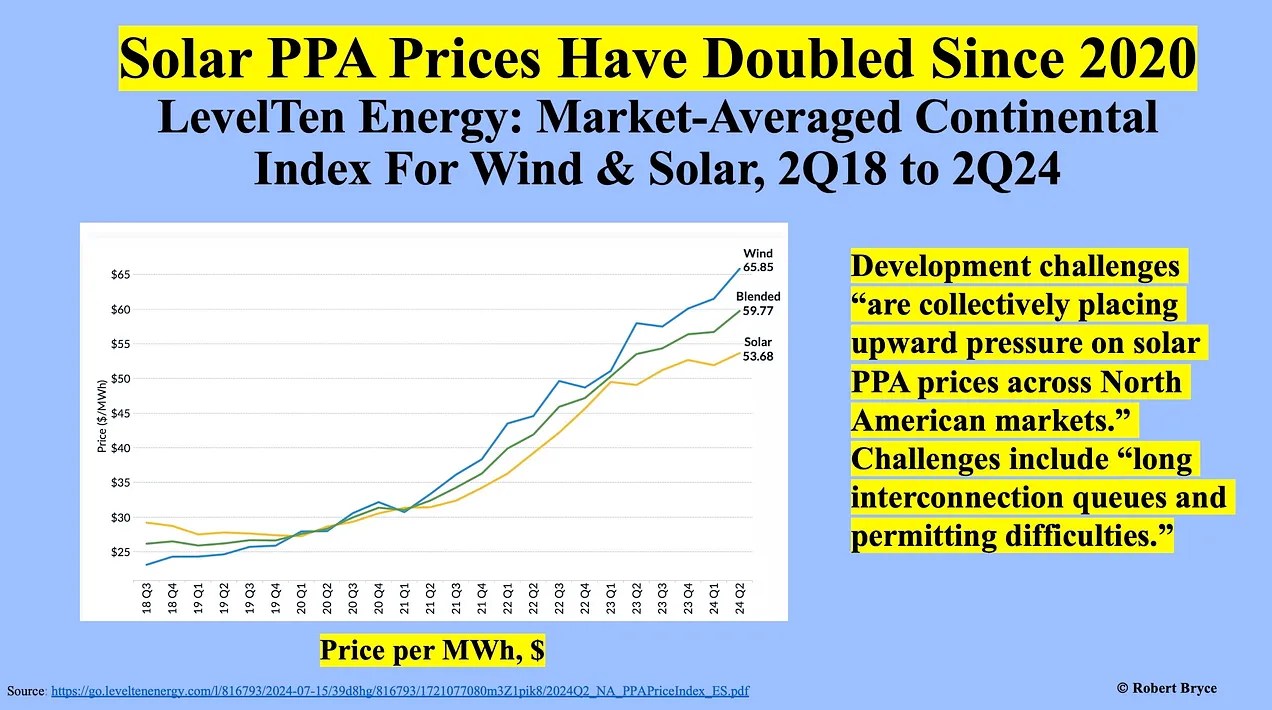
The latest figures from LevelTen Energy show that solar prices aren’t falling, they are rising.

Wallace-Wells can cheer until my PV panels are destroyed by the next hail storm, but he might consider resting on his pom poms for a moment to report on what’s happening in the marketplace. As seen above, solar prices aren’t falling. They are rising. In July, consulting firm LevelTen Energy reported that prices for solar power purchase agreements rose 3% during the second quarter and that solar prices have nearly doubled since 2020. LevelTen said the price surge reflects “the development challenges that are collectively placing upward pressure on solar PPA prices across North American markets.” It continued, saying the challenges include:

Long interconnection queues and permitting difficulties. But in recent months, additional uncertainties have been introduced through the expansion of tariffs on Chinese PV components as well as a new investigation into allegations of duty circumvention and dumping practices from PV component producers in Southwest Asia. These events illustrate a trade law environment that is growing increasingly challenging for solar developers in the United States.

Wallace-Wells barely mentions China in his article. But trade laws are casting big clouds over the solar sector. Three years ago, the Biden Administration issued sanctions against multiple Chinese companies due to their connections with Uyghur slave labor.
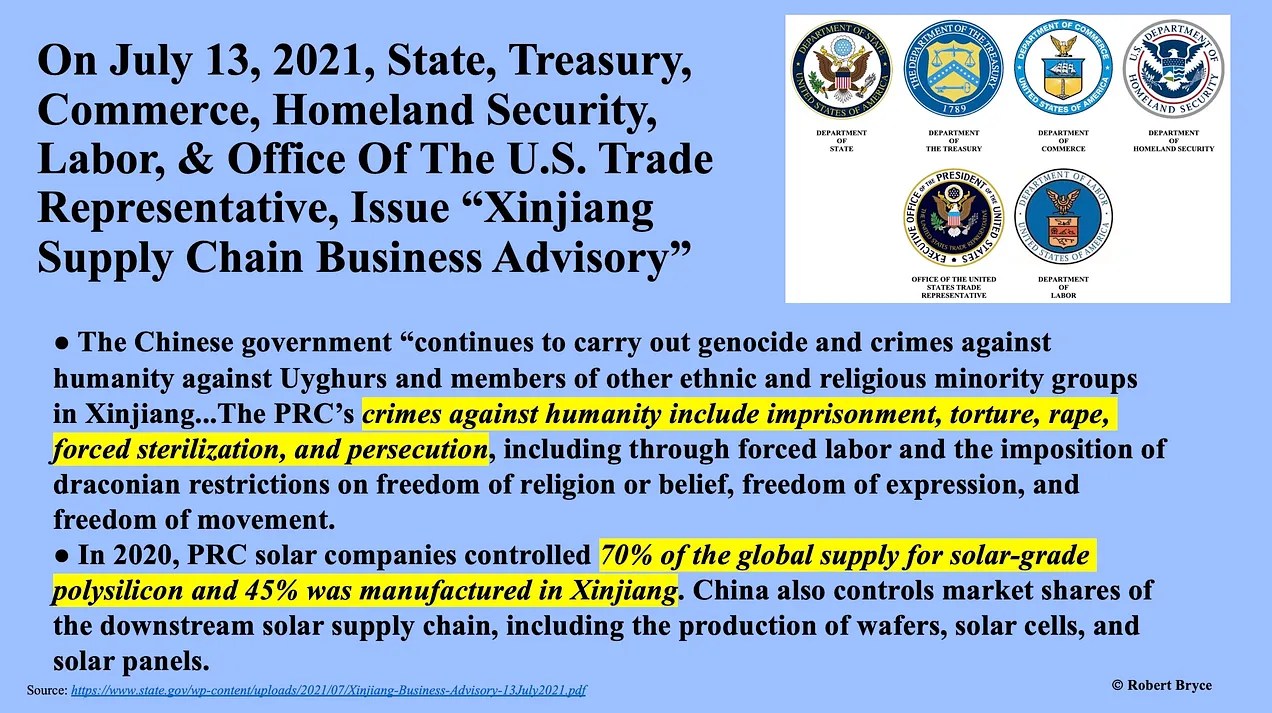
In May, in “Shanghaied,” I published the graphic above. Remarkably, six different agencies of the federal government are saying the Chinese government is carrying out genocide in Xinjiang, the province that produces some 45% of the world’s solar-grade polysilicon. Given that reality, it’s not surprising that solar cheerleaders like Wallace-Wells, Bill McKibben, and others don’t want to talk about their favorite industry’s near-total reliance on Chinese supply chains.
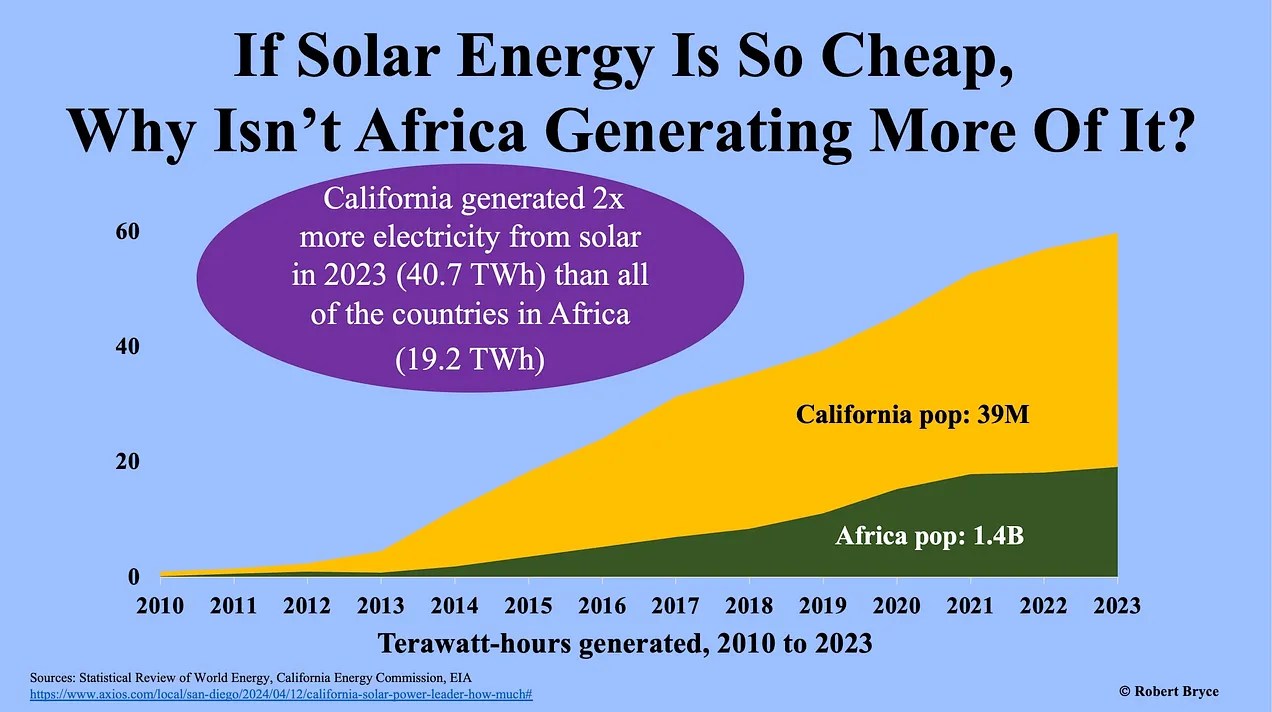
Wallace-Wells also ignores the vast disparity in solar deployment around the world. He claims, “by some ways of tabulating, solar power is already cheaper than all other new sources of electricity for something like 95 percent of the world.” And what are those ways of tabulating? He doesn’t say. That begs the question: if solar is so cheap, why isn’t Africa using more solar? As seen in the graphic above, the unfortunate answer is that solar is still mainly used in wealthy places. That helps explain why California, a state with 39 million people, is generating twice as much electricity from solar as Africa, even though the African continent has roughly 36 times more people than the Golden State.
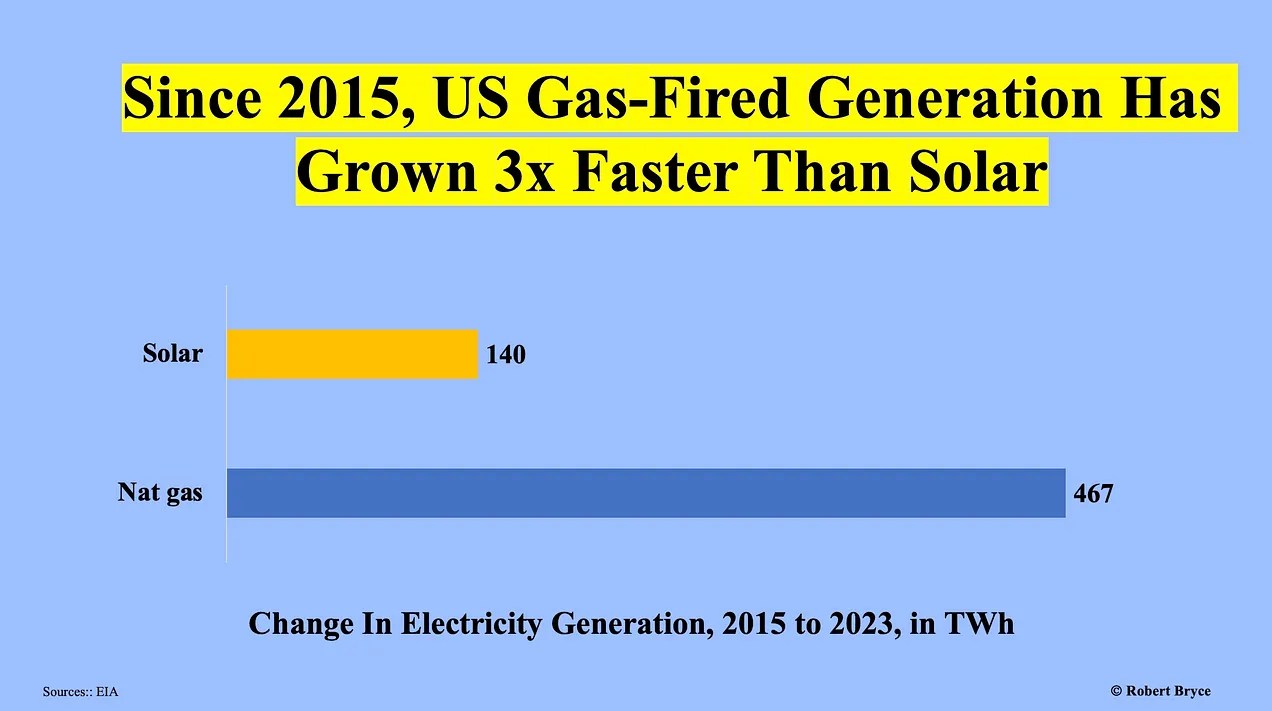
By now, it should be clear that Wallace-Wells cares more about the narrative about solar than marketplace realities. Speaking of the market, as seen above, the growth in natural gas-fired generation has swamped the increase in solar since 2015.
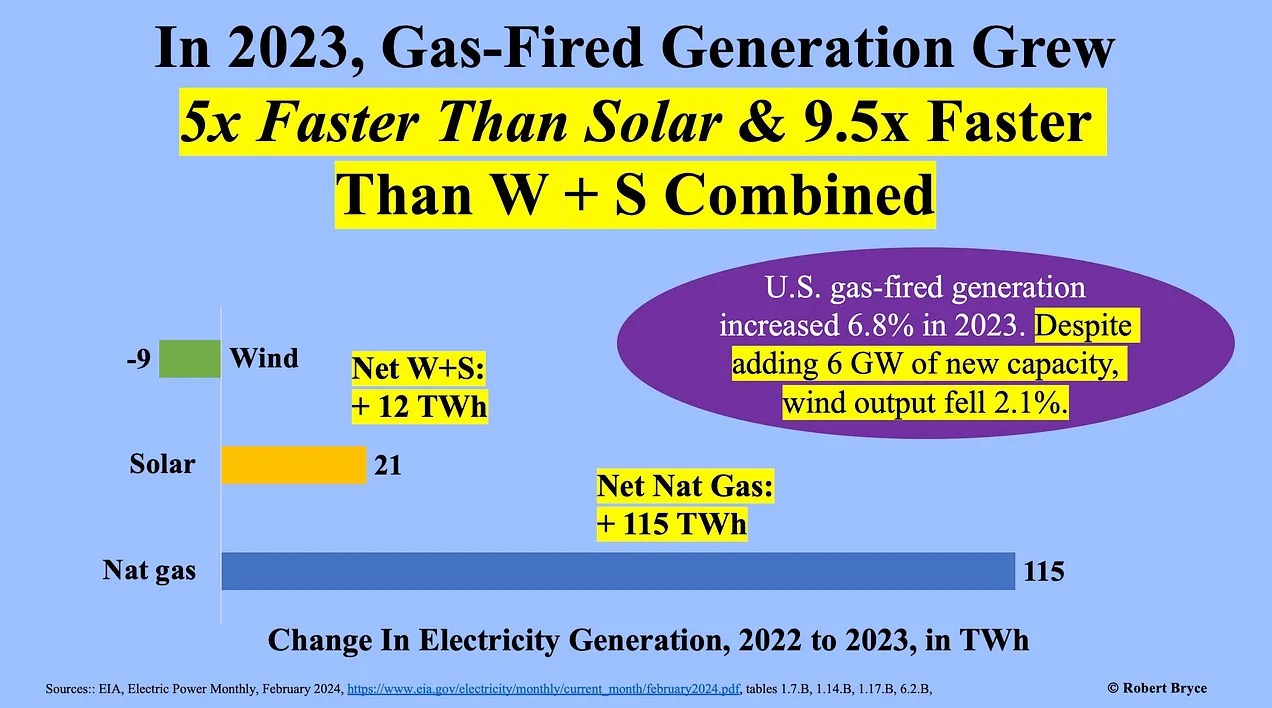
As seen above, that growth continued last year when gas-fired generation grew by 115 terawatt-hours while solar increased by 21 TWh. Put another way, gas-fired generation grew five times faster than solar last year.

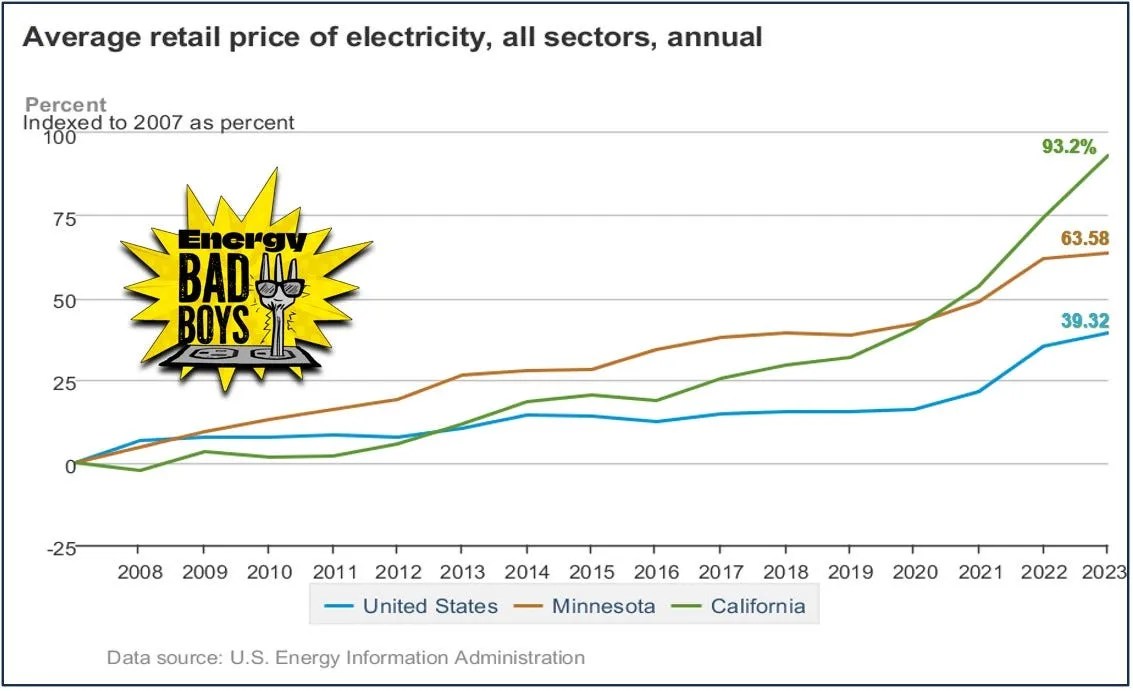
A final point, and it’s one that I’ve made before. California has added more solar than any other state in the country. And as it has added more solar, electricity prices in California have increased at an alarming rate. As I pointed out last month in “Kamala America?” in absolute and percentage terms, California’s electricity prices have surged more than any other state in the country since 2008 when then-governor Arnold Schwarzenegger issued a mandate for renewable energy.

In March, my favorite Energy Bad Boys, Isaac Orr and Mitch Rolling, wrote an excellent piece here on Substack called “How to Destroy the Myth of Cheap Wind and Solar.” And destroy, they did. Orr and Rolling asked the critical question: if wind and solar are so cheap, why do they make electricity expensive? Their answer was straightforward:

We aren’t building a new electric grid from scratch, so we should be comparing the cost of new wind and solar with the cost of existing power plants that these intermittent generators would hope to replace. The truth is that we already have reliable, depreciated assets that produce electricity at low cost, and they could’ve kept doing so for decades. This means that building new wind and solar adds to the cost of providing electricity to the grid. If wind and solar were truly lower cost than other forms of energy, we would expect states like California and Minnesota, which have high penetrations of wind and solar, to see falling electricity costs. Instead, electricity prices in these states have increased much faster than the national average.
Orr and Rolling concluded:

The intermittency of wind and solar imposes unique expenses on the electric grid that require an evaluation of the entire electric system in order to derive meaningful cost estimates from these generators. This is difficult to do, which is why most people don’t do it.

The “unique expenses” that Orr and Rolling mention are becoming more apparent by the day. Consider California, which has more installed solar capacity than any other state, about 49.4 GW. But the state’s all-out solar push has created a regressive tax on the poor and middle class. Last month, the Public Advocates Office at the California Public Utility Commission reported that solar subsidies in the state will cost ratepayers who don’t have rooftop solar panels about $8.5 billion this year.
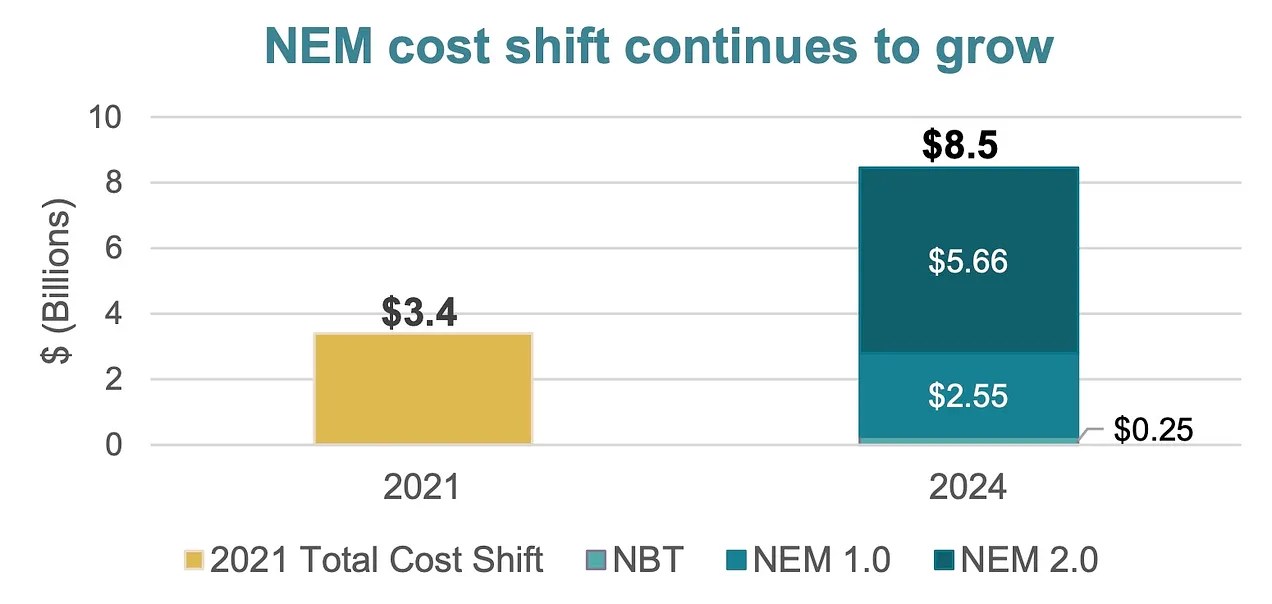
Furthermore, those costs are rising. As seen in the graphic above, pulled from the PAO’s report, the cost shift related to net energy metering, which subsidizes rooftop solar, has more than doubled since 2021. Here’s the key section from the report:

The subsidies, paid for by non-rooftop solar customers, are a contributing factor to high electricity rates. This cost burden — commonly referred to as a cost shift — to non-rooftop solar customers of Pacific Gas and Electric, Southern California Edison, and San Diego Gas & Electric has risen from $3.4 billion annually in 2021 to $8.5 billion annually by the end of 2024, and it will continue to grow in coming years.

To put this in perspective, remember that California has the dubious distinction of having the highest poverty rate in the country. And yet, in its headlong pursuit of solar energy in the name of climate change, it is imposing a regressive energy tax on the people who can least afford it. Ashley Brown, the executive director of the Harvard Electricity Policy Group, rightly calls the proliferation of rooftop solar systems and the returns they provide to lucky people like me, “a wealth transfer from less affluent ratepayers to more affluent ones.” It is, he says, “Robin Hood in reverse.”

Alas, none of these facts about solar energy made it into Wallace-Wells’ article. But they are facts.
Substack

via STOP THESE THINGS

https://ift.tt/72y4Gxm

October 8, 2024 at 01:32AM

“Free Market Electricity”

“A free market in electricity would terminate the current provisions of landmark federal statutes, such as the Power Act of 1935, Public Utility Holding Company Act of 1935, Public Utility Regulatory Policies Act of 1978, Energy Policy Act of 1992, Energy Policy Act of 1995, and Inflation Reduction Act of 2022.”

My new AIER primer defines and applies the free-market classical liberal worldview to electricity. This is particularly important because this sound perspective has been both forgotten and misapplied.

Forgotten regarding the criticisms of traditional public utility regulation that emerged in the 1960s; misapplied regarding the current mandatory open access era involving central planning at the wholesale level with ISOs/RTOs.

My major points with quotations follow:

1. Electricity is a free-market product with a clear free market, classical liberal meaning: the separation of government and electricity in all phases and in the whole.

“A free market in electricity is defined as the absence of government ownership, control, or regulation. Electricity and government are separate, apart from legal protection against force or fraud. Government neutrally upholds the enforceability of private contracts and other market norms under the rule of law.”

“… contra government direction and control, from municipal ownership to franchise protection and cost-based rate ceilings (public-utility regulation); to mandatory open access for outside parties (an uncompensated taking); to renewable requirements (the forced energy substitution of wind and solar).”

“Grid electricity was never considered a common-pool resource at odds with definable private property rights and efficient operation. The ‘commons’ theory of governmental organization arose only with the government-mandated open-access transmission, itself a clear violation of private property rights.”

2. Electricity, while having unique qualities, is subject to market forces and does not require government intervention or ownership. The US power sector has a clear free market history for empirical evaluation—and no demonstrable market failure.

“Highly coordinated multiphase operation, evident in petroleum and natural gas (in a free market), was required by the uniqueness of electricity. Governmental franchise protection was not necessary.”

“The market era was characterized by declining rates, expanding usage, and reliable service…. Market-directed integrated operations resulted in unprecedented affordability and continuous, coordinated service.”

3. Electricity is the second-most regulated sector of the U.S. economy today, next to money and banking (outside of the military industrial complex). It is an unholy mix of public utility regulation; government-enabled dilute, intermittent wind and solar; and mandatory open access.

“Today, a growing number of regions are subject to rising power rates, conservation appeals, and service interruptions.”

4. Mandatory open access has introduced its own problems under de facto socialism, particularly pricing for reliability.

“Economic calculation has bedeviled ISO/RTOs…. Some regions have implemented ‘capacity charges’ to reward generators for standby capacity. Others have banked on ‘energy only’ prices, betting that ample capacity would be incited by periodic price windfalls.”

“Consumer welfare and ‘the obligation to serve’ have been lost in the transition to central planning, as well as in the governmental quest for decarbonization. Worse, agency errors … have been protected by sovereign immunity.”

5. Public policy going forward begins with federal deregulation of electricity (state deregulation would need to follow).

“A free market in electricity would terminate the current provisions of landmark federal statutes, such as the Power Act of 1935, Public Utility Holding Company Act of 1935, Public Utility Regulatory Policies Act of 1978, Energy Policy Act of 1992, Energy Policy Act of 1995, and Inflation Reduction Act of 2022.”

“Competition could entail direct rivalry with duplicate facilities, or it could be a single firm maintaining a market against potential rivals. Either way, the private and public costs of government intervention could be bypassed and market signals established.”

The post “Free Market Electricity” appeared first on Master Resource.

via Master Resource

https://ift.tt/PcO0BNw

October 8, 2024 at 01:05AM

Rapidly Intensifying Hurricanes

During 1957, five storms originated in the Gulf of Mexico, including major hurricane Audrey, which rapidly intensified, made landfall on June 27 and killed more than 400 people.  The US hasn’t been hit by a hurricane during June in almost … Continue reading →

via Real Climate Science

https://ift.tt/jiVgRYU

October 8, 2024 at 12:47AM

The Cost Of Miliband’s Flywheels

From NOT A LOT OF PEOPLE KNOW THAT

By Paul Homewood

Mad Miliband did no tell us how much his crazy plan to build giant flywheels up and down the country would cost, but Paul Burgess came up with these numbers:

So that 250 kW job would cost a total of about $75000, assuming $300/kW.

If we convert that to £300/kW and assume that Miliband’s flywheels would be needed to replace 30GW of gas and coal plants, we would be looking at a total of some £9 billion. The idea, after all, is that they are needed to provide system inertia, which is currently only provided by spinning generators – gas, coal and nuclear principally.

I seem to recall reading that battery storage would also be required, in order to smooth delivery of power; this could add to those theoretical costs.

It seems unlikely that flywheels would last more than a few years, certainly not without plenty of maintenance. Either way, the cost of flywheels would be considerable.

###


Here it the transcript of the above video, which is also archived on our ClimateTV page, , a collection of over six hundred videos, featuring new interviews and analysis, and covering dozens of media sources discussing, debating and analyzing the latest in climate science, climate politics, and energy policy, including topics concerning temperature, sea level, polar bears, ocean acidification, extreme weather, censorship, wild fires, and more..

Hello everyone. Well there I was peacefully making my hydrogen video, you know, explaining the myth and the delusions about hydrogen, when in came a comment on one of my videos saying what do I think of Milan’s flywheel idea. And when that came in, I didn’t know about it. I was busily working and whilst I’m aware of what flywheels are used for in the energy system, which is to really stabilize frequencies and take care of very very small time increments to smooth things out, I wasn’t aware that our energy minister Ed Miliband had completely lost the plot with claims that flywheels are going to help balance our grid in terms of storage taking and you know, uh excess energy which we still pay the full price for of course and moving it into periods of high demand.

This is a nuts idea and Ed Miliband is easily the most dangerous um person in the UK at the moment because he’s going to ruin our economies. I mean this last week we’ve closed, we know we’ve closed Tata Steel, we’ve closed our last Coal Mine, uh we’re doing away with Grangemouth um costing thousands of jobs. What we’re… we’ve stopped new um exploration of the North Sea and uh and so on and so on and so on and we are… this man is so dangerous he’s fanatical but the worst thing is he really doesn’t understand the most basic basic things about energy.

Now let me give you one of my problems when I go to research these things and like flywheels I look for how much storage, how much energy they can store. You’d think that would be a simple issue because that’s measured in megawatt hours, kilowatt hours, gigawatt hours, but it’s measured in hours. But no, all you get is oh this flywheel can do 20 megawatts. Well that’s meaningless unless I know what time it can maintain that for because that gives me the amount. And I I I I I’ve actually been in situations of public meetings when I’ve gone up to so-called experts who didn’t understand the difference between a kilowatt and a kilowatt hour and I find that amazing.

So the kilowatt hour is the amount of energy that means one kilowatt for 1 hour. A kilowatt is meaningless unless you know how long it can last. It it it’s meaningless and yet all the time journalists and even you know promotions videos just use the megawatts or the kilowatts without giving me the storage.

So it always takes me extra time to try to find out how much storage is in these things.

Now from the outset here I knew that flywheels can store a very little amount of energy and so I’m going to explain in this video just how stupid this man is and the idea is to avoid blackouts in Britain. Well I’m sorry to say this isn’t going to help at all with blackouts.

Well flywheels aren’t new, they’ve been used for a long time. I mean the early steam engine used them to smooth out the power as it were and that’s their role, smoothing out energy over small increments of time. And even if you look at the Modern engine here you’ll see we still use flywheels. You… this is a this is a four-cylinder engine and the flywheel helps smooth out the power. It carries the… the has the inertia between The Strokes as it were. That’s the role of flywheels.

We will now take a look at Ed Miliband’s bonkers plan. So there is the claim is to prevent Net Zero blackouts because of the intermittent nature of solar and wind. But it doesn’t do that. In fact it doesn’t do that at all.

The national Energy System operator, that’s ESO, is the brand new organization taken over from the National Grid and is publicly owned and they state: “If there’s a sudden change in system frequency” – and note the word frequency there please – “the weight and inertia of generators means they carry on spinning even if they’ve lost power. This avoids a sudden change of frequency giving time for our control room to restore the balance.” So what we’re talking about there is frequency. Yeah, tiny amounts of time to adjust tiny things as it were. That is what they saying there. They carry on.

The scale of the problem is shown by the number of contracts awarded for so-called stability Services expected to Total more than 100 by the time all are operational probably in 2026. ESO is now planning to open an entire new stability service Market to encourage the construction of more flywheels or other services that back up the grid. So we’re still talking about frequency.

But then they go on to say ESO said the schemes would save the consumer money by cutting the need for maintaining backup power stations and importing power from overseas via interconnectors. And that is what I’m going to challenge. A spokesman said the Pathfinders alone are expected to provide consumers with savings of £14.5 billion between 2025 and 2035. Wow. So it sort of saves us for importing power from overseas. Well that’s not frequency. That’s acting as a backup. There’s a huge difference between using flywheels as a frequency adjuster doing tiny little adjustments to stabilize the frequency on the network to using it as a backup to restore power because the question then becomes how much energy do flywheels store and how long can they last.

So let’s look at an example now which used to be the world’s biggest until recently when China built a slightly bigger one and let’s look at the one that’s in the USA and they call it a 20 megawatt one, a 20 megawatt flywheel system. We’ll take a look now as an example.

Let’s take this Beacon 20 megawatt flywheel plant in the USA. This is what they said to justify it: “Beacon power is building the world largest flywheel energy storage system in Stevenson New York. The 20 megawatt system marks a milestone in flywheel energy storage technology. Our similar systems have only been applied in testing and small scale applications. The system utilizes 200 carbon fiber flywheels levitated in a vacuum chamber. The flywheels absorb grid energy and can steadily discharge one megawatt of electricity for 15 minutes.” Now remember that figure – one Mega for 15 minutes. “The system takes a place of supplemental natural gas power plants that have been used to balance supply and demand in Grid activity prior boosting energy production during Peak demand and lowering production during Peak Supply.” That is utter nonsense that I will now prove.

So how much energy have we stored in that, the biggest at the time um flywheel um plant in the world?

Well it was a quarter of 1 megawatt which is… that’s all it is. One megawatt for 15 minutes is a quarter of a megawatt hour. We need 7,200 gigawatt hours for the one and day example I’ve often used when we went nine days without wind in the UK and that is 7,200,000 megawatt hours. But we’ve only a quarter of one. And I can tell you now that would support the national grid for just 1/1200th of a second. That’s it.

And even the bigger one that’s been built in China is 50% bigger so basically you still have well over… well below 100th of a second support for the Grid. In other words there is not enough storage no matter what system you use. So that’s what we’re into.

So clearly clearly there is no element of uh grid storage to balance the grid for Renewables with flywheels.

None whatsoever. All there is is the frequency adjustment.

It’s worth following up what happened to that Beacon power plant and again in this statement here they go on about it being used for the regulation of power grid operations not just for the frequency adjustment. “The storage systems are designed to help utilities match Supply with varying Demand by storing Excess power in arrays of 2,800 flywheels at off peak times for use during Peak demand.” No no no. But let’s carry on with the history.

Beacon power was founded in Wilmber Massachusetts in 97 as a subsidiary of SatCon Technology Corporation, the maker of Alternative Energy Management Systems. The company went public in 2000 and in June 2008 Beacon power opened new headquarters in Tyngsboro um with financing from Massachusetts state agency. There we are, the big subsidy.

In 2009 Beacon received loan guarantee from the United States Department of energy. There we are again for $43 million to build a 20 megawatt flywheel power plant in Stevenson New York which is what we’re talking about. The DOE loan for 43 million was awarded in 2010 with a plan to be online by 2011. It was also awarded 24 million from the DOE for a second flywheel plant. On the 30th of October 2011, the company filed for chapter 11 bankruptcy protection under the United States Bankruptcy Court in Delaware. As part of the bankrupt Court proceedings Beacon power agreed in November 18 to sell it Stevenson facility to repay the DOE loan.

So that one and it was the world’s largest at the time went bust the same year that it opened and it already had a total of 43 million plus a further um sum of 24 million so totaling 67 million pumped into it.

Lasted for months and went bust.

So at this point we can clearly state that flywheels have no capacity, no ability to store any significant amount of energy at all. They have a role in adjusting the frequency um of of stabilizing the frequency of the energy Supply mainly caused by by the varying amount of intermittent energy coming in. So there’s a big and growing need for that but no question of them being able to store energy to transfer it from uh um excess time to a high demand time. Not at all. We’re talking hundredths of a second uh for that plant and even the biggest one is still less less than a hundredth of a second for the UK power supply. No chance at all. But let us move on to another aspect of it just to finally put the nail in the coffin.

Looking at the cost of these flywheels, my source is from this paper “A review of flywheel energy storage rotor materials and structures”. I quote: “The capital cost per unit power of a FESS system with a rated power output of 250 kW and a maximum expected storage time of 50 minutes is $250 to $350 a kilowatt.” That’s the capital cost if you like. “But the corresponding unit energy cost is between 1,000 to $5,000 a kilowatt hour.” $1,000 to $5,000 a kilowatt hour. That is $763 to 3,816 per kilowatt hour when gas today and we’re talking wholesale prices here is 65p per kilowatt hour. That is 1173 times to 5,871 times more expensive.

But not to… the international renewable energy agency estimates that the unit energy insulation costs of FESS will decrease by 35% by 2030 from the current estimate and it’s their estimate of $1,500 to $6,000 per kilowatt hour down to $1,000 to $3,900 a kilowatt hour. Wow. So if you hang on in hope you’ll only have to pay £763 to 2,977 per kilowatt hour. Just 1173 to 4,610 times the price of gas. So putting a um 2 kilowatt fire on for an hour would only cost you around £6,000 and that is providing you’re buying those kilowatt hours at wholesale prices.

Look it doesn’t really matter what the exact price is. No matter what it is it’s exorbitant. It is totally out of the question as backup. But the capacity Factor itself, the amount of energy the flywheel system can store is so small you know a couple of seconds for the National Grid as to be inconsequential. It is not for backup storage. It is totally misrepresented in the press and frankly a lot of the advocates for it have no understanding of of The Logical background to it of the actual math, the actual calculations. And as the engineering part of me looks at these things it is natural to look at the costs and the viability things because I’m into a world that works not a theoretical world.

So now I hope this has armed you, the viewers of this, has armed you with the answers to why flywheel energy storage has backup to intermittence is actually not good, is incredibly expensive, can only be used for really frequency regulation, ironing out the frequencies and even that is very very expensive. And of course we need more of this, a lot more of this now because of the intermittent nature and the varying all over the place of all these intermittent inputs. So it’s an extra cost of the energy you know.

I’m just exasperated quite frankly at the world that puts all this forward. I can’t keep up with all the false stories coming through the Press almost every day um and just to tell you by the way uh some of you may may want to know I wear glasses because um I’ve been having a left eye trouble but I had an operation last Thursday during the making with this video actually and so maybe in a month or so I’ll be able to take the glasses off. At the moment of course it looks absolutely deplorable my eye so I don’t want to distract people with that. It’ll… people would concentrate on that rather than what I’m saying.

So um that’s it. I hope you’ve enjoyed the video and I hope it has yet again armed you um to bring the sanity back into this renewable Madness.

Just one more thing before I leave you um Brian cat the engineer physicist um this week actually passed to me a small video from Carl Sagan um which I think explains um what the danger is in the west, why all these um why all these governments so deplorable at managing all this um. I was on GB news again yesterday um and again there’s an ex-minister was on after me and someone had already met in the green room and you know clear they they know nothing of what they’re talking about. Yesterday was about The Madness of carbon capture um but um this short video I think is the nearest I’ve seen uh to explaining how the madness happens because it is madness and so I’m going to leave you with that now.

I’m going to leave you with this short video that I think is worthwhile listening to. So thank you for watching.

There there’s two kinds of dangers. One is what I just talked about that we’ve arranged a society based on science and technology in which nobody understands anything about science and technology and this combustible mixture of ignorance and power sooner or later is going to blow up in our faces. I mean who is running the science and technology in a democracy if the people don’t know anything about it. And the second reason that I’m I’m worried about this is that science is more than a body of knowledge. It’s a way of thinking, a way of skeptically interrogating the universe with a fine understanding of human fallibility.

If if we are not able to ask skeptical questions, to interrogate those who tell us that something is true, to be skeptical of those in Authority, then we’re up for grabs for the next charlatan political or religious who comes ambling along. It it’s a thing that Jefferson lay great stress on. It wasn’t enough he said to Shrine some rights in a in a constitution or a Bill of Rights. The people had to be educated and they had to practice their skepticism and their education otherwise we don’t run the government, the government runs us.

Never a truer word said.

via Watts Up With That?

https://ift.tt/jTK64YN

October 8, 2024 at 12:04AM