Why Are Well-Off EV Owners Charged Half as Much as Poor Pensioners for Off-Peak Electricity?

From THE DAILY SCEPTIC

by Nick Rendell

“The surprise is not whether the dog plays the piano well or poorly but that it plays it at all!” Dr. Johnson might well have applied this aphorism to Rachel Reeves’s cancellation of the pensioner’s winter fuel allowance. However, in this instance the shock was both that the allowance was cancelled and that it was handled so badly.

As a general rule I’m fine with anything that removes the state from people’s lives. However, the ‘optics’ of this announcement were shockingly dreadful. Why wasn’t it wrapped up with a programme of initiatives, such as confirmation that the triple lock would be retained or alongside details of the forthcoming increase in pensions?

In any case, here is an even greater mystery: why are people who are sat shivering at home in poorly insulated, under-heated social housing paying about twice as much per kWh for off-peak electricity as EV owners, swanning about in their £65,000 Teslas?

You must remember the biblical parable about the widow’s mite. At the temple one day the widow was only able to afford a small charitable donation. She gave her two pennies then quietly slipped away. Meanwhile the rich man made a great show of his large donation, despite it being a sum that he could easily afford.

Well, something like that is happening today in every parish in the country. The widows in this case are mainly the poor little old ladies living in post-War houses and flats with night-storage heaters. Remarkably, there are about 1.4 million homes still using night-storage heaters. The rich men in my parallel parable are the 1.2 million EV drivers, a group not known for understating their contribution to the selfless pursuit of Net Zero, especially when that contribution is funded by subsidies from general taxation and additional charges on everyone else’s energy bills.

Why do I contrast the two groups – the 1.4 million dwellers of sub-optimal housing and 1.2 million drivers of expensive EVs? Because, in many ways they’re comparable, at least in their desire for cheap, off-peak electricity. Surely, you might think, isn’t this where ‘smart meters’ come in? Isn’t the idea that they can differentiate between user groups to provide more tailored tariffs? Alas, the £20bn or so being spent on ‘smart meters’ doesn’t seem to have delivered something quite that smart.

As a kid I remember my dad had a Ford Sierra in ‘burnished gold’. Today, like so much else, the choice of a car’s paint finish has been inverted. Long gone are the days when Henry Ford could say, “you can have any colour you like providing it’s black”. Elon Musk’s customers now seem to say, “paint it any colour you like but to us we will always see it as ‘burnished virtue”.

If our widow with three night-storage heaters could buy off-peak electricity at the same price as EV drivers she’d save about £500 per year – far more than the amount she’s missing out on if she’s no longer collecting the winter fuel allowance.

You may never have given it a moment’s thought, so perhaps it’ll come as a surprise to learn that a single night-storage heater uses about the same amount of electricity as an EV covering about 11,000 miles a year. A study quoted in This is Money suggested that the average number of miles covered by an EV was, at 8,292, slightly lower than the distance covered by the average combustion car. So, for most EV drivers, they’re using less electricity than a single night-storage heater consumes. But of course, while our EV driving eco-warriors tend only to have one EV, our widows have three or four night-storage heaters. While our EV champion is spending less than £200 a year on the 2,750 kWhs of off-peak electricity at 7p per kWh to propel his car 11,000 miles, our widows are getting billed about £350, 75% more, for each of their night-storage heaters.

But it doesn’t have to work this way. The market for EV drivers is pretty competitive with prices in the range of 6.9p to 10p per kWh, as illustrated on the right hand side of the table, nabbed from Martin Lewis’ MoneySavingExpert site and reproduced in Figure 1.

Figure 1

Conversely, as can also be seen in Figure 1, the kWh prices for conventional Economy 7, or “off-peak (night) rate” electricity ranges from 10.95p to 14.85p, in some cases twice as expensive.

Is there something special about ‘EV destined’ off-peak electricity in comparison to Economy-7 electricity ear-marked for our widow’s night-storage heaters? Of course not. There’s absolutely no reason why the electricity companies shouldn’t offer the same price to Economy-7 users as EV users. In fact, Dale Vince’s Ecotricity appears to do just that, well done Dale. So, why doesn’t British Gas or EON do the same?

In general I’m not in favour of regulators. We only have regulators when markets don’t work properly. Self-evidently the electricity market doesn’t work properly. But if we are going to have a regulator why hasn’t it stepped in here and required the energy companies to follow Dale Vince’s lead and not discriminate against the widows and their night-storage heaters in favour of rich men in EVs?

Even more pertinently, why doesn’t Ed Milliband flag up the potential savings if all night-storage heater users switched to Ecotricity?

Why doesn’t Milliband go one step further and encourage our widows to install night-storage heaters? A large-scale national scheme could easily get the installed price down to about £300 for a state-of-the-art unit, about the same cost as the much lamented winter fuel allowance. We’re not short of available night-time electricity which could be priced lower than gas and directly substitute a renewable energy source for a fossil fuel.

Of course, Milliband might argue that rather than messing about with night-storage heaters he wants to install millions of heat pumps. But look at it from the widow’s point of view. If she’s only expecting to live another five or 10 years she’d be mad to squander the money she’s been squirrelling away for her kids on a £25,000 heat-pump installation that would never pay back during her lifetime (if, indeed, they ever pay back during their own lifetime).

Why not go for the low hanging fruit and get night-storage heaters in thousands of homes? Oh, and while we’re at it we could tell the widow that her contribution to ‘climate change’ (assuming she gives a damn) is rather more valuable than that donated by the rich man who just razzed by in his Y-class Tesla. 

via Watts Up With That?

https://ift.tt/7IGuXj4

October 6, 2024 at 12:01AM

Ruling-class energy ignorance is a global wrecking ball

From the BOE REPORT

Terry Etam

In the US resides a guy who’s academic and professional credentials are as impressive and impeccable as one can assemble in a career. His Wikipedia professional/academic bio shows top-level roles at a who’s who of globally significant institutions.

Larry Summers has been: student at MIT, PhD from Harvard, US Secretary of the Treasury, director of the National Economic Council, president of Harvard University, Chief Economist of the World Bank, US federal Under Secretary for International Affairs in the Department of Treasury, a managing partner at a hedge fund, and is now on the board of OpenAI. 

And yet…just a few weeks ago, Larry Summers made a comment about a bedrock of the economy seems so fundamentally bad that it is enough to shake one’s faith in every one of those institutions. He was talking about whether the US should create a Sovereign Wealth Fund, which is kind of like a national savings account that governments squirrel money into in order to fund future projects or spending requirements. They are very great things indeed, reflecting the wisdom of having savings for a rainy day, but given how politicians love to spend not just the money that they have but everything they can borrow, the idea seems kind of quaintly hopeless in the first place, even though some countries have accomplished it. 

But the shocking part of this story is why Summers was against the idea; here’s his quote: “It’s one thing if you’re Norway or the Emirates — that has this huge natural resource that’s going to run out that you’re exporting— to accumulate a big wealth fund. But we’ve got a big trade deficit. We’ve got a big, budget deficit…”

He’s absolutely right about the US’ financial woes; our dear southern neighbour is currently the equivalent of a 28-year-old guy twice divorced with 8 kids between 4 women who is working at the lumber yard and juggles 14 credit cards simultaneously (definitely not implying Canada is much better…).

No, he’s right that those are the biggest fiscal issues to deal with, but what’s crazy is the other part of his statement. He says that Norway and the Emirates should create sovereign wealth funds because they ‘have this huge resource that’s going to run out that you’re exporting’ and thus can/should accumulate a big wealth fund.

Mr. Summers apparently does not understand either depleting natural resources, or the US’ economic powerhouse status due to these resources, or both. Either fact is shocking, given his stature; but his analysis of the situation gives a clue about why major western powers are in such shambles with respect to energy policy.

What Mr. Summers presumably meant is that the US does not have an economy that is dominated by export of a natural resource, such as how oil or natural gas exports are not a fundamental pillar of the economy as with Norway or the Emirates. And yes, the US does have other desperately needed uses for the money derived from exports.

But he seems to think the US is immune from its resources ‘running out’. He doesn’t seem to understand that while the US economy may not be dominated by oil/gas exports, the problem of resource depletion will not matter to the US because it does not dominate the economy. That is the charitable interpretation; the less kind one is that he may well believe that the US will never run out of affordable hydrocarbons.

It’s easy to see where he and other policy makers get the idea. If they think about petroleum reserves at all, they would find coverage in the general mainstream financial press, in publications such as Forbes, a standard of US economic communications that claims over 5 million readers through 43 global editions. The publication is aimed at the who’s who of the financial world: “Forbes is #1 within the business & finance competitive set for reaching influential decision-makers.” It is exactly what a guy like Summers would turn to to understand the US’ resource capability (I doubt he spends much time understanding rock quality).

Here is what Forbes had to say about the US’ hydrocarbon reserves. In an article entitled U.S. Shale Oil and Natural Gas, Underestimated Its Whole Life, the author chronicles how forecasts of US shale potential have been continually underestimating productive capability. Fair enough, that is definitely true. But the extrapolations/conclusions are pretty wild, and, dangerous: “…the reality is that shale production [for both oil and natural gas] has surpassed all expectations namely through the constant advance of technologies and improvement of operations…In fact, the Shale Revolution has shown us that the amount of oil and gas we can produce is essentially unlimited.”

It’s not a bad article on the whole, when it describes how we’ve underestimated shale growth, but these silly concluding assumptions are not good at all. They’re soundbites that reach far more ears because of the source than true expertise from industry journals (including, ahem, this excellent one).  Those soundbites are what lodge in the minds of people like Larry Summers when he huddles with his global cohort to discuss energy policy. 

Consider as an alternative analysis something far more thoughtful and thus less dead-certain, such as the work of Novi Labs, who put out incredibly detailed reports that analyze production trends, with a key difference from Forbes: Novi bases their projections on actual well data, well spacing, well productivity, well length, gas/oil ratios, rock quality, and many other parameters. For example, Novi recently published a paper entitled “Analyzing Midland Basin Well Performance and Future Outlook with Machine Learning” in which they conclude that, based on the above parameters and more, that the Midland Basin has about 25,000 future locations remaining, and breaks them out into prices required to develop them, and has the wisdom to conclude: “Due to the Permian Basin’s role as the marginal growth barrel, overestimating the remaining resources will have consequences spanning from price spikes to energy security and geopolitics.” 29dk2902lhttps://boereport.com/29dk2902l.html

Based on such incredibly detailed analyses, Novi is comfortable making, for example, Permian oil/gas production out to the year 2030. 

Forbes is comfortable making oil/gas production forecasts to infinity, based on nothing more than a string of failed projections. 

And people head off into the highest levels of government having read Forbes but not Novi. And we get Germany. And Canada. And etc.

This isn’t a question about whether we will “run out of oil”. The surest way to rile an audience it seems – just behind challenging EV superiority – is to question the ultimate productive capability of hydrocarbon resources. “Peak oil” is now a term of derision, in some ways rightly so because many smart people have, over time, warned that resources are about to run out. 

It does seem erroneous to think that way, because as prices for something rise, more exploration will occur, and by definition we don’t know what those discoveries will encounter. Could be a little, could be a lot. 

The point here is best explained by way of a real life example. A long time ago, late last century, natural gas was dirt cheap across western Canada. (Bizarrely, it’s even cheaper now, but not consistently so.) In Saskatchewan where (and when) I grew up, an alfalfa processing industry had developed that was a godsend to many small communities. Farmers would grow alfalfa and dedicate the output to a local (often community owned) alfalfa-processing facility that would convert green alfalfa into nutrient-rich pellets for which Japan (primarily) had a seemingly insatiable appetite.

The whole business existed because of the availability of cheap natural gas, which allowed for the rapid and economical dehydration of the green alfalfa; huge drying drums ran around the clock, all summer long, turning huge piles of fresh chopped-alfalfa salad into dried out pellets within 12 hours. 

But then natural gas prices soared to unprecedented levels, over $10/GJ, and found a new average that was probably about twice the average in the 1980s and 1990s. This spike in natural gas prices wiped out the entire industry. Every little town lost a pillar of the community, investors lost investments, municipalities lost tax revenue, and hundreds or maybe even thousands of punks like me lost summer job opportunities. 

THAT is what people like Larry Summers should be thinking about when they talk of, or heaven forbid ask questions about, the longevity of our hydrocarbon resources. Yes, there will be oil and natural gas reserves forever – but at what price? And what will the consequences of higher prices be? 

In the spring of 2022, some large US trade associations issued warnings about the consequences of higher natural gas prices. “Last winter’s heating bills were unsustainable,” said the CEO of the Western Equipment Dealers Association. The winter to which he was referring, 2021-22, had average Henry Hub prices of $4.56/mmbtu – far higher than today, but a number that will probably be required over the long term to enable continued US reservoir development and feed LNG export demand. 

That price level of which the CEO was frightened of, it is well worth noting, is a fraction of the global price of LNG. In other words, US industry will freak out if it has to pay even half of what the rest of the world does.

At a time when the US is desperate to ‘onshore’ a lot of manufacturing capacity, policy makers should be very careful about ‘what they know for sure’ about the future of US and Canadian energy productive capability. 

Energy ignorance, at these levels of government, are getting deadly. I mean, we can all see Germany, right? It’s turning slapstick, what they’re doing to energy policy, and so many western leaders seem intent on following them. Force the closure of baseload power, force the adoption of intermittent power, watch AI buy up all the power from nuclear sources, claim to support new nuclear power which everyone knows won’t get here for a few decades, then trot off to an annual fall climate conference to tell the world what to do next. 

As Mark Twain said, “It ain’t what you don’t know that gets you in trouble. It’s what you know for sure that just ain’t so.”

What the world desperately needs – energy clarity. And a few laughs. Pick up The End of Fossil Fuel Insanity,  available at Amazon.ca, Indigo.ca, or Amazon.com.

via Watts Up With That?

https://ift.tt/o1jcfe8

October 5, 2024 at 08:01PM

Hurricane Helene Hype Nonsense

Roger Caiazza

The basis of the emotion driven narrative that there is an existential threat of climate change is fueled by endless articles and opinion pieces in the mass media that conflate every extreme weather event with climate change.  Remember climate is what you expect, and weather is what you get.  This article describes how the hucksters incorrectly make the extreme weather devastation caused when a rare weather pattern caused the storm to stall into an example of worsening climate change when a hurricane in hurricane alley during the hurricane season occurred.

Good Energy Hype

I was prompted to write this post when I came across an opinion piece in the LA Times: Helene destroyed my hometown. I don’t want climate change stories of false hope by Anna Jane Joyner.  She is the founder and chief executive of the “story support nonprofit” Good Energy.  Last March I did an article about Irina Slaw’s article “Burn, Hollywood, burn” where Slav called out the blatant indoctrination and propaganda associated Good Energy – “Story support for the age of climate change”.

After noting that she had been checking on the weather and evacuation plans while preparing to board a plane on her way to NYC Climate Week  Joyner writes:

The hurricane didn’t come for my partner and me this time, but it destroyed my hometown in the mountains of North Carolina. I’ve spent 20 years working on climate and I live between Los Angeles and the Gulf Coast of Alabama, where I’ve reckoned with the likelihood of one day losing our home. I’ve also accepted that worsening fires, droughts and heat waves could make Southern California unlivable. But Asheville was considered a climate haven. I’ve always told family members we can never sell our homes there. It is utterly unfathomable that it would be devastated first by one of the worst climate disasters in U.S. history. Helene showed us nowhere is safe. 

Joyner went on to provide descriptions of the destruction caused by storm.  This was followed by her attempt to link the storm to climate change and her climate change false hope argument:

Scientists estimate that climate change increased Hurricane Helene’s rainfall by up to 50% in parts of the Carolinas and Georgia, dumping more than 40 trillion gallons of water. At NYC Climate Week, the annual awareness event held alongside the U.N. General Assembly, the disconnect from this shattering reality was surreal. There were fancy parties, cheerful sun imagery and giant signs reading “HOPE.” The dominant theme was: We can solve this! We need to tell hopeful climate stories! But there’s no “solving” a hurricane wiping out western North Carolina, hundreds of miles from the sea. Only focusing on optimism is like telling a cancer patient that everything will be OK if they just stay positive. At best, it comes across as out of touch; at worst, it feels callous. Yes, we can still prevent the worst impacts and must demand our governments scale solutions and act urgently, but we cannot minimize the horrors unfolding now, or that it will get worse in the coming years.

If you thought the hyperbole could not get worse I have bad news:

Fossil fuel executives have known since the 1970s that burning oil, coal and gas would cause escalating climate catastrophes and worldwide suffering. Yet they lied, sacrificed our safety for their greed and just unleashed an apocalypse on my hometown. Their actions will condemn children today to a planet that’s more hell than Earth by the end of the century if we don’t stop them. It isn’t just a tragedy; it’s a crime against humanity.

Sorry to subject you to that.  Joyner goes on to argue that more stories are needed and I am sure she will be happy to provide them to anyone with a deep wallet.

What’s happening in North Carolina doesn’t feel real. I have no emotional framework for this, no story to help me. Right now, what I desperately need are authentic stories that help us figure out how to be human in this changing world, to face this overwhelming crisis with bravery. Stories that help us navigate our very understandable fear, anxiety, grief, despair, uncertainty and anger in a way that allows us to feel seen. Stories that make us laugh — not in ignoring our reality, but in the midst of it — and stories that remind us there’s still so much beauty here to fight for. That capture how, in the living nightmare of climate disasters, people demonstrate extraordinary kindness and creativity, as they’re doing in Asheville and Black Mountain at this very moment. And we need stories that expose the guilt of the fossil fuel industry.

Reality

In the real world, her pessimism is unwarranted.  A quick review of recent articles at Watts Up With That demonstrates that the devastation of the remnants of Helene in the Asheville region was an extreme weather event and not evidence of climate change.

Paul Homewood did a nice summary of the data for Hurricane Helene that was highlighted here.  His description of the Asheville rain notes:

In Asheville, North Carolina, a total of 13.98 inches (35.52 centimeters) of rain fell from September 25 to 27, according to National Weather Service records. The storm swamped neighborhoods, damaged roads, caused landslides, knocked out electricity and cell service, and forced many residents to evacuate to temporary shelters. Record flood crests were observed on multiple rivers in the state. Flooding was widespread across the southern Appalachians; preliminary rainfall totals neared or exceeded 10 inches (25 centimeters) in parts of Georgia, North Carolina, South Carolina, Tennessee, and Virginia.

Note that the 14 inches of rain occurred over three days.  Joyner referenced a statement that climate change increased Hurricane Helene’s rainfall by up to 50% in parts of the Carolinas and Georgia.  I found that the reference stated that “In one provisional rapid attribution statement, a trio of scientists at the Lawrence Berkeley National Laboratory said the rainfall over the 24 hours Helene moved through was made ‘up to 20 times more likely in these areas because of global warming.’”  Comparing the 24 hours in this reference to the three-day storm total makes it clear that the storm motion was a major factor in the amount of rain and that the attribution analysis got that part wrong.

Charles Rotter’s article on the observations of Steve McIntyre and Andy Revkin about the real lessons to be learned from the storm completes the destruction of the arguments in Joyner’s op-ed.  McIntyre explains that flood control dams were planned for some of the rivers that had devastating floods but were not built.  Clearly there are negative consequences of building dams and positive benefits associated with keeping the rivers open.  But if you want to prevent flood damage when you keep the rivers free of dams then you should take prudent actions.  Revkin points out that was not the case:

Revkin also described a 1960 report “Floods on French Broad and Swannanoa Rivers around Asheville” explaining that this storm was not unexpected for experts:

Andy reported that the report stated that developments around Asheville “would cause these great floods of the past to be higher if they occurred again. Land fills and buildings in the flood plain and the many bridges across the streams have seriously reduced flood flow capacity.” “On the French Broad River a flood of the same discharge as the 1916 flood would today be 3 to 4 feet; higher between Pearson Bridge and West Asheville Viaduct than the actual flood elevation. On the Swannanoa River, a repetition of the 1916 flood would be up to 2. 5 feet higher today at Biltmore and up to 15 feet higher upstream from the Recreation Park dam.”

Anthony Watts described a couple of articles from Climate Realism that debunked the media claims about climate change effects on the storm in general.  He shows that the claims of climate change worsening storms such as Helene just don’t hold up.  Of particular note, is the reference to a massive flood in Asheville in 1916. Matthew Wielicki provides a good comparison of this storm and the 1916 storm.  He found that the 1916 flood peaked at 23 feet.  In this storm the peak was 24.7 feet. 

Note that the 1960 report projected that if there was another 1916 storm that the flood would be between 3 to 4 higher because of development.  Hurricane Helene flood waters peaked at less than two feet higher than the 1916 storm.  The observed increase in the peak flood was due to development and not climate change.

Conclusion

Joyner concluded her article:

I need help making meaning of all this, and stories have always been how humans make sense of our world. But as I grieve an unimaginable loss, the last thing I want are optimistic stories about hope. As climate scientist Kate Marvel says: “We need courage, not hope, to face climate change.”

I find it difficult to sympathize with the grief of someone who provides Hollywood “story support for the age of climate change” because reality paints a different picture of the world.  The data show that Helene was a rather typical hurricane in hurricane alley that occurred in the hurricane season.  Devastating floods in Asheville have occurred before and evidence suggests that the greater flood peak was probably due to development.  There is nothing to suggest that this is anything, but an extreme weather event.  It certainly is no evidence of any kind of worsening climate change impacts.

In my opinion, the worst part of this is that the usual suspects are using this tragedy to call for US reductions in fossil fuel to prevent this from happening again.  Putting aside the lack of a causal link between GHG emissions and specific weather events, the relative magnitude of US and global emissions and the rate of change of those emissions, the indisputable fact is that storms causing this kind of devastation have happened before and will happen again whatever is done to mitigate emissions.  If nothing is done to adapt to this observed extreme weather, then the tragedy will inevitably reoccur.  The monomaniacal emphasis on emission reductions is not in the best interests of society.


Roger Caiazza blogs on New York energy and environmental issues at Pragmatic Environmentalist of New York.  This represents his opinion and not the opinion of any of his previous employers or any other company with which he has been associated.

via Watts Up With That?

https://ift.tt/3POItDf

October 5, 2024 at 04:01PM

Shoving It Where the Sun Don’t Shine

In Denierland, I bemoaned the way policy makers evaluate success when it comes to climate. There is a level of abstraction in climate policy success that is not found elsewhere – or at least, not to the same degree.

How do you – or how should you – measure climate policy success? Obviously, the most direct measure is the temperature change avoided by a certain date, say 2050. No single policy can ever create a significant difference in the temperature of 2050, and unsurprisingly this metric is not used. Next down in the hierarchy is emissions avoided. This is also a stat that is hard to obtain. Then there are more abstract measures like the quantity of “green” energy generated by a scheme, or the number of “green” jobs created by a scheme, or at the sad end of things, the amount of cash “invested” in (not spent on) a scheme.

All such measures have innate problems. In particular, jobs in “green” energy are a cost, not a benefit… unless the energy is being exported. If the jobs of a hundred men with shovels can replace the work of a single machine, then destroying the machine is a great job creation scheme. (The famous remark said to have been made by Milton Friedman that if jobs were wanted from such a program, then the workers should have been issued with teaspoons rather than shovels apparently originated far earlier from an unknown source.)

Anyway, all this is a roundabout introduction to the news that the UK government gave the wink to a new carbon capture and storage scheme this week, one whose benefits could almost be calculated by the announced figures.

The Liverpool City Region Combined Authority’s (puff, puff) website has the costs and benefits of the scheme, which is called HyNet (the particulars are not given there, and are not really germane here. The CO2 could be being captured by any means and pumped anywhere for our purposes.) The BBC has somewhat different numbers, which I also provide.

The cost is given as £21.7 bn over 25 years. (LCRCA does not say when the scheme is supposed to begin operation. The BBC says 2028.)

The jobs are 6000 in construction and presumably a far smaller number in operation. (The BBC says 4000 direct jobs and supporting 50,000 in the long term.)

Reduction of emissions of CO2 are “up to” 10 million tonnes per year. (“…the equivalent to removing four million cars from the road.”) (BBC: 8.5 million tonnes.)

Let us assume that the annualised cost will be £1 bn/yr, and that the 10 million tonnes CO2 removed per year is true. However, some of that CO2 would never have been emitted, since extra energy is used to capture it. Ecosia chat says 15-30% of energy is wasted in the snaffling, so to be scrupulously fair, let’s call it 20%. That means that on net we are capturing 8 million tonnes CO2/yr, and the cost is simple to calculate at £125 per tonne of CO2. [Absent the obviously inevitable over-runs.]

Again referring to Ecosia chat, I get a range of estimates for the social cost of carbon (SCC) from $50 to $200 per tonne of CO2, and the chatbot refers to the possibility that extreme climate change outcomes might mean it is up to $400. At the present exchange rate of $1.3 = £1.0, our cost of £125/tonne is about $160/tonne, so it’s close to the higher end.

This is assuming that it all goes swimmingly.

The next issue with the scheme is an obvious one. The social cost of carbon is a cost spread across every human on the planet. The population is >8 billion. Therefore the benefits of the new scheme will be funded by the ~70 million population of the UK, but benefit everybody equally: the cost to outsiders is nil, but they stand to benefit as much as we do.

In fact, if the SCC is $200/tonne, then every tonne pumped where the sun don’t shine is worth an inconsequential amount to each human alive. 40 million times 200 = 8 billion, so quickmaths tells me that each human benefits to the tune of one 40 millionth of a dollar every tonne of CO2 we save. That includes each of us. So the UK’s total savings per tonne sequestered under the Irish Sea are ($200 * 70 million) / 8 billion = $1.75.

To recap: it’s costing us ~$160/t CO2 to bury the stuff, and the climate benefits to us are ~$1.75 using the higher end of the estimate of SCC. You could argue that the true benefits amount to 40 cents, or nothing.

Now let’s ask one final question. What will the temperature change avoided by 2050 be? Given a successful project storing 8 million tonnes of CO2 over the years from 2028-2050 (22 years), we have saved by that point 8 * 22 = 176 million tonnes.

Quoting myself from last year, I said:

1 ppm CO2 ≈ 8 Gt (billion tonnes)

So our project will have saved 176 / 8000 = 0.022 ppm CO2 by 2050.

For Denierland, I used a model that gave an atmospheric CO2 concentration at 2050 of 512.64 ppm. [It used a quantity of emissions increasing linearly by 0.1 GtC each year.] Using this figure in the standard calculation with transient climate response a generous 2 K gives a temperature change from pre-industrial in 2050 of +1.745 K. After the UK’s tremendous efforts with HyNet, the concentration of CO2, ceteris paribus, will be 512.62 ppm, and the temperature change from pre-industrial will be

+1.745 K.

No, your eyes do not deceive you. The numbers are the same. In fact, the saving from the £22 billion will be 0.0001 K, making the cost to save a single degree easy to calculate: £22 billion / 0.0001 K = £220 trillion / K. Let me just say that again, in case you didn’t hear me.

£220 trillion / K

Here I was going to excoriate some of the platitudes that various political figures have er, emitted, over this project, but I won’t bother. The soundbites of these dimbulbs are easily found, if you have the urge. I will dwell for a moment on two things. First, Mark Poynting and Justin Rowlatt yesterday asked the question at the BBC,

Will carbon capture help the UK tackle climate change?

I read it with interest, but I have to tell you, that they didn’t tell me. Singularly lacking was any context of cost vs. benefit such as I have provided here. I invite the reader to scrutinise it and tell me if there was anything there worth his or her time.

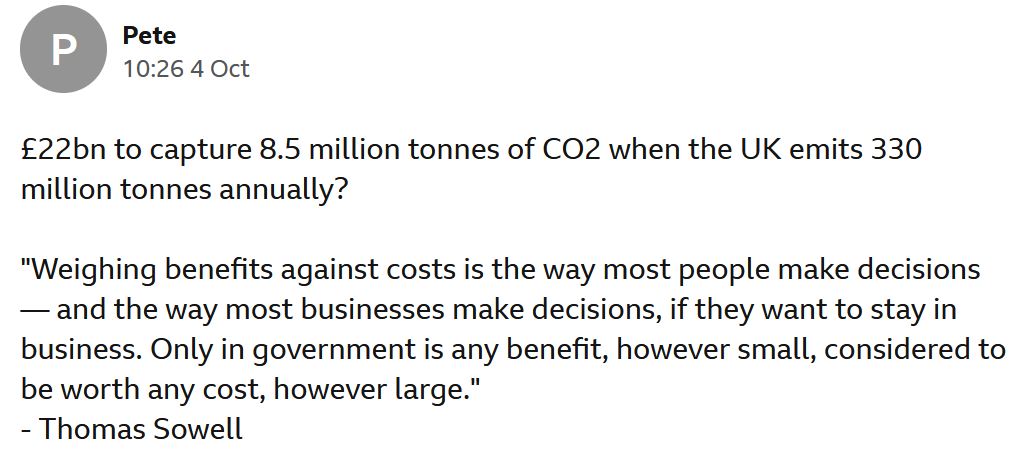
Second, at the BBC’s announcement of the scheme, comments were allowed. I was interested in the top one:

A rather important point, I would say. It is worth dipping into these comments, if you have a mo.

So a black hole is created: but is it a black hole for CO2, or cash?

via Climate Scepticism

https://ift.tt/Bj5uxXs

October 5, 2024 at 12:45PM