Microsoft ‘Buys’ Nuclear Power Plant to Run AI – and it’s Showing Us the Future

From THE DAILY SCEPTIC

by Nick Bowler

On September 20th there was an announcement by a little known energy company located in Baltimore Pennsylvania:

Constellation announced today the signing of a 20-year power purchase agreement with Microsoft that will pave the way for the launch of the Crane Clean Energy Centre (CCEC) and restart of Three Mile Island Unit 1, which operated at industry-leading levels of safety and reliability for decades before being shut down for economic reasons exactly five years ago today. Under the agreement, Microsoft will purchase energy from the renewed plant as part of its goal to help match the power its data centers in PJM use with carbon-free energy.

There are two highly significant things about this announcement. The first is that the company operates a nuclear reactor at Three Mile Island, the site of one of the world’s biggest nuclear accidents. The reactor was due to be decommissioned in the next few years and the plant shut down completely, but it now has been given a new lease of life with this deal. If Constellation gains approval from its local authorities to go ahead with the project, it will truly be a turning point for the future of nuclear energy.

The second significant fact is that the purchaser of the entire output of this reactor for the next 20 years is Microsoft. The technology giant will build a new plant to develop AI nearby, and it will need the output of a nuclear reactor to guarantee the energy requirements of the project.

The anticipated huge surge in energy demand from this sector (all of which has to be in the form of electricity) is prompting AI companies to make deals with energy companies to secure their slice of the cake in a world where energy security is becoming less and less certain.

AI is set to surpass even the huge energy consumption requirements of digital crypto-currency transactions and storage.

It takes a very long time to build a new nuclear power station, so the spotlight is now turning to small modular reactors (SMRs) for a faster turnaround. These can be built and commissioned a great deal more quickly than conventional reactors, assuming of course that the political will is there to approve their construction in the first place.

There are many companies eyeing the opportunity presented by this new technology. Amongst others, Rolls Royce is getting in on the act – with an emphasis already on “clean and affordable”, tying the technology in to the green revolution in order to win Government backing.

All of this provides both a problem and a solution for the Labour Government’s drive towards Net Zero. It is becoming increasingly clear to many people that the limitations and costs of Net Zero are going to far outweigh the benefits of trying to reach the lofty goals contained in the eco-aspirations of the current Government.

In particular, as many articles on this website have attested to, it will be impossible to rely on renewable sources of energy without a constant power backup. As fossil fuels are ruled out, that leaves only one currently viable source at reasonable price levels: nuclear energy.

However, nuclear energy comes with a severe political taint due to a long history of fear-mongering and negativity, associated for decades with Labour party opposition to the Trident missile system.

The political activism group Campaign for Nuclear Disarmament (CND), which opposes all forms of nuclear energy, saw a surge in membership when Tony Blair announced plans to expand U.K. nuclear power capacity in 2007.

This rekindling of public anxiety at that time must contain a warning to the Labour Government when it comes to try to ‘sell’ nuclear to its supporters and the public. But how much choice will it really have in the matter? The catalyst for the change is coming from the AI revolution, which doesn’t look like it has any intention of being stopped in its tracks.

This is what Yann lecCun, the Chief AI Scientist at Meta had to say about the deal with Constellation:

AI datacentres will be built next to energy production sites that can produce gigawatt-scale, low-cost, low-emission electricity continuously.

Basically, next to nuclear power plants.

The advantage is that there is no need for expensive and wasteful long-distance distribution infrastructure.

Note: yes, solar and wind are nice and all, but they require lots of land and massive-scale energy storage systems for when there is too little sun and/or wind. Neither simple nor cheap.

AI and nuclear energy are a marriage made in heaven it seems. It holds out hope for a more sensible energy policy in the U.K. to be developed after all. But expect to see all kinds of hand-wringing and hypocritical statements from the Government as it tries to make nuclear power palatable to its Left-wing supporters.

via Watts Up With That?

https://ift.tt/SJt30cb

October 3, 2024 at 08:02AM

Hurricane Helene Update

By Paul Homewood


We have now got most of the data in for Hurricane Helene, so it is time for a proper recap:


image

September 25 -  27, 2024

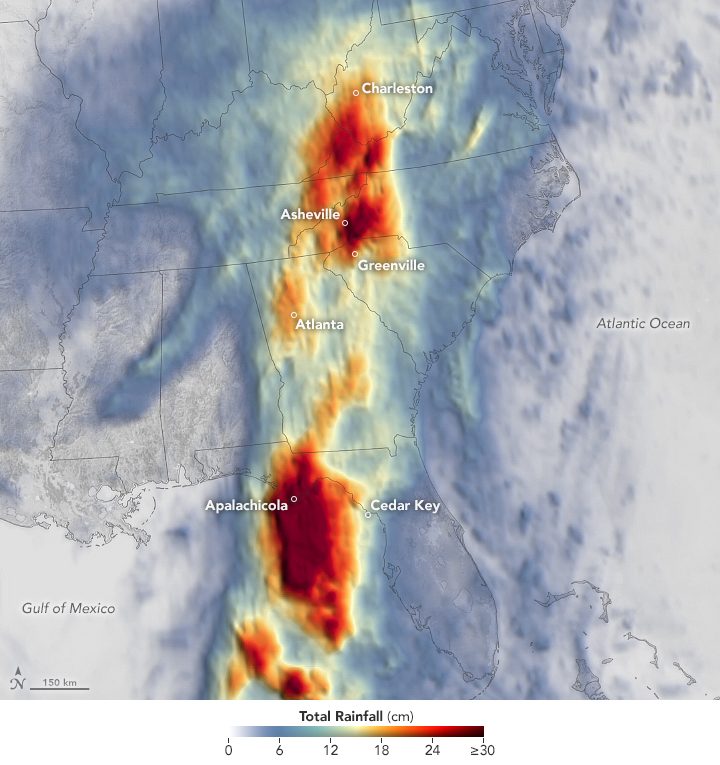
Hurricane Helene intensified as it approached Florida’s Big Bend in fall 2024, ultimately making landfall as a Category 4 storm at 11:10 p.m. Eastern Time on September 27. Even while its center was still over the Gulf of Mexico, the hurricane had begun producing devastating outcomes on land. A predecessor rain event and then the main storm system brought heavy precipitation to southern Appalachia starting on September 25. Deadly and destructive flooding occurred as a result in eastern Tennessee, western Virginia, and North Carolina, among other areas.

This map shows rainfall accumulation over the three-day period ending at 7:59 p.m. Eastern Time (23:59 Universal Time) on September 27, 2024. These data are remotely sensed estimates that come from IMERG (the Integrated Multi-Satellite Retrievals for GPM), a product of the GPM (Global Precipitation Measurement) mission, and may differ from ground-based measurements. For instance, IMERG data are averaged across each pixel, meaning that rain-gauge measurements within a given pixel can be significantly higher or lower than the average.

In Asheville, North Carolina, a total of 13.98 inches (35.52 centimeters) of rain fell from September 25 to 27, according to National Weather Service records. The storm swamped neighborhoods, damaged roads, caused landslides, knocked out electricity and cell service, and forced many residents to evacuate to temporary shelters. Record flood crests were observed on multiple rivers in the state. Flooding was widespread across the southern Appalachians; preliminary rainfall totals neared or exceeded 10 inches (25 centimeters) in parts of Georgia, North Carolina, South Carolina, Tennessee, and Virginia.

On the coast of Florida, the heaviest rainfall was concentrated west of the storm’s center, in and around the town of Apalachicola. For hurricanes in the gulf, heavy rainfall typically occurs east of the storm’s center, where counterclockwise rotation brings in the most moisture from the water body. In the case of Helene, a frontal boundary over the Florida Panhandle interacted with the circulation to concentrate the highest totals west of the center, noted Steve Lang, a research meteorologist at NASA’s Goddard Space Flight Center.

Parts of the Florida coast receiving less rain were not spared from flooding, however. Several Gulf Coast cities and towns, including Cedar Key and Tampa, were affected by storm surge.

https://earthobservatory.nasa.gov/images/153387/devastating-rainfall-from-hurricane-helene


Asheville and the surrounding region took the brunt of the flooding, and nearly 14” of rain in three days is certainly unprecedented in Asheville since records began. But the NWS shows that this was actually spready evenly over all three days:

image

https://www.weather.gov/wrh/Climate?wfo=gsp

As can happen, atmospheric blocking meant the storm was trapped over the Asheville area for all three days. Daily totals of four or five inches are unusual but not unheard of. It was the duration of the rain that really caused the problems.

image

.

But that has not stopped the usual suspects blaming the floods on climate change.

NWS have also published the wind speed data. In Florida peak gusts hit 99 mph (not sustained), a long way below the claimed Cat 4 levels.

140 mph sustained winds may have occurred somewhere out over the sea, but never got anywhere near that on land, at least where there was any measuring equipment.

image

https://www.wpc.ncep.noaa.gov/discussions/nfdscc4.html

via NOT A LOT OF PEOPLE KNOW THAT

https://ift.tt/AOB3QKv

October 3, 2024 at 05:50AM

Coventry:Coundon DCNN 4488 – Caught at Deep Fine Leg?

52.42445 -1.53641 Met Office assessed CIMO Class 4 and Satisfactory Installed 1/10/1998

I would like to suggest this is one of the more “unusual” of Met Office sites, unfortunately such absurdly located sites are actually quite normal features of the 384 strong list of climate reporting sites the Met Office currently uses.

A fellow investigator recently suggested to me regarding another typically absurd site ” I think we should be taking this up with individuals at the Met Office.  For instance asking who specifically signed off on this station being used.  We need to make them feel hot under the collar. ” I totally agree with that sentiment – who was/are the meteorologists who felt Coventry:Coundon was/is an acceptable site to contribute recordings to the historic climate record?

In this case the site has a very detailed account of its history by those who originally established it – students at the private and historic Bablake School. It is not unusual for school weather stations to have been adopted by the Met Office.

A Bablake (Coundon) weather station originally dates back to 1977 and involved none other than well known weather presenter Ian McCaskill amongst other celebrity benefactors in its formation. The detailed and quite charming history is available on the site’s very own web page and makes interesting reading showing the dedication of amateur meteorologists both young and old.

http://www.bablakeweather.co.uk/bws-history-1977-2017

Circumstances required the station to be relocated to its present automatic site in 1998 from which date its readings are fully archived. For all this charming history and endeavour, however, it should not be forgotten that weather stations are supposed to, as far as possible, reflect the natural environment and be representative of the widest possible area. How does this Coundon site fare in that respect?

How much of the surrounding area of Coventry is a cricket pitch? Virtually none thus the site fails on that count from the off – and even the on.

The CIMO guide gives specific definitions of extraneous heat sources but I seriously doubt that cricket nets (which Google Earth Pro images clearly show predate the weather station) were considered. The originators of those standards would probably have presumed no credible meteorological organisation would actually locate a weather station alongside intermittently placed enclosures like these. Similarly they would not be likely to have expected sight-screens to be moved alongside Stevenson screens – indeed they probably would never have heard of the former screening.

I seriously doubt the presence of occasional and temporary spectator seating would have been a consideration in the siting requirement stipulations…and the low level ball catching sheeting…..and the ground’s staff equipment. It would have been assumed such things would not exist at any credibly assessed site.

And then going back to the headline image….how were those circles and straight lines mowed in the grass? Certainly not by “push mower” but by a motorised mower regularly passing within inches of the screen.

All in all, despite its “charming” history, it is still an exceptionally poor site that cannot be considered reliable nor accurate. The Met Office oversaw the installation of this site – whoever “signed it off” needs to seriously consider their interpretation of the standards.

via Tallbloke’s Talkshop

https://ift.tt/sQl8vmq

October 3, 2024 at 04:41AM

India Monsoon Drying Up, Says BBC

From NOT A LOT OF PEOPLE KNOW THAT

By Paul Homewood

.

The good news about the Indian monsoon seems to have disappeared into a black hole as far as the BBC is concerned. Searches on Google fail to bring up any BBC reports on the first page at least. And there is nothing at all on the BBC News website, when India is searched:

.

There is however one report which does appear, from two years ago:

https://www.bbc.com/future/article/20220517-the-uncertain-fate-of-asias-monsoons

As is often the case with the BBC’s coverage of climate, the opposite is true. Far from drying up, India’s monsoons have been getting wetter since the 1960s:

via Watts Up With That?

https://ift.tt/YZ4kx0Q

October 3, 2024 at 04:04AM