India’s monsoon rains hit four-year high in boost to crop output

By Paul Homewood


Another good monsoon for India:


 image

MUMBAI (Reuters) – India’s monsoon rainfall this year was its highest since 2020, with above-average precipitation for three consecutive months, helping the country recover from last year’s drought, the state-run weather department said on Monday.

India’s annual monsoon provides almost 70% of the rain it needs to water farms and replenish reservoirs and aquifers, and is the lifeblood of a nearly $3.5 trillion economy. Without irrigation, nearly half of Indian farmland depends on the rains that usually run from June to September.

Rainfall over the country from June through September was 107.6% of its long period average, the highest since 2020, according to the India Meteorological Department (IMD).

India received 11.6% more rainfall than average in September, following 9% and 15.3% above-average rainfall in July and August respectively, the IMD data showed.

Above-average rainfall in September, arising from a delayed monsoon withdrawal, damaged some summer-sown crops like rice, cotton, soybean, corn, and pulses in certain regions of India.

However, the rains may also enhance soil moisture, benefiting the planting of winter-sown crops such as wheat, rapeseed, and chickpea.

India badly needed good rainfall in 2024 after its driest year in five years in 2023, which depleted reservoir levels and trimmed production of some crops. This forced New Delhi to impose curbs on exports of rice, sugar and onions.

Rainfall distribution was generally good, which helped farmers expand areas under most crops, said Ashwini Bansod, vice president, commodities research at Phillip Capital India.

"This means we could have larger harvests of some summer-sown crops, potentially helping the government to relax trade restrictions in certain cases," she said.

India on Saturday lifted curbs on exports of non-basmati white rice. That came a day after New Delhi cut export duty on parboiled rice to 10%, buoyed by a new crop in the offing and higher inventories in state warehouses.

https://uk.finance.yahoo.com/news/indias-monsoon-rains-hit-four-121413615.html


A wetter than normal monsoon is always good news for India. It is a boost for the whole economy. As well as the obvious benefits for agriculture, it also fills the reservoirs, increasing hydro power.

This year, rainfall was 7.6% above average during the monsoon season, June to September:
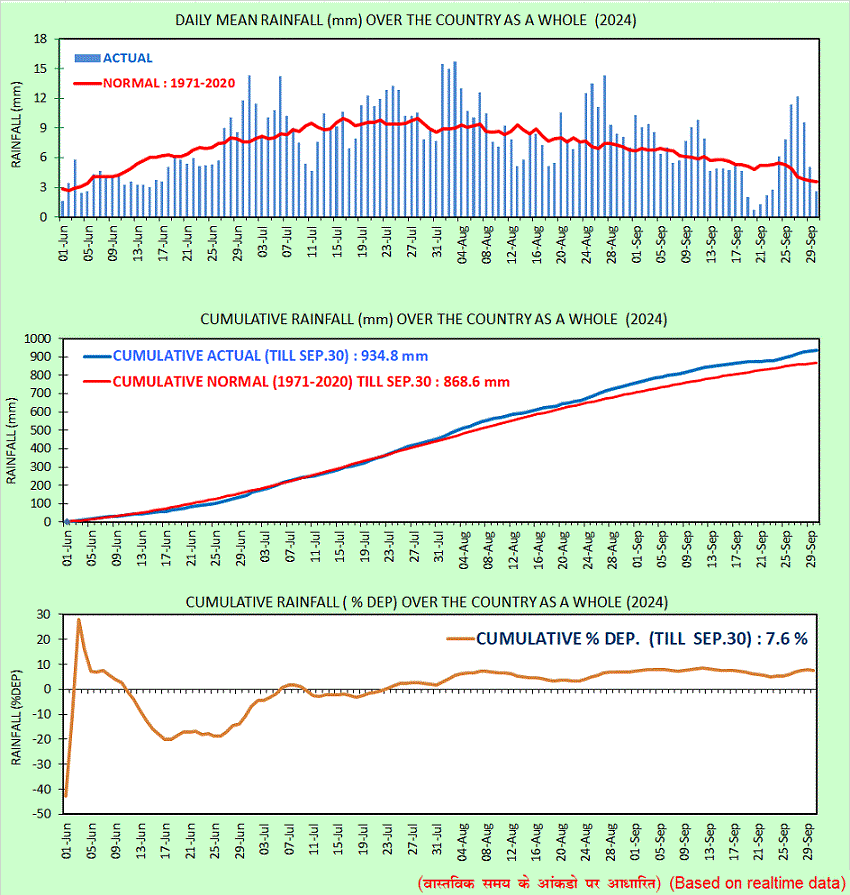
 

https://mausam.imd.gov.in/imd_latest/contents/rainfall_time_series.php

Reuters refer to last year’s “drought”, but rainfall was actually well within the normal range. In India they only classify below 90% of average as drought. As the chart below shows, there have been no severe droughts for several years.

Droughts tend to be associated with El Nino, as in 2015.

One long period of severe drought stands out, the 1960s to 80s, which was directly linked to global cooling. This episode was part of the wider drought belt, which extended from the Sahel in Africa, across the Middle East as through India as far as China.

In contrast, global warming between the 1920s and 40s brought plentiful rain for India.

All India Summer Monsoon Rainfall

https://mol.tropmet.res.in/monsoon-interannual-timeseries/

via NOT A LOT OF PEOPLE KNOW THAT

https://ift.tt/tqg6Jwu

October 1, 2024 at 06:08AM

St Athan WMO 03716 – Taxiway Temperature Taking – but not by the “Runway”.

51.40543 -3.44077 Met Office assessed CIMO Class 5 & Satisfactory Installed 1/9/1988

Another aviation site subject to similarly close proximity of aircraft movements as highlighted at DYCE . The wider area view clearly demonstrates that aircraft, under power and on the taxiway, must regularly pass very close to this site likely queueing at busy periods as shown.

Any reasonable person would conclude that the exhaust heat from aviation gas turbine engine exhausts in such close proximity would affect instruments taking temperature readings. So what is the view of the alleged experts in this field? From https://www.metoffice.gov.uk/weather/learn-about/how-forecasts-are-made/observations/weather-stations

“For example, official weather stations are often located at airports as they have plenty of open space making them a good place for observations to take place. However, the observation equipment is set an internationally-agreed distance from the runway to ensure no external factors can influence readings in any way.”

Notice how carefully worded that statement actually is – “internationally-agreed distance from the runway”

There is NO internationally agreed distance from a runway (hyphenated or not.) Nowhere in the CIMO assessment procedure refers to the specific terminology of “runways”, after all, that would exclude “taxiways”. If there really were an “internationally-agreed distance” why not simply state what that distance is?

And then “….ensure no external factors can influence readings in any way.” Gas Turbines seemingly do not count as “external factors”? Do meteorologists never stand downwind of powerful heat sources? Jet engine exhausts run up to 850°C.

What the CIMO assessment procedure does refer to is

2.2 Class 1
(a) Flat, horizontal land, surrounded by an open space, slope less than ⅓ (19°);
(b) Ground covered with natural and low vegetation (< 10 cm) representative of the region;
(c) Measurement point situated:
(i) At more than 100 m from heat sources or reflective surfaces (buildings, concrete
surfaces, car parks, etc.);
(ii) At more than 100 m from an expanse of water (unless significant of the region);
(iii) Away from all projected shade when the sun is higher than 5°.

The only distance mentioned is of “buildings, concrete surfaces, car parks, etc.” presumably on the assumed basis that no credible meteorological organisation would ever consider proximity to fully functioning jet engine aircraft as acceptable but the UK Met Office demonstrably does. Very obviously somewhat mealy-mouthed words from the Met Office.

For St Athan’s readings to be considered acceptable for the historic climate record is clearly indefensible, however, the Met Office regularly proclaims this site as a regional daily high and allows it to distort the overall climate record. Surely this is unacceptable.

via Tallbloke’s Talkshop

https://ift.tt/dhblgAw

October 1, 2024 at 04:34AM

Ed Miliband faces growing legal threat over pylons roll-out

They claim that their countryside will be disproportionately affected by the rollout, which they say will scare off tourists and ruin farmland.
As a result, all four have warned that they will launch a High Court challenge to block Mr Miliband’s plans.

via Watts Up With That?

https://ift.tt/zW26L78

October 1, 2024 at 04:03AM

Miliband’s net zero sprint risks destabilising the grid, warns EDF

By Paul Homewood


 image

Rapid shift away from fossil fuels threatens to leave energy system at risk of shortfalls

Ed Miliband’s bid to move the UK on to green energy risks destabilising the National Grid, a leading EDF executive has warned.

Rachael Glaving said that by abandoning stable forms of energy generation, such as coal, gas and nuclear, the grid would be reliant on intermittent sources such as wind and solar.

She indicated that this would leave the UK’s energy system at risk of a shortfall should the weather fail to deliver.

Mr Miliband’s bid to shift away from fossil fuels is integral to his goal of decarbonising Britain’s power system by 2030.

To achieve this, he launched the National Energy System Operator (NESO), a new quango tasked with operating the UK’s high-voltage transmission networks.

It comes after the final shutdown of Ratcliffe-on-Soar, the UK’s last coal-fired power station, as well as the looming closure of eight of EDF’s nuclear reactors within the next four years.

Ms Glaving, who is responsible for EDF’s nuclear fleet, said that these reactors were crucial to providing the steady baseload power essential for grid stability.

Speaking at the Conservative Party Conference, she said: “A key issue for NESO is to make the grid as stable as possible, and as we lose nuclear, that stability is what we will lose.

“We will lose our strong foundation of baseload generation, which helps support renewables, and which has made it possible to add so much wind and solar.

“Our ability to have even more renewables in the UK has been because of this strong [nuclear] foundation.

“So if you start eroding the foundation then we have to start leaning on other things to support renewables. Perhaps we’ll import more power from Europe and we will see the impacts on our bills. We’ll also see it in grid stability.”

https://www.telegraph.co.uk/business/2024/10/01/milibands-net-zero-sprint-risks-destabilising-grid/

via NOT A LOT OF PEOPLE KNOW THAT

https://ift.tt/Ol0YEBw

October 1, 2024 at 03:37AM