“Exxon Knew”: More Rebuttal (again)

“The contrived sense of accomplishment in history matching is spurious correlation for an infinitesimally small period of time. Using Exxon’s internal analysis of CO2 climate forcing is little more than a propaganda tool.”

“Exxon Knew” is a political-lawyer campaign focusing on certain internal company documents to make a case that the oil major knew that carbon dioxide (CO2) emissions were a future threat to human betterment.

Smoking gun? Hardly.

A half century later, the IPCC is still trying to update and figure out physical climate science. Exxon did not do a study on the benefits of CO2 or the offset of sulfur dioxide emissions. The concern way back then was Global Cooling, Peak Oil, and Peak Gas. And as the company knew, fossil fuels had no viable substitute, as in wind and solar.

This historical correction has been documented in many posts here at MasterResource, including:

Big Oil, Exxon Not Guilty as Charged: Six-part Rebuttal (September 22, 2022)

‘ExxonKnew’: More Correction (September 18, 2023)

Shell Knew? No (July 19, 2023)

Climate Alarmist as ExxonMobil Whistleblower (March 27, 2024)

In Search of the “Greenhouse Signal” in the 1990s (June 21, 2023)

Unsettled Science, IPCC-style (February 18, 2020)

It became my turn when I encountered this argument by Mark Burger on social media, He stated:

As opposed to fossil fuel industries war on hiding their impacts for decades? One example: “Exxon scientists predicted global warming with ‘shocking skill and accuracy,’ Harvard researchers say

My Rebuttal

To which I respond (expanded from my reply on social media):

To say that Exxon knew the truth back in the early 80s is a laughable fallacy. Effectively they built a primitive model that is characteristically similar to the erroneous modern climate models of today.
Fundamentally their work is based on the poorly understood climate sensitivity (ECS) derived from radiative convective models and GCM models. To their credit, they actually acknowledged the high degree of uncertainty in these estimations. Today, even Hausfather (2022 vs 2019) is beginning to understand the climate sensitivity (ECS) is too high. CMIP6 is running still even hotter than CMIP5 and using ECS of 3 to 5° C rather than ~ 1.2° C as highlighted in Nick Lewis’s 2022 study.

CMIP6 should have been better because it incorporated solar particle forcing (Matthes et. al.) and as they incorporate more elements of natural forcing (an active area of research as we still do not have a predictive theory for climate), the effect is highlighting more underlying problems with the models.

However, Exxon investigators fell into the same trap that climate modelers of today where they build the models to history match temperatures and then wow, because they can create a model that appears to history match temperatures, they assume it is telling them something. Truth? Anyone can create a model to do this, but it would never mean the model is correct. While the models today are much more complex, they are based are based on a complex set of non-linear equations, and the understanding the various sources of nonlineararity is poor. This opens up wide degrees of uncertainty yet wide opportunity for tuning. Furthermore, natural forcing is undercharacterized and deemed inconsequential.

The contrived sense of accomplishment in history matching is spurious correlation for an infinitesimally small period of time. Using Exxon’s internal analysis of CO2 climate forcing is little more than a propaganda tool. Current climate models, much more sophisticated, face the same problem of unknown, false causality.

————-

Randall Utech, former Advisor Geoscientist at Schlumberger, has researched climate science for nearly 30 years with emphasis on geology, paleoclimate, and the glacial cycles. An interview with him by the American Association of Petroleum Geologists can be found here. Utech is author of On the Benefits of CO2 (April 11, 2023).

The post “Exxon Knew”: More Rebuttal (again) appeared first on Master Resource.

via Master Resource

https://ift.tt/wVfB8zJ

September 19, 2024 at 01:15AM

Michigan union members blame Biden electric-vehicle mandates for auto-industry layoffs: ‘Want to slit our throats’

From CLIMATE DEPOT

By Marc Morano

https://nypost.com/2024/09/17/us-news/michigan-union-members-blame-biden-electric-vehicle-mandates-for-auto-industry-layoffs

ANN ARBOR, Mich. — The auto industry is big business in Michigan, and a major round of layoffs is revving the election into high gear for industry workers in the critical swing state — who blame the Biden-Harris administration’s heavy-handed electric-vehicle mandates for the painful job losses.

Stellantis, which manufactures Chrysler, Jeep and Dodge vehicles, announced last month it will lay off 2,450 workers at its Warren plant. While industry jobs in the state have been declining since 1990, Michigan autoworkers explained to The Post why Team Biden’s green-energy rules are at fault this time.

United Auto Workers member Isaiah Gordon, 24, works on hybrid batteries at Ford’s Rawsonville plant and said the forced transition to electric vehicles is damaging the industry.

via Watts Up With That?

https://ift.tt/weT146x

September 19, 2024 at 12:01AM

Ryan Maue on Climate Attribution

Note, just because the Earth is 1.3°C warmer than Little Ice Age in 1850 and atmosphere holds more water vapor does NOT mean a particular weather event was caused by climate change. It’s not that simple.

via Watts Up With That?

https://ift.tt/z1qialA

September 18, 2024 at 08:05PM

Which Turtle, and Where was VW – the Mega Grouper?  Part 5. Inaugural Megafauna Expedition, September 2024 

It is one of the best wreck dives in the world, arguably one of the top ten dive sites in the world – and yet we know so little about it.   Who did the last inventory of the megafauna at the Yongala?

When I was there earlier this year, on May 6th, 2024, I got to swim with a rare stingray, a Megatrygon microps.   The largest stingray species in the world.  Apparently.

A few months later, on September 3rd, 2024, as part of the inaugural Megafauna Expedition, there were no M. microps. 

 I was hoping that at least one of the photographers on the expedition would find and photograph perhaps the largest fish at the Great Barrier Reef, nicknamed VW.

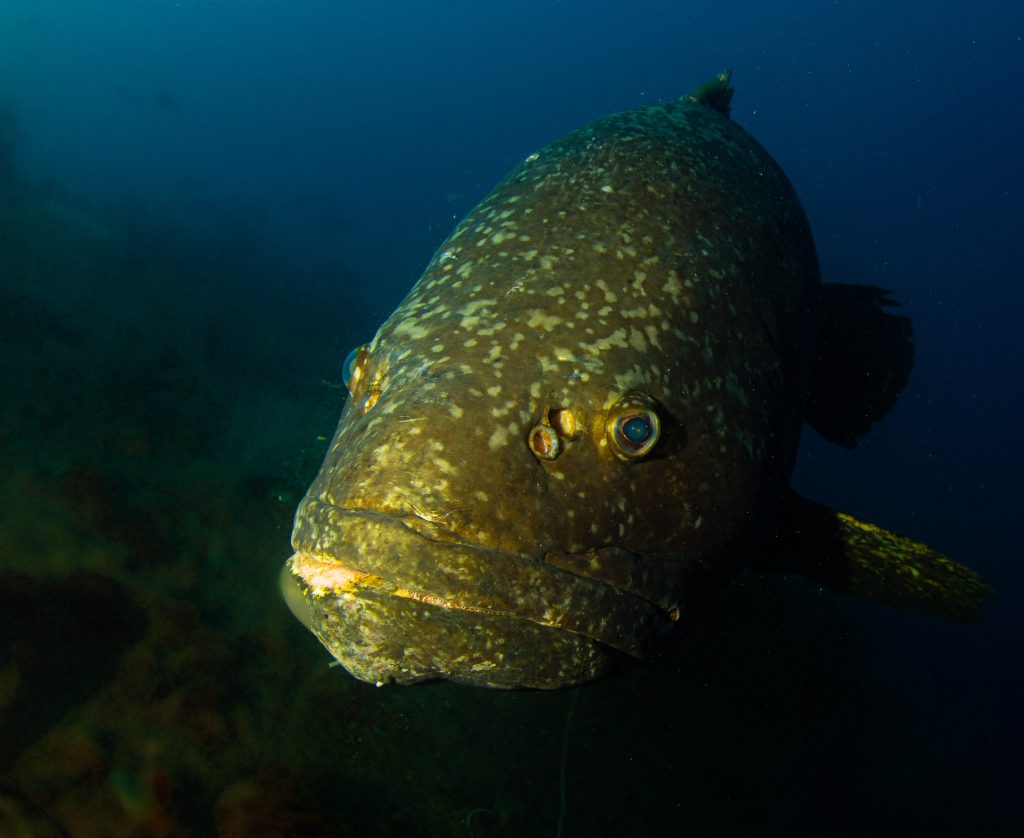
VW is the nickname for the largest of the resident Queensland Groupers reportedly at the Yongala, with the scientific name Epinephelus lanceolatus.  Reportedly the size of a Volkswagen Beetle car – that would make this fish four metres long.   Is that an exaggeration?   I’ve never seen VW.

How big is VW really – and exactly, and when is he at the Yongala?

 Fifteen of us got into the water the very first morning of the inaugural Megafauna Expedition.  But not a VW in sight.

Which begs the question for me: when is that fish reliably at the Yongala shipwreck?  Does VW move with the season, as well as the time of day?

One of our team photographs, Dave Baxter, photographed a very large Queensland Grouper, not VW.  I estimate the fish that he photographed to be 2.3 metres.

The Queensland Grouper photographed by Dave Baxter at the Yongala on 3rd September, 2024. This is one of a series of photographs by Dave of this mega fish.

More about this fish soon – hopefully with some information about other Queensland Groupers photographed by Dave.  Perhaps even some historical photographs taken by Dave of VW back 25 years.    Has VW really been around that long?  .There must have been a census of the fishes of the Yongala shipwreck.   When was that –  when was the last census?  I know that the Australian government undertakes an annual census of the penguins at Antartica.  And where is the Australian Institute of Marine Science (AIMS) on all of this, the census of the fishes of the Yongala?

Meanwhile, I am just wanting a turtle ID.

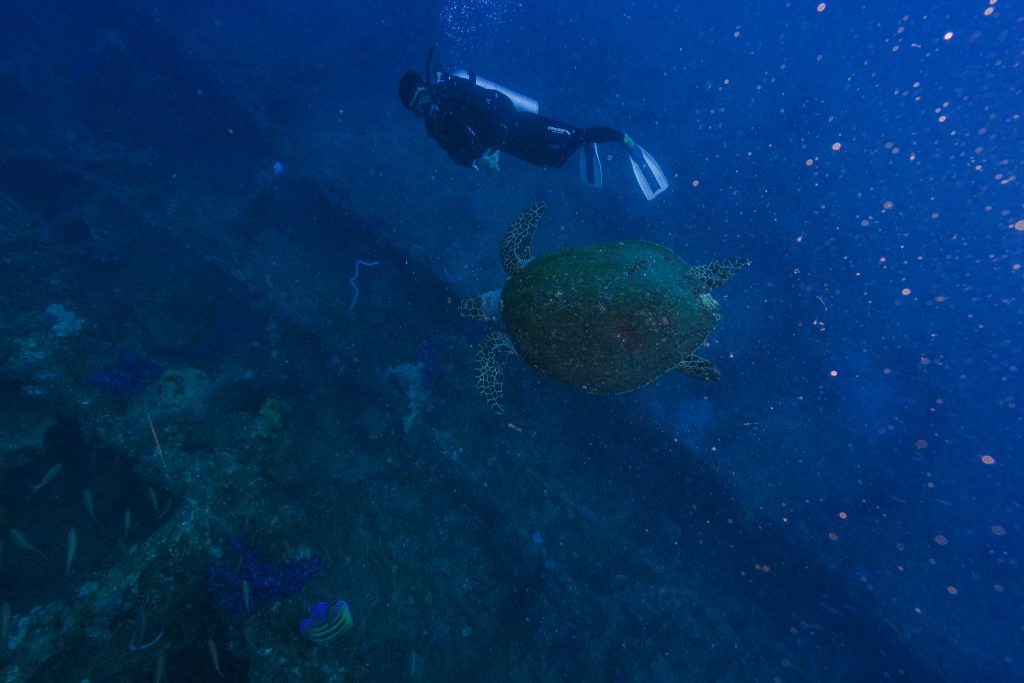
Rookie underwater photograph, Laura Boderke, trying out her rig for the first time on that first dive on the first morning at the Yongala – the very first morning of the inaugural Megafauna Expedition – Laura photographed, and also shot some video of her scuba buddy Sebastian Falk swimming with a turtle.   A large turtle, but which species?

We just want a correct identification for the turtle.  I am no turtle expert, and neither is Laura.

I put Laura’s turtle photograph, a winning entry in the Megafauna Photographic Competition, up at iNaturalist.

Sebastian Falk as yardstick for the largest turtle photograph submitted in the Megafauna Photographic Competition.

The provisional ID at iNaturalist is:

“The scales on the head align more with a Hawksbill [than Green Sea turtle]. The prefrontal scales are a good indicator for distinguishing the two. [end quote]

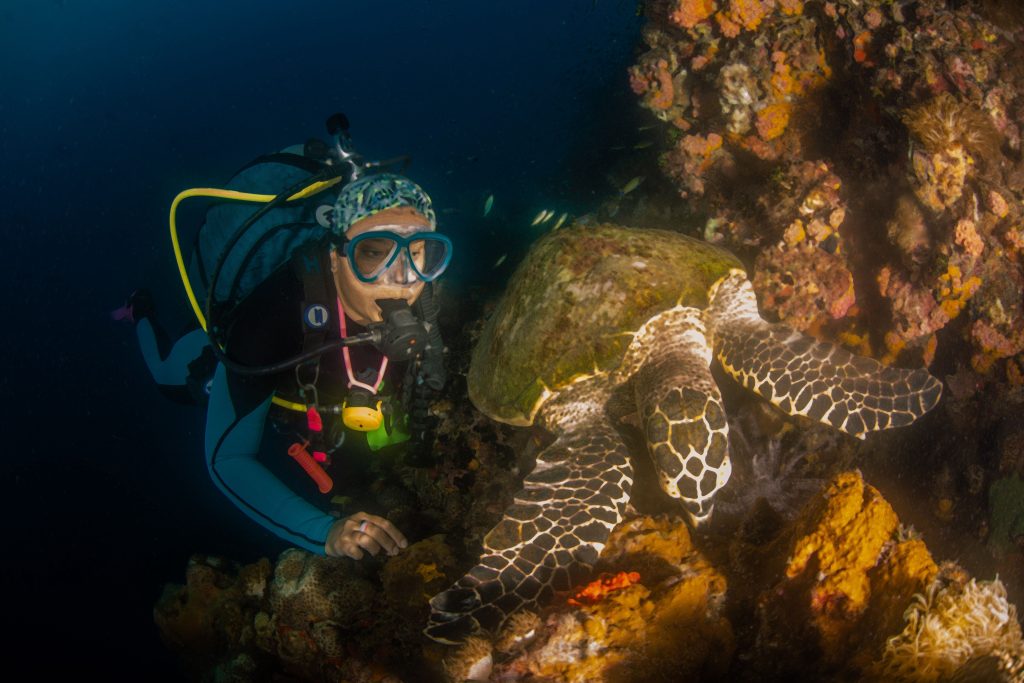
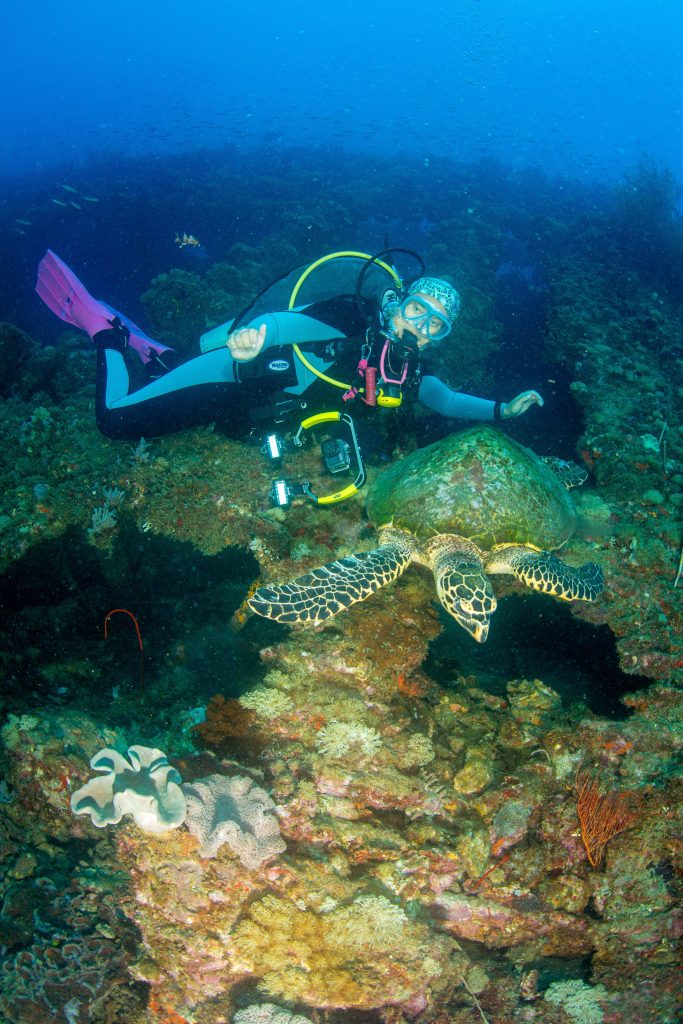
Dave Baxter took some photographs of perhaps this same turtle – with his scuba buddy Kate Armstrong.

Photographs by Dave Baxter of Kate Armstrong with a turtle, also at the Yongala shipwreck on 3rd September, 2024.

Is this the same turtle, and which species is it anyway?

The feature image at the top of this post is of Seb Falk with Laura, about ready to jump in for the night dive at Wheeler Reef, the next day.

Previous scribbles from me about this dive site, including some politics:

Never have I heard anyone mention in the same breath the fishes of the Yongala historic shipwreck and its proximity to the ‘highest exposure levels’ of nutrients and sediments attributed to agricultural runoff.

In the most recent ‘Great Barrier Reef Outlook Report’ (2019) there is a focus on the Burdekin River, and how the coral reefs in this region to the south of Townsville are suffering terribly because of agricultural runoff with specific mention of Stanley and Darley Reef.   Even closer to the mouth of the Burdekin River, in fact in the direct path of river flood plumes, is the Yongala – regularly listed as one of the best dive sites in the world.

Read more here:

https://jennifermarohasy.com/2024/06/more-agriculture-supersized-fish-best-dive-site-the-yongala/

Megatrygon microps is the largest species of stingray in the world with a width of 2 metres and some.   But I felt calm in its presence, and I also wanted to get closer.

The four of us, Thomas, Jessica and Alyson, had jumped in some 15 minutes earlier off the MV SeaEsta for a second dive that morning, on Monday 6th May.    It can be difficult – diving the Yongala. There was a 2-metre swell forecast, but we jump into something less than that.   ‘A bit rollie,’ was how first mate Kerrie described it.

My objective was to just get in and get down the 18 metres to the wreck and hopefully make it the entire length – to swim the entire top of the wreck, the entire length of the Yongala without running out of air.   If I got to the other end with 120 bars, I would be happy.

We got there, to the stern and did an air check.  My three buddies and I, we each still had at least 120 bars.   Whoo hoo!   And the current would take us back to the bow, from where we would make our ascent.

I was feeling happy. Relaxed.  I could see a giant groper in the distance, purple soft corals and golden fish covered the top of the wreck.

Then it appeared.

It hovered and then swung around.  Moved away and then returned.   It swung its tail over my head, and I saw the barbs up close.

Read more here:

https://jennifermarohasy.com/2024/05/swimming-with-a-rare-giant-sting-ray-yongala-6-may-2024/

via Jennifer Marohasy

https://ift.tt/ml8tHxi

September 18, 2024 at 05:58PM