
By Paul Homewood
Who is thickest – Lammy or Miliband?
via NOT A LOT OF PEOPLE KNOW THAT
September 18, 2024 at 03:40PM
By Paul Homewood
Who is thickest – Lammy or Miliband?
via NOT A LOT OF PEOPLE KNOW THAT
September 18, 2024 at 03:40PM
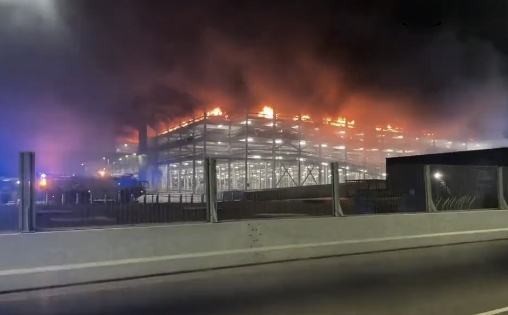
Lest we forget, the Luton airport carpark fire October 2023.
By Jo Nova
We know it’s coming. One day, sometime there will be a skyscraper inferno started by an EV or a scooter and made so much worse because there were other EV’s in the basement carpark.
At the moment companies can be fined $100,000 in Australia for failing to include high fire danger warning labels on kids beach towels, but it’s no problem if children sleep in a tower above a carpark full of EVs.
Chinese Hotels are starting to ask customers with EV’s to park in open areas outside the hotel. Though there is anecdotal evidence that Chinese made EVs are more at risk.
by Jamie Seidel, News.com
… Chinese hotels and property managers have begun to ban all electric vehicles – scooters, e-bikes, family cars or commercial vans – from their undercroft car parks.
“Hotels and other buildings in Hangzhou, Ningbo, Xiaoshan and other places in Zhejiang have banned electric vehicles from entering underground garages for safety reasons, sparking heated discussions,” Chinese online dissident “Mr Li is not your teacher” reported in a post to X (which is banned in China) in September.
Local news reports that property owners were spurred into action after 11 intense battery fires in Zhejiang’s capital, Hangzhou, in May of this year.
“Based on the characteristics of electric vehicle fires and our hotel’s firefighting capabilities, we think it safer not to allow them into the underground garage,” RFA quotes one five-star hotel owner as stating.
“A lot of basement parking lots are designed with low ceilings, meaning that fire trucks can’t get inside.”
Some will point to studies that claim gas powered cars catch fire 20 or 30 times as often, but old cars are riskier and these studies don’t appear to control for age. And if one EV sets fire to 1,200 cars, hypothetically at an airport terminal, we have to wonder whether the incident adds more “fire deaths” to the petrol car scorecard rather than the EV tally at the Department of Motor Vehicles.
Remember, we’re forcing EVs on people to save the world in a hundred years, but no one has the time to conduct a proper age-standardized study on the risks of storing EV’s in home garages or under apartment blocks now.
In related news, two weeks ago BMW recalled 140,000 Mini Coopers due to a battery fire threat:
Wall Street Journal, Sept 3, 2024
The German carmaker said the recall of electric Mini Cooper SEs came after tests that revealed the potential for leaks from the battery housing.
“The high-voltage battery could also switch off and the vehicle could roll out slowly, even while driving,” BMW said. “A vehicle fire, even when the vehicle is parked, cannot be ruled out.”
h/t Graeme#4, NotalotofPeopleknowthat
0 out of 10 based on 0 rating
via JoNova
September 18, 2024 at 03:22PM
While the UK Westminster Parliament has (on little more than a nod and a wink) legislated for the UK to achieve Net Zero by 2050, it is of course the case that the Holyrood Parliament decided that Scotland should go one better, and achieve that feat by 2045: the Climate Change (Emissions Reduction Targets) (Scotland) Act 2019. All too predictably, however, that target is running into difficulties. Just three months ago the BBC reported that “Scotland misses another climate change target”. It’s not easy, this accelerated Net Zero business:
This is likely to be the last time progress will be measured against annual targets with the Scottish government confirming in April that it will scrap all but the 2045 net zero goal.
The annual targets will be replaced with carbon budgets covering each five-year Parliamentary term, in line with the rest of the UK.
The interim target of reducing emissions by 75% by 2030 was ditched with ministers admitting it was “out of reach”.
Undaunted it seems, there are some in Wales who want to achieve Net Zero ten years faster than the deluded Scottish target. A couple of days ago the Pembrokeshire Herald reported that “Wales could achieve Net Zero by 2035 under bold new proposals”. It turns out there is such a thing as a Wales Net Zero 2035 Challenge Group, and it has released some new proposals, which have made the news (in Wales, if not in the rest of the UK, so far as I can see). Intrigued and staggered in equal measure by the claim that “[t]he new proposals reveal that huge benefits to the Welsh public are possible through a faster net zero transition, including improved public health, reduced pressure on the NHS, greater energy security, a more resilient food supply, and low-carbon job generation” I thought I should take a look at the report.
First, though, I thought I should check out the group behind the report. The “about” section of its website makes interesting reading:
The Wales Net Zero 2035 Challenge Group was established in January 2023 to deliver on a specific commitment in the formal Co-operation Agreement between the Welsh Government and Plaid Cymru. The Welsh Government and Plaid Cymru Cooperation Agreement (2021) committed to “commission independent advice to examine potential pathways to net zero by 2035 – the current target date is 2050. This will look at the impact on society and sectors of our economy and how any adverse effects may be mitigated, including how the costs and benefits are shared fairly”.
There are 25 Group members, and it is supported by a secretariat. In addition, “The Wales Centre for Public Policy has also been asked by the Welsh Government to support the work of the Group as an independent institution.” I cannot find any reference on the website to sources of funding, but presumably it is being funded by the Welsh taxpayer as part of a cosy deal between Plaid Cymru and Welsh Labour.
Enough of that, and back to the Report. I’m afraid it’s the usual optimistic mish-mash of woolly thinking, but some aspects do bother me enough to call them out here. It’s the utter failure of logic which I think grates most. For instance, on page 10 we are treated to a short section headed “Our risk of inaction”. The clear implication is that by acting in this precipitate way (Net Zero in just eleven years) Wales can somehow obviate the alleged risks of climate change. Wales, which probably contributes little more than 0.05% of global greenhouse gases, apparently thinks it can avoid risks stemming from greenhouse gas emissions by accelerating its Net Zero plans. Given the number of serious people who must have been involved in writing this report, the delusional and childish level of the thinking it displays leads me to despair:
The risks of not acting are stark. Firstly, we have increasing climate risks, risks which have historically been underestimated. Secondly, delaying action on climate change will result in far greater costs. Finally, Wales risks reducing its ability to deliver a just transition and outcomes aligned with the Well-being of Future Generations (Wales) Act. The Welsh Government needs to be an active leader in the transition, working with communities, business and finance to deliver a just transition rooted in the Well-being of Future Generations (Wales) Act. The risk of inaction is an unfair or corporate centric net zero –already evident in the rise of carbon offsetting companies pricing Welsh farmers out of the market for land.
Heavily footnoted (by way of purported justification) that section links to reports by the likes of Climate Policy Initiative, which is hardly a disinterested source of information (“…an analysis and advisory organization with deep expertise in finance and policy. Our mission is to help governments, businesses, and financial institutions drive economic growth while addressing climate change….”). (It looks as though they make money from this too). There’s Climate Outreach too (“We are the first British charity to focus exclusively on public engagement with climate change.”). Isn’t it great when organisations pressing for accelerated net zero, some seeking to make money out of it, can write reports which are then eagerly cited in reports by official bodies seeking to justify an acceleration of Net Zero plans. It’s all very circular and also mightily convenient.
The hubris on display is also quite staggering. Where Wales leads, apparently the rest of the world will follow:
Wales’ approach to climate change is world leading in many ways. We were the first country to declare a Climate Emergency in 2019. In 2021, the Welsh Government committed to achieving net zero by 2050. The significant inclusion in the Cooperation Agreement between Welsh Labour and Plaid Cymru of the need to accelerate ambition to address climate change and the nature crisis by 2035 was groundbreaking in recognising the importance of addressing these issues in a non-partisan way. This represented a significant advance in climate leadership, and Wales can lead by example in the crucial task of developing a similarly united approach to climate action.
And again, this:
Wales already has soft power in international climate governance having been the first country in the world to declare a climate emergency in 2019.
I’m sorry, but I struggle to take this seriously.
There’s some stuff in there about restoring nature, which is hard to argue with, though it’s remarkably light when it comes to the question of energy generation and the damage caused to the environment by such things as wind and solar farms (in fact, a word search of the article located just three minor references to solar energy and none to wind).
Heavy on jargon and rhetoric, light on practical detail, quite frankly I wonder why they bothered with this pie-in-the-sky exercise. I can’t see the Chinese Goliath taking much notice of the Welsh David, whatever the members of this Group seem to think.
via Climate Scepticism
September 18, 2024 at 02:32PM

The Earth’s polar regions are associated with geomagnetic forces i.e. magnetic north and south, but are there any equator-related (west-east) forces? One at least, as Wikipedia says : ‘The ring current system consists of a band, at a distance of 3 to 8 Earth radii, which lies in the equatorial plane and circulates clockwise around the Earth (when viewed from the north). The particles of this region produce a magnetic field in opposition to the Earth’s magnetic field and so an Earthly observer would observe a decrease in the magnetic field in this area.’ The article mentions Saturn’s rings, which clearly align with that planet’s equator, and looks at ‘potential climate implications’ of Earth having had something similar. The research determined that of all the places on Earth where craters should have been preserved ‘only 30% of the suitable land area was determined to have been close to the equator, yet all the impact craters from this period were found in this region.’ (NB the Van Allen radiation belts also have some affinity with the equator.)
– – –
In a discovery that challenges our understanding of Earth’s ancient history, researchers have found evidence suggesting that Earth may have had a ring system that formed around 466 million years ago, at the beginning of a period of unusually intense meteorite bombardment known as the Ordovician impact spike, says Phys.org.
This surprising hypothesis, published in Earth and Planetary Science Letters, stems from plate tectonic reconstructions for the Ordovician period noting the positions of 21 asteroid impact craters.
All these craters are located within 30 degrees of the equator, despite more than 70% of Earth’s continental crust being outside this region, an anomaly that conventional theories cannot explain.
The research team believes this localized impact pattern was produced after a large asteroid had a close encounter with Earth. As the asteroid passed within Earth’s Roche limit, it broke apart due to tidal forces, forming a debris ring around the planet—similar to the rings seen around Saturn and other gas giants today.
“Over millions of years, material from this ring gradually fell to Earth, creating the spike in meteorite impacts observed in the geological record,” said lead study author Professor Andy Tomkins, from Monash University’s School of Earth, Atmosphere and Environment. “We also see that layers in sedimentary rocks from this period contain extraordinary amounts of meteorite debris.”
“What makes this finding even more intriguing is the potential climate implications of such a ring system,” he said.
The researchers speculate that the ring could have cast a shadow on Earth, blocking sunlight and contributing to a significant global cooling event known as the “Hirnantian Icehouse.”
This period, which occurred near the end of the Ordovician, is recognized as one of the coldest in the last 500 million years of Earth’s history.
“The idea that a ring system could have influenced global temperatures adds a new layer of complexity to our understanding of how extra-terrestrial events may have shaped Earth’s climate,” Professor Tomkins said.
. . .
Could similar rings have existed at other points in our planet’s history, affecting everything from climate to the distribution of life? This research opens a new frontier in the study of Earth’s past, providing new insights into the dynamic interactions between our planet and the wider cosmos.
Full article here.
– – –
Image credit: planetary.org
via Tallbloke’s Talkshop
September 18, 2024 at 02:05PM

