Energy customers are being short-changed by “perverse” government targets to install electronic smart meters in homes across the UK, according to the consumer campaigner Martin Lewis.
Lewis, the founder and chair of MoneySavingExpert.com (MSE), has written to Ed Miliband, the secretary of state for energy security and net zero, warning that installations are being prioritised over repairs, leaving thousands of households facing shock bills because their meters have malfunctioned.
Last December, the artist Grayson Perry reported that his monthly electricity charge had soared from £300 to £39,000 because of a faulty smart meter. Lewis wants suppliers to be incentivised to fix faulty meters as well as installing new ones.
“I am writing to you […] to warn of the brand damage that risks making the government’s targets framework perverse,” Lewis said in his letter. “A rethink is needed – specifically I’d suggest shifting firms’ targets from smart meter installations to the overall number of ‘working’ smart meters, which would incentivise firms to do both installations and repairs.”
Smart meters record energy consumption, display costs in real time and submit regular readings to energy firms. The government expects them to be installed in 74.5% of homes by the end of 2025, with the estimated overall £13.5bn cost funded by suppliers and recouped in consumer bills.
However, the rollout, originally intended to be completed in 2019, has been beset with problems. Nearly 4m smart meters are malfunctioning in the UK, leaving some householders facing life-changing bills, according to figures released by the Department for Energy Security and Net Zero (DESNZ) earlier this year.
Lewis said the DESNZ figures did not reflect the full extent of the problem. “The government’s estimate of how many domestic smart meters are not working is about 10%. Yet this only includes the narrow definition of smart meters … not sending automatic readings to the supplier,” he wrote.
“Our latest MSE research … shows 19% say theirs don’t work. The reason this is so much higher is that it includes … in-home displays that won’t communicate or connect, incorrect data on tariffs or usage, and prepay top-ups that don’t register correctly. Repairs are slow, if they happen at all, as resources are focused on installs, leaving consumers frustrated and at risk of misbilling and further problems.”
Until this year customers had to pay to fix any problems that occurred after their year-long warranty expired. In February, Ofgem launched a new scheme that committed participating suppliers to repairing them for free, but not all firms have signed up.
Think your power bill is crushing now; the worst is yet to come. The grand wind and solar ‘transition’ is – according to the 5 year planners – in its infancy, but already the effects of heavily subsidised and chaotically intermittent wind and solar are being spelt out in record retail power bills.
To reach our utopian energy Nirvana, we are told, requires trillions more in taxpayer subsidies for mythical mega lithium-ion batteries, and extending transmission grids to bring the power generated by wind and solar (only occasionally, of course) from far-flung places to market.
America’s socialist call it the Green New Deal.
David Wojick calls it a costly recipe for disaster.
The Green New Deal could make electricity 28 times more expensive
CFACT
David Wojick
3 September 2024
Below, I show how the Green New Deal can cause the average household electricity bill to go up a crushing $52,500. The reason is simple. Wind and solar require a lot of battery backup, and we use a tremendous amount of electricity, so the cost of all these batteries is many trillions of dollars.
Here is the basic derivation. It is kept simple, and the numbers are all rounded off so they can be remembered. (The U.S. Energy Department should have done a detailed analysis long ago.)
— The electricity storage capacity required to replace today’s fossil-fueled electricity generation nationwide with intermittent wind and solar is 250,000,000 MWh.
— Assume grid-scale battery facilities cost $300,000 per MWh of storage capacity. (Today’s cost is higher.)
— Thus, the capital cost of this storage is 75 trillion dollars.
— Spreading this cost over 20 years gives an annual cost of 3.75 trillion dollars.
— U.S. household electricity usage is 1.5 trillion KWh per year.
— Thus, the household cost is $2.50 per KWh.
— Average household usage is 10,500 KWh/yr.
— Thus, the annual household cost of this storage capacity is $26,250.
— Today’s average annual electric bill is $1,800.
— Thus, the electricity cost increase is over 14 times as much.
In short, everyone’s electricity bill will be 14 times greater than today if wind and solar replace today’s fossil fuel-powered generation under the Green New Deal.
This will be true of industrial and commercial consumers as well, which will drive up the cost of virtually all goods and services. This impact is truly inflationary.
But this does not include the electrification of transportation and gas heat, which are also part of the Green New Deal. Electrification is often estimated to roughly double the amount of electricity generated.
— Given electrification, the cost of electricity might jump a whopping 28 times today’s cost. The Green New Deal causes the average household electricity bill to go up a crushing $52,500.
Of course, the economy would likely collapse before this happened, but this simple analysis is the necessary starting point for thinking about the incredible cost impact of the Green New Deal.
There are lots of technical refinements to be added to this analysis to make it a good engineering cost estimate. Some make the numbers go down; others make them go up. I would love to see this done and would happily help.
For example, the cost of batteries might go down a lot, and there are studies that project this. Given that the material requirements for this vast number of batteries greatly exceed our present mining and manufacturing capacity, this may be unlikely, but it is not impossible.
On the other hand, this simple analysis assumes batteries charge and discharge from zero to 100% of capacity. If it is actually 10-90 or 20-80, then a great deal more storage capacity will be needed.
Then, too the storage requirement can be reduced by overbuilding the wind and solar generating capacity. However, this reduction is limited; I have been told to 180 million MWh because there is still no solar at night and no wind when it does not blow hard enough.
But it is unlikely that these giant batteries have an average full performance life of 20 years.
Note, too, that this analysis does not include the cost of the enormous amount of wind and solar generating facilities. Nor does it include the cost of borrowing trillions of dollars.
The basic point is that the Green New Deal is impossibly expensive. There is no cure for intermittency. CFACT
“The Competitive Enterprise Institute is leading a coalition of free market advocates attempting to organize support to stop the IRA’s obscene and consumer abusive funding. In response, the Biden (mis)Administration is attempting to shovel IRA funding out the door as fast as it can to contractually shield it.”
The upshot is that despite Federal rebates of up to $8,000 per the “Inflation Reduction Act,” real-world economics of electric heat pumps are dismal. Several commenters to the second article aptly summarized why from a consumer perspective.
Case Study One
As the owner of a 30-year-old gas furnace, I was in the market for a heat pump during all of 2023. As a low-income retiree, I also looked forward to an $8,000 subsidy from the Inflation Reduction Act passed in November of 2022. Well, as readers of this blog probably know already, the IRA subsidies did not take effect in 2023 (and are now projected to be available in California no sooner than late summer 2024).
I had gotten a bid in the summer of 2022 of $25,000 for a heat pump, but I was waiting for the IRA subsidy to take effect. Then I discovered that the bidder had failed to mention that installing a heat pump would also require new ductwork because the existing ducts were too small to handle the larger air volumes required by a heat pump. Two subsequent bids in mid- and late-2023 ranged from $30K to $40K when ductwork was included.
So when the furnace failed in December 2023 at age 31, I had to make a quick choice: a replacement gas furnace (costing $12K with an 18-month 0% loan, and a 2-day wait for installation), or $30K+ for a heat pump with a couple month wait for installation. The estimated fuel savings from the heat pump worked out to under $1000 per year, not even close to enough to outweigh the $18K capital cost differential. The fact that the estimated life for the heat pump was 15 years, versus 30 years for the gas furnace, didn’t help at all.
So there’s my anecdotal story: it wasn’t interest rates, it wasn’t tax law, it largely wasn’t fuel prices, it was mostly capital costs. Had the original bid of $25K been legit and had the $8K subsidy been available by mid-2023, I would have chosen the $17K heat pump over the $12K furnace based on environmental concerns. But at $30K versus $12K, I didn’t.
Case Study Two
I also got pricing for a 6 head mini-split heat exchange system that would be mounted in each room, and it came to $26,000 for the two pumps and 6 heads wired, installed and tested. Pricing is important.
Yes, pricing (meaning total installed cost) is important. Total installed costs for heat pumps (as evidenced by the above commenters) can include expensive retrofit expenses that normally are avoided when not switching from a traditional gas furnace to an electric heat pump. And heaven forbid something like a motherboard failure out of warranty (that tend to be much shorter than furnace warranties).
Alas, however,, our Federal energy efficiency “experts” are also making sure that traditional/inexpensive (non-condensing gas furnaces are going to soon be illegal as a result of their abuse of regulatory authority regarding minimum appliance efficiency standards under the Energy Policy and Conservation Act of 1975 ( EPCA) in response to the “1973 oil crisis by creating a comprehensive approach to federal energy policy.”
The American Public Gas Association (APGA) explains:
The Office of Energy Efficiency and Renewable Energy (EERE) within DOE issued a notice of proposed rulemaking establishing a new 95% annual fuel utilization efficiency (AFUE) standard for furnaces. This proposed standard can only be met by condensing furnaces, effectively banning non-condensing furnaces that have been in millions of American homes for a generation or more.
“But wait, there’s more” (in the immortal words of Ron Popeil). EPCA also states that DOE can include “any such other factors as the Administrator deems appropriate.” The social cost of carbon SCC is a prime example of how DOE is using this nebulous authority to impose carbon reduction benefits within its cost/benefit analyses. The Competitive Enterprise Institute’s (CEI), Ben Lieberman, explains SCC:
The Biden-Harris administration has embarked on a wave of anti-consumer home appliance regulations over the last several years. Each was justified in part by overblown claims of climate change benefits. And now, the Department of Energy (DOE) has proposed using a new methodology that would further inflate these hypothetical benefits to justify even worse regulations in the years ahead.
DOE is in the process of creating new energy use limits for stoves, dishwashers, furnaces, washing machines, water heaters, ceiling fans, refrigerators, and more. The agency always asserts that consumers experience net gains from these regulations, but CEI has filed comments highly critical of these rosy assumptions. In reality, such rules often raise the up-front costs of appliances more than is likely to be earned back in the form of energy savings. Some rules also compromise appliance choice, performance, and reliability.
But DOE’s fictitious consumer benefits are only part of the problem. CEI has also taken issue with the agency’s assertions that these regulations deliver quantifiable climate change benefits. For example, DOE’s costly 2023 final rule for residential furnaces was estimated by the agency to provide $16.2 billion worth of such benefits.
The agency arrives at this figure by calculating the reduced energy use attributable to the efficiency standards and then estimating the amount of greenhouse gas emissions avoided as a result – mostly carbon dioxide emitted to produce electricity at coal or natural gas-fired power plants. Then it multiplies the tons of emissions avoided by the calculated per unit dollar cost to society of such emissions.
Until now, DOE has relied upon the 2021 Interagency Working Group on the Social Cost of Greenhouse Gases (IWG 2021). IWG 2021 provides the agency with the per ton Social Cost of Greenhouse Gases (SC-GHG) values.
Relying on IWG 2021 was bad enough, but in its most recent proposed rule for commercial refrigeration equipment DOE is switching to an updated 2023 version of SC-GHG provided by the Environmental Protection Agency.
The new methodology takes several already-dubious assumptions in IWG 2021 and stretches them further. For one category of commercial refrigeration equipment covered in the proposed rule, DOE calculates the climate benefits of $48-$320 million dollars under IWG 2021 but a whopping $564-$1,713 million under the new way. That’s around 5-10 times higher.
More Concerns
In May of 2022, I wrote an article published in Real Clear Energy titled Fallacies of Supplying American LNG and Electric Heat Pumps to Europe to Fight Putin and Global Warming. Primarily, it summarized the flawed “energy efficiency” physics behind this Biden administration plan that has since been regurgitated in the Investment Reduction Act a few months later. This article, which I stand by, received 189 comments.
This leads to my overarching concern: What is the fundamental motive behind all of this. It is:
Globalized social control through the establishment of an all-electric energy monoculture.
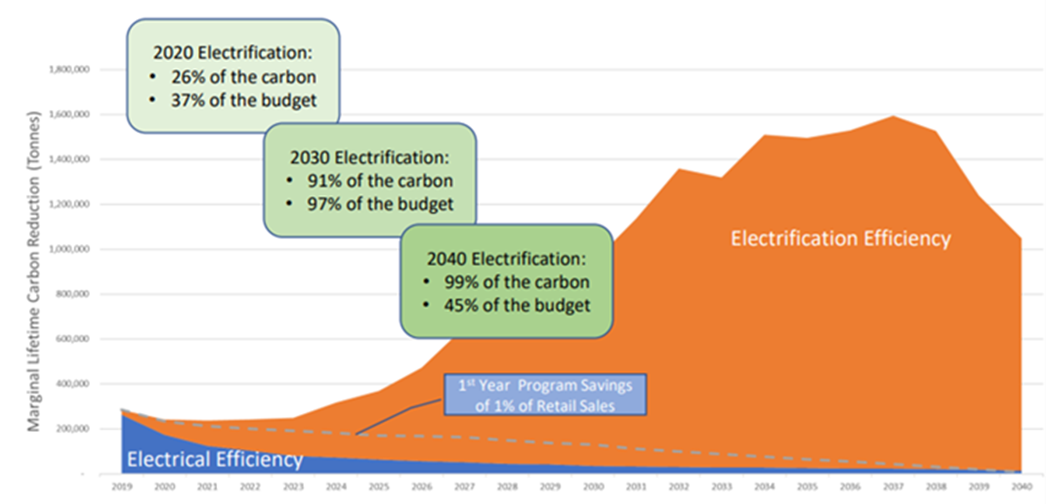
The transformation and growth of energy efficiency regulations into carbon efficiency regulations.
The following graphic cogently illustrates:
“Transitioning” energy efficiency to carbon efficiency grows the regulation business
In short: DOE and its minions are running out of stuff to regulate under existing energy efficiency statutes within EPCA. A move to carbon efficiency regulation vastly expands their regulatory empire. The IRA is providing obscene amounts of taxpayer funding to force-feed this anti-consumer agenda. For more information, see Dangerous ‘Deep Decarbonization’ (Krebs PowerPoint to Cooler Heads Coalition). For the record, that presentation identified the $8,000 heat pump tax credit stated at the beginning of this article.
As Travis Fisher testified before the House Energy & Commerce Subcommittee on Energy, Climate, and Grid Security on September 11th, “ The subsidies in the IRA for wind, solar, and batteries alone could cost American taxpayers $3 trillion by 2050.” Fisher also testified: “Between the IRA subsidies and the EPA rules, I would summarize the administration’s power grid policy as this: Green the grid and brace for blackouts.”
The Competitive Enterprise Institute is leading a coalition of free market advocates attempting to organize support to stop the IRA’s obscene and consumer abusive funding. In response, the Biden (mis)Administration is attempting to shovel IRA funding out the door as fast as it can to contractually shield it. For further information, see Dismantling the Inflation Reduction Act green Subsidies Coalition Letter
——————–
Mark Krebs, a mechanical engineer and energy policy consultant, has been involved with energy efficiency design and program evaluation for over thirty years. Mark has served as an expert witness in dozens of State energy efficiency proceedings, has been an advisor to DOE and has submitted scores of Federal energy-efficiency filings. His many MasterResource posts on natural gas vs. electricity and “Deep Decarbonization” federal policy can be found here. Mark’s first article was in Public Utilities Fortnightly, titled “It’s a War Out There: A Gas Man Questions Electric Efficiency” (December 1996). Recently retired from Spire Inc., Krebs has formed an energy policy consultancy (Gas Analytic & Advocacy Services) with other veteran energy analysts.