Cavendish DCNN 3122-Anatomy of an ongoing challenge – Crop Circling?

52.09070 0.62795 Met Officed AssesseD CIMO Class 4 & Satisfactory Installed 1/1/1974

This weather station sits in the rear garden of a private house – not at all uncommon for Met Office Stations, I will report on several particularly questionable ones in due course. Originally operating as a manual station with (presumably) the home’s occupant taking the readings, it was subsequently deemed worthy of converting to automatic reporting in 2010. Tim Channon originally reviewed the site back in 2012 correctly assessing the site as Class 4/5.

This site regularly records regional as well as occasional national highest daily temperatures. Whilst Tim requested polite consideration for the site’s owner he also made the point that it should be noted that the Met Office is the responsible authority. Personally, I feel this site is totally inappropriate for recording data for the historic temperature record for many reasons. I started a challenge to the Met Office for continuing to use its readings, thus the anatomy of a “challenge” began…….

{I started writing this post 15th September – updates are ongoing.}

So what is so wrong about this site? Well firstly, I find it hard to accept that (no matter how diligent and dedicated the home owner may be) a domestic garden can ever be described as a wholly natural environment nor can it be considered secure and “tamper proof”. Life will always get in the way in such locations and there are no guarantees whatsoever that extraneous heat sources will not come into play in myriad different ways. The £mutli-million Met Office can surely find better locations.

The site is part of a small housing development of the 1970s (again unnatural) but also backs onto regularly cropped fields. In Tim’s original review commenter “Caz” managed to identify the Stevenson Screen from google street view (Author’s note “thanks for that eagle eye catweazle666, I was stumped trying to locate it”).

The little white square box to the right of the (presumably) wind pole to left of centre of picture is the Stevenson Screen. The purpose of showing this image in addition to the aerial imagery above is to highlight not only the regular crop changing but also the proximity of the recording devices to the fields. Note from the headline image the highly pronounced and almost permanent tracks from the tractors, combine harvesters etc. that must regularly be turning almost alongside the screen. Clearly modern, highly responsive Platinum Resistance Thermometers (PRTs) could be affected by the warmed air gusts from diesel engine exhausts regularly turning and pausing so remarkably close by. Furthermore as was pointed out in comments on Tim’s original article, “a newly plowed(sic) field has similar properties to equivalent expanses of tarmac or concrete.”

On the 14th August this year I noted this Met Office “Daily “extreme” for Cavendish showing the UK’s highest daily temperature.

I found this questionable as none of the surrounding stations at Wattisham, Andrewsfield and Broom Barns came within 2 degrees of this reading. The nearby local Private Weather Stations (PWS) similarly did not achieve such high levels and most relevantly a resident of Cavendish informed me that those fields to the rear of Peacock Close had been “Combined” that day.

I asked the Met Office (14th August) to provide me details of precisely when the high reading occurred and for the duration that reading was sustained. Acknowledgement and case number were duly received but no answers were forthcoming. On 2nd September I further chased for details but as yet still no response more than acknowledgement.

What increased my suspicion was that the Met Office had been selectively removing readings from its own sites from its Weather Observations site . Cavendish’s data is no longer freely available to view from them (though it was until recently). This makes it very difficult to question their data if it is simply not there for the public record to freely view. However an international website WeatherObs does show live online data for UK synoptic and automated sites which indicated none near Cavendish recorded such high readings.

The situation now appears to be repeating with yesterday’s (14/9/2024) “Daily Extremes”.

Note: Class 4 (known 2 degree error margin by siting) Cavendish registered 2.4 °C higher than regional neighbour Class 1 (accurate) Rothamsted.

Suspicion again deepens when studying Weather Obs hourly resolution data.

The highest hourly reading of 20.02°C is also again higher by typically 2°C over Class 2 Andrewsfield only a few miles the south west, Class 2 Wattisham a few miles to the east and Broom Barns (a part of Rothamsted Research) a few miles to the North. It seems somewhat unlikely that the natural environment at the centre of the triangle described by these three higher quality stations should be so markedly hotter on a regular basis. As a result I am questioning the integrity of this Class 4 (more realistically class 5) with the Met Office.

Importantly it is worth noting that there is no formal process available to query Met Office data or practices. I asked this very question some time ago to be informed –

“Dear Mr Sanders, thank you for your enquiry. 

The Met Office does not have a formal process, other than the direct email approach you have been using, by which you can challenge WMO CIMO ratings for weather observations site in the UK. Met Office observations sites are underpinned by a rigorous quality management system including a longstanding and well-honed site inspection methodology, ensuring that data produced at a site is as accurate and reliable as it can be. (Author’s note: So why are 27 stations currently noted as “unsatisfactory”?)

The Met Office inspection scheme assesses a station for each meteorological element in terms of its suitability for use in meteorological and climatological products. All Met Office weather stations are routinely inspected by trained expert Met Office Regional Network Officers. Each weather station is assessed against the Met Office inspection standards as well, as more recently, the World Meteorological Organization inspection standards.   

Consistency of measurements is vital, both for informing our forecasts and for the long-term weather and climate records of the UK.  

You can find a lot more information on our website regarding our observation network. The following pages may be of interest to you………..  Weather Desk”

One day further forward and this time Cavendish again recorded the national highest daily temperature.

And yet again the reading of 21.0 °C is 2 degrees higher than the neighbouring Met Office Stations. Andrewsfield registered a maximum of 19.3°C, Wattisham 19°C and Broom Barns just 18.89°C. Rothamsted peaked at just 18.05°C and similarly close Class 1 Cambridge NIAB at 19°C. Neither of the (non CIMO assessed) purely aviation-specific sites at RAF Mildenhall and RAF Lakenheath registered anywhere near that high either.

All these figures can be checked on Weatherobs – details appear (as this for Brooms Barn shown below) with a seven day historic graph available as well as tabulated hourly readings.

So how is it that this Cavendish, Class 4 (at best) back garden site adjacent to ever changing field cropping and likely intermittent engine exhausts with no effective quality control oversight can so regularly be heralded? Are the Met Office claims of ” rigorous quality management ” actually being maintained? It would appear not in the absence of any responses from them to justify their claims.

Is this just another of those convenient “threshold breaching” sites like Wiggonholt and many others? I am putting all of this to the Met Office and will report any response.

In the meantime I would welcome any further information and/or assistance any readers can offer……alternatively feel free to dubunk any of my claims if you consider them incorrect.

via Tallbloke’s Talkshop

https://ift.tt/98v0D6L

September 16, 2024 at 06:27AM
The battle over net zero has only just begun

From NOT A LOT OF PEOPLE KNOW THAT

By Paul Homewood

h/t Paul Kolk

Scotland’s last remaining oil refinery – Grangemouth – is to shut, we learned last week, with the loss of 400 jobs.

The plant – co-owned by Sir Jim Ratcliffe’s Ineos – is closing due to the UK’s incoming ban on new petrol and diesel cars to hit net zero targets.

Grangemouth produces most of the petrol, diesel, heating oil and aviation fuel used in Scotland, Northern England and Northern Ireland. The closure, said Ineos, reflected lower fuel demand given the “ban on new petrol and diesel cars due to come into force”.

While Sharon Graham, general secretary of Unite, accused Grangemouth’s “billionaire owners” of “industrial vandalism”, she also highlighted the car ban. “The road to net zero cannot be paid for with workers’ jobs,” said the boss of Britain’s second-biggest union.

Along with Grangemouth, the Government recently confirmed the closure of the last two blast furnaces at the iconic Port Talbot steelworks, resulting in 2,500 more layoffs.

Labour’s green policies are “hollowing out working-class communities”, said Gary Smith, the leader of GMB, Britain’s third-biggest union. The Government, he said, must stop “decarbonisation through deindustrialisation”.

At last week’s Trades Union Congress conference, Unite and GMB highlighted union concerns about the route to “net zero” – a journey Labour is determined to pursue more doggedly than the Tories.

The two unions pushed through a joint motion opposing Labour’s incoming ban on new North Sea drilling licences, championed by Energy Secretary Ed Miliband.

They want “cast-iron” guarantees for the workers affected – some 30,000 off-shore North Sea oil and gas jobs, plus another 200,000 or so along the UK’s oil and gas supply chain.

Graham evoked the coal mine closures of the 1980s. “Unite will not stand by and watch those workers becoming the miners of our generation,” she said, one of Britain’s most powerful union barons raising the spectre of Thatcher-era industrial relations, marred by chaos and violence, barely two months into the first Labour Government for 14 years.

Attention has lately focused on the row between Downing Street and the Labour Left over the means-testing of pensioners’ winter fuel payments – complaints Downing Street has largely waved away.

But there are signs of a much more substantial, long-term conflict, as the existential industrial cost of the UK’s bid to hit legally binding “net zero carbon emissions” target by 2050 comes into sharper focus.

Grangemouth and Port Talbot are just the latest in a growing list of closures linked to net zero at plants that have long provided decent, well-paid jobs in parts of the country where such jobs are hard to come by.

The destruction of the UK’s North Sea oil and gas operations, and the huge range of related activities, will cause enormous industrial tensions – exposing the chasm between Labour’s relatively wealthy, often urban-based “environmental” voters and its traditional base.

Already, there is growing awareness among voters that “net zero” is aggravating the cost of living crisis. Yes, the UK boasts a relatively high share of what Miliband insists on calling “cheap renewables” – which produced around two-fifths of our electricity over recent months.

But the subsidies involved, added to bills, mean despite the growing use of renewables, or even because of it, UK firms and households are paying almost the highest electricity prices in Europe.

Unless net zero starts delivering soon for ordinary people, instead of just adding to their financial burden, the consensus to pursue the 2050 targets – taken for granted by much of our political and media class – could come under serious pressure.

And as trade unions fight for tens of thousands of blue-collar jobs during Sir Keir Starmer’s “first term”, the resulting environmental-industrial conflicts could tear the Labour movement apart.

The first big test is the incoming ban, from 2035, across Britain and the European Union, on new petrol and diesel cars – with second-hand sales remaining legal.

The Labour manifesto pledged to bring that forward to 2030 – which I strongly suspect won’t happen. I predict the 2035 deadline will slip as well.

Why? Because consumer take-up of electric vehicles (EVs) is far lower than forecast and imposing the planned ban could destroy much of the UK car industry, which employs around a million people – while handing vast swathes of our car market to massively subsidised EVs made in China, which already accounts for around 60pc of global production.

UK car sales, up around 3pc over the last year, remain 15pc lower than before lockdown. Within that, EV sales have slumped, with their market share stuck at around 18pc for the last three years.

Last week I interviewed Robert Forrester, co-founder and chief executive of Vertu Motors – one of the UK’s biggest car retailers – for The Telegraph’s Planet Normal podcast. He described how the incoming petrol and diesel ban is already impacting sales.

That’s because manufacturers, since January, face fines if 22pc of the cars they sell in Britain aren’t fully electric – paying £15,000 for every vehicle by which they fall short. The target ratchets up to 28pc next year and is expected to hit 80pc by 2030 – even if the complete ban remains at 2035.

Forrester describes how this will lead to the “rationing” of petrol and diesel cars as the ban approaches, with prices soaring as low EV sales mean manufacturers can only avoid ruinous fines by dramatically curtailing petrol and diesel car production.

He is just the latest senior car industry figure to highlight the dangers of a rapid switch to EVs – joining bosses at Ford, Stellantis and Renault.

Governments in the UK and across Europe face a mighty industrial battle over the coming years to push through net zero policies, in the teeth of trade union and popular resistance which is certain to grow.

With each high-profile plant closure, the intensity of that fight ratchets up.

https://ift.tt/6jtWdLu

via Watts Up With That?

https://ift.tt/Tx9gL7I

September 16, 2024 at 04:01AM

Tennessee leads the way toward a U.S. nuclear revival

“Project IKE” is a new nuclear energy development boosted by the new Tennessee Nuclear Energy Fund.

via CFACT

https://ift.tt/QT5s3nt

September 16, 2024 at 03:06AM

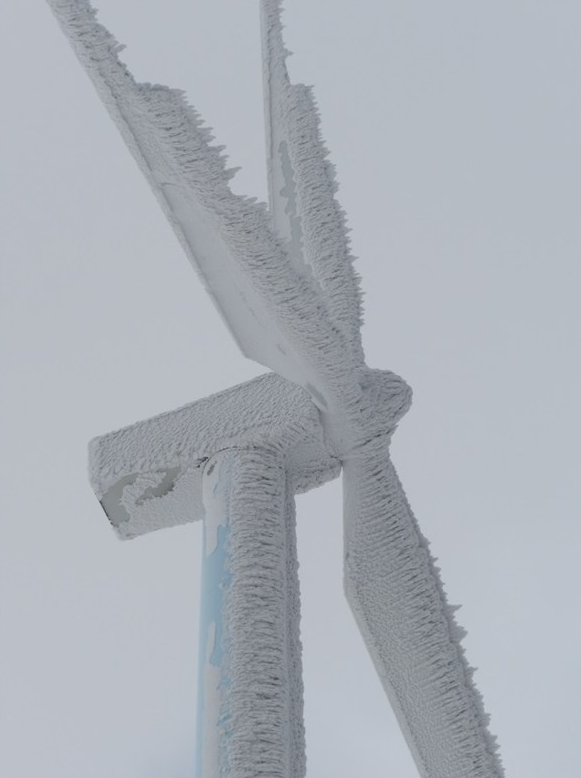
Freezing In The Dark? Just Ask Wind & Solar Generators to ‘Turn It Up’

The inherent absurdity in our headline is precisely the point. No one in touch with reality expects wind power during calm weather or solar power when the sun sets. No one believes that wind and solar generators can simply ‘turn it up’ on a calm night. Oh no, that responsibility is always left to conventional generators: coal, gas or nuclear plants that, properly maintained, never miss a beat, and which can always turn it up, on demand.

Australia’s Eastern Grid has the most geographically dispersed wind turbines operating within the same interconnected system, anywhere in the world. The cult claims that ‘the wind always blowing somewhere’, so, you’d think it would be reasonable to expect that those turbines – with a combined capacity of 11,409MW – will always be producing some meaningful output.

However, every time a large High Pressure System wedges itself across this continent, there will be periods of a day or days when those turbines are producing less than 5% of that capacity: Chaos Rules: Massive Wind Power Output Collapses Threaten Total Grid Failure

Back in June, the entire fleet was producing a trifling 88MW – representing 0.77% of billions of dollars worth of ‘capacity’: Totally Risible: Wind Industry Couldn’t Power Australia’s Toasters & Kettles

Of course, rent seekers and their propagandists play a game of bait and switch – always pointing to perfectly reliable conventional generators as the real villains, accusing them of being solely responsible for mass output collapses, and the associated grid instability, load shedding and, ultimately, mass blackouts.

It’s a theme that Isacc Orr and Mitch Rolling unpack below as yet another effort to dress up the chaotic intermittency of wind and solar as a problem caused by everybody else.

Why Don’t They Turn the Wind Turbines Up? Your guide to debunking the myth that it’s not the wind’s fault
Substack
Isacc Orr and Mitch Rolling
27 July 2024

There is a truism among wind and solar advocates that these resources are never to blame for anything bad that happens on the electric grid.

During Winter Storm Uri, for example, wind advocates claimed low wind output was not even partially to blame for rolling blackouts in ERCOT. Jesse Jenkins of Princeton University famously tweeted that the wind is “reliably unreliable.”

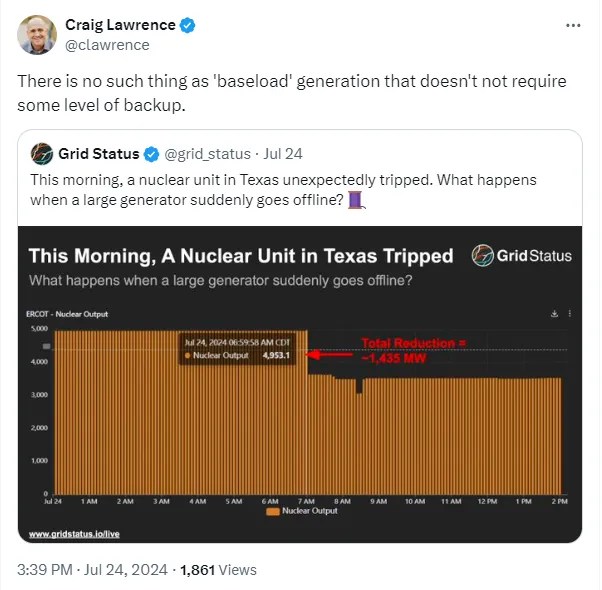
Inevitably, wind and solar advocates will point to problems with every other resource, arguing that coal piles can freeze, natural gas pipelines can malfunction, interrupting supply and causing gas units to go down, and nuclear units can unexpectedly trip offline.

These arguments are correct – any power plant technology can experience problems – but they also reek of Whataboutism.

When dispatchable power plants go offline, it is a bug with identifiable steps that can be taken to mitigate outages in the future. When wind and solar underperform expectations, it’s a feature resulting from the intermittency of the resource that can result in a shortage of electricity on the system.

If resource planners didn’t rely on wind and solar for reliability, arguments such as Jesse Jenkins’ would be more accurate. However, that isn’t the case.

Why Don’t They Turn the Wind Turbines Up?
Rather than hold wind and solar accountable for the inherent intermittent energy they produce, wind and solar advocates want you to believe that not planning for thermal outages is the real culprit behind power shortages in renewable-heavy grids like ERCOT and CAISO. What they fail to admit is that “reliably unreliable” energy is the plan and has been for some time.

In every Regional Transmission Organization (RTO) around the country, wind energy is given some kind of capacity accreditation value—which is the percentage of total installed capacity that is expected to be available during peak demand. In ERCOT, for example, wind turbines have capacity values of 19 – 43 percent in the winter and up to 61 percent in the summer, depending on where it’s located in Texas (coastal, panhandle, etc.).

This means rather than expecting the wind to be reliably unreliable, ERCOT and other RTOs expect wind energy to reliably serve a percentage of peak demand.

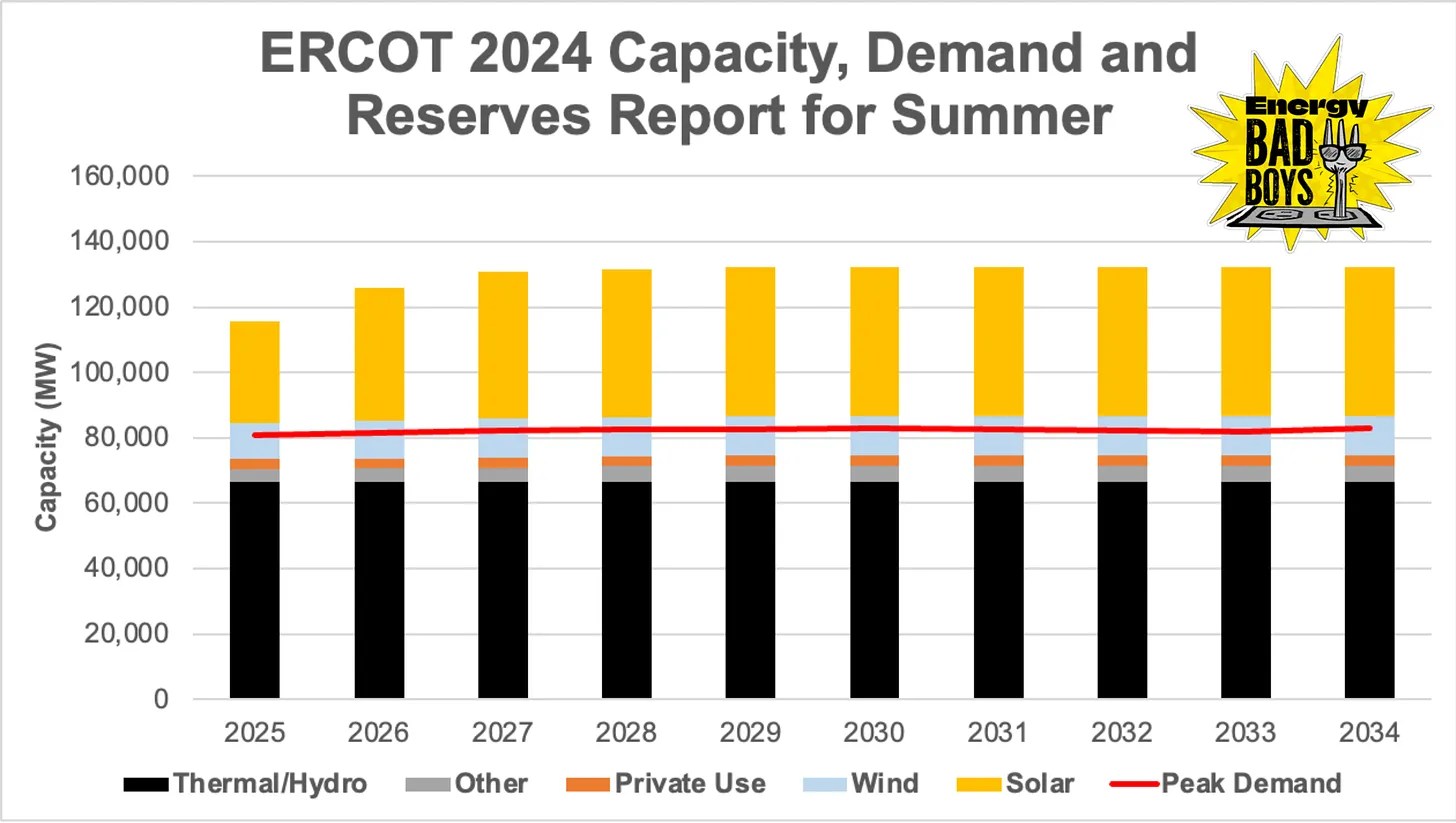
In fact, in the summer, the reserve margin in ERCOT—which represents a safety net in case of unplanned plant outages or unexpected higher demand—is made up entirely of intermittent wind and solar. As you can see in the graph below, the red line is the projected peak demand and everything above it represents the reserve margin.

In other words, because the reserve margin is entirely made up of wind and solar resources, ERCOT is dependent on intermittent energy sources showing up in the summer, which is a far cry away from planning for them to be “reliably unreliable.” By 2031, ERCOT reports show that this trend will hit the winter reserve margin, as well.

Wind Energy Underperforms Expectations
The problem with this is that wind energy routinely underperforms capacity accreditations.

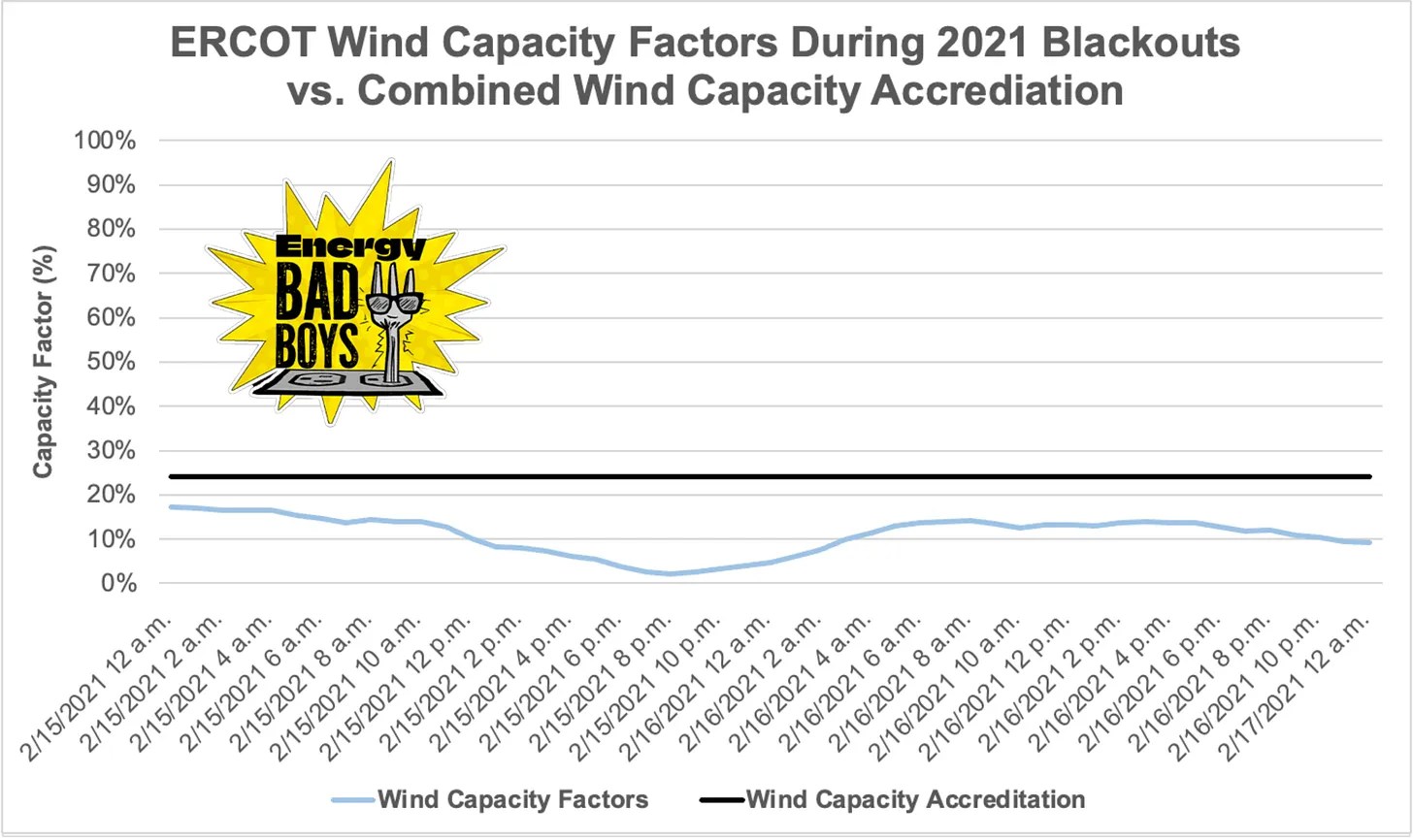
As the graph below shows, wind energy was producing nowhere near its capacity accreditation during Winter Storm Uri when the rolling blackouts ensued in Texas. At no point during the initial blackout was wind operating above its combined capacity accreditation of 24 percent (capacity-weighted) at the time.

This begs the question, “Why don’t they turn the wind turbines up?”

Obviously, they can’t, which is why giving wind any capacity accreditation for meeting peak demand is the equivalent of playing Russian roulette on the energy grid. This is why we refer to the capacity accreditation given to wind and solar as “phantom firm” resources. Maybe they show up, maybe they don’t.

A National Concern
Grid operators frequently warn that the continued rapid pace of resource retirements, EPA regulations further accelerating resource retirements, and an increasing reliance on wind and solar threaten grid reliability.

The problem here is that system operators are increasingly reliant upon wind turbines and solar panels showing up to work to meet their peak demands by giving them capacity values. In layman’s terms, they are expecting wind and solar to show up in some capacity to meet peak demand.

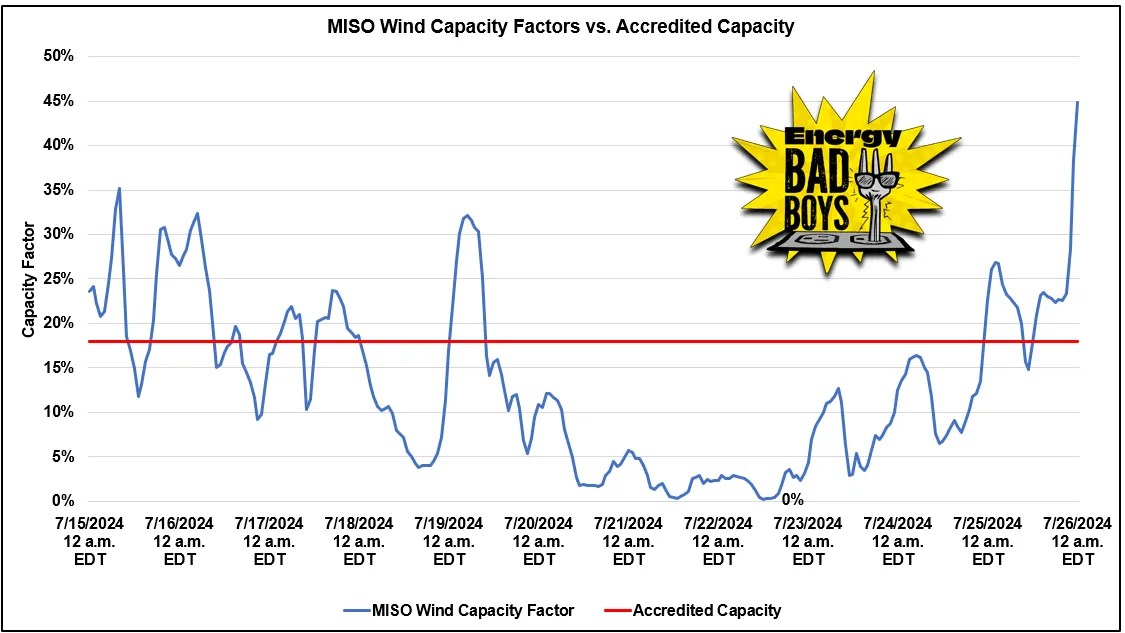
However, wind generation often experiences droughts, and it has been especially paltry in the Midcontinent Independent System Operator (MISO) region over the last two weeks.

The graph below, constructed with U.S. Energy Information Administration data, shows the hourly wind capacity factors in the region and compares it to the 18 percent capacity accreditation given to wind turbines by MISO.

Essentially, it shows that wind has been underperforming the grid operator’s expectations for 133 consecutive hours. Thankfully, the region has seen low electricity demand relative to the expected peak demand, allowing the lights to stay on despite the wind’s underperformance. Grid operators take huge gambles hoping that these droughts don’t occur during higher demand periods.

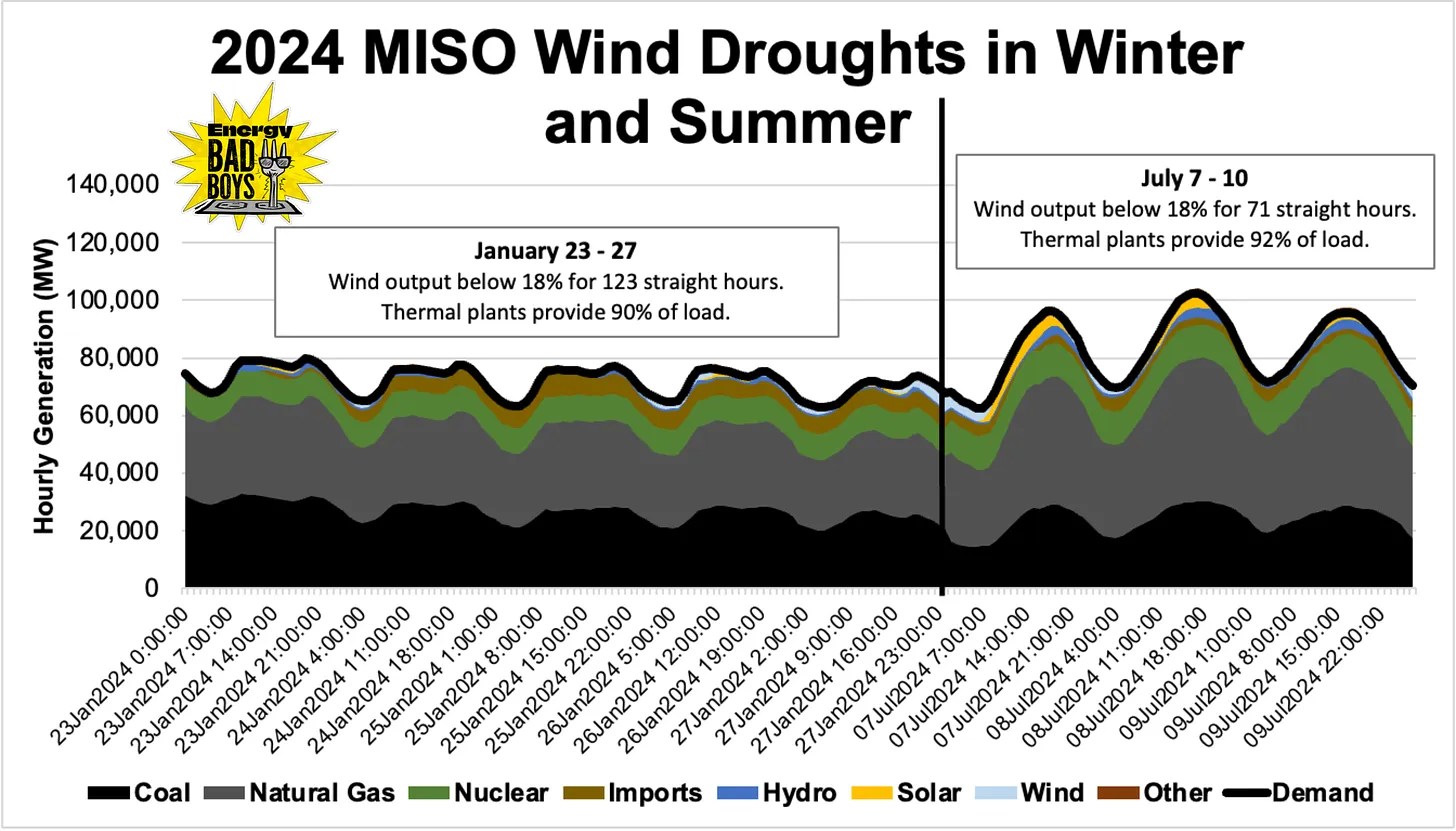
As we pointed out in our article Wind Drought Blackout, these are not isolated incidences.

As you can see below, already in 2024, two major wind droughts occurred in different seasons. In January of this year, wind in MISO was performing at less than 18 percent of its potential output for 123 straight hours – or over 5 days – despite grid operators assigning it 52.2 percent capacity credit in winter months. Then, from July 7th to July 10th, wind was operating below its accredited capacity of 18 percent for 71 straight hours.

Thermal generation served over 90 percent of the system’s load during each wind drought.

While summer underperformance for wind and solar will be inconvenient, winter underperformance could be deadly. Currently, much of the nation experiences its peak electricity demand in summer for air conditioning. In the future, electrification of home heating will cause winter electricity demand to skyrocket, raising the stakes of relying on renewables to heat our homes.

For example, ERCOT is expected to be a winter-peaking system by 2032 due to the ongoing electrification of new homes.

Removing Roadblocks to Reliability
The situation looks grim, but there may still be time to head off the worst effects of our growing reliance on wind and solar generators.

The obvious solution to this problem is to acknowledge the limited capacity value that wind and solar provide to the grid, as Jesse Jenkins did below, and greatly reduce the amount of accredited capacity these resources receive—perhaps to zero—from RTOs for purposes of system planning.

Another common sense solution is to require our electric grids to have enough dispatchable capacity on their systems to meet the projected peak demand, plus a margin of safety of more dispatchable capacity to account for frozen coal piles and nuclear plants tripping offline.

Natural gas plants should also be required to store fuel on-site, whether that be fuel oil or liquefied natural gas (LNG). If nothing else, wind and solar facilities should be required to pay for the cost of firming the grid to make up for their intermittency.

These changes, not the addition of more wind, solar, and battery storage, will enable grid planners to affordably “plan around the likelihood of significant simultaneous thermal plant outages” and ensure that disruptions in the natural gas supply don’t cascade into blackouts.

Conclusion
Our current energy policy can be described as “all gas and no brakes” in favor of wind and solar. At some point, the chickens will come home to roost. We will have more rolling blackouts if we continue to shut down reliable power plants and become increasingly reliant upon wind and solar showing up to work when we need them most.

When these blackouts occur, we can expect wind and solar advocates to turn on the spin cycle, pointing fingers at everything but the failure of their preferred resources to get the job done. When this happens, we encourage you all to pose the question: “Why don’t they turn the wind turbines up?”
Substack

via STOP THESE THINGS

https://ift.tt/8qHxIcF

September 16, 2024 at 02:30AM