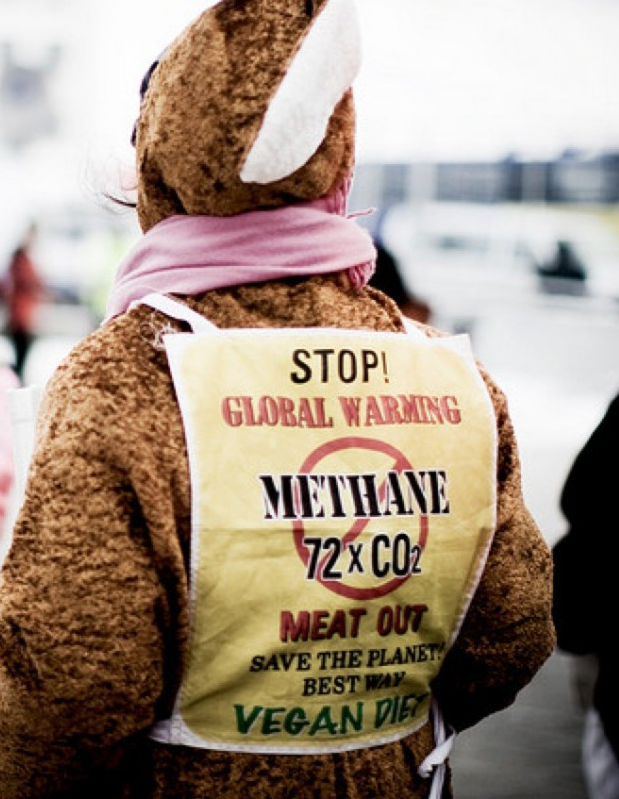
Methane Madness Strikes Again

The latest comes from Australia by way of John Ray at his blog Methane cuts on track for 2030 emissions goal.  Excerpts in italics with my bolds and added images.

Australia’s methane emissions have decreased over the past two decades, according to a new report by a leading global carbon research group.

While the world’s methane emissions grew by 20 per cent, meaning two thirds of methane in the atmosphere is from human activity, Australasia and Europe emitted lower levels of the gas.

It puts Australia in relatively good stead, compared to 150 other signatories, to meet its non-binding commitments to the Global Methane Pledge, which aims to cut methane emissions by 30 per cent by the end of the decade.

The findings were revealed in the fourth global methane budget, published by the Global Carbon Project, with contributions from 66 research institutions around the world, including the CSIRO.

According to the report, agriculture contributed 40 per cent of global methane emissions from human activities, followed by the fossil fuel sector (34 per cent), solid waste and waste­water (19 per cent), and biomass and biofuel burning (7 per cent).

Pep Canadell, CSIRO executive director for the Global Carbon Project, said government policies and a smaller national sheep flock were the primary reasons for the lower methane emissions in Australasia.

“We have seen higher growth rates for methane over the past three years, from 2020 to 2022, with a record high in 2021. This increase means methane concentrations in the atmosphere are 2.6 times higher than pre-­industrial (1750) levels,” Dr Canadell said.

The primary source of methane emissions in the agriculture sector is from the breakdown of plant matter in the stomachs of sheep and cattle.

It has led to controversial calls from some circles for less red meat consumption, outraging the livestock industry, which has lowered its net greenhouse gas emissions by 78 per cent since 2005 and is funding research into methane reduction.

Last week, the government agency advising Anthony Albanese on climate change suggested Australians could eat less red meat to help reduce emissions. And the government’s official dietary guidelines will be amended to incorporate the impact of certain foods on climate change.

There is ongoing disagreement among scientists and policymakers about whether there should be a distinction between biogenic methane emitted by livestock, which already exists in a balanced cycle in plants and soil and the atmosphere, and methane emitted from sources stored deep underground for millennia.

“The frustration is that methane, despite its source, gets lumped into one bag,” Cattle Australia vice-president Adam Coffey said. “Enteric methane from livestock is categorically different to methane from coal-seam gas or mining-related fossil fuels that has been dug up from where it’s been stored for millennia and is new to the atmosphere.

“Why are we ignoring what modern climate science is telling us, which is these emissions are inherently different?”  Mr Coffey said the methane budget report showed the intense focus on the domestic industry’s environmental credent­ials was overhyped.

“I think it’s based mainly on ideology and activism,” Mr Coffey said.

This concern about methane is nonsense.
Water vapour blocks all the frequencies that methane does
so the presence of methane adds nothing

Technical Background

Methane alarm is one of the moles continually popping up in the media Climate Whack-A-Mole game. An antidote to methane madness is now available to those inquiring minds who want to know reality without the hype.

Methane and Climate is a paper by W. A. van Wijngaarden (Department of Physics and Astronomy, York University, Canada) and W. Happer (Department of Physics, Princeton University, USA) published at CO2 Coalition November 22, 2019. Below is a summary of the more detailed publication. Excerpts in italics with my bolds.

Overview

Atmospheric methane (CH4) contributes to the radiative forcing of Earth’s atmosphere. Radiative forcing is the difference in the net upward thermal radiation from the Earth through a transparent atmosphere and radiation through an otherwise identical atmosphere with greenhouse gases. Radiative forcing, normally specified in units of W m−2 , depends on latitude, longitude and altitude, but it is often quoted for a representative temperate latitude, and for the altitude of the tropopause, or for the top of the atmosphere.

For current concentrations of greenhouse gases, the radiative forcing at the tropopause, per added CH4 molecule, is about 30 times larger than the forcing per added carbon-dioxide (CO2) molecule. This is due to the heavy saturation of the absorption band of the abundant greenhouse gas, CO2. But the rate of increase of CO2 molecules, about 2.3 ppm/year (ppm = part per million by mole), is about 300 times larger than the rate of increase of CH4 molecules, which has been around 0.0076 ppm/year since the year 2008.

So the contribution of methane to the annual increase in forcing is one tenth (30/300) that of carbon dioxide. The net forcing increase from CH4 and CO2 increases is about 0.05 W m−2 year−1 . Other things being equal, this will cause a temperature increase of about 0.012 C year−1 . Proposals to place harsh restrictions on methane emissions because of warming fears are not justified by facts.

The paper is focused on the greenhouse effects of atmospheric methane, since there have recently been proposals to put harsh restrictions on any human activities that release methane. The basic radiation-transfer physics outlined in this paper gives no support to the idea that greenhouse gases like methane, CH4, carbon dioxide, CO2 or nitrous oxide, N2O are contributing to a climate crisis. Given the huge benefits of more CO2 to agriculture, to forestry, and to primary photosynthetic productivity in general, more CO2 is almost certainly benefitting the world. And radiative effects of CH4 and N2O, another greenhouse gas produced by human activities, are so small that they are irrelevant to climate.

Transmission of shortwave solar irradiation and long wavelength radiation from the Earth’s surface through atmosphere, as permitted by Rohde [2]. Note absorption wavelengths of CH4 and N2O are already covered by H2O and CO2.

Radiative Properties of Earth Atmosphere

On the left of Fig. 2 we have indicated the three most important atmospheric layers for radiative heat transfer. The lowest atmospheric layer is the troposphere, where parcels of air, warmed by contact with the solar-heated surface, float upward, much like hot-air balloons. As they expand into the surrounding air, the parcels do work at the expense of internal thermal energy. This causes the parcels to cool with increasing altitude, since heat flow in or out of parcels is usually slow compared to the velocities of ascent of descent.
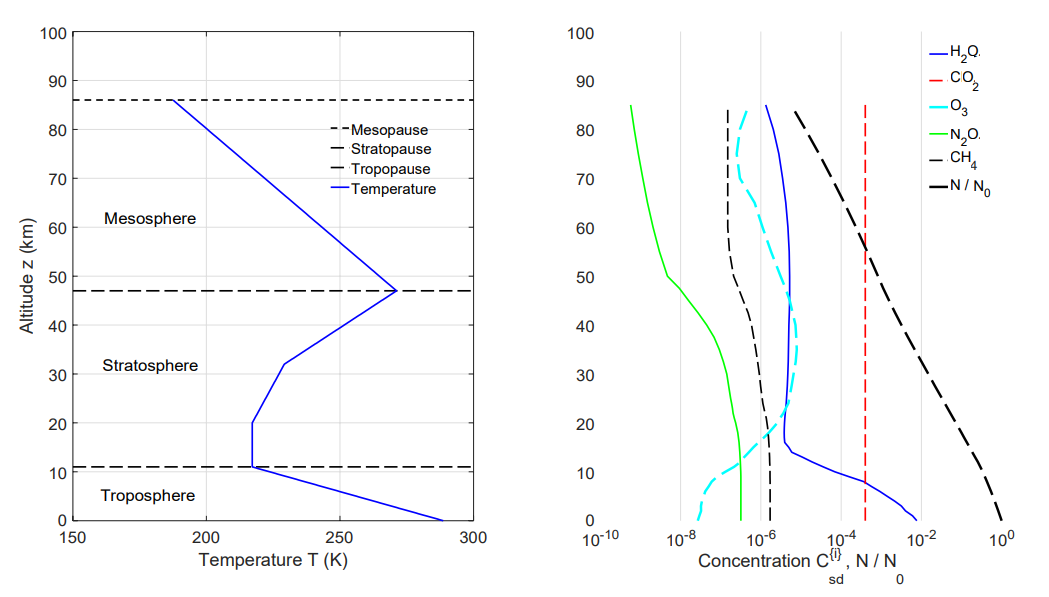
Figure 2: Left. A standard atmospheric temperature profile[9], T = T (z). The surface temperature is T (0) = 288.7 K . Right. Standard concentrations[10], C {i} = N {i}/N for greenhouse molecules versus altitude z. The total number density of atmospheric molecules is N . At sea level the concentrations are 7750 ppm of H2O, 1.8 ppm of CH4 and 0.32 ppm of N2O. The O3 concentration peaks at 7.8 ppm at an altitude of 35 km, and the CO2 concentration was approximated by 400 ppm at all altitudes. The data is based on experimental observations.

If the parcels consisted of dry air, the cooling rate would be 9.8 C km−1 the dry adiabatic lapse rate[12]. But rising air has usually picked up water vapor from the land or ocean. The condensation of water vapor to droplets of liquid or to ice crystallites in clouds, releases so much latent heat that the lapse rates are less than 9.8 C km−1 in the lower troposphere. A representative lapse rate for mid latitudes is dT/dz = 6.5 K km−1 as shown in Fig. 2.

The tropospheric lapse rate is familiar to vacationers who leave hot areas near sea level for cool vacation homes at higher altitudesin the mountains. On average, the temperature lapse rates are small enough to keep the troposphere buoyantly stable[13]. Tropospheric air parcels that are displaced in altitude will oscillate up and down around their original position with periods of a few minutes. However, at any given time, large regions of the troposphere (particularly in the tropics) are unstable to moist convection because of exceptionally large temperature lapse rates.

The vertical radiation flux Z, which is discussed below, can change rapidly in the troposphere and stratosphere. There can be a further small change of Z in the mesosphere. Changes in Z above the mesopause are small enough to be neglected, so we will often refer to the mesopause as “the top of the atmosphere” (TOA), with respect to radiation transfer. As shown in Fig. 2, the most abundant greenhouse gas at the surface is water vapor, H2O. However, the concentration of water vapor drops by a factor of a thousand or more between the surface and the tropopause. This is because of condensation of water vapor into clouds and eventual removal by precipitation. Carbon dioxide, CO2, the most abundant greenhouse gas after water vapor, is also the most uniformly mixed because of its chemical stability. Methane, the main topic of this discussion is much less abundant than CO2 and it has somewhat higher concentrations in the troposphere than in the stratosphere where it is oxidized by OH radicals and ozone, O3. The oxidation of methane[8] is the main source of the stratospheric water vapor shown in Fig. 2.

Future Forcings of CH4 and CO2

Methane levels in Earth’s atmosphere are slowly increasing.  If the current rate of increase, about 0.007 ppm/year for the past decade or so, were to continue unchanged it would take about 270 years to double the current concentration of C {i} = 1.8 ppm. But, as one can see from Fig.7, methane levels have stopped increasing for years at a time, so it is hard to be confident about future concentrations. Methane concentrations may never double, but if they do, WH[1] show that this would only increase the forcing by 0.8 W m−2. This is a tiny fraction of representative total forcings at midlatitudes of about 140 W m−2 at the tropopause and 120 W m−2 at the top of the atmosphere.
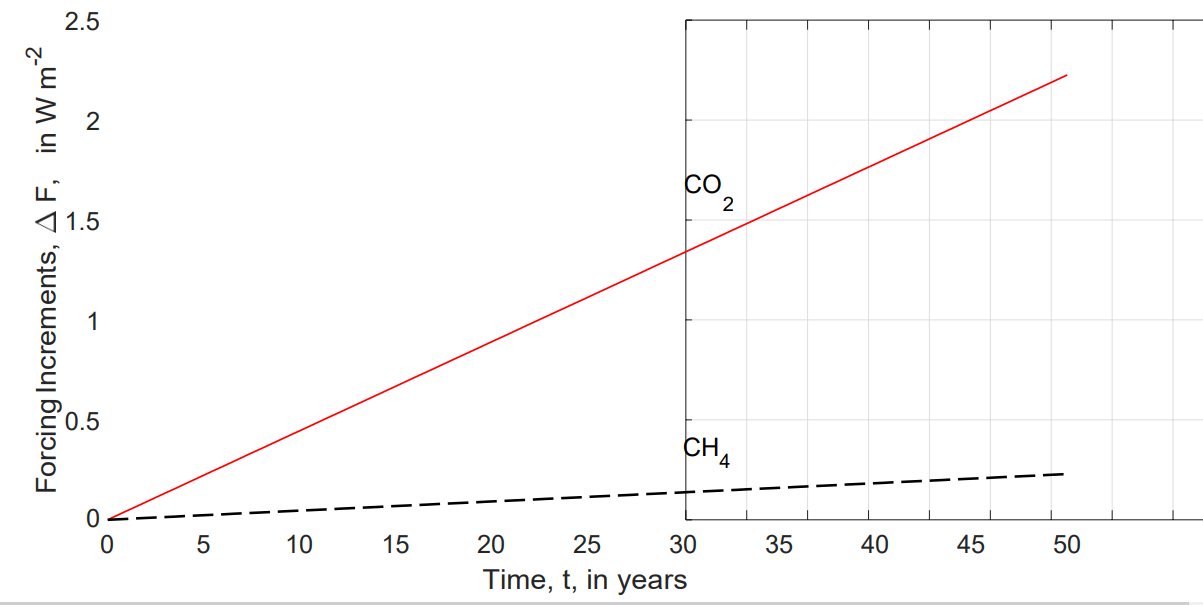
Figure 9: Projected mid-latitude forcing increments at the tropopause from continued increases of CO2 and CH4 at the rates of Fig. 7 and Fig. 8 for the next 50 years. The projected forcings are very small, especially for methane, compared to the current tropospheric forcing of 137 W m−2.

The per-molecule forcings P {i} of (13) and (14) have been used with the column density Nˆ of (12) and the concentration increase rates dC¯{i}/dt, noted in Fig. 7 and Fig. 8, to evaluate the future forcing (15), which is plotted in Fig. 9. Even after 50 years, the forcing increments from increased concentrations of methane (∆F = 0.23 W m−2), or the roughly ten times larger forcing from increased carbon dioxide (∆F = 2.2 W m−2) are very small compared to the total forcing, ∆F = 137 W m−2, shown in Fig. 3. The reason that the per-molecule forcing of methane is some 30 times larger than that of carbon dioxide for current concentrations is “saturation” of the absorption bands. The current density of CO2 molecules is some 200 times greater than that of CH4 molecules, so the absorption bands of CO2 are much more saturated than those of CH4. In the dilute“optically thin” limit, WH[1] show that the tropospheric forcing power per molecule is P {i} = 0.15 × 10⁻²² W for CH4, and P {i} = 2.73 × 10⁻²² W for CO2. Each CO2 molecule in the dilute limit causes about 5 times more forcing increase than an additional molecule of CH4, which is only a ”super greenhouse gas” because there is so little in the atmosphere, compared to CO2.

Methane Summary

Natural gas is 75% Methane (CH4) which burns cleanly to carbon dioxide and water. Methane is eagerly sought after as fuel for electric power plants because of its ease of transport and because it produces the least carbon dioxide for the most power. Also cars can be powered with compressed natural gas (CNG) for short distances.

In many countries CNG has been widely distributed as the main home heating fuel. As a consequence, in the past methane has leaked to the atmosphere in large quantities, now firmly controlled. Grazing animals also produce methane in their complicated stomachs and methane escapes from rice paddies and peat bogs like the Siberian permafrost.

It is thought that methane is a very potent greenhouse gas because it absorbs some infrared wavelengths 7 times more effectively than CO2, molecule for molecule, and by weight even 20 times. As we have seen previously, this also means that within a distance of metres, its effect has saturated, and further transmission of heat occurs by convection and conduction rather than by radiation.

Note that when H20 is present in the lower troposphere, there are few photons left for CH4 to absorb:

Even if the IPCC radiative greenhouse theory were true, methane occurs only in minute quantities in air, 1.8ppm versus CO2 of 390ppm. By weight, CH4 is only 5.24Gt versus CO2 3140Gt (on this assumption). If it truly were twenty times more potent, it would amount to an equivalent of 105Gt CO2 or one thirtieth that of CO2. A doubling in methane would thus have no noticeable effect on world temperature.

However, the factor of 20 is entirely misleading because absorption is proportional to the number of molecules (=volume), so the factor of 7 (7.3) is correct and 20 is wrong. With this in mind, the perceived threat from methane becomes even less.

Further still, methane has been rising from 1.6ppm to 1.8ppm in 30 years (1980-2010), assuming that it has not stopped rising, this amounts to a doubling in 2-3 centuries. In other words, methane can never have any measurable effect on temperature, even if the IPCC radiative cooling theory were right.

Because only a small fraction in the rise of methane in air can be attributed to farm animals, it is ludicrous to worry about this aspect or to try to farm with smaller emissions of methane, or to tax it or to trade credits.

The fact that methane in air has been leveling off in the past two decades, even though we do not know why, implies that it plays absolutely no role as a greenhouse gas.  (From Sea Friends (here):

More information at The Methane Misconceptions by Dr. Wilson Flood (UK) here.

Climatists Aim Forks at Our Food Supply

via Science Matters

https://ift.tt/nSQVl8o

September 13, 2024 at 04:36PM

Climate Anxiety: The Latest Trend in Elite Neurosis – Now Blame “Individualism” for Your Panic Attacks

Oh, the elites are at it again, folks. They’ve figured out that the real reason you’re lying awake at night, sweating over whether the world will combust in a fiery climate apocalypse isn’t because of their fearmongering, but because of—wait for it—individualism. That’s right, in this gem from the Los Angeles Times, the author wrings their hands over the scourge of “climate anxiety” and, of course, traces it back to the root of all evil: the fact that you still value your personal freedom.

This masterpiece of neurotic nonsense, titled “To Fix Climate Anxiety, We First Have to Fix Individualism,” (behind a paywall), is peak elite navel-gazing. Let’s break down their neurotic argument and laugh at their complete inability to function outside their groupthink bubble.

The Anxiety Industry: The Left’s New Favorite Hobby

First, let’s talk about climate anxiety, the latest designer disorder that’s sweeping the liberal elite like avocado toast. In case you haven’t heard, it’s what happens when your climate virtue signaling turns into full-blown panic attacks. People are losing their minds because they’ve been bombarded for years by end-of-the-world rhetoric from media, politicians, and activists who’d have you believe that every breath you take is choking Mother Earth to death.

Just knowing that climate change is getting worse can trigger serious psychological responses. And the shock and trauma are all the more great if you’ve already had to live through the kinds of disasters that keep the rest of us up at night.

https://www.latimes.com/environment/story/2024-09-11/climate-anxiety-essay

According to this article, people are feeling “anxious” about the climate, and naturally, the solution is not for them to step back and take a rational look at things—no, no, the solution is to dismantle individualism. Because of course it is.

Blaming Individualism: The Left’s Favorite Boogeyman
The article opens with the dramatic claim that “climate anxiety can’t be fully addressed until we confront the toxic ideology of individualism that underpins it”​. You read that right. If you’re feeling uneasy about the planet, it’s not because of the endless climate alarmism or the fact that these elites have been screaming “we have 12 years to save the Earth” every year for the last 30 years. Nope, it’s because you still stubbornly believe in your right to live your life without being micromanaged by bureaucrats.

“One huge reason why climate anxiety feels so awful is this feeling of not being able to do anything about it,” Ray said. “But if you actually saw yourself as part of a collective, as interconnected with all these other movements doing meaningful things, you wouldn’t be feeling this despair and loneliness.”

The trick to fixing climate anxiety is to fix individualism, she said. Start small, tap into what you’re already good at, join something bigger than yourself.

And by fixing individualism, as many young activists like Patel have already figured out, we just might have a better shot at fixing climate change.

https://www.latimes.com/environment/story/2024-09-11/climate-anxiety-essay

Apparently, individualism—yes, that awful notion that you have autonomy over your own choices—is now considered “toxic.” Forget that individualism is the cornerstone of free societies, personal freedom, and, oh yeah, human achievement. In the world of the eco-left, it’s now the villain in their ongoing climate horror show.

A Neurological Condition? Please
What’s more laughable is how they frame climate anxiety as a mental health crisis akin to depression or PTSD. They write about it like it’s an epidemic of post-traumatic stress from people being bombarded by all those horrible individual freedoms. I mean, seriously? The real crisis here is that people have been indoctrinated into believing that they’re responsible for saving the entire planet every time they use a plastic straw or don’t recycle perfectly. This is what happens when you raise a generation to believe that everything they do contributes to the imminent collapse of the world’s ecosystems.

The Author’s Prescription: Collective Climate Neurosis
So, what’s the solution according to these enlightened minds? Naturally, we need to get rid of this pesky idea that you have any individual rights or freedoms. The article practically celebrates the idea that if we can only get everyone to think collectively, like good little comrades, the anxiety will melt away.

It pushes the idea that “individualism places all the responsibility on each of us to act, making it impossible to live up to expectations, creating a cycle of guilt, shame, and paralysis”​. Oh, poor babies! The very same people who lecture us about reusable shopping bags and meat-free Mondays are now telling us that the crushing weight of their own guilt is our fault. Let’s not forget who’s been creating these unrealistic standards and then weaponizing guilt against anyone who doesn’t fall in line.

But don’t worry, they’ve got a plan! Their brilliant strategy is to embrace collectivism—because nothing says mental health like forcing people into a hive mind where the individual is secondary to the group. Yep, if you could just stop thinking for yourself and let the climate overlords run your life, you’d be so much happier. Or at least that’s what the elites think.

A Reality Check for the Paranoid
Here’s the thing: climate anxiety isn’t a real problem; it’s a manufactured condition, hyped up by a generation of activists, politicians, and media hacks who’ve been making a living by scaring the living daylights out of everyone. They’re the ones who’ve been telling you the world is ending unless you stop eating hamburgers and driving your SUV.

The truth is, climate change is not an existential crisis, and certainly not one that justifies abandoning the values of personal freedom and individual rights. But for these people, it’s not even about the climate anymore—it’s about control. Every crisis, real or imagined, is an opportunity to chip away at your autonomy. And “climate anxiety” is just the latest weapon in that fight.

We hear so often today that climate change is the existential crisis of our time, but that dismisses the trauma and violence to all the people who have been fighting to survive for centuries. Colonization, greed and exploitation are inseparable from climate change, Uchendu said, but we miss these connections when we consider our emotions only through a Western lens.

https://www.latimes.com/environment/story/2024-09-11/climate-anxiety-essay

Elites and Their Collective Fantasy
What really drives the article’s insane conclusion is this ongoing obsession the left has with collectivism. They yearn for a world where nobody thinks for themselves, where your life is dictated by the enlightened few who, of course, know better than you. The article barely hides its disdain for the idea that individuals should be responsible for their own actions. Instead, they fantasize about a world where everything is a group project, and we all obediently march to the beat of the latest government decree.

According to them, if you weren’t so caught up in your individual rights, you wouldn’t be so darn anxious. Yeah, because nothing calms the nerves quite like having the state control every aspect of your life.

Their Real Goal: Control, Not Climate Solutions
Make no mistake, this isn’t about fixing climate anxiety. This is about eliminating individual thought. The environmental elite knows that if they can convince you to surrender your personal freedoms for the “greater good,” they can push through their agenda without resistance. They can introduce any policy—no matter how ridiculous, no matter how intrusive—because you’ll be too busy trying to be a good little cog in their collective machine to object.

In the end, their whole argument boils down to this: your desire to think for yourself and live independently is making the planet worse and giving you panic attacks. So, naturally, the only way to fix the problem is to surrender your autonomy to the group. Because, hey, collectivism always works out great, right? Just ask Cuba or Venezuela how that’s going.

Final Thought: Don’t Fall for the Nonsense
Let’s get real: climate anxiety is a product of indoctrination by a radical environmental movement that thrives on fearmongering. And now, instead of taking responsibility for the anxiety they’ve caused, they’re trying to shift the blame onto your belief in personal freedom. It’s absurd.

You don’t need to fix individualism to “fix” climate anxiety. You need to fix the constant stream of doomsday propaganda that’s designed to scare you into submission. The real mental health crisis isn’t caused by climate change; it’s caused by the relentless bombardment of apocalyptic messaging designed to make you feel guilty for existing. Don’t let them fool you into thinking that giving up your individual rights will somehow make you feel better. The only thing that will do is make it easier for them to control you.

So, to the hand-wringing author and the climate anxiety brigade: Take a breath, grab a steak, and stop trying to guilt the rest of us into your collective neurosis. We’re not buying it.

via Watts Up With That?

https://ift.tt/dGYspmM

September 13, 2024 at 04:01PM

That Was The Week That Was

Monday

“’Grim’ September ahead with 6,000 steel and oil jobs to go” said the BBC headline. The report went on to discuss the likelihood that 2,800 jobs were set to be lost at Port Talbot in Wales, up to 3,000 jobs were in jeopardy at British Steel in Scunthorpe, and a further 400 would be cut at the oil refinery at Grangemouth in Scotland. Never let it be said that the pain of net zero isn’t being borne across the entire country.

Tuesday

A vote was held in the House of Commons with regard to the Social Fund Winter Fuel Payment Regulations 2024. In other words, MPs were voting on whether or not to withdraw from most old age pensioners in the UK the annual payment of £200 or £300 made to them in winter to help them pay their ever-rising fuel bills. Needless to say MPS voted by 348 to 228 to take the money off the old people. What ought to be more surprising (but, sadly, isn’t) is that the vast majority of the 348 MPs voting to take the money off pensioners (many, but not all, of whom are relatively poor) were Labour Party MPs.

Wednesday

The appalling news from south Wales was confirmed as the Government boasted about wasting half a billion pounds of UK taxpayers’ money in order to bring to an end 2,500 jobs imminently, with a further 300 job losses down the line. “UK government confirms £500m Tata Steel subsidy” said the BBC headline The new Labour Business and Trade Secretary said this brought “hope”.

Thursday

Another day, another depressing headline: “Scotland’s only oil refinery is to close by the summer of next year, with the loss of 400 jobs.”

Friday

Today’s first headline hadn’t been touted by the BBC at the beginning of the week, but why not finish the week as it started? This is, after all, Britain under a Labour Government that doesn’t seem to understand the “labour” part of its name. “Boiler maker Worcester Bosch considering job cuts” is the depressing conclusion to the “working” week. We aren’t told how many jobs are, regrettably, at risk, but we do learn (not that it’s a surprise) that the “move towards electrification” is among the factors leading to the business review that seems certain to result in job losses.

It’s not the only headline today, though. The other one of significance relates to west Cumbria, a depressed area of the country with high rates of unemployment. This time it isn’t job losses that are the problem, rather it’s the determination of some people to ensure that poor people can’t have work. “Coal mine plan quashed by High Court” we learn. I don’t blame the Judge, who had no choice other than to follow the ruling of the Supreme Court in R (on the application of Finch on behalf of the Weald Action Group) v Surrey County Council and others. However, I do blame the recently elected Labour government, which is already making a habit of deciding not to defend its predecessor’s decisions when they are challenged in Court by lawfare groups. So that’s another 500 direct jobs and potentially many more in the supply chain that won’t now be created.

Net zero is the policy that underlies many of these headlines. It’s raising fuel bills, it’s enabling foreign companies to hoover up subsidies, it’s impoverishing people, it’s destroying jobs, it’s damaging the UK’s manufacturing base, it’s devastating the UK’s wild places, and it’s achieving absolutely nothing vis-a-vis the climate. And a Labour government is accelerating the process as we hurtle towards the cliff. If a week is a long time in politics, I shudder to think what five years will be like.

via Climate Scepticism

https://ift.tt/d48hMiu

September 13, 2024 at 02:26PM

FRIDAY FUNNY: Escape from Houston – Autonomous Chaos Edition

From the University of Texas at Austin and the “What could possibly go wrong?” department comes this inanity that reminds me of how well the evacuation of New Orleans went in 2005 with Hurricane Katrina. I’m amazed anyone actually spent any time and money on this. Thanks to Charles for the graphic depicting my vision of the process. – Anthony


Escape from hurricanes with driverless cars

Supercomputers aid simulations to help carless populations in Houston evacuation scenario

When a hurricane strikes, the most vulnerable are not always able to get out in time. UT Austin scientists are using supercomputers at the Texas Advanced Computing (TACC) to study how shared autonomous vehicles (SAVs) can get people who do not have their own car into shelters out of harm’s way.

“A key finding of our study is that if you need to size this system for a certain evacuation period, then you’re going to want one shared vehicle for every 14 evacuees along the very long coastline between Galveston and Houston,” said Kara Kockelman, a professor of transportation engineering in the Department of Civil, Architectural and Environmental Engineering at UT Austin. She co-authored the study, published in the journal Transportation Planning and Technology (June 2024). 

The idea is to use shared autonomous vehicles, akin to the robotaxis of companies like Cruise and Waymo, to bring carless populations to bus stations that can then transport them to hurricane shelters further inland of Houston. 

“That can be difficult to do in these low density, more rural environments to do in less than a couple of hours,” Kockelman added. The areas at high risk for evacuation include Brazoria, Chambers, Galveston, Harris, and Liberty counties. The study focuses on the thousands of people who can be stranded, such as those listed in Medicare databases who don’t have cars or access to a ride.

An estimated 900,000 people will receive orders to evacuate when a Category 5 hurricane strikes—about 12.4 percent of the Houston area’s total population. The engineers estimated that the background traffic is about 50 percent of the normal traffic load. The rest of the population is assumed to remain in place. 

The evacuees will travel across Houston’s complex network of roads; 36,124 links spread across 5,217 areas, known as traffic analysis zones. Out of these, 1,035 zones are in areas highly likely to be hit by strong hurricanes.

Evacuation map of Houston, TX. The utilized network, with at-risk TAZs marked in yellow to red and the recommended evacuation route defined by the local metropolitan planning organization (MPO). Credit: DOI: 10.1080/03081060.2024.2360678.

Kockelman was awarded allocations for her traffic simulations with SAVs on TACC’s Frontera supercomputer, the fastest supercomputer on a U.S. university campus and funded by the National Science Foundation.

“This work is impossible without supercomputers,” added Kockelman. “We’re tracking individual persons and individual vehicles every few seconds over 24 hours or days of actual traffic as it evolves from morning to evening and overnight.”

The traffic decisions in the simulations account for how bad traffic is, picking the best routes, and prioritizing pick-ups to minimize the time that it takes to clear evacuees.

The engineers used the (SUMO) Simulation of Urban Mobility traffic simulation software to assess traffic congestion and network capacities. They modeled pre-disaster evacuation scenarios with a lead time of several days before hurricane landfall. 

“SUMO models the daily activities of everyone living in the region,” said Kentaro Mori, a UT Austin PhD student supervised by Kockelman. “There’s a lot of complexity that adds to the computational cost. Without TACC, we wouldn’t be able to run the many scenarios that we need to truly answer these important research questions and make the best policy recommendations.”

The team started the simulations with 200 robotaxis expanding out to 1,200—they also tried different sized cars.

“At the end of the day the 5-seater cars were the nimblest,” Kockelman said. “These vehicles accelerate more quickly into traffic compared to the larger vehicles.” What’s more, the simulations showed diminishing returns on a fleet larger than 200. 

This study was a pioneering effort that provides suggestive data of a viable alternative mode of transportation for hurricane evacuees without access to private vehicles. While the results are not being directly used for hurricane applications yet, the engineers did consult with evacuation leaders for Texas in forming the study. The authors anticipate SAVs playing a bigger role in evacuations, as companies like Waymo broaden their ridership; and operations make improvements through methods such as smart repositioning of idle vehicles, optimal dynamic ride sharing matching, enhanced path finding algorithms, and more.

Kockelman added that the traffic simulations could apply to other cities and different disaster evacuation scenarios, such as wildfires on the west coast.

 “The ability to simulate in detail and allow for uncertainty and heterogeneity in the population was never feasible before with the way people make decisions or how traffic unfolds second-by-second level,” Kockelman said. “That richness comes alive with the use of TACC systems. We’re fortunate that we’re here at UT Austin and able to harness that ability.”


The study, “Leveraging shared autonomous vehicles for vulnerable populations during pre-disaster evacuation,” was published June 2024 in the journal Transportation Planning and Technology. The study authors are Jooyong Lee of the Department of Urban & Transportation Engineering, Kyonggi University, Suwon, South Korea; and Kara M. Kockelman of Transportation Engineering, Department of Civil, Architectural and Environmental Engineering, The University of Texas at Austin. 

via Watts Up With That?

https://ift.tt/s9jFf47

September 13, 2024 at 12:07PM