
By Paul Homewood
h/t Joe Public

https://www.telegraph.co.uk/news/2025/07/01/glyndebourne-plagued-power-cuts-despite-wind-turbine/
via NOT A LOT OF PEOPLE KNOW THAT
July 2, 2025 at 03:08AM
By Paul Homewood
h/t Joe Public
https://www.telegraph.co.uk/news/2025/07/01/glyndebourne-plagued-power-cuts-despite-wind-turbine/
via NOT A LOT OF PEOPLE KNOW THAT
July 2, 2025 at 03:08AM
What the National Energy System Operator (NESO) figures tell us is that a third of daily generation will have to be constrained. At an average price of £100/MWh, that works out at a cost of £3.3 billion, just for summer alone.
Throwing Away A Third Of Our Electricity | NOT A LOT OF PEOPLE KNOW THAT
via climate science
July 2, 2025 at 01:30AM
“We have proved the commercial profit of sun power in the tropics and have more particularly proved that after our stores of oil and coal are exhausted the human race can receive unlimited power from the rays of the sun.” – Frank Shuman, quoted in “American Inventor Uses Egypt’s Sun for Power,” New York Times, July 2, 1916.
Solar electricity is not an infant industry. The following Wiki information on the inventor Frank Shuman tells an important part of the story.
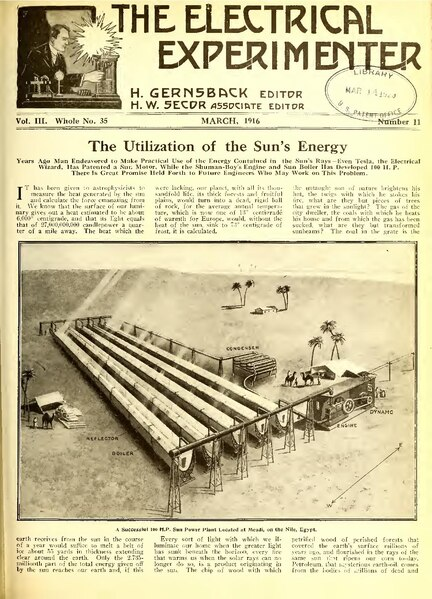
The post The First Solar Power Plant: 1916 appeared first on Master Resource.
via Master Resource
July 2, 2025 at 01:11AM
By P Gosselin
A 70-metre-long rotor blade of a V150 wind turbine fell from a height of 123 meters at the Lübbenow wind farm in Germany, heightening concerns about the safety of wind turbines.
AI generated symbol image. Hat-tip: Blackout News.
The affected turbine had been put into operation only 6 years ago, in 2019.
The incident raises questions about just how safe wind turbines really are. The incident is one in a series of technical defects. In January 2017, a rotor blade broke near Zichow (presumably due to a pitch control failure). In 2016: An entire wind turbine tower collapsed in Grimmen. A short time later, a Nordex 149 tower in Güstow had to be taken down for safety reasons. This affected a total of 18 identical turbines in Germany following a collapse in the Ruhr area in 2021 due to a design fault.
The Brandenburg Ministry of the Environment counted five accidents within two and a half years (as of August 2023), but no complete overview exists, as there is no central data collection for the dismantling of turbines and it is unclear who is responsible for the recycling and disposal of old turbine parts.
Not only are wind turbines prone to catastrophic failures, but they severely impact the quality of life of local residents due to the noise pollution they cause, especially in north-westerly winds. The rattling and clattering affect residents, restaurants and tourism. The rapid expansion of wind turbines has been accompanied by inadequate control systems and a lack of consideration for local residents.
Subscribe to get the latest posts sent to your email.
via Watts Up With That?
July 2, 2025 at 12:06AM
 Iowa Climate Science Education