Safety Of German Wind Turbines Heightens After 70-Meter Rotor Blade Snaps Off

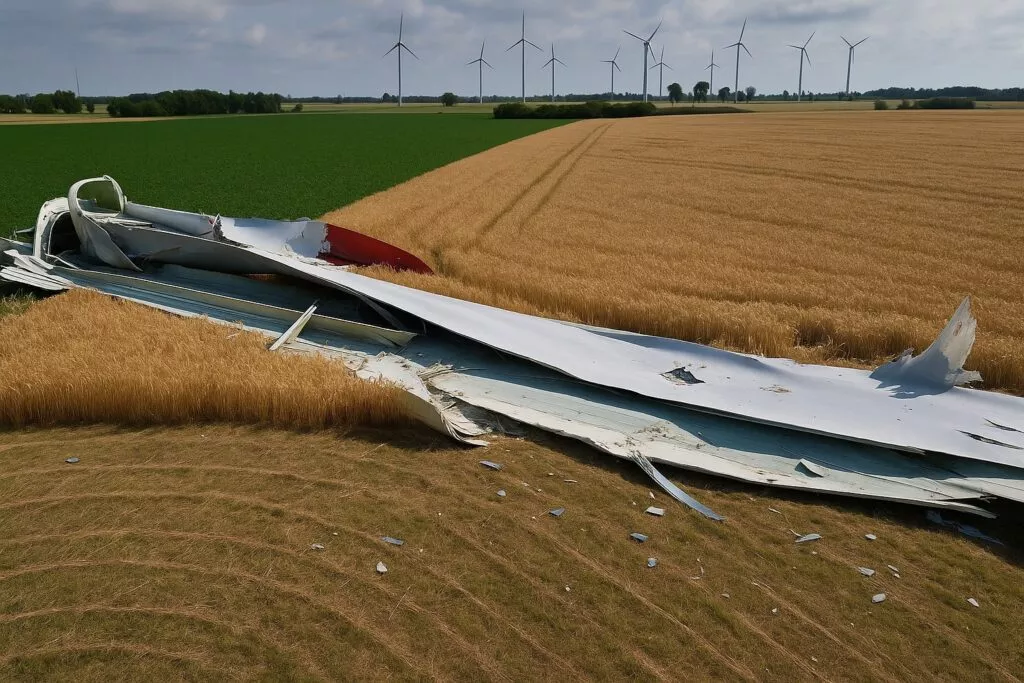
A 70-metre-long rotor blade of a V150 wind turbine fell from a height of 123 meters at the Lübbenow wind farm in Germany, heightening concerns about the safety of wind turbines. 

Blackout News here

Rotorblatt stürzt ab: Windkraftanlage beschädigt Feld – Sicherheitsprobleme und Kontrollmängel erneut im Fokus der Diskussion.

AI generated symbol image. Hat-tip: Blackout News.

The affected turbine had been put into operation only 6 years ago, in 2019.

The incident raises questions about just how safe wind turbines really are. The incident is one in a series of technical defects. In January 2017, a rotor blade broke near Zichow (presumably due to a pitch control failure). In 2016: An entire wind turbine tower collapsed in Grimmen. A short time later, a Nordex 149 tower in Güstow had to be taken down for safety reasons. This affected a total of 18 identical turbines in Germany following a collapse in the Ruhr area in 2021 due to a design fault.

The Brandenburg Ministry of the Environment counted five accidents within two and a half years (as of August 2023), but no complete overview exists, as there is no central data collection for the dismantling of turbines and it is unclear who is responsible for the recycling and disposal of old turbine parts.

Not only are wind turbines prone to catastrophic failures, but they severely impact the quality of life of local residents due to the noise pollution they cause, especially in north-westerly winds. The rattling and clattering affect residents, restaurants and tourism. The rapid expansion of wind turbines has been accompanied by inadequate control systems and a lack of consideration for local residents.

Donate – choose an amount

via NoTricksZone

https://ift.tt/zO8jouH

June 28, 2025 at 12:01PM

BBC Still Ignore The Elephant

By Paul Homewood


image

https://notalotofpeopleknowthat.wordpress.com/2025/04/16/bbc-ignore-the-renewable-elephant-in-the-room/

You may recall this item on World at One a couple of months ago. Sarah Montague interviewed a renewable industry lobbyist, Adam Berman, on the question of why UK electricity prices are so high.

I covered the story here.

Berman claimed that the principal reason was the high price of gas, exacerbated by the energy market mechanism which normally sets the wholesale price on the price of gas power. This supposedly stops consumers from benefitting from what he calls cheaper renewable energy. His claims went unchallenged by Montague.

I complained to the BBC that Berman’s claims renewables were cheaper, and that the principle reason why electricity prices are so high is that they are loaded with close to £20 billion of subsidies for renewables and other associated costs, such as system balancing.

I received this ludicrous reply:

Thanks again for contacting us with your concerns about the interview with Adam Berman Director of Policy at Energy UK (trade body for energy firms) on The World at One programme broadcast on 14 April. Please accept our apologies for the delay in responding.

We’ve shared these with the programme editors and senior news managers.

We’ve sorry you are disappointed with our first reply.

Listeners were informed about the premise of the interview which was to explore specifically why energy bills (principally for industry) are so expensive compared to other countries.

In answer to your comments about the broader costs of green energy – this didn’t fall within the narrow scope of what we were discussing here. 

Our presenter raised the comparison with Germany where energy bills are cheaper but where there is a similarly ambitious target to reach net zero. In other words, even setting aside the capital costs for low carbon energy, why is the UK still more expensive than its peers? That was the focus of our interview. 

It is worth adding that Adam Berman did also explain that there is a mechanism to recoup some of the profits which green energy companies make, but that the government does not choose to hypothecate that money to reduce the cost of bills. 

Therefore, we believe our listeners would have come away from the interview understanding that government policy also contributes to the relative cost of energy.

We believe pertinent questions were put to Adam Berman given his experience of the market. 

In true BBC style, the response did not address my complaint, so I have now upped the complaint to the ECU, with this:

Your two responses do not address my central complaint, ie that claims that renewables are cheaper than gas and that UK high electricity prices are largely due to the high price of gas.

Your response talks about “narrow scope” – but the issues I have raised actually go the very heart of the interview – why are prices so high.

Your response also mentions prices in Germany, but this is a red herring – German industries are exempt from the Renewable Energy Sources Act (EEG) surcharge, which funds renewable energy expansion. Instead all of the cost is loaded onto domestic users. (See here: https://www.bundeswirtschaftsministerium.de/Redaktion/EN/Artikel/Energy/electircity-price-components-state-imposed.html) That is why electricity prices for domestic users are as high in Germany as here.

As I pointed out, the main reason why UK prices are so high is the subsidies paid to renewable energy. This year subsidies and other associated renewable costs (such as providing standby capacity) are estimated by the OBR to add £17.1 billion to bills : https://notalotofpeopleknowthat.wordpress.com/2025/03/27/environmental-levies-will-cost-95-billion-in-next-five-years/

In addition can be added the costs of grid balancing, needed to cope with intermittent wind and solar power, costing £2.6 billion this year : https://notalotofpeopleknowthat.wordpress.com/2025/06/26/grid-balancing-costs-hit-2-6-billion-a-year/

Any discussion of high electricity prices should have focussed on this factor, as it dwarfs other factors. It is also untrue that renewables are cheaper than gas. The CfD scheme continues to pay out billions every year in subsidies for renewables, which top up the market price they receive to a guaranteed strike price. (This is why renewable generators always undercut gas in the market – they know they will receive the higher price anyway) For details of CfD, see here, under Green Energy Support. https://data.spectator.co.uk/energy

Similarly other renewable generators not in the CfD scheme receive subsidies worth £8.2 billion this year via the Renewable Obligations Scheme, on top of the market price they are paid.

The interview referred to the windfall tax – however according to the OBR, this will only raise £700 million this year, and £100 million. In other words, it is chicken feed beside the billions paid out to subsidise renerwables. (see here: https://obr.uk/efo/economic-and-fiscal-outlook-march-2025/

  • Table A5, page 162)

Listeners have been misled on two counts:

  1. That renewables are cheaper than gas

  2. That high electricity prices are largely the result of the cost of gas

Neither claim is true. If there were no renewables on the system, electricity bills would be about £20 billion lower a year. The electricity market is valued at around £70 billion, so bills would be about 30% lower without renewables.

via NOT A LOT OF PEOPLE KNOW THAT

https://ift.tt/Sz7cbEn

June 28, 2025 at 11:30AM

The Real Climate Science Crisis: CAGW Hypothesis Lacks Scientific Evidence

From C3 headlines The Real Climate Science Crisis: The Catastrophic Anthropogenic Global Warming (CAGW) Hypothesis Is Without Scientific Evidence.  Excerpts in italics with my added images.

For a hypothesis to reach the status of being a legit theory, it requires withstanding the onslaught of observed empirical evidence. The CAGW hypothesis is no such animal.

Known by its more contemporary aliases, such as ”climate crisis,” “climate emergency,” “climate collapse,” or “existential threat,” the CAGW has zero empirical evidence to support it.

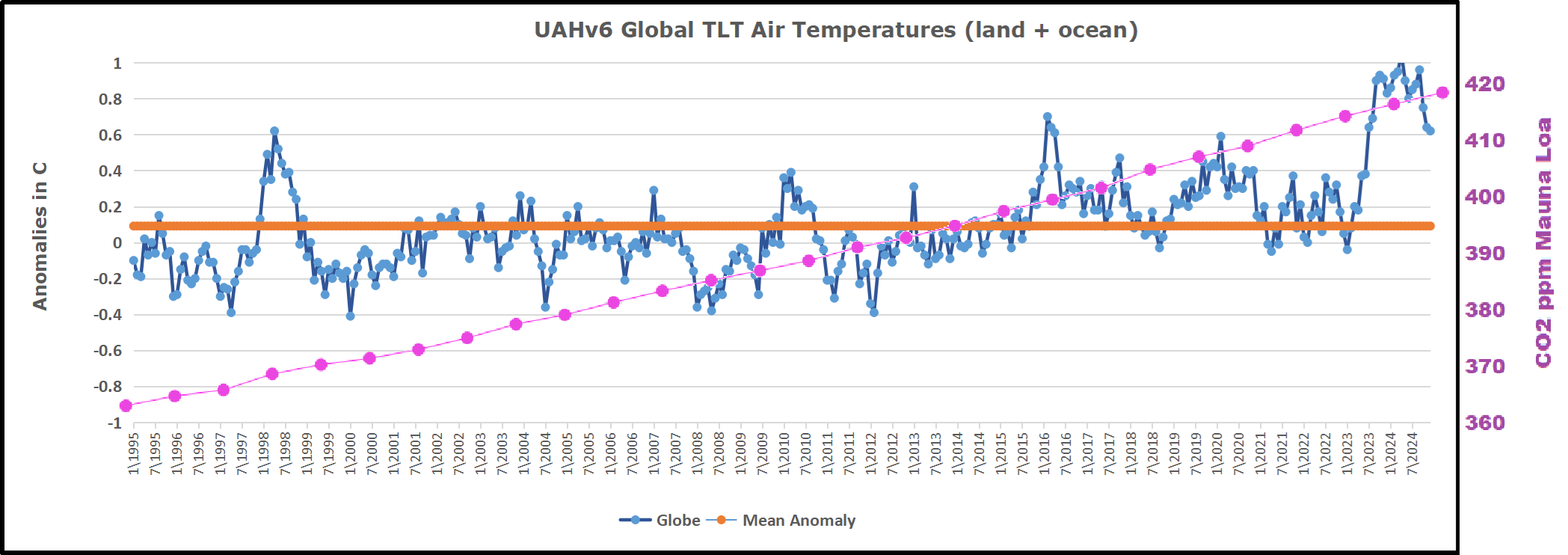
Unlike the related hypothesis regarding greenhouse gases (GHG) and global warming, at least the GHG hypothesis has warming global temperature data that somewhat coincides with increasing atmospheric CO2 levels, putting aside the growing possibility that the purported cause-and-effect direction is probably the reverse.

In order to reach a CAGW climate disaster, global warming
temperatures must change rapidly in an accelerating manner
that will initiate a ‘tipping point’ for the climate.

The rapid acceleration would present its occurrence in a continuous increasing of the slope, i.e., trend, of temperatures, such as monthly temperatures. Each subsequent month would represent a greater temperature magnitude increase than the month before, hypothetically.

But those tipping point precursors are not occurring in the real-world climate.

For example, it is agreed by all climate scientists that oceans play a very major role in the world’s climate and its global temperatures due to their being both the world’s largest carbon sink and its largest heat content storage.

However, despite these characteristics, in totality, the global oceans HAVE NOT warmed since the year 2014. And certainly, there is no empirical evidence that oceans exhibit constant temperature increases of magnitude.

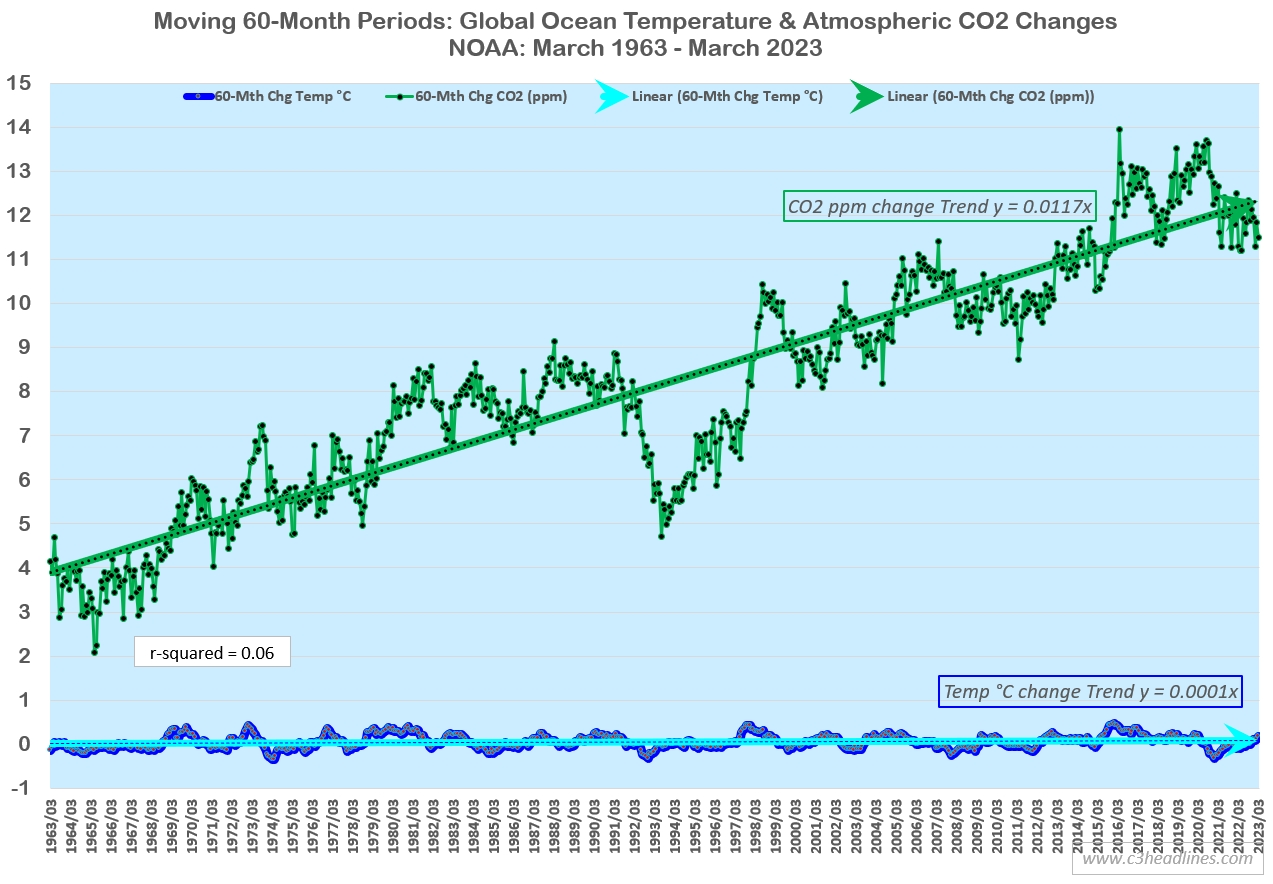
Quite the contrary, combined oceans exhibit a regular pattern of temperature decreases and increases, as the adjacent plot of NOAA’s monthly ocean data indicates.

Specifically, this is a plot (dark blue) of moving 5-year temperature changes ending each month of the 60-year period from March 1963 through March 2023.

[Explanation: the first data point is the temperature change for the 60 months ending on March 30, 1963; and the chart’s last temperature change data point is for the five 5 years (i.e. 60 months) ending on March 2023.]

The chart also includes a plot (green) of the moving 60-month CO2 level changes over the same sixty year period, plus a linear trend for both CO2 changes and ocean temperature changes.

The trend of the 60-month CO2 changes significantly exceeds the slight positive trend of ocean temperature changes by a factor of 117x. This huge differential undercuts the belief that global warming is primarily the result of GHGs. Which is confirmed by the paltry R^2 of +0.06 – an almost non-existent relationship between 5-year atmospheric CO2 changes and 5-year changes in ocean temperature.

Not only are the large increases in CO2 levels not causing a concerning uptick of temperature change magnitude, it also has not lead to any type of acceleration, per the linear trend since 1963.

Specifically, with a trend of a tiny +0.0001°C, that would project out 20 years to be an increase of 5-year temperature changes to an insignificant amount of +0.024°C – definitely not an existential threat of ‘runaway warming’ or a CAGW ‘climate crisis’ as portrayed by bureaucrats, politicians and Hollywood celebrities.

So, if 5 years of increasing amounts of CO2 in the atmosphere barely influence 5-year changes in temperature over a 60-year span, either in magnitude or acceleration rate, then it is highly unlikely that this trace gas would cause a catastrophic climate disaster or an extinction event.

Thus, it is fair to state that for all those scientists pushing a narrative of an imminent climate change catastrophe from CO2 without the requisite empirical evidence, this has become the real climate science crisis facing society.

via Science Matters

https://ift.tt/MnL8K65

June 28, 2025 at 11:13AM

Energy Institute Energy Review

By Paul Homewood


A few more graphs from the Energy Institute Review of World Energy, formerly known as the BP Energy Review. (Available here)

We naturally focus on China, as the biggest emitter. But the reality is that the whole of the non-OECD world is following the same pattern.

As far as emissions are concerned, the developed countries in the OECD are now an irrelevant sideshow:

image

It goes without saying that wind and solar power still contribute only a miniscule portion of China’s energy, despite the misinformation spewed by many in the media.

And, surprise, surprise{!), the same is true for all the rest of the non-OECD:


image

image

via NOT A LOT OF PEOPLE KNOW THAT

https://ift.tt/xTkqBHE

June 28, 2025 at 10:33AM