Climate Exchange with Jean Boissinot: For the Record

Diana Urge-Vorsatz , Vice Chair of the IPCC, Professor at Department of Environmental Sciences and Policy, Central European University, posted:

JUST HOURS AGO, the UN’s International Maritime Organization (IMO) adopted a landmark carbon pricing measure for international shipping. Starting in 2028, ships will be financially accountable for missing decarbonisation targets – a crucial development for a sector that was not included in the Paris Agreement, which focused solely on domestic emissions.

She justified the action:

Shipping is responsible for nearly 3% of global CO₂ emissions (which is about as much as Russia)… Without stronger action, shipping emissions are projected to double by 2100. Moreover, with over 40% of maritime freight used for carrying fossil fuels (AR6 WGIII Ch 10.6), decarbonising energy systems could also lead to a reduction in shipping volumes.

“This levy,” she concluded, “represents a crucial addition to existing IMO measures (EEXI, CII, SEEMP) and signals that even the most challenging sectors are finally entering the climate policy fold.

I commented: “Can be repealed before it takes effect. All pain and no gain–and going against the grain politically once voters catch up with this.”

Jean Boissinot (director, risk & research Banque de France, NGFS Sec., DG Trésor & HM Treasury) pushed back: “Rob, very much like your humour! 🤣 would be interesting to compare the cost-benefits analysis of this IMO régulation and that of reciprocal (and universal) US tariffs.”

I responded: “US tariffs, another issue. And early yet.”

Mark Rohrbacher joined in, asking Boissinot: “Tariffs or carbon regulations? If the goal is to shut down ocean shipping, they are both equally effective.”

Boissinot answered: Yes (anyhow, ~40% of shipping (in value) is about moving fossil fuel around…) but the latter is not about shutting it down for the sake of it (just make sure that what is shipped is what’s really needed to be shipped) while the former is unnecessary self-inflicted pain with no clear benefits (or some achieved in a very inefficient way).

After Rohrbacker answered that taxes or tariffs hurt everyone, Boissinot answered:

Mark, going back to basics: you may want to levy some taxes for 2 reasons – either you want to raise revenues or you want to incentivise a behavioural change (à la Pigou). In both cases, you intend to limit welfare losses.

Carbon taxes belong to the 2nd category: you are trying to limit CO2 emissions to an absolute minimum. The IMO scheme is not intended to raise revenues but to incentivise a reduction in CO2 emissions. Against this background, it looks fine (not perfect but relatively reasonable) and, overall, welfare enhancing (when you take into account the associated climate mitigation).

Tariffs are usually designed to raise revenues. As such they are always detrimental from a welfare perspective (it’s typically a rather distortive way to raise public revenues – by the way, it’s the end consumer who is effectively paying these taxes). And if it’s about incentivising some reshoring, even assuming it is possible (something that is not clear) it won’t be sufficient on its own and probably not even necessary if you implement the additional policy decisions that should be considered (e.g. on labour cost).

So while I can find good reasons to implement a carbon tax, I find it difficult to argue that tariffs are a good idea.

At this point I jumped back in:

Pigou was clear that market failure should be judged against politics and political failure. And CO2 is a positive externality in important ways, so not sure why you are demonizing it. Debate, don’t assume.

Boissinot then got fussy:

Rob, I think I don’t need to be lectured about Pigou and market failure (I learnt economics with probably the best teachers you could think of at that time on these issues) but thanks.

As for CO2 as a positive externality, we might have argued that one too many times already – you’re hopelessly refusing to understand that your evidence are valid in a lab environment but cannot be generalised at planetary level without taking other dimensions into consideration – like the greenhouse effect to start with. I’m not the one refusing to consider the evidence I’m presenting with – but you don’t seem to have the same open-minded and honest approach.

I responded:

Perhaps you didn’t know about Pigou in this regard. Did you? I can give you the quotation and page in the 1920 book if you would like.

My mind is quite open, and the case for CO2 not being a negative eternality, or at least having known positive effects, is strong. You can’t refute it because I argue from real science and you depend on climate models that cannot be tested and do not know the microphysics of climate, much less incorporate them.

Warmer is better in many situations, natural or anthropogenic. The enhanced greenhouse effect is benignly distributed…. Etc.

This is now the official position of the US federal government. Time to debate, not assume!

“I very much like your argumentum ab auctoritate that it’s now the official position of the US federal government,” Boissinot answered.

Again :
1/ increased CO2 concentration in lab can have beneficial impacts for plant growth
2/ the Earth atmosphere is not a lab, other dimensions matter…
3/ … among which the greenhouse effect which can be explained theoretically (and has been for 200+ years) and can be observed empirically (from Tyndall and Arrhenius onwards)…
4/ … which is playing a role in changing the Earth climate (and not just the temperature)…
5/ … in a way that does not make human life easier

So, we agree on 1 but you have difficulties considering 2-5 (and no, this is not just based on models but is also observed in data (esp. when you consider all the available data not just the ones you hand pick conveniently).

Bradley: The official US position is a call to not only respect the skeptics of climate exaggeration but to study their positions much more deeply. The debate has changed as the politics of Net Zero crumbles. The time to ignore and assume no longer works.

The enhanced greenhouse effect has a primary warming which is positive. It is in regard to feedback effects–in open debate- where high warming scenarios come into play.

I am considering points #2 – #5. This is where the debate is. And the ‘Deep Ecology’ position of an optimal, fragile climate is very speculative, probably wrong. Time series data does not support alarmism either.

In any case, it is fossil fuels to the rescue, not wind and solar and batteries…. This is the point of Alex Epstein and the US political mainstream. And in any case, the saturation effect makes mitigation more and more futile. It is adaptation time.

Boissinot: “Rob, with all due respect (and I mean it), you’re mixing political manifestos with science… both are legitimate but each for itself and not one for the other. As for what time series data is supporting, if you’re interested in the evidences and the scientific consensus:

Bradley: “The IPCC was created to find CO2 guilty, not benign or positive. Deep ecology scientists trying to prove that the human influence was bad. Ignoring CO2 science also. The ‘skeptics’ have long disassociated themselves from that rigged game.

The IPCC consensus is badly flawed. Climategate showed that in sentences and paragraphs, High-sensitivity climate models (RCP 8.5) are Malthus in – Malthus out. And the executive summary is politicized to exaggerate harms.

It you want to learn the other side, study Judith Curry, Roger Pielke Jr,, and others. Keep up with WUWT–the #1 climate website.

And this is even before getting to climate policy, which is an obvious failure for predictable reasons.

Boissinot: “Rob, yes, it’s all a big conspiracy to forbid the exploitation of fossil fuels. And all the science of the past 200 years has been rigged to that effect. Or maybe there is some truth in the work of thousands of scientists having worked over several decades – and remember the IPCC was created by George H. W. Bush and Margaret Tatcher (neither of which anyone in his right mind would suspect of “Deep Ecology” or “Statism” or “Climate Fear mongering”) to identify a scientific consensus

Seriously, you’re asking for a discussion but you seem to be locked in a thought system that lead you to discard any fact/evidence that would challenge your opinion. I’m starting to be worried about the mere possibility of a reasonable discussion.”

Bradley: No, not at all. You do not understand my position. Climate models used in IPCC scenarios are flawed, and the incentives are all wrong for Big Science. The truth points toward the middle, ‘global lukewarming’.

You accuse me of being biased–but you are the one not getting into the science to see the flaws in alarmism. The problems of climate models. The distribution of the enhanced greenhouse effect. The time series data on weather extremes. (And yes, the proven benefits of CO2 fertilization,,,,)

You are hiding behind the ‘consensus’ of biased scientists who have found a way to reach a political consensus amid a very unsettled ‘science’. The same (Malthusian) consensus has been errant since Paul Ehrlich in the 1960s…. You have to want to study the other side–and be willing to change your mind. I cannot do that for you,,,,

Boissinot: “Believe me, I think I invested quite some time reading or listening to the arguments of “climate realists”, “climate fatalists” (and even outright “climate deniers”). I also try to disentangle facts from theory and science from opinions – and to always question my prior beliefs, assumptions and opinions.

I’m not hiding behind anything but I not thinking either that I know better than the thousands of scientists who have painstakingly done the work – and I give them credit for being engaged into a truthful scientific exploration rather than a politically motivated long lived PR campaign.

I’m not accusing you of being biased but I regret that your one and only argument is some sort of indisputable recieved wisdom that you very much enjoy being put into practice by the current US administration – I can understand that you fancy seeing your political options turned into policy and feel vindicated; that cannot and will not substitute for a science based conversation. I’m interested in the latter.”

Bradley: This is a very unsatisfactory reply that interjects politics for my science focus. Tell us about climate models, particularly RCP 8.5. The distribution of the enhanced greenhouse effect. Time series data on weather extremes.

And I have not even brought up the ‘saturation effect’ of GHG forcing, which dooms mitigation. And how adaptation internalizes the ‘negative externalities’ that you believe in. All this even before getting to public policy….

——————-

The entire exchange is illuminating. The last word goes to Mike Robinson, who commented:

Based on all that science. Remember when we cleaned up ship emissions to reduce global warming, but ended up increasing ocean temperatures because of the cleaner skies? Oops.

The post Climate Exchange with Jean Boissinot: For the Record appeared first on Master Resource.

via Master Resource

https://ift.tt/O7ZIyDU

June 26, 2025 at 01:12AM

Energy Investment Out of Balance… And It Could Cost Us All

Lars Schernikau: Energy Economist, Commodity Trader, Author (recent book “The Unpopular Truth… about Electricity and the Future of Energy”)

Details inc Blog at www.unpopular-truth.com

The International Energy Agency (IEA) just published its 2025 World Energy Investment (WEI) report. It marks the 10th anniversary of this major annual review. And after spending time reading the full 255-page document, it’s clear to me that global energy investment trends are raising serious questions about future energy security, affordability, and return on investment.

In this article, I want to zoom in on two of the issues I identified from the report that deserve more public debate: the growing imbalance in energy investment and the troubling decline in the return on that investment. The consequences of these trends could weigh heavily on taxpayers and consumers.

Wind and solar…more money, less return

Today, global investment in wind and solar is about 7 times higher (per unit of energy generated) than investment in dispatchable power like coal, gas, nuclear, and hydro combined. That alone should make us pause and take a second look…more on this in my latest blog IEA 2025 World Energy Investment a Review

Even more concerning is the IEA’s own data that shows that wind and solar, as industries, are just not profitable. Solar manufacturers, especially in China, are losing billions as competition drives prices below production costs. Utilities in many markets are also struggling to earn stable returns from variable wind and solar generation.

Meanwhile, investment into traditional fuels that still supply about 80% of our primary energy needs has fallen dramatically. A decade ago, coal, oil, and gas received 55% of global energy investment. Today, they receive just 33%, in absolute terms, about 25% less than 10 years ago.

We have to recognize an unpopular truth: the energy return on investment (EROI) for coal, oil, and gas remains far higher than for wind and solar. A dollar invested in coal or gas delivers much more usable energy than a dollar invested in solar panels or wind farms… especially after accounting for intermittency, backup systems, grid upgrades, and storage.

Figure 1: Investments in intermittent Wind and Solar 7x higher than in desptachable Coal, Gas, Nuclear, hydro | Source Schernikau based on IEA World Energy Investment 2025 and IEA

Less investment overall

It’s not just about where the money is going. Worryingly, total global energy investment as a share of GDP is declining. In 2015, it was about 3.6% of global GDP. This year, it will drop to just 2.9%.

At a time when we face surging energy demand (think AI data centers, electrification, cooling needs), the world is spending less, relative to its wealth, on the infrastructure that keeps the lights on. That is a recipe for future shortages and volatility.

Who will pay the bill?

Taxpayers already are. The wind and solar boom is fueled by massive subsidies and incentives, mostly funded through public money. As investment in dispatchable energy lags, grid instability risks increase, forcing governments to spend even more to “patch” the system with expensive emergency measures.

How long will money flow into low yielding investments like wind and solar, before the red flags are raised?

Is it then a surprise that in many developing countries, particularly in Asia, governments are quietly turning back to coal and gas to meet rising energy demand? China approved nearly 100 GW of new coal plants in 2024 alone. India added another 15 GW.

Why you ask?…they do this because these investments reliably produce affordable energy, something no country can live without.

Figure 2: The power industry is also struggling with a shortage of skilled labor and supply equipment. For instance, transformers and cables have doubled in price in the past 10 years in Europe.

A call for balance

This is not an anti-wind, anti-solar argument. Wind and solar can play a role in a diverse energy system. But I do see the need for a more balanced investment approach, one rooted in realism and return.

Prioritizing these low-return investments while starving high-EROI energy sources will only drive costs higher for taxpayers, slow economic growth, and compromise grid reliability. If we continue down this path, the long-term cost to society could far outweigh any of the benefits.

For anyone serious about energy security and economic stability, it is time to reassess where and how we invest in the future of energy.

For sources and further reading, see my complete article on the IEA World Energy Investment 2025 report and if you are interested to remain updated on my writing, please sigh up there.


Discover more from Watts Up With That?

Subscribe to get the latest posts sent to your email.

via Watts Up With That?

https://ift.tt/E2uaHzV

June 26, 2025 at 12:04AM

Good Laugh For Today: New York State Says It Will Build A New Nuclear Power Plant

From THE MANHATTAN CONTRARIAN

Francis Menton

In case you missed it, here is New York Governor Kathy Hochul’s breathless announcement from yesterday: “Governor Hochul Directs New York Power Authority to Develop a Zero-Emission Advanced Nuclear Energy Technology Power Plant.” And here is Hochul’s picture of herself making the announcement:

Does something here seem like it doesn’t quite fit? Yes, it was just four years ago, in April 2021, that New York completed the forced closure of the two perfectly functional Indian Point nuclear plants, with combined generating capacity of about 2 GW, for no other reason than relentless opposition from environmentalists and NIMBYs. And yet now the Governor is saying that the plan is to start over and build a new nuclear plant at some unspecified place.

Before getting to a few of the problems, let’s start with some of the excited language from the Governor’s press release:

Governor Kathy Hochul today directed the New York Power Authority (NYPA) to develop and construct a zero-emission advanced nuclear power plant in Upstate New York to support a reliable and affordable electric grid, while providing the necessary zero-emission electricity to achieve a clean energy economy. . . . “As New York State electrifies its economy, deactivates aging fossil fuel power generation and continues to attract large manufacturers that create good-paying jobs, we must embrace an energy policy of abundance that centers on energy independence and supply chain security to ensure New York controls its energy future,” Governor Hochul said. . . .

NYPA, in coordination with the Department of Public Service (DPS), will seek to develop at least one new nuclear energy facility with a combined capacity of no less than one gigawatt of electricity, either alone or in partnership with private entities, to support the state’s electric grid and the people and businesses that rely on it. NYPA will immediately begin evaluation of technologies, business models, and locations for this first nuclear power plant and will secure the key partnerships needed for the project. This process will include site and technology feasibility assessments as well as consideration of financing options, in coordination with the forthcoming studies included in the master plan. . . .

Now who wouldn’t want “a reliable and affordable electric grid” that provides “the necessary zero-emission electricity to achieve a clean energy economy”? Not meaning to be the grinch here, but let me lay out a few of the problems that I have with the approach to energy policy for New York as described by our Governor:

  • Are we really talking about just one new nuclear plant with just one GW of generation capacity? That is barely a drop in the bucket compared to the immediate need, and doesn’t even meaningfully address the problem of keeping the grid operating as we pursue a statutorily-mandated transition to mostly wind and solar generation. The State’s Climate Leadership and Community Protection Act of 2019 (CLCPA) demands closure of at least 20 GW of dispatchable power plants running on natural gas; and the State’s Independent System Operator, NYISO, has stated that the State needs at least 20 GW of what they call “dispatchable emissions-free resources” (DEFR) to replace the natural gas generation. Nuclear is the only plausible DEFR. So why we are going to build only one GW of new nuclear capacity? Wouldn’t you think the Governor would at least mention the rather large disparity between the identified need and her plan?
  • The Governor’s announcement doesn’t say anything about the timeline, beyond making it clear that this project hasn’t even gotten to the most preliminary of preliminary steps. (“NYPA will immediately begin evaluation of technologies, business models, and locations for this first nuclear power plant. . . .”). We don’t even know the “technology” or the “business model” yet, let alone the location. The most recent nuclear plant to begin operation in the United States — Vogtle Units 3 and 4 in Georgia — took 15 years from start of construction in 2009 until commencement of operation in 2024. Fifteen years from now is 2040, by which year the CLCPA mandates that New York produce all its electricity from “zero-emissions” sources. But before Governor Hochul’s unicorn power plant can begin construction, we must have not just selection of technology, business model, and location, but also such things as preparation and completion of an EIS, permitting, design, awarding of a contract, financing, and, don’t let me forget, defeat of a few dozen litigations attempting to block the project. We will be very, very lucky if this plant is ready to operate by 2045. 2050 would be more likely — if it ever operates at all.
  • Shouldn’t there be at least some mention by the Gov that the CLCPA plan for a “zero emissions” electricity grid by 2040 has become completely unachievable — indeed, ridiculous? 20+ GW of reliable natural gas generation will go away by the mid-2030s, to be replaced by — what? One 1 GW nuclear plant, to maybe become available some time post-2045? That’s a complete joke. How about Hochul’s other plan for 6 GW/24 GWh of “grid-scale” battery storage? Per calculations at this post from March 2024, New York would need at least 720 hours of average usage, which is 12,240 GWh of energy storage, to reliably back up a grid predominantly powered by wind and sun; the 24 GWh in our Gov’s plan would be about 0.2% of that requirement. Another complete joke. Is there a third proposal? Not that I can find.

So what is Governor Hochul even thinking when she puts out a proposal for a single new nuclear power plant, describing it as supporting a future “reliable and affordable electric grid,” when she knows that her proposal represents at best 5% of what is needed and at least 5 to 10 years too late? What this proposal clearly is not is a serious plan to move toward a “zero-emissions” grid by the statutory mandate of 2040. Being charitable toward our Governor, perhaps the idea here is to lay down a marker, so that when her 1 GW nuclear plant proposal gets killed by some combination of environmental activism and bureaucratic stumbling, she will be able to say that she tried to put forth a solution but got blocked. The alternative hypothesis — that Governor Hochul actually thinks her 1 GW nuclear plant proposal is a relevant solution to the problem at hand — would imply that the Gov operates at essentially a kindergarten level of incompetence.

I’ll let you pick which of these two alternatives is more likely. Meanwhile, let this be your good laugh for today.


Discover more from Watts Up With That?

Subscribe to get the latest posts sent to your email.

via Watts Up With That?

https://ift.tt/5YPUGBb

June 25, 2025 at 08:03PM

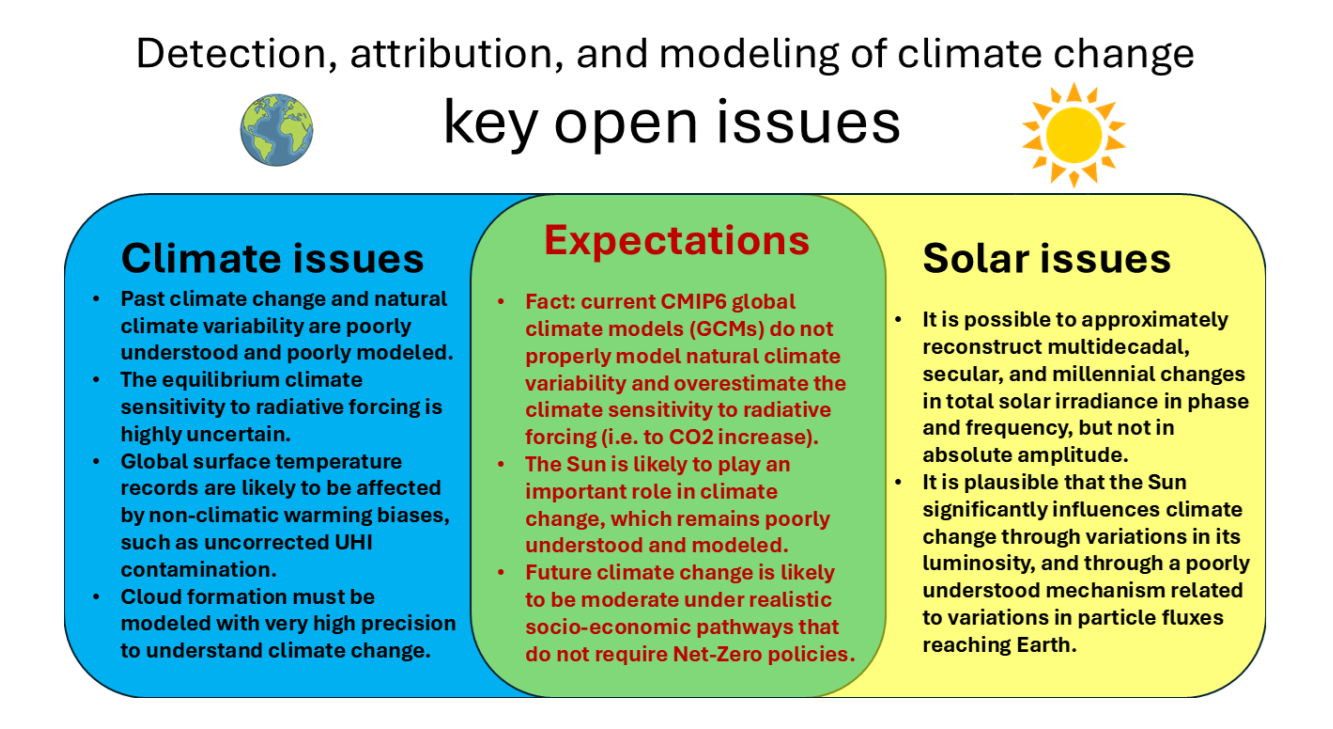
Scafetta: Climate Models Have Issues

On June 18, 2025 Nicola Scafetta published Detection, attribution, and modeling of climate change:  key open issues.  Excerpts in italics with my bolds and added images.

Abstract

The Coupled Model Intercomparison Project (CMIP) global climate models (GCMs) assess that nearly 100% of global surface warming observed between 1850–1900 and 2011–2020 is attributable to anthropogenic drivers like greenhouse gas emissions. These models also generate future climate projections based on shared socioeconomic pathways (SSPs), aiding in risk assessment and the development of costly “Net-Zero” climate mitigation strategies.

Figure 1. Anthropgenic and natural contributions. (a) Locked scaling factors, weak Pre Industrial Climate Anomalies (PCA). (b) Free scaling, strong PCA Source: Larminat, P. de (2023)

Yet, as this study discusses, the CMIP GCMs face significant scientific challenges in attributing and modeling climate change, particularly in capturing natural climate variability over multiple timescales throughout the Holocene. Other key concerns include the reliability of global surface temperature records, the accuracy of solar irradiance models, and the robustness of climate sensitivity estimates. Global warming estimates may be overstated due to uncorrected non-climatic biases, and the GCMs may significantly underestimate solar and astronomical influences on climate variations.

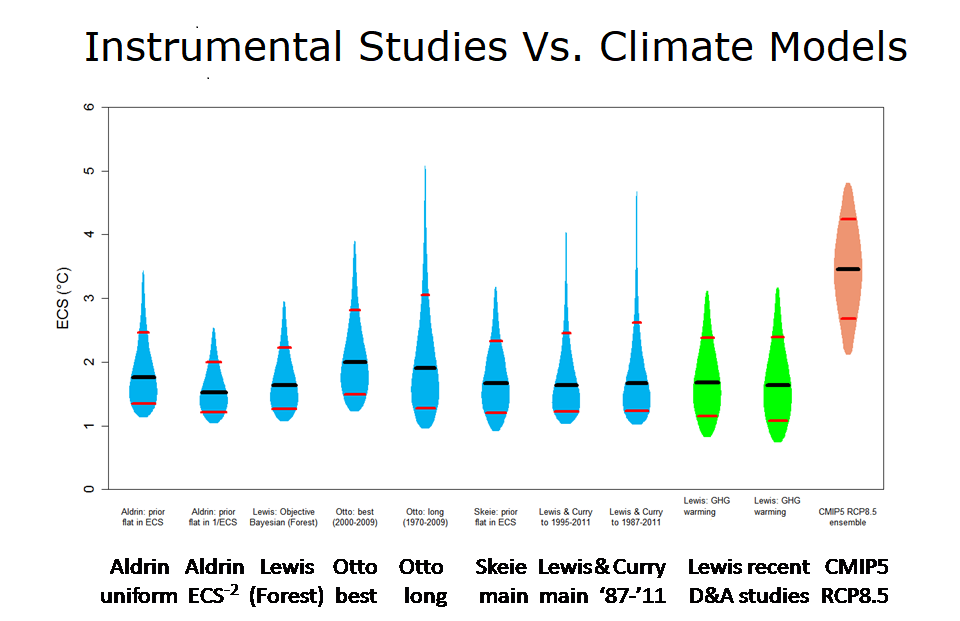
The equilibrium climate sensitivity (ECS) to radiative forcing could be lower than commonly assumed; empirical findings suggest ECS values lower than 3°C and possibly even closer to 1.1 ± 0.4 °C. Empirical models incorporating natural variability suggest that the 21st-century global warming may remain moderate, even under SSP scenarios that do not necessitate Net-Zero emission policies.

These findings raise important questions regarding the necessity and urgency of implementing aggressive climate mitigation strategies. While GCMs remain essential tools for climate research and policymaking, their scientific limitations underscore the need for more refined modeling approaches to ensure accurate future climate assessments. Addressing uncertainties related to climate change detection, natural variability, solar influences, and climate sensitivity to radiative forcing will enhance predictions and better inform sustainable climate strategies.

Discussion

Scientific challenges in climate detection, attribution, and modeling stem from three primary issues:

1. the inherent uncertainty of what measurements really indicate complicates the detection of climate change and its causative factors;
2. the anthropogenic contribution is superimposed to natural climate variability, necessitating comprehensive understanding and accurate modeling of the latter;
3. key physical processes, such as cloud formation and solar contributions to climate dynamics, remain poorly characterized.

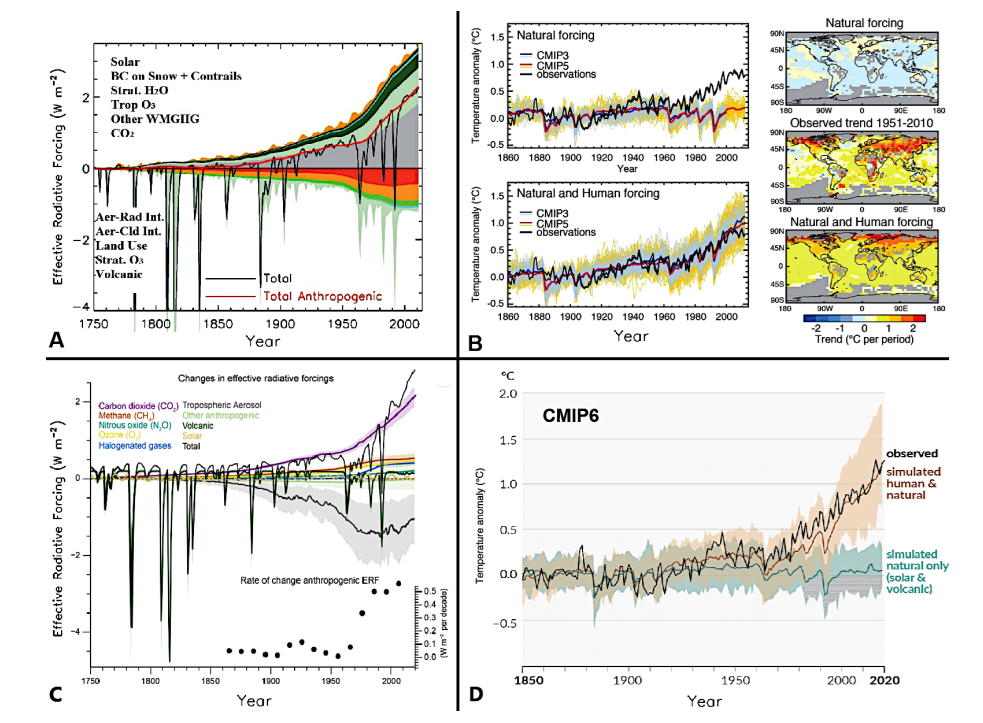
Figure 1:

(A) Compilation of the radiative forcing functions utilized in the CMIP5 GCMs (adapted from IPCC,2013, Figure 8.18).
(B) Variations in observed global surface temperature (black) alongside the CMIP3 and CMIP5 model simulations incorporating only natural forcing and combined natural-anthropogenic forcing (adapted from IPCC, 2013, FAQ 10.1, Figure 1).
(C) Compilation of the radiative forcing functions utilized in the CMIP6 GCMs (adapted from IPCC, 2021, Figure 2.10).
(D) Observed global surface temperature variations (black) alongside the CMIP6 model simulations incorporating only natural forcing and combined naturalanthropogenic forcing (adapted from IPCC, 2021, Figure SPM.1).

Notably, in both (B) and (D), the observational data necessary
to validate the GCM predictions that consider only natural forcings
are not reported because they do not exist.

While all available GCMs indicate that the positive feedbacks surpass the negative ones thus amplifying the effects of radiative forcing, large uncertainties associated with crucial feedback mechanisms — particularly those related to water vapor and cloud formation — remain substantial.

Feedback mechanisms include:

Water Vapor Feedback — A positive feedback governed by the Clausius-Clapeyron law, which links ocean vaporation rates to temperature increases;
Albedo Feedback — A positive feedback arising from changes in surface reflectivity due to ice and snow
cover variations;
Cloud Feedback — Particularly challenging to quantify, as cloud formation, type, and distribution are sensitive to warming; certain clouds cool the surface by reflecting solar radiation, while others trap emitted
heat, making their net contribution highly uncertain;
Lapse Rate Feedback — A negative feedback involving modifications to atmospheric temperature vertical
gradients;
Carbon Cycle Feedback — Activated by warming-induced CO2 release from soils and oceans (per Henry’s law), further increasing atmospheric CO2 concentrations;
Vegetation Feedback — Temperature and precipitation changes alter vegetation cover, which influences
carbon storage and surface albedo.

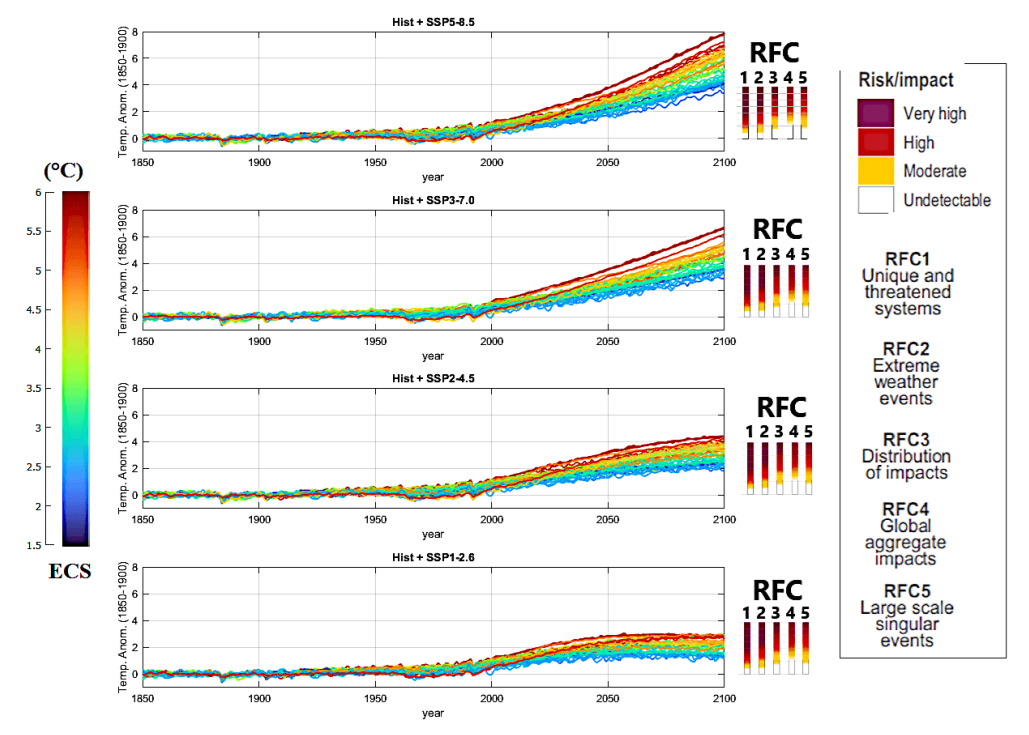
The CMIP6 GCMs are also employed to simulate future climate scenarios based on hypothetical radiative forcing functions derived from Shared Socioeconomic Pathways (SSPs). The ones mainly adopted in the IPCC AR6 are:
SSP1-2.6 — low greenhouse gas emissions, with robust adaptation and mitigation measures leading to
Net-Zero CO2 emissions between 2050–2075;
• SSP2-4.5 — intermediate emissions, where CO2 levels remain near current levels until 2050 and subsequently decline without achieving Net-Zero by 2100;
• SSP3-7.0 — high emissions, with CO2 concentrations doubling by 2100 under minimal policyintervention;
• SSP5-8.5 — very high emissions, with CO2 levels tripling by 2075 under a worst-case scenario devoid of
mitigation measures.

Figure 3: CMIP6 GCM ensemble mean simulations spanning from 1850 to 2100, employing historical effective radiative forcing functions from 1850 to 2014 (see Figure 1C) and the forcing functions based on the SSP scenarios 1-2.6, 2-4.5, 3-7.0, and 5-8.5. Curve colors are scaled according to the equilibrium climate sensitivity (ECS) of the models. The right panels depict the risks and impacts of climate change in relation to various global Reasons for Concern (RFCs) (IPCC, 2023). (Adapted from Scafetta, 2024).

Conclusion

Over the span of approximately three decades, from the publication of the First Assessment Report (FAR, IPCC, 1990) to the Sixth Assessment Report (AR6, IPCC, 2021), the Intergovernmental Panel on Climate Change (IPCC) has significantly advanced  marked up its understanding of the role of anthropogenic emissions in driving global warming.

In the 1990s the IPCC posited that both natural mechanisms and human activities could have contributed roughly equally (∼50% each) to the observed warming of the 20th century. However, since the years 2000s the prevailing scientific opinion has shifted, and the IPCC (AR6, 2021) now asserts that human activities are almost exclusively responsible (∼100%) for the global warming and climate change observed from 1850–1900 to 2011–2020.

The most recent assessment reports IPCC (2021, 2023) underscore this conclusion with striking clarity. As shown in Figure 2, the average contribution of natural factors — solar and volcanic forcing and internal natural variability — to global warming during the aforementioned period is estimated to be approximately 0°C.  Consequently, from the CMIP GCM perspective, concerns about future climate warming due to additional anthropogenic greenhouse gas (GHG) emissions are well-founded. However, this conclusion depends on the reliability of global surface temperature records and the robustness of the physical science underpinning global climate models (GCMs).

The findings outlined above underscore significant uncertainties in climate modeling, climate data, solar records, and solar-climate interactions, leaving unresolved the key question of whether observed warming is primarily driven by anthropogenic factors, natural processes, or their interplay. Empirical methodologies, such as those utilized by Scafetta (2023a, 2024) and Connolly et al. (2023), highlight this ongoing ambiguity.

Concerns are mounting regarding the limitations of the CMIP GCMs employed by the IPCC in its assessment reports from 2007, 2013, and 2021. These models appear unable to accurately replicate natural climate variability across different timescales, highlighting critical unresolved issues in fundamental climate dynamics.Also the magnitude of solar variability across temporal scales requires further investigation, particularly given the strong correlations identified between solar proxy records and climate patterns throughout the Holocene. Schmutz (2021) argued that such strong correlations challenge the validity of the low-variability TSI models, such as those proposed by Matthes et al. (2017), Kopp et al., 2016 and Wu et al. (2018). Since these models serve as solar forcing inputs for the CMIP6 GCMs, their choice needs to be reconsidered.

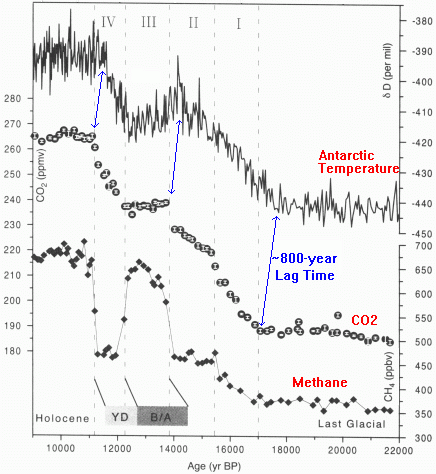
Climate science remains far from settled, yet trillions of dollars continue to be allocated toward policies aimed at mitigating extreme hypothetical warming scenarios based on potentially flawed GCM outputs. Historically, atmospheric CO2 levels have been 10 to 20 times higher than current concentrations during approximately 95% of Earth’s history since complex life emerged 600 million years ago (Davis, 2017). Notably, CO2 concentrations often lag temperature changes across different timescales, suggesting temperature fluctuations may drive CO2 variations rather than vice versa (Shakun et al., 2012; Koutsoyiannis, 2024).

Advancing climate science requires directly confronting uncertainties in detection, attribution, and modeling. Further research on unresolved issues is critical for improving climate risk assessment and developing more effective strategies for addressing future environmental challenges.


via Science Matters

https://ift.tt/I0un4AE

June 25, 2025 at 07:42PM