
Regular readers may have noticed that my humble offerings have been scant of late. Well, the fact is, I’ve been distracted by working on a book. But Jit, you’re always working on a book. Yes, but this one is non-fiction. When I write fiction, I just make stuff up. When I write non-fiction, Dr. Pedant here has to make sure that every thing I say is true, or sufficiently caveated that it is at least not misleading. And this particular project, which will probably see the light of day in about 2027 the way things are going, and sell north of ten copies, is particularly irksome in that regard.
More on that another day. Today, I wanted to talk about the Morning Midas.
The Morning Midas caught fire about ten days ago. It was carrying cars, and some of them were EVs, and some hybrids. Was the fire caused by a lithium battery? I don’t know. The crew probably knows, but they don’t appear to be going freelance and telling us, no doubt much to the relief of their employers. For there may be a tussle at some future point re: who is going to pony up: the shipper, the cargo owner, or their insurers.
One way the media has of making us believe certain things is to filter out the events they deem unhelpful to whatever line they hold. Of course, they already filter out events that are not very newsworthy. That’s their job. But it must be tempting to move the line between newsworthy and not newsworthy based on your preferred narrative.
As far as I know, the Morning Midas fire has not been mentioned by the BBC. It is either not newsworthy, or (the cynic says) not helpful owing to the whiff of lithium in the sea breeze.
Was it an EV? There is circumstantial evidence to support the theory. Top of these, to my mind, is the fact that the crew had to abandon ship. Several news sources have hinted darkly that an EV battery lit the spark. News.com.au:
The floating inferno is said to have been caused by the lithium-iron batteries in the 70 electric vehicles on board – batteries that are can cause fires that can burn for weeks. [sic.]
Hinting not only darkly, but illiterately too. The same top-drawer outlet:
…said to have started in the deck where the EVs were being ferried.
And
Local media reports said lithium-iron batteries from one or several of the electric vehicles on board may have been the cause of the blaze.
It doesn’t help that a degree of misinformation is swirling around the event, as these snips from searches under “news” for “Morning Midas” demonstrate:

And
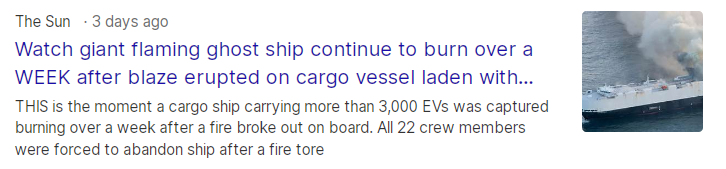
The Midas was not full of EVs, nor were there 3,000 on board. According to Shipwreck Log:
The Morning Midas departed from Yantai, China with over 3100 vehicles with 65 electric and over 600 hybrid vehicles…
As John Cadogan noted in the wake of the Fremantle Highway fire (2023), in a real sense, it doesn’t really matter whether an EV caused the fire. The point is that once a fire has begun, EVs represent a cargo that is far more dangerous than other vehicles. The one cannot be extinguished by carbon dioxide, when the other can. One of Cadogan’s vlogs on the topic:
The Felicity Ace
This is the one that everyone has heard of, because it sank. It was sailing from Emden to Davisville in February 2022 carrying about 4,000 cars when a fire broke out on board. The crew were unable to contain the fire and abandoned the ship, which subsequently sank. Presumably there has now been ample time for an investigation into the cause of the fire. Was it an EV?
I found a report from the Panama Maritime Authority, which leaves the reader in no doubt that the blaze began in a Porsche Taycan. The Taycan is the electric Porsche, whose battery, shall we say, has an indifferent reputation re: fire risk.
8.8 According to the crew evidence, the fire started on a electrical Porche Taycan. [sic.]
[This comes from a third party website, and I could not find it on the PMA site. According to gCaptain, the report has not been released yet, so presumably the third party have received an draft copy somehow. Maybe the document, when finalised, will have a different tale to tell.]
The owners of the ship and the insurers Allianz are suing Volkswagen [owners of Porsche] for causing their losses. This is somewhat indicative that they believe the Taycan was responsible.
The BBC reported the fire and sinking, but as far as I know have not mentioned the possibility that an EV was the cause.
Wikipedia says “Contrary to speculations in the media, it is unknown whether an electric car caused the initial fire.” Of course, my referring to a draft report is just such speculation, so that is a fair position for them to hold.
Fremantle Highway
The Fremantle Highway caught fire off the coast of Holland in July 2023 en route from Bramerhaven to Singapore. It was carrying 3800 cars. There was a little to-ing an fro-ing between EV sceptics and the EVangelists, who were keen to make it clear that an EV was not responsible. [The vlog by John Cadogan above refers to the spontaneous ignition of one of the EVs that survived the initial fire.]
The Dutch Safety Board’s report on the incident only considers the emergency response. Investigating the cause of the incident is the responsibility of the flag owner, Panama again. The Panama Maritime Authority has yet to pronounce.
See also Mike’s post on JC’s vlogs on this topic, and comments below.
Minor Friends
In searching for answers on this topic, I came across a number of other ship fires that were potentially caused by EVs. Operator Grimaldi seems to have a particular problem with fires. Helpfully their vessels all begin “Grande,” making them easy to pick out in a line up. However, the internet is full of crap, so beware when reading anything. There appears to be AI-generated pages on more-or-less any topic you search for these days, whose goal no doubt is to sell advertising. For example, this page says that there were 1,000 passengers on the Grande America, which was not a passenger ship. [It might be real. Just dumb.]
Grande America 2019, caught fire off the west coast of France and sank. Carrying 2,000 cars. The incident report cannot say what started the fire. (Actually, there were two fires, at remote locations.)
Grande California – fire in 2023 when carrying 2,000 vehicles [put out by CO2 and seemingly not an EV therefore], and in 2025 when docked. Link as for Brasile.
Grande Costa D’Avorio – 2023, fire when alongside, apparently due to a faulty battery in a loading vehicle (not an EV?). Link as that for Brasile.
Grande Brasile – 2025, in the English Channel. EVs were on board, cause unknown. The fire started in the vehicle decks.
Grande Congo – 2025. A small-scale fire, mentioned at same link as for Grande Brasile.
Conclusion
It has to be admitted, that answers on this topic are rather thin on the ground. It takes a long time for investigations to complete, and they often come up with a shrug when they finally do. Suspicion has fallen on EVs on several occasions, but there have been no convictions yet in the incidents I’ve read about. Suspicions, elevated concerns re: carrying EVs yes, but definitive answers, no. There are a number of further incidents that I lost the will to read up on. Maybe one of them caught the EV red handed, or smoky batteried.
Addendum
Allianz’s Safety and Shipping Review for 2025 makes for interesting reading. There is a whole page (p.42) with the title “Lithium-ion battery risks continue to develop in the electrification age.”
gCaptain’s page on recent car carrier fires.
Featured image
USCG’s snap on approach to Morning Midas on 8 June.
via Climate Scepticism
June 14, 2025 at 02:23PM
 Iowa Climate Science Education