Alaska’s Resource Potential: A Tale of Two Administrations

By Brett Huber

Alaska is home to some of the most valuable energy and mineral resources in the world—resources vital not only to the state’s economy but to America’s energy independence and national security. Yet for years, Washington bureaucrats treated Alaska like a nature preserve, ignoring the people who live here and the enormous value our land can responsibly provide. Now, under President Trump’s leadership, and aided by Alaska Governor Mike Dunleavy, that tide is turning.

No where is this more evident than what Alaska witnessed this week. For the first time anyone can remember, three cabinet secretaries made the journey here at the invitation of the Governor to give Alaska the attention its long-deserved.

The Trump administration has reasserted Alaska’s right to responsibly develop its resources, replacing federal stonewalling with a bold, America-first energy agenda. In stark contrast, the Biden administration spent four years systematically locking up our lands, kneecapping energy producers, and undermining the very projects that could strengthen the U.S. economy and global standing.

Alaska’s Abundance Ignored by Biden, Embraced by Trump

Let’s look at the numbers: Alaska holds an estimated 8.7 billion barrels of oil in the National Petroleum Reserve–Alaska (NPR-A), and Prudhoe Bay remains the largest producing oil field in North America with ANWR potentially rivaling those reserves. On the critical minerals front, Alaska has over 70 known rare earth element occurrences, plus significant deposits of cobalt, graphite, and lithium—minerals vital for clean tech and national defense.

These aren’t theoretical advantages. These are strategic assets—and under Biden, they were being buried under red tape.

In 2023, the Biden administration canceled seven legally issued oil and gas leases in the Arctic National Wildlife Refuge (ANWR). The Biden Department of the Interior then went further—imposing new rules that effectively shut down over 13 million acres of the NPR-A, decimating potential production zones and stalling job creation in rural Alaska. “Biden’s latest fiat to lock up half the reserve, without congressional approval, jeopardizes America’s energy security,” responded Governor Dunleavy.

Meanwhile, Biden’s so-called climate agenda blocked the very minerals he claimed to need for his “green” energy transition. Projects like the Ambler Access Road and Graphite One, which could help supply domestic battery production, were stalled or undermined by his federal agencies leaving us all more dependent on Chinese supply chains.

Trump’s America-First Approach Brings Relief and Resolve

The return of President Trump has brought a dramatic course correction. Just this week, his administration announced the repeal of Biden’s restrictions on drilling in the NPR-A, restoring access to vast tracts of oil-rich federal land.

Interior Secretary Doug Burgum correctly pointed out, “The NPR-A was set aside by Congress for energy production. We are simply restoring the legal balance intended by our laws.” At this year’s Alaska Sustainable Energy Conference, Energy Secretary Chris Wright reinforced that message: “Alaska’s unique position allows it to lead in both fossil fuel production and renewable energy innovation. Washington should get out of the way.

Governor Dunleavy, who hosted the conference in Anchorage, made it clear: responsible resource development is not only possible—it is essential. Alaska can be a global leader in energy, but only if the federal government treats the state as a partner, not a problem.

Real Consequences, Real Lives

This isn’t just policy—it’s people’s lives. Alaska’s economy depends on responsible development. Federal restrictions mean fewer jobs, lower revenue, and more outmigration. They also erode national energy security at a time when geopolitical instability makes energy independence more critical than ever.

Under Biden, Alaska was pushed to the sidelines. Under Trump, Alaska is back in the game.

Alaska’s future must be built on opportunity, not obstruction. The Trump administration is empowering Alaska to unlock its vast resources and reclaim its role in powering America. In contrast, the Biden administration left a legacy of missed opportunity, misguided priorities, and economic harm.

It’s time to stop treating Alaska like a political bargaining chip and start treating it like the energy powerhouse it is. With the right leadership, like that of Governor Dunleavy and President Trump, Alaska can drive America’s energy resurgence—and secure its place at the center of the nation’s future. 

Brett Huber is the Alaskan representative for Power The Future, bringing over 30 years of expertise in public policy and energy issues. With extensive experience in the Alaska Legislature, he served as Policy Director in the Governor’s office and as Chairman of the Alaska Oil and Gas Conservation Commission. His deep understanding of Alaska’s political and energy landscape makes him a key advocate for the state’s energy future. 

This article was originally published by RealClearEnergy and made available via RealClearWire.


Discover more from Watts Up With That?

Subscribe to get the latest posts sent to your email.

via Watts Up With That?

https://ift.tt/5bhDtIT

June 8, 2025 at 04:05PM

Sarah Smout’s Silly Arctic Claims

By Paul Homewood

h/t Philip Bratby

The BBC has totally lost the plot now!


image

The sound of Arctic wind howling through the strings of Sarah Smout’s carbon fibre cello on the pack ice connected to the North Pole is like nothing she has heard before.

She joined a group of artists from all over the world on a trip to research and be inspired by the "breathtaking and absolutely vast" landscape of the Arctic Circle.

The musician and poet spent 16 days on board a specially-equipped ship in the Norwegian archipelago of Svalbard and experienced temperatures of -15C.

She said she saw climate change happening before her eyes as "cracks began to form on the ice, a large shelf broke off and we were hurried back onto the boat, no longer safe on the drifting piece of ice".

Smout is using music, words and sound recordings to make her debut album, which will focus on climate change in the Arctic.

"Music is a brilliant way to bring people together, speak to their hearts and minds and inspire them to make decisions themselves to bring about positive change," said Smout.

"We are witness to the climate changing all around us, but none so dramatic and fast as in the Arctic.

"It might be far away but what happens there affects all of us."

https://www.bbc.co.uk/news/articles/clyg0z8yzz2o


So apparently Arctic sea ice never used to break up in summer!

I’ve no doubt this silly little girl actually believes what she is saying, but why is the BBC giving this ridiculous story any publicity at all?

via NOT A LOT OF PEOPLE KNOW THAT

https://ift.tt/xZhRDOW

June 8, 2025 at 12:31PM

Gravity-induced Atmospheric Thermostat

Michel Thizon published in 2024 a paper explaining why earth’s always variable climate is constrained within a narrow range.  Influence of Adiabatic Gravitational Compression of Atmospheric Mass on the Temperature of the Troposphere.  Excerpts in italics with my bolds and added images

ABSTRACT

The temperature that the Earth’s surface would have without the greenhouse effect, with an atmosphere completely transparent to infrared radiation, or even without an atmosphere at all, is generally estimated at -18°C. The greenhouse effect is estimated to induce a warming of 33°C to justify the surface temperature of +15°C.

To explain this discrepancy, we examine, with the ideal gas law, to which the Earth’s atmosphere obeys with its normal conditions of pressure and temperature, the role that the adiabatic compression of the atmospheric mass subjected to gravity can play. The dimensional analysis of the ideal gas law demonstrates that compression of the atmosphere produces energy, which can be calculated in Joules.

The temperature of the atmosphere near the Earth’s surface is influenced by
its invariable atmospheric mass, solar irradiation and the greenhouse effect.

This calls into question the commonly established Earth’s energy budgets which consider almost exclusively radiative effects, and which deduce a back radiation attributed to the greenhouse effect which is abnormally high.

Earth temperature without atmosphere or greenhouse effects

Goody et al., estimated the solar energy available to heat, both directly and indirectly, the earth and its atmosphere at an average of 224 W/m-2 [1]. Applying the Stefan-Boltzmann law they assumed that the Earth radiates as a perfect black body in the infrared band at a temperature of 255.5 K (or min 17.6°C) for the effective emission temperature [2]. These authors noted that this temperature is lower than the average temperature of the Earth’s surface and indicated that much of the radiation to space must come from the atmosphere rather than from the surface. Goody et al., arbitrarily assigned a value of 1 to the emissivity ε for the calculation, while Jacquemoud assigned a value of 0.98 [3].

According to Hansen, a solar irradiance of 1367 W/m-2 or generally accepted today 1361 W/m-2, but varying with solar fluctuations, leads to a surface temperature of 255 K (or min 18°C), which induces a greenhouse effect of +33°C [4]  Cotton reported that the emission temperature is -19°C and the earth temperature is +14°C, which corresponds to a global greenhouse effect of +33°C [5]. The global greenhouse effect is also estimated at +33°C [6-8]
.
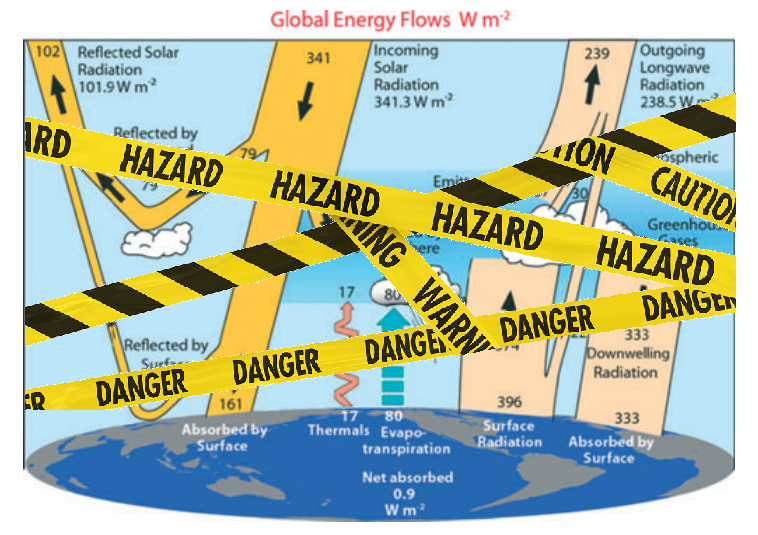
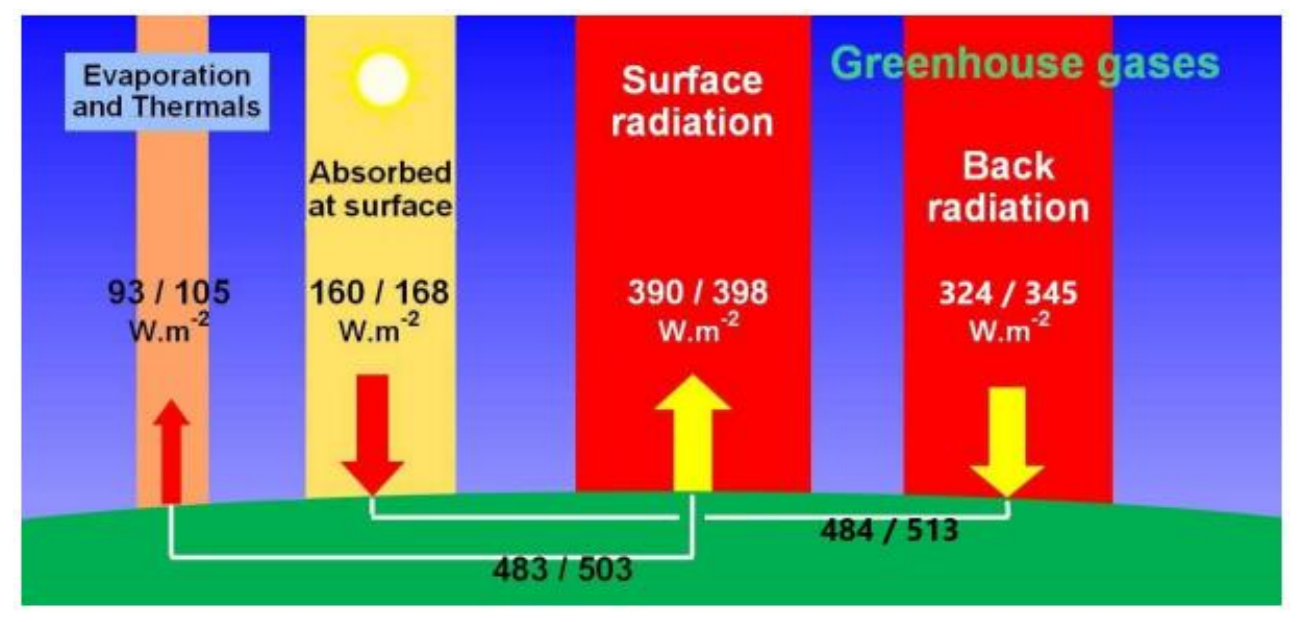
Logically, at -18°C the surface of the earth without an atmosphere or with an atmosphere totally transparent to longwave radiation and that plays no physical role, without any greenhouse effect, should be entirely frozen and covered with frost over its entire surface. This would result in a high Albedo which could be on the order of 0.5 to 0.9 instead of an albedo of 0.30 or 0.29 generally accepted in its current state. In this situation, instead of the solar energy absorbed by the surface reaching approximately 160 to 168 W/m-2 (Figure 1) this energy could be on the order of 70 W/m-2 [9-11]. The Stefan-Boltzmann formula yields a potential surface temperature of approximately -85°C [2]. Note that at these temperatures the water vapor pressure above ice is infinitesimal and could only generate an infinitesimal greenhouse effect. However, according to Nikolov et al., the effects linked to the atmosphere would bring approximately 90°C and not 33°C to the surface at a temperature of 15°C [12,13]. This would suggest that the global  natural effect of atmosphere could be on the order of 90°C rather than the 33°C of the traditional purely radiative approach as reported by almost all the authors.

Global mean energy budget of the Earth

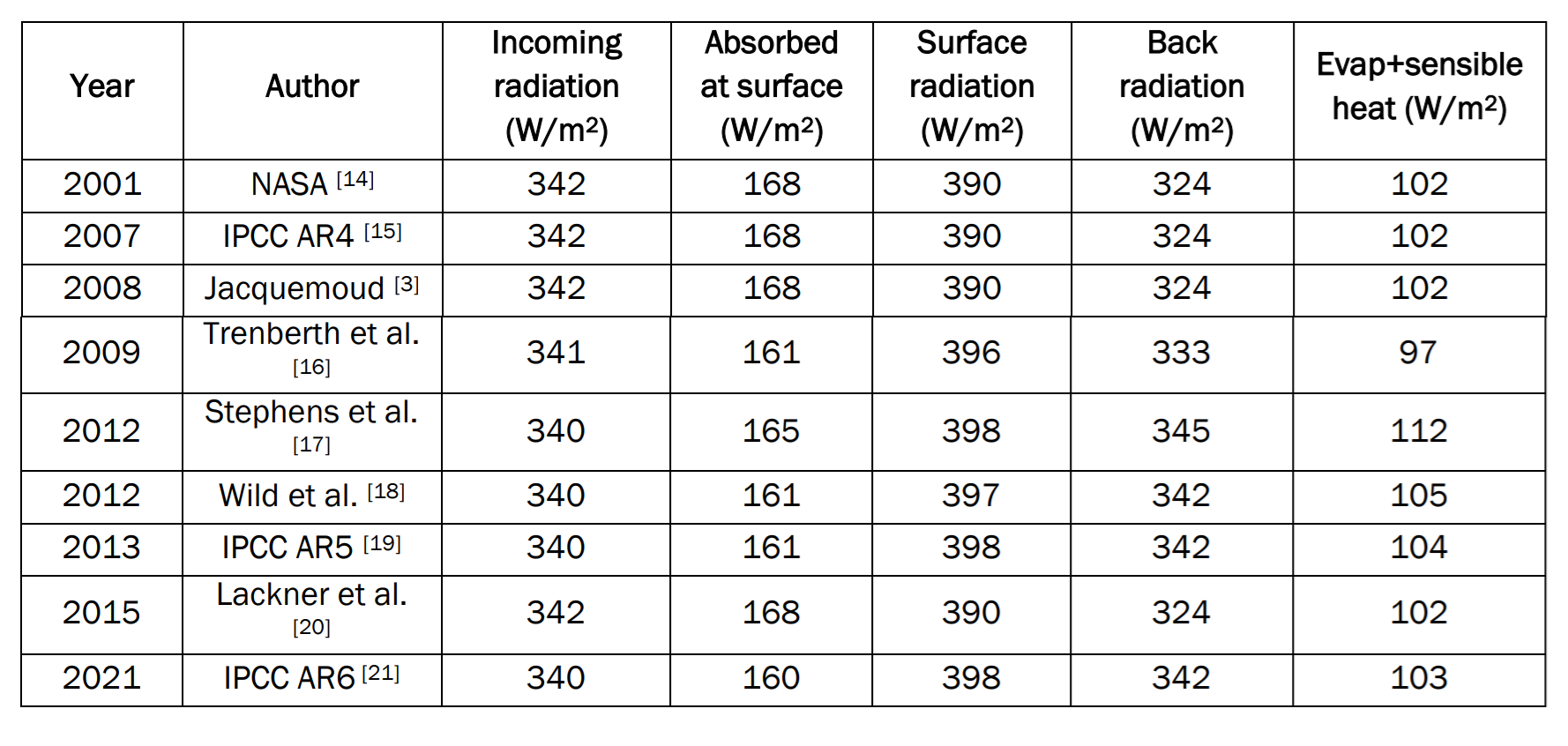
Many authors have endeavored to establish an overall assessment of the energy flows to which the earth is subjected to justify the surface temperature in an essentially radiative system. The Intergovernmental Panel on Climate Change (IPCC) itself places great emphasis on this in each of its reports. The Figure 1 summarizes the values and differences obtained while Table 1 summarizes the main authors who evaluated this earth assessment over a period of approximatively twenty years.

Figure 1. Range of nine energy balances (minimum/maximum according to the authors).

Table 1. Global energy balance of the Earth according to the authors.

The dispersion and imprecision of the results do not allow the effect on surface temperature to be deduced with sufficient accuracy. These budgets must be improved as noted by Lupo et al. [22]

Effect of atmospheric pressure

Few authors have mentioned the role that an atmospheric mass subject to gravity could play in temperature. We can nevertheless cite Leroux [23] Jelbring [24], and Chilingar [25] but these authors evoke a potential role of atmospheric pressure on a qualitative level without seeking to calculate and quantify the effects, probably given the difficulty of integrating the atmosphere as a whole. Nikolov et al. clarify the role of atmospheric pressure for several planets through a complex semiempirical iterative approach [11]

Dimensional analysis of the ideal gas law PV=nRT

The ideal gas law PV=nRT is one of the most fundamental laws of physics and applies entirely to the lower troposphere under its usual conditions of pressure and temperature. This universally accepted law, established in 1834 by Émile Clapeyron, has been perfectly stable for nearly 200 years, which is the case for very few physical laws.

  • P is the pressure (Pa);
  • V is the volume of the gas (m3);
  • n is the quantity of material (mol);
  • T is the absolute temperature (K);
  • R is the universal constant of ideal gases (8.314 J K−1 mol−1);

Dimensional analysis leads to:
R=PV/nT i.e., J K−1 mol−1=Pa.m3 K−1 mol−1, Hence J=Pa.m3=energy

The volume of air multiplied by the pressure to which it is subjected is considered energy (Joules). The atmosphere is heated by compression due to the gravitational field to which it is subjected. Isolated in space, the Earth can only exchange energy with space by radiation, but the atmospheric mass cannot radiate spontaneously since its homonuclear constituents O2, N2, and Ar are passive and cannot radiate.

The earth’s surface is warmer and the atmosphere cannot cool down on contact with it. The compression is thus adiabatic. The greenhouse gases contained in the atmosphere at low levels, mainly H2O and CO2, are capable of radiating at long wavelengths but do not interact radiatively with O2 and N2; additionally, they are under the influence of permanent terrestrial infrared radiation, which they are capable of absorbing, and which is generated continuously from the solar energy received by the Earth’s surface.

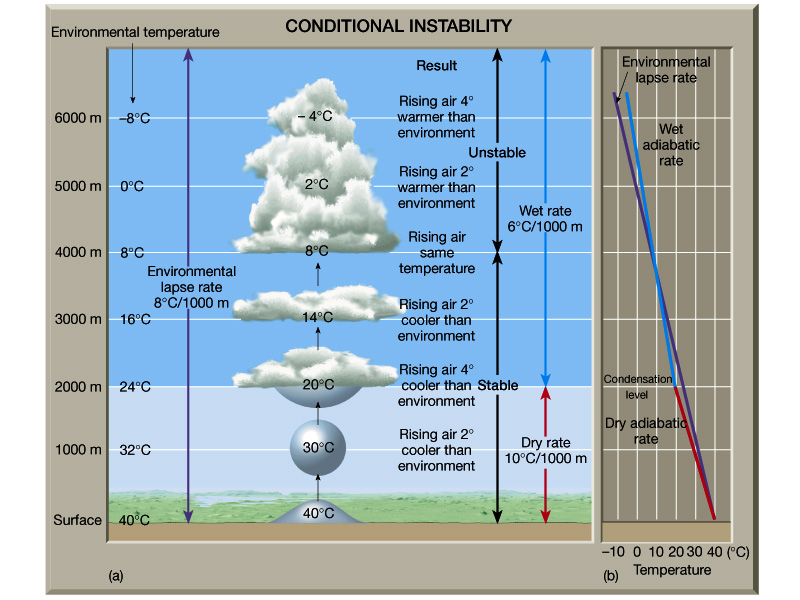
The process includes the upward expansion, toward vacuum of the agitated molecules whose kinetic energy decreases and therefore the pressure, which causes cooling with altitude. It is not due to a  decrease in gravity which decreases by less than 3/1000 at a 10 km altitude but of a struggle between gravity and the suction of the vacuum, until the equilibrium which defines an adiabatic thermal gradient. Gravity nevertheless prevents air molecules from escaping into space. Only some H2 molecules can reach the release speed.

RESULTS  Heating of the atmosphere in °K by adiabatic compression

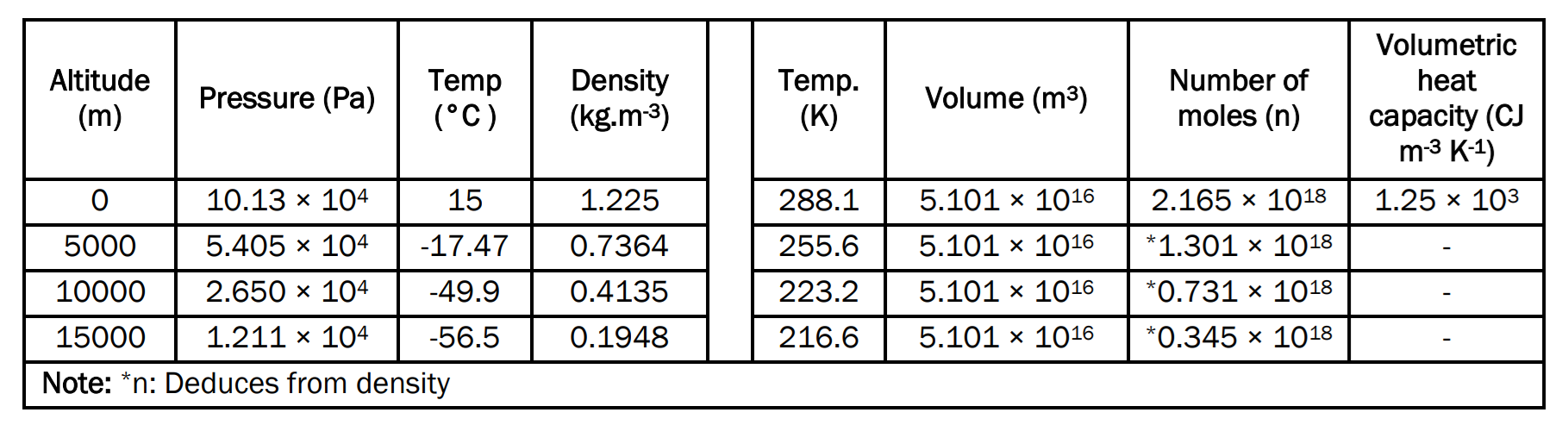
Table 2. Data for an air layer 100 m thick. The left part is from U.S. Standard Atmosphere, according to The EngineeringToolBox [26]

As a tight approximation, for 100 m of atmospheric thickness
Altitude 0 m

  • PV=(10.13 × 10⁴ Pa) (5.101 × 10¹⁶ m3)=5.167 × 10²¹ J
  • Volumetric heat capacity of air C=1256 J m−3 K−1 (at 0 m, 15°C)
  • For 5.101 × 10¹⁶ m3 of air; +1°K requires 1256 × 5.101 × 1016 J=6.41 × 10¹⁹ J
  • 5.167 × 10²¹ J/6.41 × 1019 J=80.7
  • +80.7 K overheating due to pressure

Note: With an air layer of 200 m the precision is lower and leads to an overheating of 80.6 K

Gravity compression results, to the Earth’s surface, in 80.7°C of natural greenhouse energy equivalence, which means that to reach 15°C the initial temperature without atmosphere would be -65.7°C, very different from the -18°C admitted by radiative approaches for an inactive atmosphere.

Direct application of the ideal gas law T=PV/nR

  • Altitude 0 m T=(10.13 × 104 × 5.10 × 1016)/(2.165 × 1018 × 8.314)=287.1 K (+14.0°C)
  • Altitude 5,000 m T=254.9 K (-18.2°C)
  • Altitude 10,000 m T=222.4 K (-50.7°C)
  • Altitude 15,000 m T=215.3 K (-57.8°C)

The standard thermal gradient from 0 to 10 km is -6.49°C/km. The ideal gas law explains phenomena linked to temperatures up to 10,000 m in altitude. Beyond that, the results diverge, and other factors and phenomena are involved, like ozone and UV influence.

CONCLUSION

The temperature on the surface of the earth is mainly determined by the action of gravity on the atmospheric mass, which is an immutable fact on a scale of millennia. Climatic variations are the result of lesser phenomena. The solar influence is felt during the day by the direct radiation received, mainly when the sun is at its zenith, and the balance is modified by direct thermal exchanges between the sunny surface and the air in contact. The earth’s surface and the upper layers of the atmosphere radiate permanently towards space by emitting infrared radiation day and night, thus restoring the overall balance.

Surface infrared radiation is probably less intercepted in the lower troposphere by greenhouse molecules than is usually thought, thus explaining the surface temperature. However, there is an atmospheric dynamic, in particular through the water cycle, by evaporation-condensation, but whose overall energy balance is zero. Air mass movements and convection contribute to the overall dynamics, mainly due to the rotation of the Earth and the alternations between the presence and absence of solar radiation.

Astronomical fluctuations in sunshine, surface phenomena such as ocean currents, El Niño or La Niña phenomena, extreme weather phenomena or even volcanic eruptions, as well as other factors that are probably poorly characterized, lead to variations in surface temperature that nevertheless remain relatively damped due to the stabilizing effect of the invariable atmospheric mass subject to gravity.


via Science Matters

https://ift.tt/t9KczYs

June 8, 2025 at 12:27PM

Recent Devastating Floods Failed to Convince Climate Skeptic Aussie Farmers

Essay by Eric Worrall

“… I believe the Australian climate has always been a land of droughts and floods …”

Farmers face ‘new world’ of extreme weather as scientists urge action on climate change

By David ClaughtonMichael Condon and Cara JefferyABC Rural
Topic:Climate Change
Thu 5 Jun

Climate scientist and University of Melbourne Emeritus Professor David Karoly said a near-stationary high pressure system in the Tasman Sea had contributed to the high rainfall event, stalling a moist, easterly flow of air over the NSW coast.

Craig Emerton, whose family has been farming at Croki since 1856, described the May floods as “totally unprecedented”, with water levels three times higher than he had experienced before.

However, the dairy farmer said he was not convinced climate change was the issue.

He pointed to geography for evidence of what happened before Australia was colonised and flood height records were started.

“When we look at the landform on this coastal flood plain, we can see that there’s been big floods over the years where sediment has built up,” he said.

“My dad spoke of six floods in six weeks … so we just happen to be in a very wet period.”

At Dungog, fellow dairy farmer Sue McGinn shared his view.

“I believe the Australian climate has always been a land of droughts and floods,” she said.

Read more: https://www.abc.net.au/news/rural/2025-06-05/climate-change-linked-to-floods-extreme-weather-nsw/105353550

Aussie farmers have been on the receiving end of climate activism in recent years, with allegations of bullying and heavy handed tactics pushing through renewable infrastructure approvals.

Having said that, there is plenty of reason for this skepticism other than anger at alleged coercive green tactics.

Why don’t Aussie greens embrace nuclear power as an acceptable zero carbon option?

This bizarre green rejection of nuclear power is what led me personally to first question climate alarmism. If we are facing a planetary emergency, all options for addressing the problem should be on the table. There would be no major conservative opposition to zero carbon energy, if greens embraced nuclear power.

Greens give the impression they would rather battle conservatives than embrace zero carbon energy which includes nuclear power, despite claiming CO2 emissions are a global crisis. This bizarre rejection of the only path to zero carbon energy which conservatives would accept in my opinion more than justifies questioning their other statements and claim.

The frequently repeated claim nuclear power is impossibly expensive and / or too dangerous is absurd, given that France has derived around 60%+ of their electricity from nuclear for decades. Therefore the green rejection of nuclear is irrational, which means their other claims require careful examination.

I personally recently opposed nuclear in Australia, because I support coal as the cheaper option – but unlike renewables, nuclear is a proven economically viable solution to a nation’s energy needs. I just figured with all that coal waiting to be mined, Australia had better options.

The climate council, of which climate scientist David Karoly is a leading member, is strongly opposed to nuclear power.


Discover more from Watts Up With That?

Subscribe to get the latest posts sent to your email.

via Watts Up With That?

https://ift.tt/uI7CfWc

June 8, 2025 at 12:04PM