AI DATA CENTRES CHOOSING FOSSIL FUELS

Larry Fink, head of BlackRock, claims people don’t care about renewables now, they just want power:

The reliance on gas power for data centers is a departure from previous thought, said Larry Fink, founder of global investment firm BlackRock, speaking to a crowd of industry executives at an oil and gas conference in Houston in March.

About four years ago, if someone said they were building a data center, they said it must be powered by renewables, he recounted. Two years ago, it was a preference.

“Today?” Fink said. “They care about power.”

 Forget “renewable energy” — new AI data centers are building their own gas plants in Texas « JoNova

via climate science

https://ift.tt/yo9Vs2q

June 6, 2025 at 05:18PM

If it walks like a Duck Curve… It must be California

Guest “What’s easier than picking on the Grauniad?” by David Middleton

Picking on California…

May 28, 2025

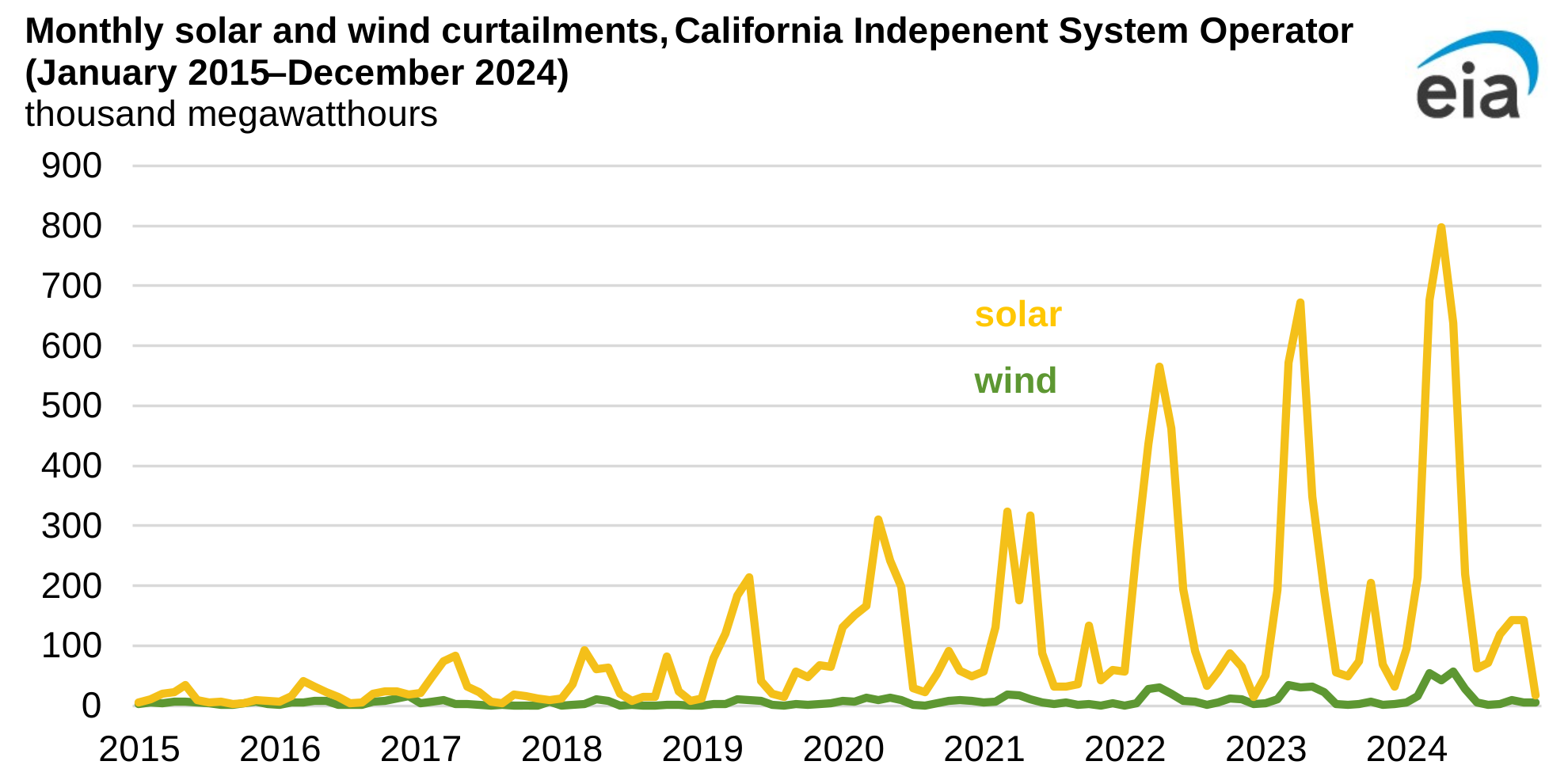
monthly solar and wind curtailments, California Independent System Operator

Data source: California Independent System Operator


The California Independent System Operator (CAISO), the grid operator for most of the state, is increasingly curtailing solar- and wind-powered electricity generation as it balances supply and demand amidst rapid renewables capacity growth.

Grid operators must balance supply and demand to maintain a stable electric system. The output of wind and solar generators is reduced either through price signals or, rarely, through an order to reduce output during periods of:

  • Congestion, when power lines don’t have enough capacity to deliver available energy
  • Oversupply, when generation exceeds customer electricity demand

In 2024, CAISO curtailed 3.4 million megawatthours (MWh) of utility-scale wind and solar output, a 29% increase from the amount of electricity curtailed in 2023.

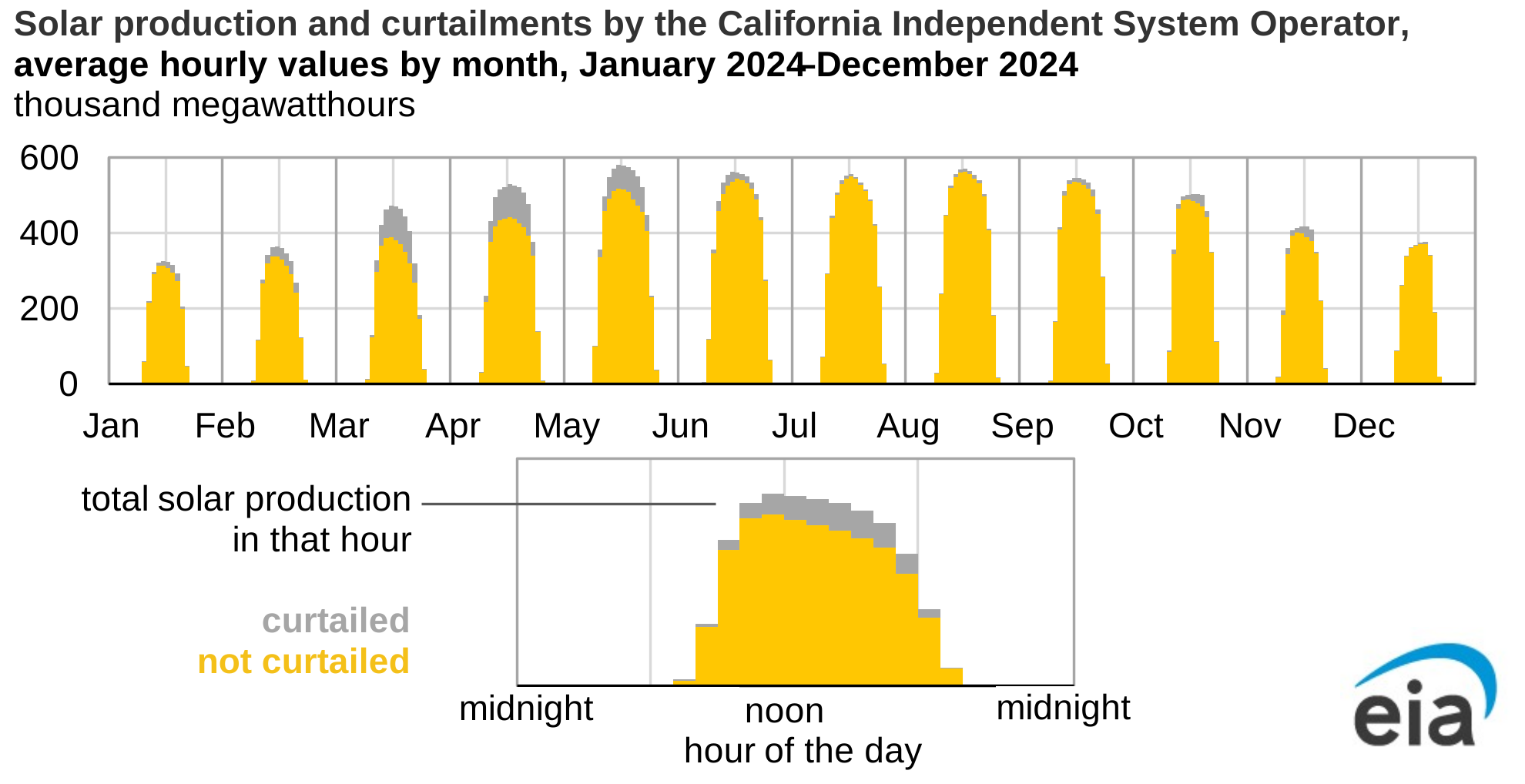
Solar accounted for 93% of all the energy curtailed in CAISO in 2024. CAISO curtailed the most solar in the spring, when solar output was relatively high and electricity demand was relatively low, because moderate spring temperatures meant less demand for space heating or air conditioning.

solar production and curtailments by the California Independent System Operator

Data source: California Independent System Operator


In 2014, a combined 9.7 gigawatts (GW) of wind and solar photovoltaic capacity had been built in California. By the end of 2024, that number had grown to 28.2 GW.

CAISO also curtails solar generation to leave room for natural gas generation. A certain amount of natural gas generation must stay online throughout the day to comply with North American Electric Reliability Corporation (NERC) reliability standards and to have generation online in time to ramp up in the evening hours.

Solar energy supplies almost half of CAISO’s electricity demand between the hours of 8:00 a.m. and 4:00 p.m., but demand increases in the later evening hours when people come home from work and turn up air conditioners or electric heaters and turn on lights, ovens, computers, and televisions. This need is especially apparent on hot summer evenings after the sun has set and no longer produces solar power overnight.

CAISO is trying to reduce curtailments in several ways:

  • Trading with neighboring balancing authorities to try to sell excess solar and wind power
  • Incorporating battery storage into ancillary services, energy, and capacity markets
  • Including curtailment reduction in transmission planning

In addition, starting this year, companies are planning to use excess renewable energy to make hydrogen, some of which will be stored and mixed with natural gas for summer generation at the Intermountain Power Project’s new facility scheduled to come online in July.

The Western Energy Imbalance Market (WEIM) is a real-time market that allows participants outside of CAISO to buy and sell energy to balance demand and supply. In 2024, more than 274,000 MWh of curtailments were avoided by trading within the WEIM, equivalent to about 8% of the electricity curtailed that year. The Extended Day-Ahead Market (EDAM) is expected to be operational by May 2026 and will allow CAISO another outlet to sell solar energy.

To further reduce renewable curtailments and increase the stability of the grid, CAISO is promoting the addition of flexible resources that can quickly respond to sudden increases and decreases in demand. Battery storage, recently the key flexible resource to come online, allows some renewable energy to be stored and used 4-8 hours later in the day. Batteries can charge using excess solar power at midday and then discharge that energy when the sun is going down, providing electricity during hours when it is most needed. Battery capacity in CAISO increased by 45% in 2024, from 8.0 GW in 2023 to 11.6 GW in 2024 according to our survey of recent and planned capacity changes. However, in the spring, more solar energy than can be used within a day is often produced. Without more transmission capacity or a long-term storage solution, high curtailments during this time of year can still occur.

Principal contributor: Lori Aniti

Tags: solarwindelectricitygenerationCaliforniastateselectric power grid

US EIA

“CAISO curtailed 3.4 million MWh of utility-scale wind and solar output”

At 26¢/kWh, that’s nearly $900 million worth of electricity generation!

Setting side the hydrogen fantasy and the notion of California forcing other states to buy their excess solar generation, the obvious solution (apart from pulling the plug on solar power) is…. Batteries.

MWh kWh $/kWh Total Cost
         3,400,000    3,400,000,000  $        300  $         1,020,000,000,000
         3,400,000    3,400,000,000  $        500  $         1,700,000,000,000

Batteries…

Featured Image Source

Gavin Newsom Named U-Haul Salesperson Of The Year

U.S.·Sep 15, 2021 · BabylonBee.com

SACRAMENTO, CA – U-Haul has named Governor Gavin Newsom its Salesperson of the Year for the third year in a row after a record-setting sales quarter. 

“We are astounded by the growth we’ve seen in California,” said U-Haul’s Western Regional Director Fennick Buggstein. “Thanks to Gavin Newsom, literally every middle-class family has moved out of the state! It’s been impossible to keep up with demand! Also, most of our workers left the state too, which kind of stinks.” 

[…]

The Babylon Bee


Discover more from Watts Up With That?

Subscribe to get the latest posts sent to your email.

via Watts Up With That?

https://ift.tt/s4AlTkq

June 6, 2025 at 04:06PM

Forget “renewable energy” — new AI data centers are building their own gas plants in Texas

By Jo Nova

New AI Data Centers are going off-grid

Such is the blistering race to get ahead in the global AI battle, that the industry is not waiting for the bureaucrats to build new power plants anymore, they are doing it themselves. And the leading edge of data engineers are not choosing the clean green wind or solar power of the future — they’re building gas plants.  The sun and wind are free, but the battery back up, high voltage lines, long approvals, and unreliable supply

Dylan Baddour, Arcelia Martin, Ars Technica

The plant would be big enough to power a major city, with 1,200 megawatts of planned generation capacity fueled by West Texas shale gas. It will only supply the new data center, and possibly other large data centers recently proposed, down the road.

The project is one of many others like it proposed in Texas, where a frantic race to boot up energy-hungry data centers has led many developers to plan their own gas-fired power plants rather than wait for connection to the state’s public grid.

It was Energy Transfer’s first-ever contract to supply gas for a data center, but it is unlikely to be its last. In a press release, the company said it was “in discussions with a number of data center developers and expects this to be the first of many agreements.”

Behold the modern gold-rush — look at the number of applications to build power (of all sorts) and connect it to the grid in Texas:

There were more than 2,000 active generation interconnection requests as of April 30, totalling 411,600 MW of capacity, according to grid operator ERCOT. A bill awaiting signature on Gov. Greg Abbott’s desk, S.B. 6, looks to filter out unserious large-load projects bloating the queue by imposing a $100,000 fee for interconnection studies.

Larry Fink, head of BlackRock, claims people don’t care about renewables now, they just want power:

The reliance on gas power for data centers is a departure from previous thought, said Larry Fink, founder of global investment firm BlackRock, speaking to a crowd of industry executives at an oil and gas conference in Houston in March.

About four years ago, if someone said they were building a data center, they said it must be powered by renewables, he recounted. Two years ago, it was a preference.

“Today?” Fink said. “They care about power.”

To get some idea on the seismic transition that is really underway, ponder that one of the new start ups wants 5,000MW of energy for a new data center covering 2,600 acres, and it is going in to a small town in Texas of less than a thousand people.  That’s a massive 5GW for a town of 940 people.

There are still a few projects with renewable ambition. One project team that requires just 120MW said it will use just wind power and one large plant says they hope to run a 5GW data center on “private wind, solar and hydrogen” but they will start with gas at first. 

We, here in Australia, are not even in the race.


0 out of 10 based on 0 rating

via JoNova

https://ift.tt/gEDxscA

June 6, 2025 at 02:56PM

“Climate dread is everywhere”

“Climate dread is everywhere: the panic, the guilt, the looming sense that nothing we do is enough.” Awe: An underrated climate strategy | by The Medium Newsletter | The Medium Blog | Jun, 2025 | Medium

via Real Climate Science

https://ift.tt/Cb4GoiF

June 6, 2025 at 02:00PM