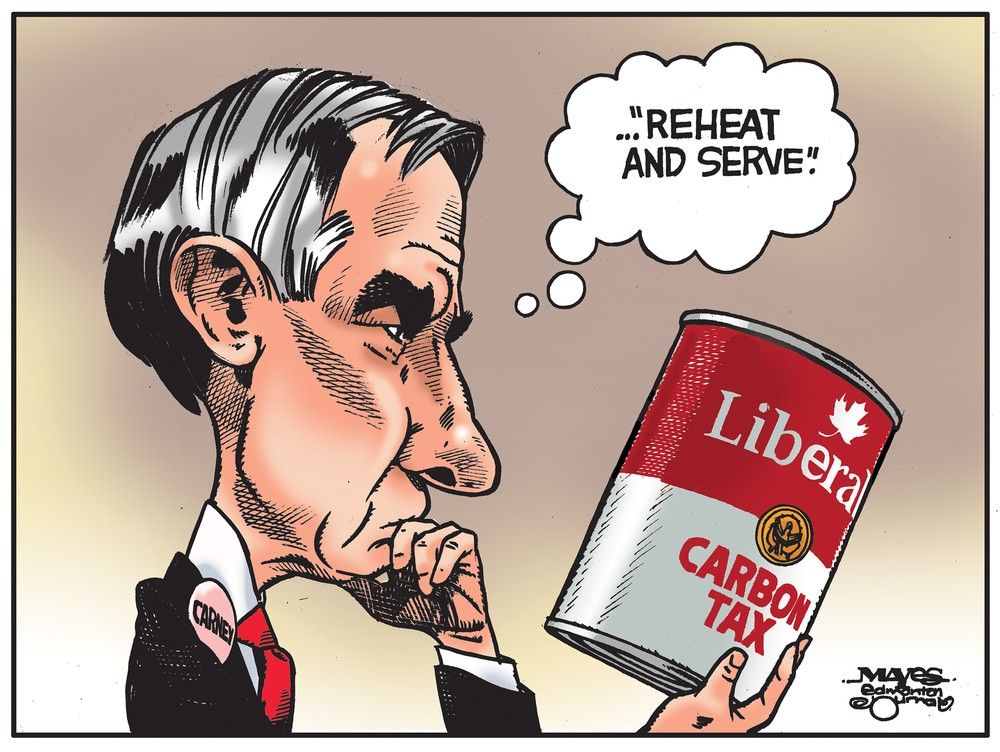
Canada PM Carney Floats Imaginary “Decarbonized Oil” Pipeline

Reality intrudes in National Post article Alberta and Ottawa tout a grand bargain on ‘decarbonized’ oil but some are skeptical.  Excerpts in italics with my bolds.

Carney said he’d consider fast-tracking a new oil pipeline
to the West Coast if it shipped ‘decarbonized barrels’

OTTAWA — “Grand bargain” was the phrase of the day on Parliament Hill after Prime Minister Mark Carney and his provincial counterparts found common ground on oil and gas development.  “If (the Conservatives) were listening to yesterday, there is a grand bargain,” Energy Minister Tim Hodgson boasted to the Opposition benches.

“There is a bargain that the Premier of Alberta has signed onto.”  Alberta Premier Danielle Smith left Monday’s first ministers’ meeting with a new deal exchanging oil sands access to coastal waters for massive investments in decarbonization technologies, but experts warn this could be a costly pipe dream. 

“I’m worried we’re seeing (the first ministers) fall into a trap of wanting to have their cake and eat it too,” said Tim McMillan, a partner at Garrison Strategy and the former head of the Canadian Association of Petroleum Producers.

“There’s real potential there (and), if further developed, the federal government will look to advance it,” said Carney.  But McMillan says the devil could be in the details.

“I don’t know exactly what they’re talking about with decarbonization, but… it may be linked to carbon capture, which does not increase our exports (or) investability,” said McMillan.  “If (carbon capture) becomes a long-term requirement for new projects, it will likely have a negative effect on future investments in Canada’s upstream oil and gas sector.”

The Calgary-based Pathways Alliance, a group of six major oil sands producers, has put forward a $16.5-billion decarbonization network that would reroute carbon emissions from nearly two dozen facilities to an underground hub near Cold Lake, Alta.  The big-ticket project has been at a standstill for years over government funding.

Smith said Monday that the financial windfall of a new West Coast bitumen pipeline serving markets in Asia could help make the economics of the Pathways project work.  “If we had a million barrel a day pipeline going to the northwest (British Columbia) coast, that would generate about $20 billion a year in revenues… that seems like a pretty good value proposition if both of those projects can proceed at once,” said Smith.

Carney and Hodgson have both paid lip service to the Pathways project in recent weeks, but the venture still faces an uphill battle.  A recent independent analysis found the project was likely to lose money due to the limited recyclability of captured carbon.

“Even under optimal conditions, the Pathways project may struggle to break even, and real-world operations are rarely optimal,” read the study, prepared by the Institute for Energy Economics and Financial Analysis.  “The Canadian federal government and the province of Alberta may be pressured to make up the likely shortfall,” it continued.

“An unprofitable carbon capture project will struggle to bring lasting positive economic benefits to host communities and become dependent on external financial subsidies to maintain operations.”

McMillan also noted that Canada’s two biggest competitors in the heavy oil industry, Mexico and Venezuela, are unlikely to follow suit with large-scale carbon capture projects of their own, giving each an edge over Canada on a per-barrel basis.

Footnote:  “Some are skeptical” understates the case.  “Decarbonized Oil” is a Ruinous Farce.

The Study is Financial risks of carbon capture and storage in Canada: Concerns about the Pathways Project and Public Energy Policy.  Highlights in italics with my bolds and added images.

Cost challenges threaten the ability of a large, planned carbon capture project to achieve financial sustainability. The Pathways Alliance plans to capture carbon dioxide (CO2) generated at 13 oil sand processing facilities, compress the gas and send it by pipeline to a storage hub near the Cold Lake region in Alberta. Publicly available financial information on the Pathways project is scant. It is instructive, however, to analyze the experiences of two existing commercial carbon capture facilities in Alberta—the Alberta Carbon Trunk (ACTL) line facility and Shell’s Quest facility.

The Institute for Energy Economics and Financial Analysis (IEEFA) examined the two currently operating CCS projects, together with current policy and provincial carbon market dynamics. The resulting report identified troubling cost implications for the Pathways CO2 transport and storage project and raises the concern that the Canadian federal government and the province of Alberta may be pressured to make up the likely shortfall.

  • We find total costs including interest, insurance, depreciation and taxes for existing commercial-scale carbon capture plants in Alberta are approaching thresholds that threaten profitability.
  • Rising project costs are not being offset by commensurate increases in CO2 capture volumes and associated revenue. Operating costs are growing at twice the rate of CO2 captured volumes.
  • CCS operating revenue is uncertain. An effective cap on emission performance credit (EPC) pricing of CAD$170 per tonne limits project revenue potential, while a looming oversupply of carbon EPCs is an example of risks to project cash flows. The option to combine Clean Fuel Regulation credits with EPCs is available to ACTL, but this significant financial benefit is not available to the Pathways project.
  • Performance risk is financial risk. Without substantial efficiency improvements, the cost per tonne of CO2 captured is likely to exceed the revenue that the project can generate for each tonne captured. 
  • An unprofitable carbon capture project will struggle to bring lasting positive economic benefits to host communities and become dependent on external financial subsidies to maintain operations.

Even under optimal conditions, the Pathways project may struggle
to break even, and real-world operations are rarely optimal.

Large-scale public investment in CCS is misguided. The technology has struggled to achieve meaningful emissions reductions or prove its long-term viability. The lack of demonstrated success and heightened financial risks indicate public investments are unlikely to yield the desired environmental or economic benefits.


via Science Matters

https://ift.tt/m1stpMe

June 6, 2025 at 10:51AM

Saturday

0 out of 10 based on 0 rating

via JoNova

https://ift.tt/YU251Oa

June 6, 2025 at 09:17AM

Environment improves as more nations prosper — the greatest polluter is poverty

Environment improves as more nations prosper — the greatest polluter is poverty
kriszti

As we approach Earth Day this Tuesday, it’s tempting to believe that the world is on the brink of environmental collapse. We are constantly inundated by dire predictions of climate catastrophe and warnings about the planet’s imminent destruction.

Category

Articles
Climate change
Air Pollution
Energy
English

Published by New York Post

https://nypost.com/2025/04/20/opinion/environment-improves-as-more-nations-pros…
Read the full article

via Lomborg

https://ift.tt/l5asVJm

June 6, 2025 at 08:52AM

New York Electric Power Trends

Roger Caiazza

Recently the New York Independent System Operator (NYISO) released Power Trends 2025.  This is the NYISO’s annual description of factors influencing New York State’s power grid and wholesale electricity markets.  It suggests that there are looming issues with New York’s aspirational net-zero transition plans that must be similar to transition plans at all other jurisdictions.

Overview

In 2019 Climate Leadership & Community Protection Act (Climate Act) legislation established a “Net Zero” target (85% reduction in GHG emissions and 15% offset of emissions) by 2050.  Since then, the State has been trying to implement the Scoping Plan recommendations through regulations, proceedings, and legislation.  One law is Public Service Law Section 66-P Establishment of a renewable energy program that requires the Public Service Commission to establish a program to meet the interim targets for 70% of the energy delivered in 2030 “shall be generated by renewable energy systems” and that “by the year two thousand forty the statewide electrical demand system will be zero emissions”.

The Power Trends Resources landing page provides documentation and links to the Power Trends 2025 report itself, and a Power Trends Fact Sheet.  A press release offers a third summary of the report.  This post describes the takeaways promoted by NYISO in those documents.

Reliability Margins

The Fact Sheet, Power Trends Report, and Press Release emphasize a concern about declining reliability margins.  The Press Release explains:

Generator deactivations are outpacing new supply additions. Electrification programs and new large-load customers associated with economic development initiatives are pushing projected demand higher. Together, these forces are also narrowing reliability margins across New York and increasing the risk of future reliability needs.

Recent Power Trend reports have included the declining reliability margins issue.  The following figure shows last year’s status compared to this year.  The decline in margin is mostly because fossil units are retiring faster than zero emissions replacements are coming on-line. 

Source: Power Trends 2025

Fossil Plants

All three NYISO documents note that the average age of the fossil fleet is increasing.  They also point out the advantages of modernizing old fossil facilities.  The Press Release explains: “Repowering aging power plants can lower emissions, meet rising consumer demand, and provide reliability benefits to the grid that are needed to integrate additional clean energy resources.”  The declining margin and the age of the fossil plants reflects a lack of foresight by New York agencies that have been pressuring existing power plants to reduce emissions or shut down. 

Power Trends states that: “Repowering aging power plants can lower emissions, meet rising consumer demand, and provide reliability benefits to the grid that are needed to integrate additional clean energy resources.”  The New York Department of Environmental Conservation (DEC) has rejected several repowering applications to replace existing old generators with modern new facilities because of the Climate Act.  Unfortunately, there is no direct link between the proposed facilities and a particular reliability issue, so DEC rejected the applications.  This is an example of poor New York energy planning because the permit decisions were considered in isolation not in the context of the needs of the electric system.  While I applaud the fact that this is a recommendation of Power Trends, it is also fair to ask why the NYISO did not intervene in the repowering applications. 

New Load Growth

Future reliability margins will also be affected by new load growth.  The Fact Sheet and Report note that “New high-tech, AI and data center projects are having an impact on future electric demand and load growth”.  Figure 1 from the Report notes that 2,567 MW of new load capacity is needed by 2035 and the document notes that other projects could add around 1,900 MW of capacity after that.  I am disappointed that the NYISO Report did not mention that these new load centers require constant energy and clean power that is free from electrical noise, surges, voltage spikes, and drops.  Those needs  exacerbate the challenge of the Public Service Law Section 66-P “Establishment of a renewable energy program” requirements.

Source: Power Trends 2025

Winter Shift

The three NYISO documents all note that the peak loads are projected to shift to the winter from the summer.  The Press Release notes that:

New York is projected to become a winter-peaking electric system by the 2040s, driven primarily by electrification of space heating and transportation. On the coldest days, the availability of natural gas for power generation can be limited, and interruptions to natural gas supply will introduce further challenges for reliable electric grid operations.

There is another unmentioned complication with winter peaking.  When the Public Service Law Section 66-P “Establishment of a renewable energy program” electric system that relies on wind and solar generating resources is in place, the winter solar availability is much lower than in the summer.  This is another challenge that I think the Power Trends report should have acknowledged.

Competitive Market

The Fact Sheet, Power Trends Report, and Press Release all extoll the power of competitive markets to support the transition while maintaining reliability and minimizing consumer costs.  The NYISO is a product of the de-regulated competitive market. The report explains that: “We are committed to administering and overseeing the competitive electricity markets as the most cost-effective way to attract and retain new resources to meet our reliability needs as we transition to a decarbonized grid.”  I do not share their optimistic outlook for the market’s ability to attract and retain new resources.  At this time, it is not clear what kind of resources and how much of those resources are needed, so the presumption that they can design a market to attract those resources is questionable.

Interconnection Process

The three NYISO documents all note that there are interconnection issues.  The Press Release states: “New supply, load, and transmission projects are seeking to interconnect to the grid at record levels. NYISO’s interconnection processes continue to evolve to balance developer flexibility with the need to manage the process to more stringent timeframes.”

This is an issue that is directly within the purview of NYISO, and it is a problem.  Power Trends describes proposed modifications to the process but does not acknowledge that there are fundamental issues.  Many of the new projects are inverter-based resources and integrating this new category of resources is problematic for grid stability and reliability.  Regulatory frameworks are under development to address this problem, and this has contributed to the interconnection delays.  I do not understand why NYISO did not mention that problem.

Discussion

The most recent edition of Power Trends warns of significant issues facing the New York electric system.  While I think that NYISO has become more forthcoming in this edition than previous reports about the severity and consequences of the problems, I am still disappointed with the report for several reasons.  In the first place, it is still necessary to read between the lines in all their reports to understand that they know there are enormous challenges associated with the transition to a renewable energy electric system.  I think that is a disservice to the residents of New York.  A truly independent agency should explicitly describe the reliability and affordability difficulties facing the electric system without holding back. 

I am also disappointed that the Power Trends document did not describe specific Climate Act-related issues that I mentioned in the description above.  In my opinion the biggest reliability challenge for any electric system dependent upon weather reliant resources is the necessity of a new category of electric system support technology that can be reliably dispatched to provide both energy and capacity over long durations with no emissions.  NYISO calls this resource the Dispatchable Emissions-Free Resource (DEFR) and notes that they are “crucial for meeting energy demands when intermittent renewable sources like solar and wind are unavailable.”  However, DEFR was only mentioned in passing.  The consequences of the challenges that we don’t know what DEFR will work and we don’t know how much DEFR is needed were not discussed.

Finally, I wish that NYISO would be more assertive in New York energy policy matters.   It is understandable given the bully-tactics of previous Administrations but New York State needs to hear from the experts.  For example, Power Trends notes that we need to do repowering of existing fossil power plants, but NYISO did not intercede directly to advocate for repowering applications that were rejected. 

Conclusion

The Power Trends 2025  report provides an excellent overview of New York State’s power grid and wholesale electricity markets.  There are suggestions that the State’s mandate to go to zero emissions is in trouble,  Unfortunately, NYISO does not consolidate all the warning signs about Climate Act implementation, nor does it call out state policies that are exacerbating problems.

Ultimately the problem is that New York has no comprehensive energy plan.  The Climate Act Scoping Plan is just a list of technologies that describe an electric system that is zero-emissions.  However, there is no feasibility study that shows how it will work nor has the Hochul Administration reconciled the differences between the Scoping Plan and NYISO resource outlooks.  As it stands now, the Administration plan is to build as many wind and solar facilities as possible and hope someone works out how they are supposed to be integrated into the electric system.  When that does not work, I predict the NYISO will be blamed.


Roger Caiazza blogs on New York energy and environmental issues at Pragmatic Environmentalist of New York.  The opinions expressed in this post do not reflect the position of any of his previous employers or any other organization he has been associated with.


Discover more from Watts Up With That?

Subscribe to get the latest posts sent to your email.

via Watts Up With That?

https://ift.tt/CaDmT3u

June 6, 2025 at 08:01AM