Climate Attribution Lawfare Hits New Low with 2021 Heat Wave Lawsuit

In yet another theatrical act of lawfare against the fossil fuel industry, Misti Leon has launched a wrongful death lawsuit against seven oil and gas companies, alleging they were responsible for the tragic passing of her mother, Juliana Leon, during the 2021 Pacific Northwest heatwave. The legal argument? That anthropogenic emissions from these companies directly caused the heatwave and therefore, her mother’s death. This suit, announced on May 29, 2025, marks a new chapter in the ongoing campaign to litigate weather.

The idea that any single heatwave—or any isolated weather event—can be laid at the feet of specific industrial actors stretches credulity. But this isn’t about evidence. It’s about constructing a politically useful narrative. The 2021 heatwave, which indeed brought record-breaking temperatures to the region, is now being used as a legal battering ram against energy producers. But the scientific scaffolding behind this claim is conspicuously hollow.

The event in question occurred in June 2021, when temperatures in the Pacific Northwest surged past 108°F. Juliana Leon died in her vehicle on a sweltering day in Ferndale, Washington, with a broken air conditioner and windows rolled down—a tragic circumstance exacerbated by her recent bariatric surgery and increased vulnerability to heat. The lawsuit alleges that oil companies failed to warn the public about the dangers of climate change and actively sowed doubt about the “consensus” on global warming. Yet none of this explains why individual risk factors, personal decisions, and public weather warnings play no role in the plaintiff’s logic. It’s a crude scapegoating operation masquerading as justice.

On the scientific front, the lawsuit relies on a distorted interpretation of “climate attribution science”—a burgeoning field that attempts to assign probabilistic blame for weather events to human activities. In the immediate aftermath of the heatwave, NOAA analysts called it a “1,000-year event,” with some attributing its occurrence to man-made climate change. But more rigorous follow-ups told a different story.

A 2024 study published in Nature Communications makes clear that the 2021 event defied conventional climate modeling. The authors describe the heatwave as a statistical and dynamical outlier—so extreme that it exposed fundamental weaknesses in current modeling frameworks. Specifically, their simulations could not reproduce an event of similar magnitude under standard greenhouse gas forcing scenarios. The study notes:

“We find that the models analyzed largely fail to simulate events as extreme as the 2021 heatwave. This discrepancy calls into question their ability to assess the frequency and drivers of such events accurately.”

https://journals.ametsoc.org/view/journals/wefo/39/2/WAF-D-23-0154.1.xml

This is not a ringing endorsement of attribution science—it is a direct indictment of its limitations.

Even the World Weather Attribution (WWA) group, typically eager to draw a straight line between emissions and extreme weather, conceded that this particular heatwave exceeded their models’ capabilities. They went as far as to speculate about unknown feedback mechanisms—an admission that the scientific community doesn’t fully understand what happened, much less why. The authors of the Nature paper went further, calling the event a “Black Swan,” a chaotic one-off driven more by atmospheric randomness than CO₂ levels.

But nuance isn’t useful when constructing a climate morality play. Instead, the lawsuit conflates correlation with causation, implying that the presence of emissions means culpability for any and all associated weather extremes. The plaintiff’s lawyers want it both ways: they allege the event would not have happened without climate change and simultaneously argue that climate change merely worsened it. Which is it? As meteorologist Ryan Maue wryly noted, “You can’t argue both. Pick one.”

Equally problematic is the suit’s attempt to pin liability on oil companies for not publicizing the dangers of climate change. This overlooks the elephant in the room: forecasts for the heatwave were accurate, publicly disseminated, and well-publicized. The National Weather Service issued timely warnings. If there was a failure, it was not one of awareness. Juliana Leon tragically encountered a lethal environment, but the proximate causes—lack of A/C, personal health risks, and direct exposure—don’t involve ExxonMobil or Chevron.

This suit is emblematic of a growing trend in climate litigation: ignore the uncertainties, simplify the science, and vilify an industry. As the Sabin Center for Climate Change Law gleefully documents, more legal cases are targeting fossil fuel companies—not for direct environmental harm, but for their alleged ideological noncompliance. “Disinformation,” “denial,” and “deception” are the new torts.

What’s at stake here isn’t compensation or justice; it’s control. These lawsuits are tools of policy-making by other means. Unable to pass sweeping Green New Deal-style reforms legislatively, climate activists are turning to the courts to impose de facto regulations through liability judgments. If successful, this lawsuit could open the door to endless claims—each one blaming oil producers for everything from floods to frostbite.

Make no mistake: Juliana Leon’s death is a tragedy. But exploiting it as a cudgel in the unscientific crusade of climate attribution is an abuse of both science and law. If the courts lend credence to such spurious reasoning, they won’t just be sanctioning junk science—they’ll be encouraging it.

This is lawfare dressed in climate robes, and it’s time to call it what it is: a cynical, opportunistic campaign built not on facts, but on fervor.


Discover more from Watts Up With That?

Subscribe to get the latest posts sent to your email.

via Watts Up With That?

https://ift.tt/2FV4wUJ

May 30, 2025 at 04:05PM

Tropical timings: a new Jupiter-Saturn model


In this post we propose a heliocentric view of solar system planetary motion based on Arnholm’s Solar Simulator 2, data provided by Jean Meeus and his collaborators. On the screen it says: ‘Looking down on Sun’s north pole.’

We refer to the tropical orbit data in NASA’s Planetary Fact Sheets for the main planets in the solar system, which says:
Jupiter = 4,330.595 days
Saturn = 10,746.94 days

Ratio calculation:
10746.94 / 4330.595 = 2.48163
2.48163 * 27 = 67.00404
A ratio of 27S:67J is almost 100% accurate (99.994%) so we proceed with that. The number of J-S conjunctions in the period of those orbits will be 67-27 = 40.

(Incidentally, in earlier Talkshop posts e.g. here we’ve defined the Jupiter tropical orbit as 83/7 tropical years = 4330.728 days, almost the same as the NASA figure.)

Degrees of orbital motion in the period:
Saturn = 27*360 = 9720 = 243° (9720/40) per J-S conjunction.
Jupiter = 67*360 = 24120 = 603° (24120/40) per J-S conjunction.

Each conjunction occurring when Saturn has moved 243° and Jupiter 603° (243° + 360°) means an ‘extra’ 3° each per conjunction compared to a 2:5 (= 600:240) theoretical orbit ratio model. The absence of such an exact orbit ratio is sometimes described as ‘The Great Inequality’ of Jupiter and Saturn. It leaves both planets 117° short of a whole number of orbits (1 for Saturn, 2 for Jupiter).

The difference of 40(67-27) * 360° = 40 J-S conjunctions, and also 13 precessions of their conjunction axis since:
40*117° = 13*360°.

This can be seen in the graphics here…

To confirm the consistency of these motions, here are the planet positions at 40 Jupiter-Saturn conjunctions earlier (left), and later (right) than the dates in the graphic above…

We can see the Sun-planets(J,S) line orientation is the same for all four dates, or almost so. In the second graphic the time interval of 2383.29~ years is equivalent to the well-known Hallstatt cycle, or 120 (40*3) J-S conjunctions. We’ll explore this further in another post.

[NB there’s nothing special about the dates we’ve used in those graphics, other than being intervals of 40 J-S conjunctions. Any initial J-S conjunction date with the same intervals should give the same outcome, although the orientation will depend on that date. On the solar simulator the last J-S conjunction date allowing a full Hallstatt cycle to be shown is in July 610, ending in December 2993.]

These closely aligned J-S conjunctions occur every 20 J-S or ~397y, as described in this article from Sky & Telescope: The 400-Year Rhythm of Great Conjunctions (see chart, right). Reason: 20*117° = 13*180° (i.e. halves of the conjunction) as the chart in effect shows, with the highlighted ‘great conjunction’ years alternating between rising and falling parts of the waves (1563-2020 = 397~ years). Our earlier graphics hint at the reason for the three overlapping waves, to be explained in a follow-up post.

The caption says: ‘In this chart, each small square represents a Great Conjunction.’

See also: 2020, November 2: Jupiter – Saturn Heliocentric Conjunction at the site ‘When the Curves Line Up – Watching the Sun, Moon and Planets’.


The graphic in that article has the caption:
‘2020, November 2: Jupiter passes Saturn in a heliocentric conjunction, as viewed from outside the solar system.’
Arnholm’s solar simulator also shows the conjunction on the same date (right), confirming the heliocentric view.

Note that NASA’s article: The ‘Great’ Conjunction of Jupiter and Saturn says that viewed from Earth the same conjunction peaked on December 21, 2020. This date is an outcome of Earth’s offset orbital position relative to a line between the Sun and the two big planets at the time (as ‘When The Curves…’ shows).

In a future post we’ll expand on some of the points raised here.
– – –
Note on tropical orbit periods –
In a recent Talkshop post: Tropical timings – the orbit of Neptune, we showed that Neptune’s orbit is 163.73~ TY (as in the NASA factsheet) in the reference frame of the solar simulator, just over a year less than the sidereal orbit period quoted by NASA. The solar simulator clearly uses the tropical year, otherwise the 18.25 orbits shown (2988 TY) wouldn’t fit into its 3000-year ‘window’ (18.25 * 164.79~ sidereal years = 3007.4~).

via Tallbloke’s Talkshop

https://ift.tt/Mweq94d

May 30, 2025 at 03:54PM

Billions of dollars spent on wind, solar and batteries and Australian electricity emissions went up last year

By Jo Nova

Welcome to Futility Island

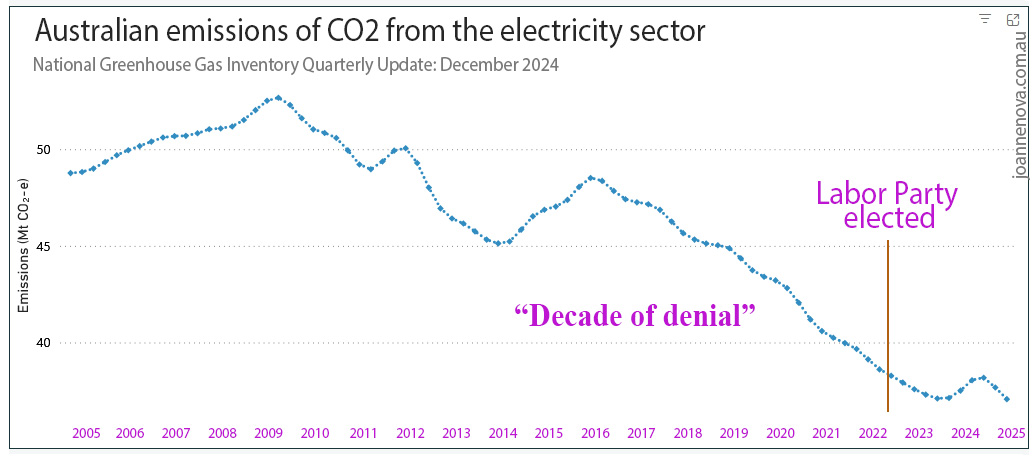
Anthony Albanese was elected in May 2022 and set God-like new emissions targets in to legislation. Ponder the scale of the national achievements of the last three years. All that money, all the wind factories, the solar panels, the batteries, the holes bored in the Snowy Mountains, and this is all we have to show for it?

This is the graph from the latest Quarterly figures shown on the DCCEEW website (with added notation from me):

Poignantly, Mr Bowen, the Minister for Weather Changing and Energy said —  “We’re turning around a decade of denial and delay, by setting serious climate targets in law and delivering the policy certainty to industry to bring down emissions”. Indeed. Tell us when you start Chris.

The bump last year was because the clouds didn’t rain on the Tassie Hydro Scheme as much as we needed. And the wind didn’t blow anywhere much in Australia in Quarter 2 last year. Who can forget the calm days of April-May-June last year when the wind turbines on the continent stood still? At one point, $20 billion dollars worth of wind power  could only make as much power as two diesel generators.

For some reason none of our expert Climate Models saw any of that coming far enough in advance for us to plan ahead. So we just had to burn a bit more gas and coal. You’d think at this point the Greens would be begging the Labor Party to build some nuclear plants.

But, even despite weather anomalies, the Labor Government and all the extra “renewables” have not seemed to achieve a lot in the last three years. With all the money spent, wasn’t the line supposed to dip below the trend, not plateau? But more than a million people have immigrated to Australia since 2022, and they like emitting carbon dioxide too, and need houses and cars, but no one talks about that. Does the Labor Government care about our national emissions, or is it all just a performance art to justify trips to Davos and Brazil, and enrich their friends and donors?

By Greg Brown and Perry Williams, The Australian

Anthony Albanese’s 2030 target to reduce emissions is on life support after new data showed Australia’s carbon footprint rose slightly last year driven by a 2.2 per cent increase in the electricity sector.

Figures released by the Climate Change Department show carbon dioxide emissions rose by 0.05 per cent in 2024 to 446.4 million tonnes, equivalent to 27 per cent lower than in 2005.

Despite Labor going all in on renewables as part of its climate change agenda, emissions in the electricity sector increased in 2024 with coal and gas needing to step up due to a lack of water ­limiting hydro generation in ­Tasmania.

Australia has currently reduced our emissions by 27% reduction in total since 2005 (mostly due to land use changes, not electricity, but that’s another story). Supposedly, if something supernatural happens, like aliens visit, or a meteor hits Sydney, we’re going to get to a 43% reduction by 2030.

Otherwise to have even the faintest ethereal chance we’d need to increase “renewable-unreliables” from the current 40% up to 82% and 2030 is only five years away? Everyone knows it’s impossible, and yet bus keeps going?

Even the believers like Bruce Mountain are saying he did not think there was a chance… yet Mr Bowen is still emphatic that “we’re on track”.  (Like we live in a different decade of denial now?)

We’re so “on track”, that 75% of the projects the Minister is expecting are not taking off:

Only a quarter of the large-scale renewable energy generation required to hit Labor’s 2030 target in the first three months of 2025 progressed to a firm capital commitment, new data showed this week, sparking a warning that the pace of investment must quickly accelerate to hit the end of decade goal.

At this point in our breakneck transition, wind-factories and solar panels should be going in all over the country. But we just heard that the price of high voltage transmission towers was going to cost up to 55% more than expected, and the AEMO was throwing their previous plans to the wind. Now, we’re all supposed to subsidize each other to buy home batteries, EVs, and solar panels. What do we call that? — a pyramid scheme.


0 out of 10 based on 0 rating

via JoNova

https://ift.tt/0HCbx3s

May 30, 2025 at 03:29PM

Choice?

It occurred to me the other day that the last time the Tories succumbed to a crashing general election defeat (in 1997, to Tony Blair’s Labour Party) the doctrinal and dogmatic obsession with climate change had barely stirred, and in those days the mantra – from all three main parties – was about the need to facilitate personal choice. Nobody was telling us we had to put up with renewables infrastructure (solar farms, wind farms, BESS, pylons) next door to our homes whether we liked it or not; nobody was telling us we had to have “smart” meters, whether we liked it or not; nobody was telling motor manufacturers that they had to sell cars that their customers didn’t want, or else they would have to pay fines; nobody was telling landlords and home-owners that they should install heat pumps, and nobody was considering fining boiler manufacturers for selling the gas boilers that people want and for selling insufficient numbers of heat pumps that people don’t want.

The interesting thing is that a generation ago, in 1997, I don’t remember the population at large sharing the obsession of the political class with choice. A generation later, and I don’t believe the population is happy with being dictated to by a political class that is fixated on climate change and net zero. And yet, without any popular demand at all, the narrative has changed. Choice is out; compulsion is in. Although there has been no shortage of publicity (propaganda or brain-washing might be more appropriate terminology) about climate change and net zero, nobody in the political class has articulated the U-turn that has taken place. There has been no fanfare, no explanation, and (ironically enough) no choice has been offered to the electorate with regard to this policy change. The Uniparty has simply changed direction, and whereas in 1997 we were all supposed to embrace choice as a good thing, now we are supposed to accept that the politicians and the “experts” know best, and we must do as we are told.

I think the point can be made quite simply by taking a quick look at the 1997 election manifestos of the three main parties, and then comparing them with their 2024 equivalents.

Conservative Party – 1997

The 1997 Tory Party manifesto can be found here. The word “choice” appears 27 times, though in fairness, not all are entirely relevant. For example, this paragraph contains the word “choice” three times, but it doesn’t precisely illustrate the point I seek to make:

That choice – between stagnation and dynamism – is the choice which faces Britain at this election. It is a stark choice between the British way – of trusting the people and unleashing enterprise – and the failing social model, practised on the continent, which the Labour Party wants to impose on us here under the guise of “stakeholding”.

Having said that, it does demonstrate a desire to allow people to get on with their lives, and not to tell them what they must do. Other references to “choice” are perhaps more explicit:

We have strengthened choice and personal ownership for families, and rolled back the state from areas where it was interfering unnecessarily in our lives….We need also to widen choice in areas where state bureaucracy has constrained it.

Imagine them saying that now! The next reference to choice is to a choice between spending wholesale or prudent and cutting taxes. That doesn’t sound much like the Conservative government that left office last year.

Then we got a section on families, with stuff like this:

Self-reliance underpins freedom and choice….We believe that families who use social services should be able to exercise choice wherever practicable…We also want new ways of reinforcing individual choice where possible.

There’s even a whole section devoted to choice and diversity (though I suspect that in 1997 something different was meant by “diversity” to the way the word is used by politicians now):

Since 1979 we have created a rich diversity of schools, to serve the varied talents of all children and give parents choice within that diversity, because we believe that parents know what is best for their children….The high standards, real choice and genuine diversity which we have introduced will produce the best results for all our children.

The same was true with regard to healthcare:

We will publish more information on how successfully hospitals are treating patients so that they and their GPs can make more informed choices between services in different hospitals and help stimulate better performance.

Looking back almost 30 years, some of it seems surreal, given the state of Britain today. One thing hasn’t changed – the levels of delusion and self-congratulation seemingly shared by all politicians:

Old style public services were centrally planned with little information or choice for the public who used the service….We have made public services genuinely accountable, with useful information and real choices for the people who use them.

Given recent developments, this bit feels as though we then lived through halcyon days:

We will use the planning system to ensure that more new homes are built on reclaimed sites in our towns and cities. We will aim for more than 60 per cent of all new homes to be built on derelict sites.

This will reduce the pressure to build in our countryside and expand choice where it is needed most.

There are also fairly random references to choice, it was obviously viewed as such a good thing:

Wherever possible, we are widening competition and choice in public services.

The concluding section then reiterates the references to choice that appeared in the main body of the manifesto. Let’s see how things have changed.

Conservative Party – 2024

The 2024 Conservative Party manifesto can be found here. This time, the word “choice” appears just ten times. When you do read the word, you can readily understand why they lost the election:

Give young people the skills and opportunities they deserve by introducing mandatory National Service for all school leavers at 18, with the choice between a competitive placement in the military or civic service roles.

Mandatory national service, but with a choice as to how it is served. How things have changed! And words like decarbonisation (or variants on the theme) are now liberally scattered around in some fairly incoherent and inconsequential parts of the document:

We will back our maritime sector, including shipping and ports, as it decarbonises. Recognising the current challenges with cross-Solent transport, we will establish a review to explore all options to provide more choice and drive down fares…

When the word “choice” appears now, it’s in a context where disapproval is apparent:

We introduced the household beneft [sic] cap and the two-child limit to make the system fairer to the taxpayers who pay for it and ensure benefts [sic] are always a safety net, not a lifestyle choice….to make sure that being on benefts [sic] remains a safety net, not a lifestyle choice, we will [get tough, basically].

There is a solitary reference to old-fashioned choice of which the Tories apparently continued to approve:

We will further protect parents’ choice on where to send their child to school, including preserving the rights of independent and grammar schools…

But once more, the choice that people are to have is to make the right choice, the one mandated by the state:

We will continue to tackle childhood and adult obesity and will legislate to restrict the advertising of products high in fat, salt and sugar. We will gather new evidence on the impact of ultraprocessed food to support people to make healthier choices.

In the context of energy, I love the choice that isn’t a choice:

Giving households the choice of smart energy tarifs [sic], which can save them £900 a year.

Their energy policy is about as literate as the person who wrote the manifesto, it seems. You will have a smart meter, and you can then choose between a tariff reflective of the bills you used to pay, or else you can have high bills. Actually, regardless, we all now have high bills, thanks to net zero.

There’s another token reference to choice in the context of a failing railway system:

We will task GBR with growing the role of the private sector, including supporting the expansion of open access services to bring greater choice for passengers...

And there’s a nod to continuing choice within the health sector, though this isn’t so much about allowing you to be seen by the doctor or surgeon of your choice; rather it’s about allowing you to try to see someone sooner rather than waiting for years to be seen:

We will assess options to promote choice in NHS services across the UK, whether provided by the NHS or independent sector and improve interoperability between the NHS in diferent [sic] parts of the UK, cross-border healthcare processes and joint working to tackle waiting lists.

And that’s it. How times have changed. Next up – the Labour Party.

Labour Party – 1997

Labour’s 1997 manifesto can be read here. It contains only eight references to choice, in fairness, but apart from the first two, which don’t make my point (“The purpose of new Labour is to give Britain a different political choice: the choice between a failed Conservative government, exhausted and divided in everything other than its desire to cling on to power, and a new and revitalised Labour Party that has been resolute in transforming itself into a party of the future”) it’s much more pro-choice than anything you’ll see now:

…all parents should be offered real choice through good quality schools…We will also support efficiently run social and private rented sectors offering quality and choice…We also support effective schemes to deploy private finance to improve the public housing stock and to introduce greater diversity and choice…Labour will promote choice in pension provision…A sustainable environment requires above all an effective and integrated transport policy at national, regional and local level that will provide genuine choice to meet people’s transport needs….

I suppose for those who were looking, the early signs of what was to follow might have been apparent:

A new environmental internationalism

Labour believes that the threats to the global climate should push environmental concerns higher up the international agenda. A Labour government will strengthen co-operation in the European Union on environmental issues, including climate change and ozone depletion. We will lead the fight against global warming, through our target of a 20 per cent reduction in carbon dioxide emissions by the year 2010.

Labour believes the international environment should be safeguarded in negotiations over international trade. We will also work for the successful negotiation of a new protocol on climate change to be completed in Japan in 1997.

Labour Party – 2024

Labour’s 2024 manifesto can be found here. It contains only five references to choice, and the first is simply a reference to the electoral choice between Labour and the Conservatives, while the second reference is to the wrong choices made by the Conservative government. In the context of health, patients aren’t so much to be given greater choice, but are to be helped to understand what choices they have:

Patients will be able to see the medical guidelines for the treatment they should get, to hold health services to account and understand what their choices are.

With regard to mental health:

Labour will modernise legislation to give [mental health] patients greater choice, autonomy, enhanced rights and support, and ensure everyone is treated with dignity and respect throughout treatment.

Labour’s internationalist outlook was made clear by the last reference to choice:

Britain is a proud trading nation and flourishing international business is a vital part of our plan for growth. Openness to trade allows our firms to grow and delivers greater choice and value for consumers.

And that’s it. Lots more about energy, net zero etc than the token couple of paragraphs that appeared 27 years earlier.

Liberal Democrats – 1997

The 1997 Lib Dem manifesto can be found here. It contains nine references to choice, though the first is with regard to the choice facing the electorate at the election. Nevertheless, they were keen on choice:

Provide choice in early years education….Patients should have more choice over their type of treatment, who delivers it and when….We will strengthen the Patients’ Charter and include rights to treatment within a specified time, a choice of GP, information about the options for treatment, guaranteed access to health records and better redress….Give people choice in the services they use and the way they are provided [with regard to community care]….We will expand occupational and personal pension schemes by giving all employees an entitlement to participate in a pension scheme of their choice, funded by contributions from employers and employees….

The final reference doesn’t help my argument: “We do not duck the choices that have to be faced in this election.” Nevertheless, choice was clearly regarded as important and was to be offered in the areas of education, health, community care, pensions.

Liberal Democrats 2024

The Lib Dems’ most recent election manifesto can be found here. It doesn’t contain a single reference to choice. But it does contain a chunky section on climate change and energy, including a mad commitment to achieve net zero by 2045. As the most extreme of the main parties with regard to net zero, I suppose it’s not surprising that choice no longer features in their thinking.

Conclusion

If a week is a long time in politics, then 27 years is certainly long enough to witness generational change. Britain is a very different place today from the country that it was in 1997, in so many ways. However, the key difference for me is that choice is out and compulsion is in. Nobody asked us – we weren’t given that choice.

via Climate Scepticism

https://ift.tt/2ImhEx0

May 30, 2025 at 03:20PM