
By Paul Homewood
I am becoming increasingly impressed by Kathryn Porter. This latest interview covers a lot of ground:
via NOT A LOT OF PEOPLE KNOW THAT
May 27, 2025 at 08:26AM
By Paul Homewood
I am becoming increasingly impressed by Kathryn Porter. This latest interview covers a lot of ground:
via NOT A LOT OF PEOPLE KNOW THAT
May 27, 2025 at 08:26AM
By Paul Homewood
The latest fake news from the BBC:

After weeks of dry, sunny conditions in Scotland, torrential downpours over the bank holiday weekend marked a sudden change in weather.
Barely a drop of rain was recorded over almost the entire month.
March and April were far drier than normal, with May seeing only 4% of the normal rainfall by the middle of the month.
This flip between extremes has introduced a new phrase to our forecasting vocabulary – weather whiplash.
Some scientists believe we will have to get used to the idea that our weather will see wild swings from one extreme to another over short periods of time because of climate change….
Before the weather turned last weekend, Scotland had only recorded 41% of its usual spring rainfall, with just seven days left of the season.
This switch is driven by a warming world speeding up the water cycle and allowing the atmosphere to hold more water. So when it does rain, the rain is heavier, which in turn can lead to flooding.
We know that our weather will continue to become more extreme, because global temperatures are rising due to human-induced climate change.
https://www.bbc.co.uk/news/articles/cz63g95nxxno
Obviously the weather has never swung from one extreme to another!
And true to form, the BBC, or their so-called scientists, offer no data at all to back up their assertion.
Indeed, no such evidence exists; on the contrary the data shows nothing has changed over the years.
Here’s some of the evidence:
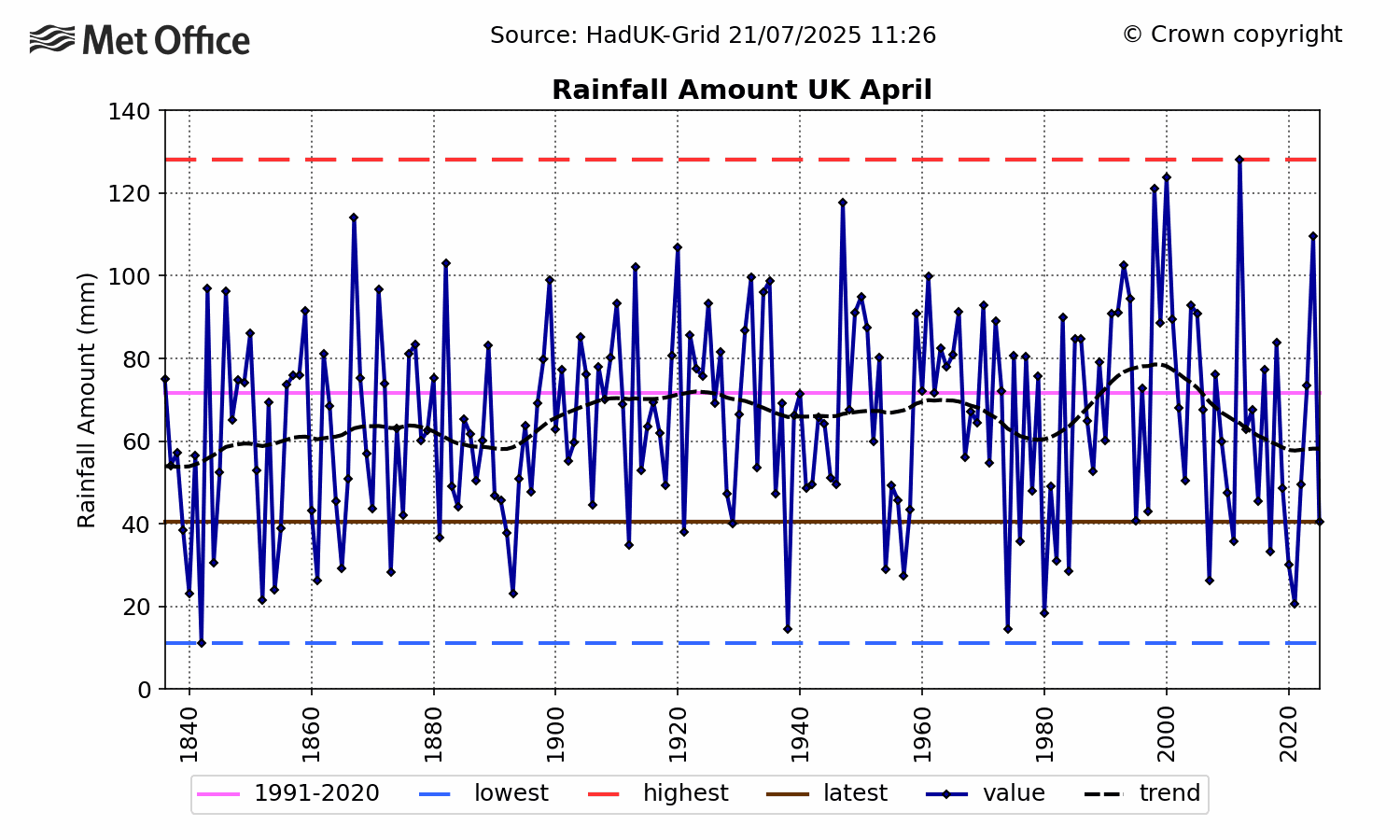
Although April was drier than average, it was not unusually so, nor is there any trends either way.
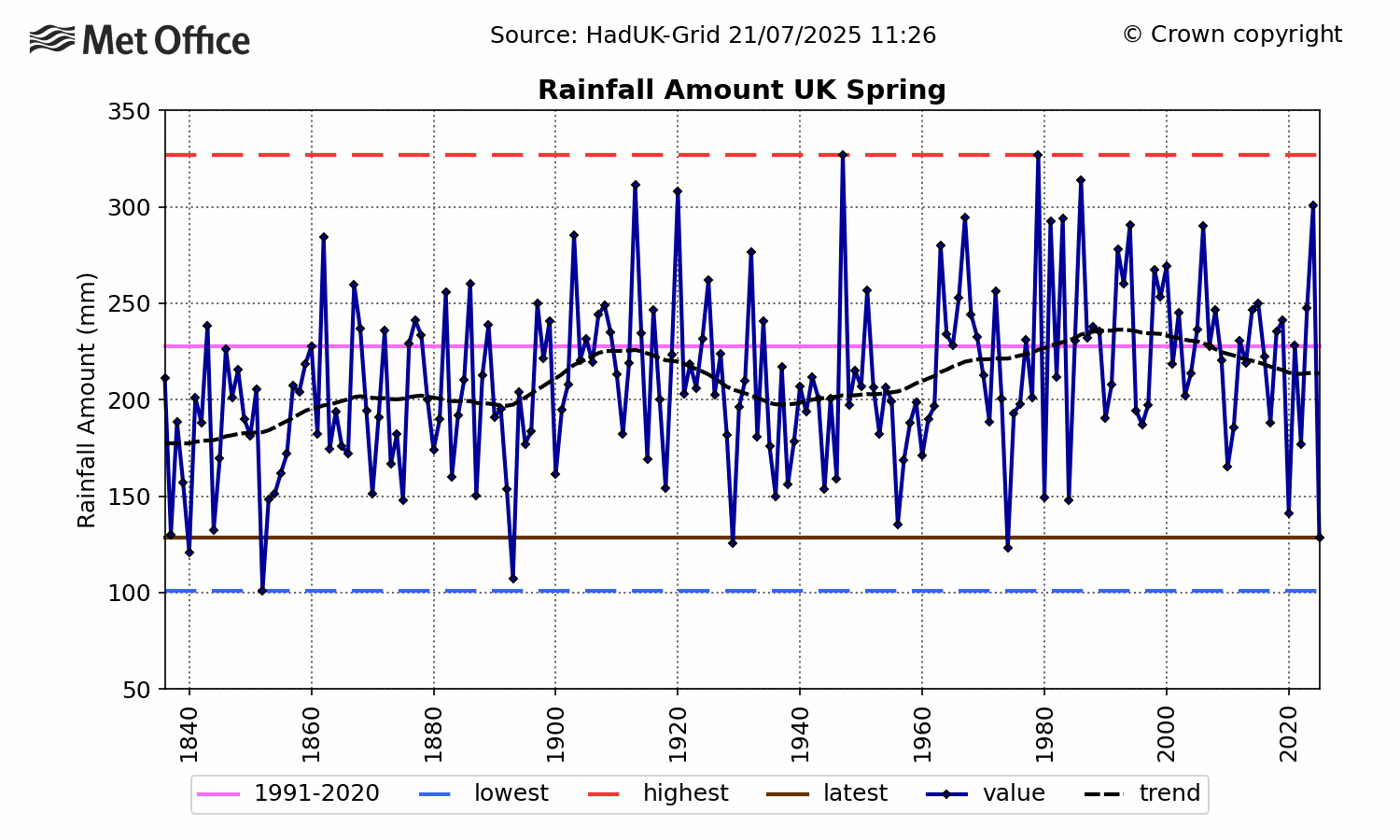
Secondly, we can look at the month to month changes during spring.
UK rainfall is inherently variable, sometimes extremely so. For instance, rainfall in May is often considerably greater, and equally often lower. But there is no evidence whatsoever the swings have been widening over time.
Exactly the same can be said for changes from May to June.


https://www.metoffice.gov.uk/pub/data/weather/uk/climate/datasets/Rainfall/date/Scotland.txt
The BBC repeat the same old lie that rainfall is heavier because of a warmer atmosphere.
The actual daily data for Scotland quite clearly shows this claim to be baseless.

The most dishonest part of the BBC report is this graph, which claims that “when it rains, it now rains more”


But Ed Hawkins’ graph does not show daily rainfall, but seasonal average rainfall.
Taking spring as an example, although the average has increased since the 19thC, that does not mean individual springs are getting wetter. What has changed is that unusually dry springs are now less common.
via NOT A LOT OF PEOPLE KNOW THAT
May 27, 2025 at 08:23AM
Meanwhile, the Iron Law of Electricity prevailed in Portugal’s recent election, as those who enjoy civilized living went to the polls and picked a “far-right” candidate.
Posted by Leslie Eastman
Legal Insurrection readers will recall that a sudden and unprecedented power outage struck the entire Iberian Peninsula in late April, plunging nearly all of Spain and Portugal into darkness for several hours.
The blackout, one of the largest in recent European history, also briefly affected parts of southern France and Andorra. Essential services, public transportation, telecommunications, and financial systems were severely disrupted. At least eight deaths have been linked to outage-related incidents.
The blackout was triggered by a rapid, cascading failure in the grid that resulted in the loss of about 60% of Spain’s electricity supply within seconds. The event was linked to the grid’s inability to handle the variability and intermittency of renewables, especially solar and wind, without sufficient backup from more stable sources like gas or nuclear power.
Now, in the aftermath of this blackout that could have been much worse, Spain has significantly increased its reliance on natural gas-fired power plants to stabilize its electricity grid. This strategic shift is the direct result of concerns about the grid’s ability to handle high levels of renewable energy, particularly solar and wind, which accounted for a substantial share of generation during the outage.
The output of combined-cycle gas turbines [CCGT], a more steady generation technology than solar, jumped 37% in the two weeks after the outage, compared with the two weeks prior, data from power grid operator Red Electrica show. Their average share of Spain’s power mix increased to 18% from about 12%.
…CCGTs can be a source of around-the-clock generation, and turbines also provide kinetic energy to the grid, a key element needed to keep the network stable. The day after the blackout, their output soared to 216 gigawatt-hours, a 157% jump compared to the day before the outage, and over three times more than two days before.
Although the grid operator’s mandate is to meet demand at the lowest possible cost, it can also modify the generation mix to maintain an “adequate voltage profile,” Red Electrica said.
The use of CCGTs is probably adding between €5 and €10 per megawatt-hours to costs, according to Javier Revuelta, senior principal at energy consultancy AFRY AB, who estimates that as many as 2 gigawatts of extra gas-fired capacity is being added daily to the Spanish mix compared to the days before the blackout.
The Blooberg article cited above focuses on the increased cost of gas-supplied energy. However, as the people of the Iberian Peninsula discovered, having electricity when you need it (especially after dark) is priceless.
Reliable energy sources are a treasure, and I strongly suspect that is why the recent election in Portugal went as it did.
Portugal’s far-right Chega won a record vote share in Sunday’s snap election and was vying to become the main opposition party as the ruling centre-right Democratic Alliance (AD) again fell short of a majority needed to end a long period of instability.
Prime Minister Luis Montenegro hailed the result as a vote of confidence in his AD which won most seats in parliament.
By “far-right”, what is actually meant is Portuguese who love their country and enjoy civilized living.
Subscribe to get the latest posts sent to your email.
via Watts Up With That?
May 27, 2025 at 08:03AM

The above image is not a photo-shop – this is Tenby weather station as it appears on the latest Street view image. How long it has been there, if it is even still there, where it ever was in the past and how many Tenby weather stations actually exist is the cause of some remarkably confusing debate. One thing is, however, quite certain – this site is a complete waste of instrumentation.
To get some clarification on the location of the official Tenby Met Office site I consulted their Weather Observations Website to find not one but eight “blue spot” marked “Tenby” sites as below.

The WOW website also includes private sites which requires clicking on each one to find out whether they are official ones or not. The inland most westerly site seemed improbable, the first to rule out I thought …

Oh, that was a surprise – it is “official” and run by the Met Office. It does not however look anything like the coastal headline image. Better check out the others to be sure – started with the most easterly coastal site.

Okay so there are two in the general Tenby area? Try another.

Three is surely a bit of overkill isn’t it? Keep going – if there is a “South Beach” what is that one to the north of it?

Still keep going and this one is just called “Tenby” could this be real one?

Well actually no because this one says “This site is not reporting observations” but that often does not indicate anything at all as was discovered at Pitsford
Keeping on going finally ruled out the two sites away from the coast as private weather stations but this still left a last one.

So there appears to be 6 locations referred to as potential Met Office “Tenby” sites. {n.b. The WOW site has just been modernised and brought “up to date”!} The CEDA archives themselves show two sets of archived data, one still operational known as just “Tenby” and the other closed but formerly known as “Tenby Priory” A cross reference to the given WGS84 coordinates supplied for the operational one led to a site that is NOT the headlined image.

51.66890 -4.70714 Met Office CIMO Assessed 4 Installed: According to the CEDA Archives – 1/1/1969 but actually originally installed 1/10/1897 nearby.
If all the above various site locations were confusing bear in mind it took me days of research to get this far and then things got extremely complicated. Firstly google historic images show the headlined image screen at that car park location all the time up to 2021 when it was moved 60 metres to the north west across the golf course to be shielded by the surrounding bushes detailed below. Very much an equally undesirable site. Why go to the expense and not improve matters similar to Culzean Castle?

For the majority of this screen’s life it was in that car park location with hot car engines or exhausts distorting readings probably ever since the dawn of the internal combustion engine. Readings from such sites are clearly unreliable and any alleged records would be no more convincing than the Motherwell: Strathclyde Park fiasco.
What is particularly strange is that the relocation is not noted anywhere contrasting sharply with the deliberate noting of the minute screen location within its small enclosure at Charterhall. Then again, despite all the Met office’s claims to the contrary, Tenby, like very many official locations, is not in any form of enclosure whatsoever. As Philip Eden of the Royal Meteorological Society noted in his investigation of the alleged Faversham 2003 record high ” The site is also open to the general public and interference from visitors unknown has not been ruled out”. There is not even a vestige of site security at Tenby.
The site archived temperature record then takes a truly bizarre twist. The other Tenby site at the Priory was actually some distance away on Caldey Island and was operational from 1914 to 1957 BUT it claims to have temperature records from 1897……..how does that work? A look at the scanned manual originals attributed to the Priory give the coordinates of the mainland site!

The Archives for the mainland site only show temperature records running from 1977 so what happened to the site’s previous 90 years records? Well it appears the Met office finally realised its mis-attribution mistakes and ended up apparently deleting the data from 1921 to 1957. From their archive notes;

Piecing together all this confusion to make some form of reality:- Tenby originally had its weather station installed near the golf course in 1897. Records were taken from that same site until some time between 2021 to 2024 when it was relocated from a seriously compromised site to one that really is only marginally “less bad”. Readings were mis-attributed to another site some distance away, discovery of this mistake resulted in deletion of a large chunk of the data ….though it may still be available in manuscript form somewhere. There may, or may not, be other official Met Office weather stations in Tenby but I could not physically locate them and I genuinely doubt they actually exist.
And then the final twist, the readings reliability in actually being taken is far from good. Below are examples of notes recorded in the digital archive. Perhaps the only thing stranger than some of the “reasons” given for not taking readings is that someone else was then actually employed and paid to digitally transcribe in full these manuscript excuses.

I have detailed this review in greater detail than this low grade site ever deserves to highlight just how “sloppy” so much of the Met office practises are in addition to the poor siting and observation standards of so much of their voluminous system. A case of “Never mind the quality, feel the width”!
via Tallbloke’s Talkshop
May 27, 2025 at 07:49AM
 Iowa Climate Science Education