New Study Documents Significant Cooling Across Eurasia Since 2004

Cooling trends of up to -2.15°C per decade are not consistent with the “global warming” narrative.

According to a new study (Li et al., 2025), 98% of the Central Eurasia study area (40-65°N and 50-130°E) experienced significantly declining temperatures from 2004-2020.

Specifically, the region cooled by nearly -2.0°C – a rate of -1.425°C per decade – from 2004 to 2018.

The authors attribute the cooling trend to a 5.38% per decade increase in snow cover percentage (SCP) across the study area.

Image Source: Li et al., 2025

via NoTricksZone

https://ift.tt/goZiAH6

May 20, 2025 at 05:54PM

“Renewable” Electricity Champion Denmark Now Looking into Nuclear

From THE MANHATTAN CONTRARIAN

Francis Menton

At this site, when I have written about countries and states seeking to be among the leaders in eliminating fossil fuels from their electricity supply, I have generally focused on the larger jurisdictions, like Germany and the UK in Europe, and California and New York in the U.S. But there is one much smaller country that puts all of those bigger ones to shame: Denmark. With a population of only about 6 million, Denmark has pushed the “renewable” electricity generation thing well beyond what others have been able to accomplish. According to its official statistics, in 2024 Denmark got some 79.5% of its electricity from what it calls “low carbon” sources. The large majority of that came from wind and solar, with only a minimal contribution from nuclear. As to nuclear, Denmark had in fact mandated phasing it out, by a law passed back in 2003.

So then, does it seem like, with just a final little push, Denmark can go over the top and reach the long-sought goal of 100% of generation from “renewables”?

In fact, according to the most recent news from Denmark, it is the opposite. Just during the past week, the lower house of Denmark’s Parliament, by a wide margin (102-8), passed a resolution reversing the nuclear phase out. This will likely lead to retaining the few remaining reactors, and then starting to build new ones. The immediate impetus for the resolution appears to have been the recent blackout in Spain and Portugal, which has been generally attributed to the lack of synchronous generation on the power grids of those countries. The statement by the Danish government announcing the Parliament’s resolution did not explicitly walk back support for the continued build-out of wind and solar generators, but said that this new pro-nuclear approach “pave[s] the way for a realistic and resilient energy model.”

Now that Denmark has recognized the need for some form of high-inertia synchronous generation to make its grid work reliably, it’s hard to see how they can avoid the next inevitable question: Do wind and solar actually serve any real function here? Or are they just a large added cost without any corresponding benefit? It can’t be long before lots of people start pressing this obvious question.

A brief history of how Denmark got to where it is can be found in this May 16 piece from World Nuclear News. Excerpt:

Belgium’s federal parliament has voted by a large majority to repeal a 2003 law for the phase-out of nuclear power and banning the construction of new nuclear generating capacity. Meanwhile, the Danish parliament has approved an analysis of the potential use of nuclear, which has been banned for the past 40 years. Belgium’s federal law of 31 January 2003 [has] require[d] the phase-out of all nuclear electricity generation in the country.

Under the 2003 law, several nuclear plants had been closed, although the closure of the last two had been delayed. Most recently, those last two were scheduled to close in November of this year, but now that is likely to be postponed again.

And meanwhile, up to now Denmark has been the absolute champion of building wind turbines and solar panels to supply its grid. Since the 1990s, Denmark has had a crash program to build out more and more wind and solar generators. According to Danish statistics reported at Low Carbon Power here, in 2024 Denmark got 52.3% of its electricity from wind and 10.2% from solar, for a total of 62.5% from those two sources. Here is a pie chart from Low Carbon Power showing all of the sources of Denmark’s electricity for 2024:

The “low carbon” total comes to 79.5%, after adding an additional 17% from a category they call “biofuels.” Note the leafy branch appearing in the pie chart as the symbol for the “biofuels.” Don’t be fooled. As far as I know, “biofuels” mainly means burning garbage, with some wood pellets from cutting down trees thrown into the mix. Both garbage and wood pellets contain carbon, and thus the energy from the “biofuels” comes from burning the carbon. Exactly why this is in the “low carbon” category is a mystery to me.

But with or without the biofuels, Denmark has well surpassed other de-carbonization “leaders” in getting its electricity from “renewable” sources. Compared to Denmark’s 62.5% of electricity from wind and solar in 2024, Germany in 2024 got a combined 43% of its electricity from those sources (28% wind and 15% solar), while in California the percentage from the two sources was 37.5% (12.5% wind and 25% solar). For their virtue, the Danes got to enjoy average residential electricity prices of 37.63 euro cents per kWh.

And yet, having surpassed the 60% threshold of electricity from wind and solar, Denmark has now recognized that 100% is not feasible, and wind and solar alone cannot be the only sources to power their grid. Even if the intermittency problem can be overcome, the problems of lack of sychronization and inertia cannot be solved with only wind and solar. Some amount of timed spinning generation is necessary, and nuclear is the proposed low-carbon solution. Some amount of nuclear is going to get built. Let’s assume the amount of nuclear to be built will be sufficient to supply 50% of average demand (the exact percentage is not important).

Once you have nuclear to supply half of average demand, here’s the key question: should you run it all the time, or should you turn it on and off, or ramp it up and down, as wind and solar generation may be available to meet the same demand? This is not a difficult question. Nuclear reactors are expensive, and the cost of the capital needed to build them (e.g., interest on bonds) accrues 24 hours a day and 365 days a year. To minimize the cost of capital per unit of electricity produced, you want to run your nuclear plant all the time. Yes, there is a cost of fuel involved in a nuclear plant, but it is minimal compared to the cost of capital.

Instead of running your new nuclear plant at full capacity all the time, you could choose to have it ramp up and down as intermittent wind and solar generation are randomly available. Assume that (like Denmark) you have sufficient wind and solar generation to supply 62.5% of demand. This means that your new nuclear plant, operating in backup mode, will only be selling power 38.5% of the time. But the bondholders who financed it must be paid 100% of the time. After some (relatively small) adjustments for costs of fuel and operations, the bottom line is that the cost per unit of electricity from your new nuclear plant will be close to triple what the cost per unit would have been if you had chosen to run the plant all of the time. But if you run the nuclear plant all the time, you don’t need the wind and the solar. They are just a useless extra cost.

The real world cost calculations would be somewhat more complex than what I have outlined, but not much. The fact is that once you have nuclear plants to cover a given level of electricity demand, wind and solar generators serve no useful function.

It shouldn’t take the Danes too long to figure this out. I will enjoy watching the process unfold.


Discover more from Watts Up With That?

Subscribe to get the latest posts sent to your email.

via Watts Up With That?

https://ift.tt/eLZmhoP

May 20, 2025 at 04:01PM

New AI data centers will use the same electricity as 2 million homes

By Jo Nova

The winds of change are howling through electricity grids

Since 2022, AI -related firms have stormed the S&P 500 market — growing by $12 trillion dollars.

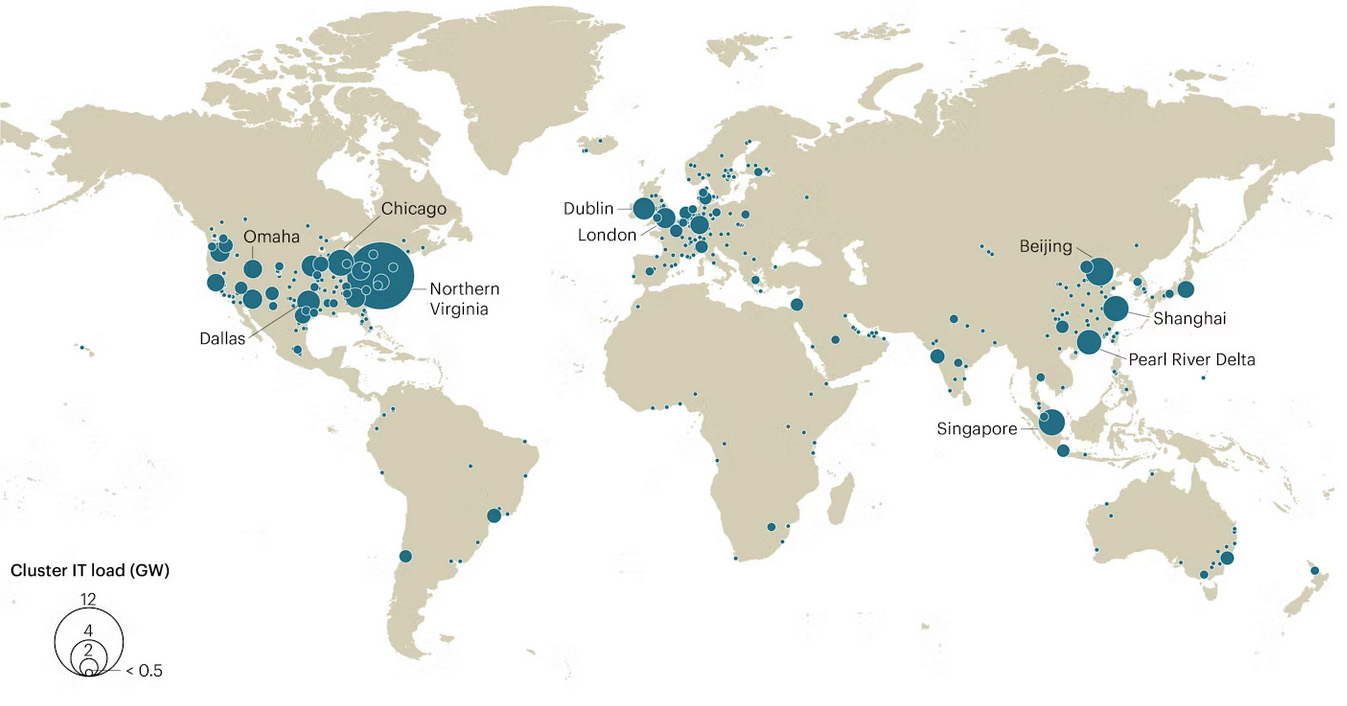
The IEA just posted a whole report dedicated to AI. The demand from data-centers is so large in some places it is already rivaling the kind of monster consumption we are used to seeing from aluminum smelters. There are six states in the United States where data centers already consume over 10% of the electricity supply. In Ireland, data centers  swallow about 20% of the electricity.

Currently, a normal data center consumes the same amount of electricity as 100,000 houses. But the new gargantuan data centers under construction will consume 20 times as much — equivalent to adding 2 million homes to the grid.

Data center of the world are not spread evenly. In Virginia, the largest conglomeration of industrial data, their power-needs pull in a quarter of the state’s electricity.

Australia is being left behind, because we won’t build coal plants in case we offend the UN, and we banned nuclear power. The AI global race is on, but digital machines need reliable cheap electricity and masses of it. Also not looking sparkling on this graph — New Zealand, Norway and Canada.

Sometime between now and 2030 the world has to build a new network the size of Japan’s national grid.

Data centres accounted for around 1.5% of the world’s electricity consumption in 2024, or 415 terawatt-hours (TWh). The United States accounted for the largest share of global data centre electricity consumption in 2024 (45%), followed by China (25%) and Europe (15%). Globally, data centre electricity consumption has grown by around 12% per year since 2017, more than four times faster than the rate of total electricity consumption. AI-focused data centres can draw as much electricity as power-intensive factories such as aluminium smelters, but they are much more geographically concentrated. Nearly half of data centre capacity in the United States is in five regional clusters.

Data centre electricity consumption is set to more than double to around 945 TWh by 2030. This is slightly more than Japan’s total electricity consumption today.

There is no single factor driving up electricity demand more than AI at the moment:

In the United States, data centres account for nearly half of electricity demand growth between now and 2030. By the end of the decade, the country is set to consume more electricity for data centres than for the production of aluminium, steel, cement, chemicals and all other energy-intensive goods combined.

The IEA report which was always a sop for “renewables” — suddenly isn’t that concerned about carbon emissions:

“Concerns that AI could accelerate climate change appear overstated, as do expectations that AI alone will address the issue”

The widespread adoption of existing AI applications could lead to emissions reductions that are far larger than emissions from data centres – but also far smaller than what is needed to address climate change.

Just like private jets for billionaires, big new AI computers will save us from carbon emissions (maybe)

AI will find cost savings all over the place, but then again, if everyone has their own automated self-driving car, they won’t need to catch the bus will they? Oh the dilemma…?

AI applications in transport can improve efficiency and save costs, but they could also increase demand for personal mobility. AI applications are being used to manage traffic, optimise routes, predict maintenance needs and develop autonomous vehicles. The widespread adoption of AI applications across the transport sector could lead to energy savings equivalent to the energy used by 120 million cars. While autonomous vehicles operate more efficiently than conventional ones, they might also attract people away from public transport as costs fall and availability increases, leading to rebound effects.

In buildings, there is significant potential for AI-led optimisations to make heating and cooling systems more efficient and electricity use in buildings more flexible

Even the IEA admits we need affordable and reliable power

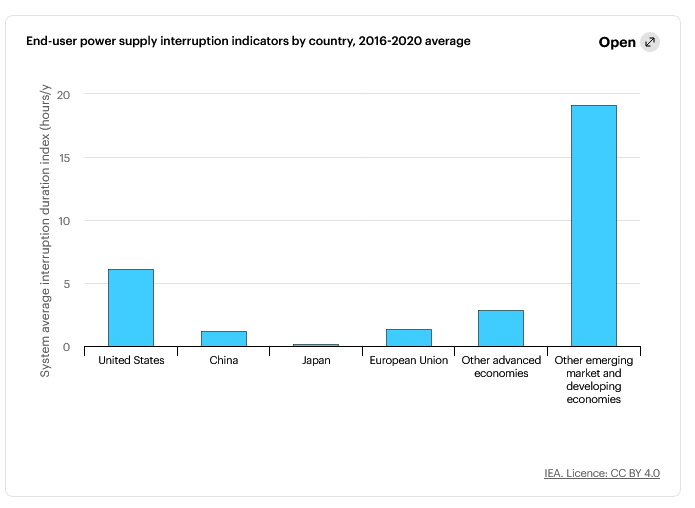
Countries with a record of reliable and affordable power will be best placed to unlock data centre growth, localise the computing power that is critical to homegrown AI development, and spur the IT industry more generally.

This graph with it’s tiny font, compares how extensive those blackouts are around the world, with the first-world looking  good (so far):

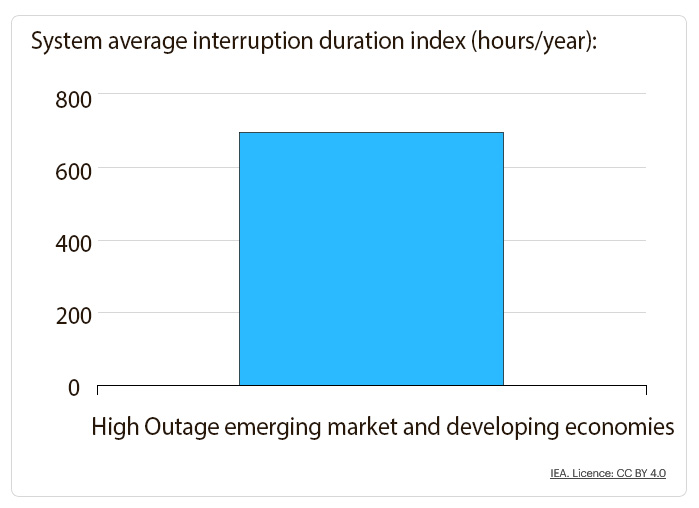
Beside that graph they have this very strange graph with microscopic fonts and one solid square of the other emerging markets and developing economies they didn’t mention in the last graph.  The High Outage class of 2025 has more like 700 hours of average system interruption a year.

Is there any industrial complex that works better on a part time random basis than it does on a predictable, reliable schedule?

History will show that countries with energy to spare will take over the world.


REFERENCES


0 out of 10 based on 0 rating

via JoNova

https://ift.tt/yRIKcNq

May 20, 2025 at 02:47PM

Are Scientists who Contest the Climate Emergency “Publicity-seeking Contrarians?”

Ecologist author Tom Hardy has pulled out all the stops, from John Cook’s 97% study to accusing the GWPF of having friends like Ian Plimer.

This cautionary statement underscores the urgency: the climate crisis is no longer a distant threat — it is here, now, destroying lives, economies, and ecosystems across the globe. The science is unequivocal.

A widely cited study by John Cook and colleagues in 2013 found that 97 per cent of climate scientists who published peer-reviewed research on the topic agreed that human activity is the most significant driver of climate change.

Incumbent

How much of the remaining three per cent can be attributed to publicity-seeking contrarians? 

And to what extent has the illusion of a legitimate debate been deliberately propagated by those funded by the fossil fuel industry, amplified by billionaire-owned media and the loud voices of the libertarian spokespeople for polluting industries?

Speaking of which…

Few places better exemplify partisanship and conflict of interest than the Global Warming Policy Foundation (GWPF) – a group where the scientifically unqualified stand alongside some academics who have lowered professional standards at the same time as receiving support from fossil fuel sponsors.

Read our extensive coverage of the Global Warming Policy Foundation.

The charity’s website claims it “aim[s] to create an educational platform on which common ground can be established, helping to overcome polarisation and partisanship.” 

Manifesto

For the purpose of this essay, let us set aside, for now, the incumbent economists – Ross McKitrick, Ian Byatt, Joe Oliver, Tony Abbott, Gwythian Prins, Robert Mendelsohn, and others.

Their priorities lie in championing the free market and resisting climate science for fear it might pave the way for what they perceive as “eco-socialist control” – following very much in the footsteps of the GWPF founder and mentor, the late Nigel Lawson.

The GWPF promotes a host of characters without relevant qualifications or expertise in the climate field. These include Allison Pearson and Professor Fritz Vahrenholt, Christian Gerondeau as well as Harry Wilkinson, its head of policy, and Graham Stringer MP, a trustee.

The right-wing press and social media currently have the loudest megaphones when it comes to attacking net zero aspirations. 

Benny Peiser has directed the GWPF since it was founded. His qualification in sport and exercise sciences would seem to provide him with few insights into climate science. It is telling that he is a visiting fellow at the University of Buckingham, which is ostensibly the education wing of the Institute of Economic Affairs (IEA), which in turn is funded by BP and, historically, tobacco companies. 

John Constable, the GWPF’s former energy editor, is also embedded at Buckingham. His 2011 report which recommended that the government should “encourage fuel switching to gas” was funded by the ScottishPower Energy People Trust, and his 2012 report was commissioned by Calor Gas. His work was dismissed by the then Department for Energy and Climate Change as a “manifesto for imported gas.”

Peer

Professor Terence Kealey, a former vice-chancellor at Buckingham University, is also on the GWPF’s so-called ‘academic advisory council’. His latest book, entitled Sex, Science and Profits, is hardly at the cutting edge of climate research.

Professor Michael Kelly has seemingly impressive academic credentials yet his papers often avoid blind peer review and are published in open-access journals. This ducking of external scrutiny through open peer review is common practice among GWPF authors.

Professor Julia Steinberger wrote in a letter to Kelly: “I have a particular objection as a scientist to the GWPF claims that their papers are ‘peer-reviewed’. You will also be aware that papers referenced by GWPF commissioned authors are not blind-reviewed, but rubber-stamped by other GWPF members and as such have no standing in the broader scientific world. 

“Another characteristic of the GWPF is their tendency to cherry-pick from both their own work and from other papers of greater academic standing. This has been much criticized in the press, and yet the GWPF persists in this approach.”

David Whitehouse, GWPF science editor, has never written for any peer-reviewed journals on the subject of climate change, according to Skeptical Science. It seems Lawson’s approval was the only peer review ever undertaken within the GWPF’s halls of academe.

Testimony

Neither do Michael Alder, nor Professor Anthony Barrett of the Academic Advisory Council have relevant qualifications to hold forth on climate science. 

According to Barrett’s Wikipedia page: “Barrett […] has contributed extensively to the synthesis of β-lactams using alkenyl anions, ynolates, novel isocyanates, iron vinylidines, heteroatom functionalized nitroalkenes, and ring-closing alkene and enyne metathesis reactions.” All very impressive, but nothing that would indicate he is to be taken seriously on climate.

More overtly compromised by fossil fuel ties are advisory council chairman Professor Gautam Kalghatgi and council member Professor Peter Dobson. Kalghatgi worked for 31 years at Shell Research in the UK, followed by eight years at Saudi Aramco. Dobson conducted research into energy and decarbonisation technologies at the Oxford Centre for Petrochemical Research while founding the BP-funded Oxford Energy Society.

The list of those with apparent conflicts of interest continues.

Notorious

In 2018, Professor William Happer was revealed by an undercover Greenpeace UK investigation to have been paid $8,000 by Peabody Energy for testimony promoting the benefits of rising CO₂ levels.

Vincent Courtillot, of the University of Paris Diderot, is at the centre of a controversy over his paper, published in Earth and Planetary Science Letters, in which he argues that it is the Earth’s magnetic field that is driving climate change. He denies that his research is influenced by his ties to oil companies Total and Schlumberger.

Paul Reiter, Emeritus Professor of Medical Entomology at the Pasteur Institute in Paris, admits that he is “not a climatologist, nor an expert on sea level or polar ice.” However, he sits on the Scientific and Economic Advisory Council of the Annapolis Centre for Science-Based Public Policy, a US think tank that has received $763,500 in funding from ExxonMobil.

Dr Samuel Furfari, a professor of energy geopolitics, has spent his career in fossil fuels, including a long tenure at the European Commission’s Energy Directorate-General. His PhD focused on coal gasification

Although, as a zoologist, Dr Matt Ridley cannot claim to have expertise in the Earth sciences – his doctorate examined the mating system of the common pheasant! – he is among the most prolific contributors of misleading op-eds to the right-wing press. He is notorious for selectively using data to undermine climate science, and his former ownership of a coalmine surely undermines his credibility as an objective commentator. 

Deceit

Some GWPF associates might simply be judged by the friends that they keep.

As well as serving as a director of several mining and resource companies, Ian Plimer, professor of mining geology at the University of Adelaide, has been closely associated with the mothership of oil-funded propagandists, the Heartland Institute which likensenvironmentalists to Osama Bin Laden and Charles Manson. He does admit that “not all global warming alarmists are murderers or tyrants”.

Astrophysicists Nir Shaviv, Henrik Svensmark, Christopher Essex and physicist Laurence Gould, have also aligned themselves with Heartland, the latter as a panelist at Heartland’s Ninth International Conference on Climate Change.

This week The Ecologist reached out to the academics named in this article and offered a right of reply. Professor Dobson responded. “I am a bit astonished by this rather pathetic bit of propaganda,” he said. “I should add that going to Net Zero for carbon is ridiculous because CO2 is not the main greenhouse gas, water vapour is, by a long way.” 

However, NASA states: “Some people mistakenly believe water vapor is the main driver of Earth’s current warming. But increased water vapor doesn’t cause global warming. Instead, it’s a consequence of it.”

Though some within the GWPF may not personally be funded by or have interests in the fossil fuel industry, they are still tainted by association as the GWPF itself receives support from entities like Koch Industries and the oil-funded Sarah Scaife Foundation.

The GWPF has claimed that the scientific consensus on climate change is overstated and that the issue is not settled. According to former environmental reporter Roger Harrabin even the BBC has fallen for this deceit. 

Disaster

He has spoken of climate stories being spiked if a denier couldn’t be found to provide spurious ‘balance’ — a practice condemned in the 2011 Jones Report which criticised the broadcaster for suggesting that Nigel Lawson’s views held equal weight to those of the science community.

The right-wing press and social media currently have the loudest megaphones when it comes to attacking net zero aspirations. Their continued platforming of deniers and delayers – whether from the GWPF or the wider Tufton Street cabal – demands that we remain vigilant about the provenance and motives of commentators.

The And Then There’s Physics  blog sums up the frustration: “This is the problem with providing the GWPF this platform as it allows them to claim credibility, but it takes an exhaustive amount of effort to put their arguments in context. This is made much harder by the fact that very few of the arguments or figures have come from reputable sources.”

David Suzuki, the influential environmentalist, puts it plainly: “Healthy skepticism is good. Criticism of the ocean study led to greater understanding and strengthening of the methodology and analysis. 

“But denying the massive amounts of evidence and even the legitimacy of science leaves us with what? Personal beliefs? Ignoring what’s in front of us to maintain the status quo? Practising ‘business as usual’?

“Those would all put us on a path to disaster.”

This Author

Tom Hardy FRSA has over 40 years of experience in education, serving as literary editor for the International Journal of Art and Design Education, as columnist for the Times Educational Supplement, and author/editor of several academic works on educational practice. He has worked as an education consultant for the Prince’s Teaching Institute and subject lead for the Qualifications and Curriculum Development Agency reporting to the Department for Education. He now works with Media Revolution.

Source: https://theecologist.org/2025/may/19/climate-denial-path-disaster

I actually feel a bit sorry for Tom Hardy. Imagine being an arts major whose world view is derived from the writings of John Cook, Greenpeace UK, Wikipedia, Roger Harrabin and David Suzuki. No wonder he is worried about the state of the planet.

That picture of John Cook in the article below is a self portrait taken from his own website.

via Watts Up With That?

https://ift.tt/Swlq2uY

May 20, 2025 at 12:05PM