音楽は心の処方箋:癒し、共感、そして生きる力を与える芸術

音楽は心の処方箋:癒し、共感、そして生きる力を与える芸術

はじめに:音楽が心に届く理由

私は20年以上、音楽療法士として医療・福祉・教育の現場に立ち続けています。その中で常に感じるのは、「音楽は言葉を超えて心に届く力がある」ということです。人が苦しんでいるとき、言葉をかけても届かないことがあります。でも音楽なら、その人の奥深くにそっと触れることができるのです。

たとえば、喪失体験の直後、声を出せなくなった方が、昔好きだった曲を聴いた瞬間に涙を流し、その後言葉を取り戻したという例もあります。音楽は単なる娯楽ではなく、「感情の鍵」を開ける存在であると、私は強く信じています。


音楽療法とは何か?

音楽療法とは、音楽の力を使って人の心身に働きかけ、症状の緩和や心の安定、社会性の向上などを目指す心理的支援方法です。近年では、医療機関や介護施設だけでなく、学校や地域の集いの場でも取り入れられることが増えてきました。

音楽療法士は、対象者の状態に合わせて楽器演奏、歌唱、音楽鑑賞などを用い、本人の表現を引き出しながら「心の回復」に寄り添います。特に言語によるコミュニケーションが難しい方にとって、音楽は重要なコミュニケーション手段となります。


脳科学から見る音楽の効果

音楽が心に作用する理由は、脳の仕組みにも深く関係しています。楽しい音楽を聴くと、脳内で「ドーパミン」という快楽ホルモンが分泌され、気分が自然と明るくなります。また、メロディやリズムは海馬や扁桃体といった「記憶と感情の中枢」に強く働きかけ、過去の体験や感情が蘇ることがあります。

最近では、音楽と脳波の関係も注目されており、一定のリズムを聞くことでアルファ波が増え、リラックス効果が得られるとされています。私はこうした科学的根拠と現場での実感を組み合わせ、ひとりひとりに最適な音楽を届けるよう心がけています。


不安・ストレスへの音楽の作用

私の臨床経験では、「何となく不安が取れない」「眠れない」「緊張が続いて疲れてしまう」と訴える方が非常に多くいます。そうした方々に音楽を処方する際、私はまず「呼吸」と「心拍」に着目します。ゆったりとしたテンポの音楽は、副交感神経を優位にし、自然な深呼吸を促してくれます。

特に不眠症のクライエントに対しては、就寝前にヒーリング音楽や自然音を組み合わせたプレイリストを提案することがあります。「眠れるようになった」という報告を受けるたびに、音の持つ生理的作用の大きさに改めて驚かされます。


音楽による感情解放と共感

音楽には、私たちが普段抑えている感情を「安全に外に出す」力があります。悲しい音楽を聴いて涙が出た経験はありませんか? 実はそれは、抑圧されていた感情が解放される健全な反応なのです。

クライエントが「ある曲を聴いたとたん涙が止まらなくなった」と語ったことがありました。そのとき私は、無理に涙を止めることはせず、音楽を止めずにそっと寄り添いました。その後、「あの涙で心のつまりが取れたように感じた」と言われたとき、音楽は人に共感し、癒す「もう一人のセラピスト」だと実感しました。


トラウマ・喪失体験と音楽の関係

トラウマや大切な人との別れといった深い喪失は、言葉にするのがとても難しいものです。こうした体験に対しても、音楽は「沈黙の中にある感情」を表現する手段として機能します。

私は、愛する家族を亡くした方と共に、その人が好きだった曲を静かに聴くセッションを行ったことがあります。最初は何も話さなかった方が、その曲をきっかけに語り始め、少しずつ日常の中に自分の感情を取り戻していきました。音楽は、悲しみの中にそっと入り込み、「ここにいていいんだよ」と伝えてくれる存在です。


認知症と音楽療法

認知症の方に対する音楽療法は、非常に効果的です。特に若い頃によく聴いていた音楽を再生すると、驚くほどはっきりとした反応が返ってくることがあります。言葉ではコミュニケーションが難しくなっていても、音楽には感情や記憶を呼び起こす力があります。

ある高齢の男性は、ほとんど言葉を発さない状態でしたが、昔の軍歌を聴いた瞬間、口ずさみ始め、顔がパッと明るくなったことがありました。そのとき一緒にいたご家族が涙を流していたのを今でも忘れられません。


発達障害と音楽の関係性

自閉スペクトラム症(ASD)や注意欠如多動症(ADHD)の子どもたちにとって、音楽は「安心」と「刺激」をバランスよく与えるツールになります。繰り返しのリズムや音のパターンは、予測可能な世界を作り出し、不安を軽減します。

また、言葉でのやり取りが難しい子でも、音楽を通じて「表現」や「応答」ができる場面が増えてきます。私が担当している子どもの中には、言葉は使えなくてもドラムでリズムを返してくれる子がいます。音を介して築かれる信頼関係は、非常に強固で温かいものです。


音楽と自律神経の調整

自律神経は私たちの心と体のバランスを司る重要なシステムです。ストレスが続くと交感神経が優位になり、緊張・焦り・睡眠障害などの不調が現れます。音楽はこのバランスを整える「非薬物的介入」として注目されており、特にゆったりしたテンポの曲や自然音を取り入れた音楽は、副交感神経を優位に導いてくれます。

私のクライエントの中には、音楽を毎晩聴くようになってから、眠りの質が劇的に改善された方もいます。心地よいリズムと共に呼吸が整い、気づけば身体の力が抜けていた――そんな体験を語ってくれる方が多くいます。


音楽と身体のリハビリテーション

音楽は、身体的リハビリの場でも有効です。たとえば、一定のビートに合わせて歩行練習を行う「リズム歩行療法」は、パーキンソン病の方の歩幅や安定性の向上に寄与します。また、メロディに合わせて体を動かすことで、自然な動作誘導が促され、無理なく筋力や柔軟性を高めることができます。

リハビリの中で「音楽があると楽しい」と笑顔が増えることもあり、継続のモチベーションを保つ要因にもなっています。


文化と音楽の交差点にある身体性

人間にとって「音」は本能的なものであり、音楽は文化の一部であると同時に、身体と深く結びついたものでもあります。たとえば、鹿児島県の**徳之島の闘牛(コリーダ)**では、試合前に鳴り響く太鼓や地元の囃子(はやし)が、観衆と牛の緊張感を一気に高める重要な役割を担っています。

このような「音によって場の空気を作る」文化は、日本各地に残っており、私たちの情動や運動に音がどれだけ密接に関与しているかを改めて感じさせてくれます。


クライエントとの音楽的対話

音楽療法の核心は、「一緒に音を共有すること」にあります。私はクライエントと共にピアノを弾いたり、太鼓でリズムを合わせたり、ただ一緒に音楽を聴くこともあります。その中で自然と心が開き、言葉では言えなかった気持ちが音になって流れ出す瞬間があります。

また、「沈黙の中に流れる音」を大切にすることも多くあります。強く語らずとも、隣に座って音楽を聴く時間には、確かな信頼関係が生まれます。


音楽療法と他の心理療法の違い

音楽療法は、認知行動療法やカウンセリングといった「言葉による介入」とは異なり、五感と身体を通してアプローチできる点が最大の特徴です。特に、言葉で感情をうまく表現できない方や、過去の体験に触れることに恐怖を感じている方にとって、「音」という手段はとても安全かつ有効です。

私の経験では、言葉では一切話せなかった子どもが、ドラムやピアノを通じて自分を表現し、徐々に他者との関係を築いていったこともありました。音楽は、セラピーを「感じるもの」へと変えてくれます。


音楽と死生観・スピリチュアリティ

人生の終わりに近づくとき、言葉よりも「音」が人の心に届く瞬間があります。私は終末期医療の現場で、ベッドサイドで家族と一緒に音楽を聴く時間を何度も経験してきました。最後の瞬間に、思い出の曲が静かに流れる中で、涙と共に穏やかな時間が過ぎる――その場には、言葉を超えた安らぎが存在します。

宗教や宗派を超えて、音楽は「祈り」や「癒し」として機能し、残された家族にとっても、「共に過ごせた」という記憶として深く心に刻まれるのです。


音楽と自己表現・創作活動

音楽は受け取るだけでなく、自分を表現する手段にもなります。クライエントの中には、歌詞に自分の思いを乗せて歌ったり、ピアノやギターで自作の曲を演奏することで、「心の整理」ができたと話す方がいます。

特に怒りや孤独、混乱といった表現しにくい感情も、音に変えることで安全に外へ出すことができます。日記では書けない感情も、メロディとして流すことで、自分の内側にあるものを客観的に見つめ直すきっかけになるのです。


音楽を日常に活かすために

音楽療法の現場だけでなく、日常の中にも音楽を「処方箋」として取り入れることは可能です。たとえば、朝はテンポのある前向きな曲を流して一日のスイッチを入れる。夜は静かで柔らかい音楽で交感神経から副交感神経へと切り替える。こうした「音による生活のリズム化」は、精神の安定にも非常に効果があります。

また、自分の気分や状態に合わせてプレイリストをカスタマイズすることもおすすめです。無理に続けようとせず、気分が向いたときに耳を傾ける。その柔らかさこそ、音楽が持つ自然な癒しの力を最大限に引き出す鍵となります。


歌う、聴く、演奏するなどを通じて、心の状態を整えたり、感情を表現するサポートを行います。

年齢や障がいの有無に関係なく、子どもから高齢者まで幅広い方が対象です。

うつ、不安障害、PTSDなどに対して、緩和的な効果が期待されます。

はい。状況に合った音楽を選べば、リラックスや集中などの効果が得られます。

特に認知症の方には、昔の歌で記憶が活性化されることがよくあります。

音楽療法は臨床的な目的があり、専門家の介入によって心理的・身体的な支援を行います。

専門の養成課程を修了し、資格や臨床経験を積む必要があります。

ありません。クラシックからポップス、民族音楽まで、対象者に合えば自由に使えます。

まったく問題ありません。聴くだけのセッションも多く存在します。

むしろ感情が出たことは前向きな反応です。セラピストが受け止めます。

好きな音楽を静かな空間で聴きながら深呼吸するだけでも効果があります。

個人差がありますが、週1回や月2回程度の継続が一般的です。

はい。発達障害や情緒不安定な子どもにとっても非常に有効です。

使われます。特に穏やかな時間の支援や家族との心のつながりづくりに役立ちます。

言葉を使わずに「心と心」がつながること。そして、自分自身とも向き合える点です。

via Quick & Yummy

https://ift.tt/0MP3xQB

May 18, 2025 at 10:38AM

Monday

0 out of 10 based on 0 rating

via JoNova

https://ift.tt/Lgtzpeu

May 18, 2025 at 09:57AM

A New IEA Report and the Iberian Blackout End Dreams of an ‘Energy Transition’

By Mark P. Mills  

It’s no secret that the Republican’s “Big Beautiful Bill” plans to axe large swaths of mandates and billions of dollars in subsidies directed at achieving a so-called “energy transition.” If that budget axe falls, it will be the proverbial third strike that puts to rest the idea that the U.S., never mind the world, will abandon fossil fuels. The other two strikes already happened.

Strike two came last month with the Great Iberian blackout. Preliminary forensics make clear that over-enthusiastic deployment of unreliable solar and wind power was the fulcrum that put 55 million people in the dark for days. Few politicians will want to risk allowing something like that to happen again, anywhere. And, as the North American Electric Reliability Corporation keeps warning, blackout risks are rising here, and for the same reason. Reliability used to be the core feature of electric grid designs, before the rush to push an energy transition in service of climate goals.

And strike one came a few weeks prior to the Iberian calamity with the release of a new report from the International Energy Agency (IEA) titled Energy and AI. That report sought to answer the question about how to reliably meet the surprising jump in power demands expected in the coming decade’s boom in artificial intelligence (AI) data centers. Answering that also answers, even if not intentionally, the same question about meeting society’s future demands.

As the IEA report noted, just one large AI data center uses as much electricity as two million households, and myriads are planned. Thus, digital infrastructures will soon create demands equivalent to—reliably—powering hundreds of millions of new households. Spoiler alert: the IEA forecast shows fossil fuels continue to play a central role.

However, since the IEA is the chief cheerleader for an energy transition, the executive summary of this latest report leads by observing that half the expected data center demand will be “met by renewables.” Not until deep into that report’s 300 pages does one find the candid observation that natural gas supplies the other half in the U.S., and coal fills that role in China. The IEA’s framing of the answer is a glass-half-full view of a failed vision, especially considering that trillions of dollars have been invested so far in pursuing the transition goal.

Meanwhile, counting on far more renewables to supply half of new demands means ignoring the political and economic headwinds for U.S. solar and wind deployments. Long before the November 2024 election, or the Iberian grid collapse, the IEA itself flagged what many now know: China has unprecedented global dominance in wind and solar supply chains. Setting aside tariff impacts, the kind of spending required to build-out transition hardware would entail a massive wealth transfer to China. At the same time, it has become obvious that jamming wind and solar onto grids wreaks economic havoc on consumers. The economic fallout is starkly visible in Germany and the U.K., for example, where aggressive transition policies are further along, and have rendered those nations ‘poster children’ for de-industrialization and energy poverty.

Cost of power, however, is not the central issue for the data center industry. After all, it has deep pockets. The Magnificent Seven, collectively, have about a trillion dollars of cash on their books. Even if ratepayers and most businesses are price sensitive, Big Tech is not. Why not just pay the premium for wind and solar?

The answer: The prime drivers in digital domains are reliability and velocity. It’s vital to ensure that power is ready when construction is done, i.e., the very near future. And it’s vital to deliver that power continuously and reliably once operations start. Thus, we’re seeing an almost covert reliance on massive quantities of natural gas turbines in nearly all the announced projects from Meta’s Louisiana site, to Amazon’s Virginia sites, to Microsoft’s sites, and to Open AI’s Stargate site in Texas. As Nvidia executive Josh Parker said at a recent energy conference, the tech community wants “all options on the table” because at “the end of the day, we need power. We just need power.” Likewise, households from Iberia to Indiana. Of course, nuclear energy is on everyone’s wish list, but there’s no prospect that it will make a significant contribution during the coming decade of furious data center buildout.

This doesn’t mean Big Tech or the IEA are backing off climate pledges. Nor does it mean the climate debate is settled. Nor will we see any diminution in transition fervor from the climate-industrial complex. Likely that fervor heats up as the Trump Administration attempts to deliver on its promise to defund the panoply of climate-energy programs marbled throughout federal agencies.

What it does mean is that whatever one believes about the science of the climate, the fact is that mandates and subsidies can’t change the physics of energy systems. Systems that can deliver reliable power at the scales necessary for robust growth remain anchored in precisely the fuels the transitionists want to abandon.<>

Mark P. Mills is the executive director of the National Center for Energy Analytics, and the author of The Cloud Revolution.

This article was originally published by RealClearPolicy and made available via RealClearWire.


Discover more from Watts Up With That?

Subscribe to get the latest posts sent to your email.

via Watts Up With That?

https://ift.tt/PS0xpWu

May 18, 2025 at 08:08AM

Speaks For Itself: PV Power Reduced 30% After Spain Blackout

What Spain Has Learned Since The April 28 Blackout

By Frank Bosse (Klimanachrichten)

We reported here on the circumstances that caused the Spain Blackout last month: oscillations in a controlled system that were built up and contained too few integrative components, which had previously prevented this from happening.

This is mainly due to the increasing number of inverters that photovoltaics (PV) are introducing.

They have practically no inertial elements, as was the case before the many PV with rotating masses of large turbines. This is the obvious and, from a control perspective, completely clear indication of “too many” inverters synchronized only to the 50 Hz of the power grid. There are also technical solutions that prevent this: An external frequency standard as a “target frequency”, phase-locked at all feed-in locations (regardless of how the generation takes place) and “disciplined” with GPS. Such an arrangement is described here.

Of course, retrofitting is not cheap and takes time. However, the electricity grid would be more resilient and a possible “black start” after a blackout would be much easier to manage and much quicker.

To date, we have heard many opinions and “snap judgments” about the cause and future prevention of such incidents.
We reported here that there is a political focus on more electricity storage in Spain. Something like this will also take decades (if the required quantities ever become sufficient) and by then a bomb will be ticking.

Now, political decisions are simply political and initially do not help the electricity grid at all. That’s where control technology comes in and it has no convictions or party memberships.

So what would a technician do if it was clear that too much PV (with the associated inverters) was one of the causes of the blackout? Correct, he would reduce the share of electricity production. Anything else would be illogical.

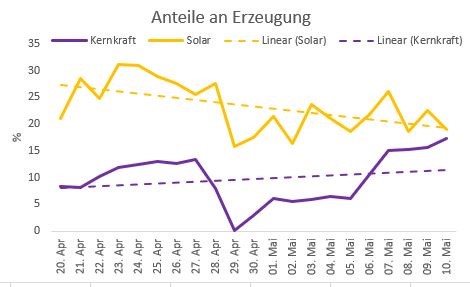
What was actually done? The daily data from here can help. A look at the share of PV and nuclear power in daily electricity production in Spain around the time of the blackout on April 28th:

Share of power generated, nuclear (Kernkraft) and solar. 

For PV (solar), the average share was 27% until April 27, and only 20% thereafter.

The downward trend is highly significant. In contrast, the share of nuclear power increased slightly, but has an upper limit: its installed capacity. Almost everything that was available in terms of integrating components (= inert masses) was activated. The “fast” inverters were reduced. The total PV output fell from an average of 182 GWh/day to 127 GWh/day. PV was therefore reduced by around 30% after the blackout in Spain. This is logical and speaks for itself.

All (political/ideological) attempts to blame something else for the blackout in Spain must be dashed by these clear realities. So no matter what little soup is tried to be cooked, technology can neither be persuaded nor fooled.

Donate – choose an amount

via NoTricksZone

https://ift.tt/rDKT7g4

May 18, 2025 at 07:43AM