New Texas Law to Force Renewables to Be Dispatchable

From NOT A LOT OF PEOPLE KNOW THAT

By Paul Homewood

Sounds like Texas is getting fed up with its electricity system being increasingly put at risk by wind and solar power.

After years of papering over the cracks with half hearted proposals, it appears that the State Legislature will formally pass a law requiring all generators, not just new ones, to be fully dispatchable.

Ed Ireland has the story:

In 2021, Winter Storm Uri pushed Texas’s electricity grid to the brink, with just 4 minutes and 37 seconds from total collapse. Snow, ice, and freezing temperatures covered all 254 counties in the State for five days, starting February 13. Wind turbines froze, overcast skies incapacitated solar panels, some natural gas wells experienced freeze-offs, and even coal plants struggled with frozen equipment.

As power generators failed and electricity demand skyrocketed, the Electric Reliability Council of Texas (ERCOT) ordered rolling blackouts across Texas. Some local utilities unknowingly cut power to areas with electric natural gas compressors, which stopped gas flows to generating stations, causing more outages. (The Railroad Commission of Texas created a new division, Critical Infrastructure, so this problem would never happen again.) The grid’s frequency dropped dangerously below 60 hertz, nearly crashing, but a slight drop in demand and the recovery of some generation saved the grid from total collapse, which could have required weeks to recover from a “black” start of the grid.

Since then, ERCOT, the Public Utility Commission of Texas (PUCT), and lawmakers have repeatedly vowed to prevent another near-disaster. They have proposed ideas such as:

  • Weatherization requirements for power plants to handle extreme cold (passed in 2021 via Senate Bill 3).
  • Incentives for building more dispatchable power, specifically natural gas plants, such as the Texas Energy Fund (House Bill 1500, 2023).
  • Market reforms prioritize reliable power, such as the Performance Credit Mechanism, which was debated but not implemented.

None of these proposals squarely addressed the grid reliability problem until Texas House Bill 3356 and Senate Bill 715 were recently approved by legislative committees and could become law. These bills set new reliability rules for all ERCOT power generators, not just new ones. They require all power generators on ERCOT, including wind and solar, to be dispatchable, meaning they can quickly adjust to meet demand.

To comply, generators must either build their own backup power, such as battery energy storage systems (BESS), or contract with others to provide their backup power.

Read the full post here.

It’s time we did the same here!


Discover more from Watts Up With That?

Subscribe to get the latest posts sent to your email.

via Watts Up With That?

https://ift.tt/4PiZuQG

May 14, 2025 at 08:01AM

Met Office Failed To Predict Dry Spring

By Paul Homewood


 image

https://www.bbc.co.uk/weather/articles/c5y64p3m7pyo

We are heading for the driest Spring on record, and no doubt the climate con artists are already lining up their “blame it on global warming” stories.

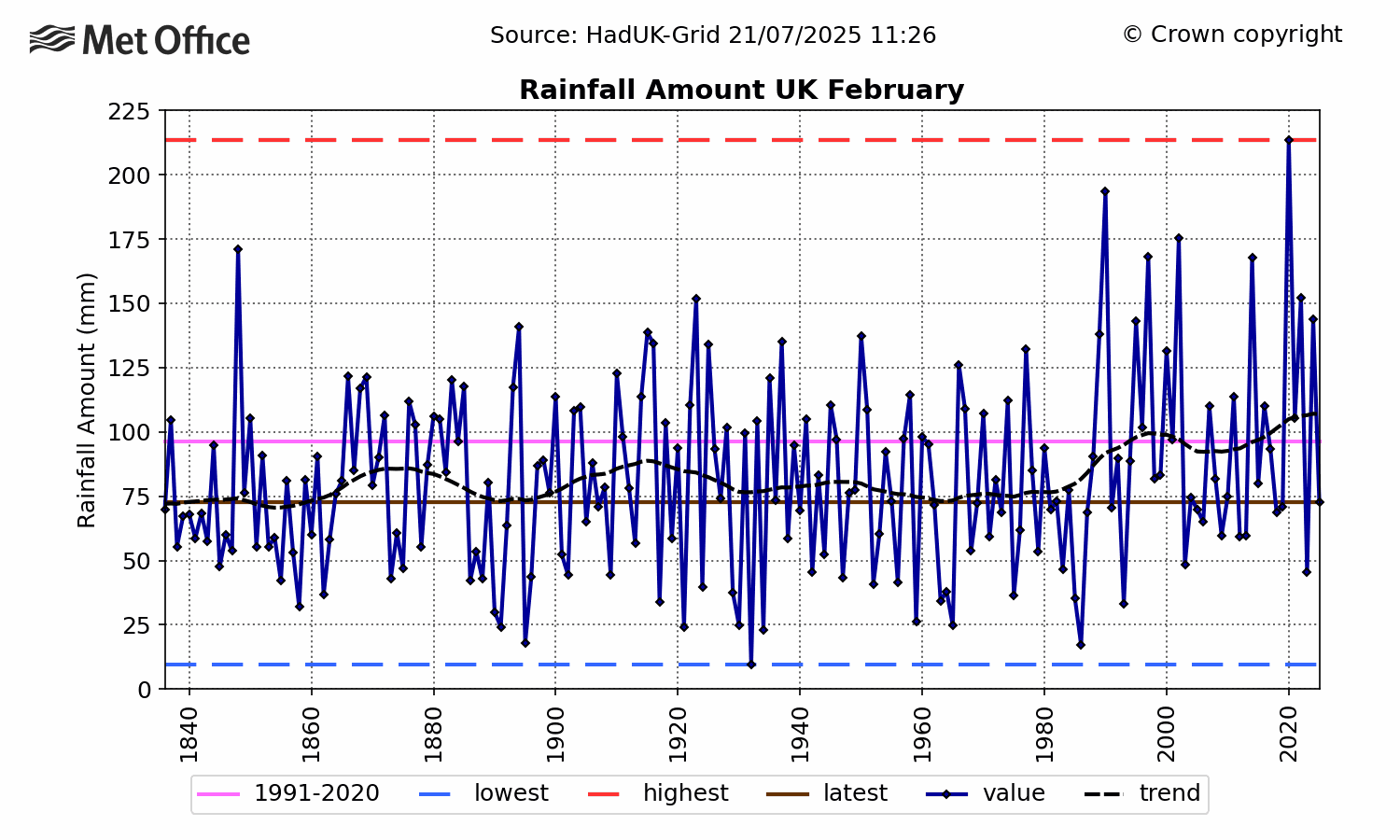
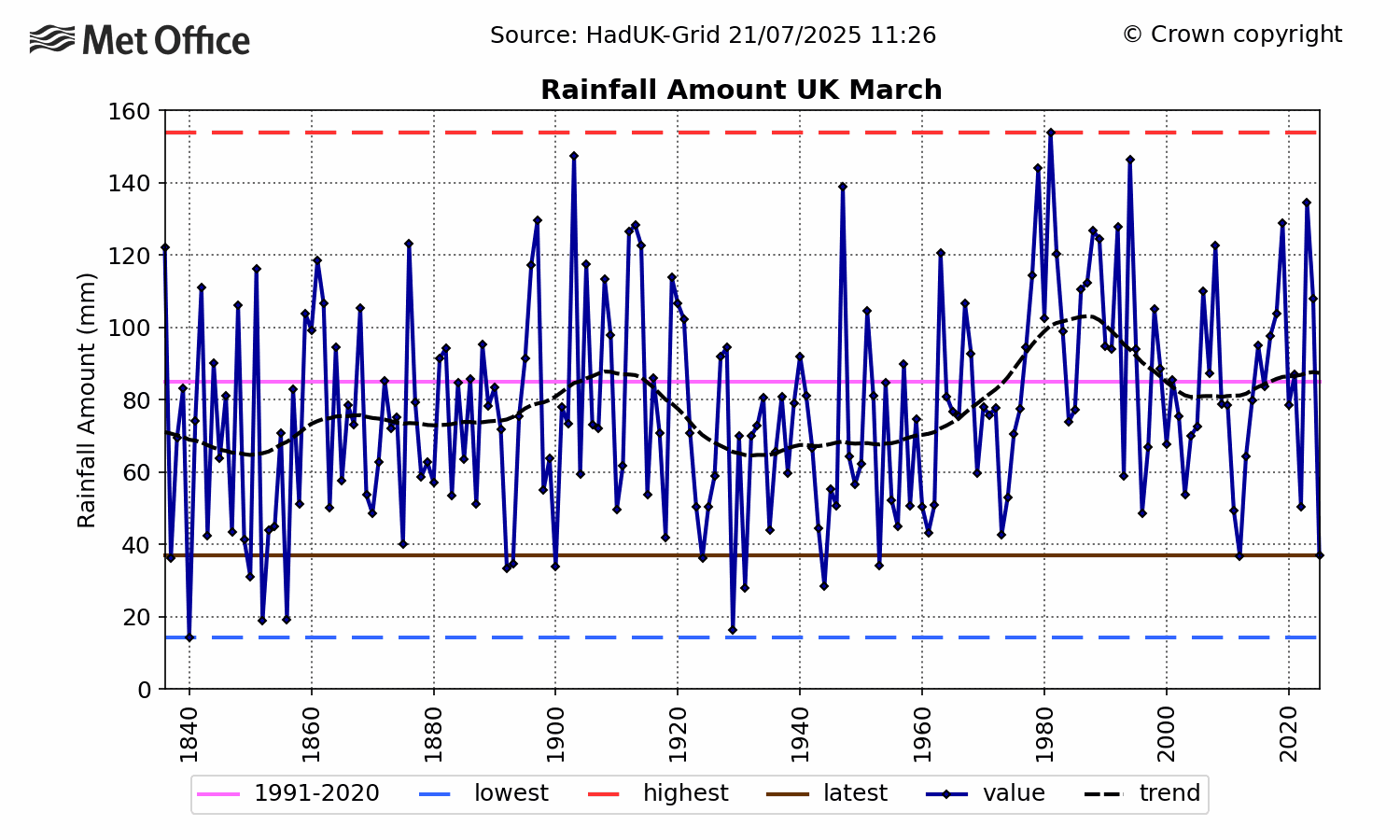
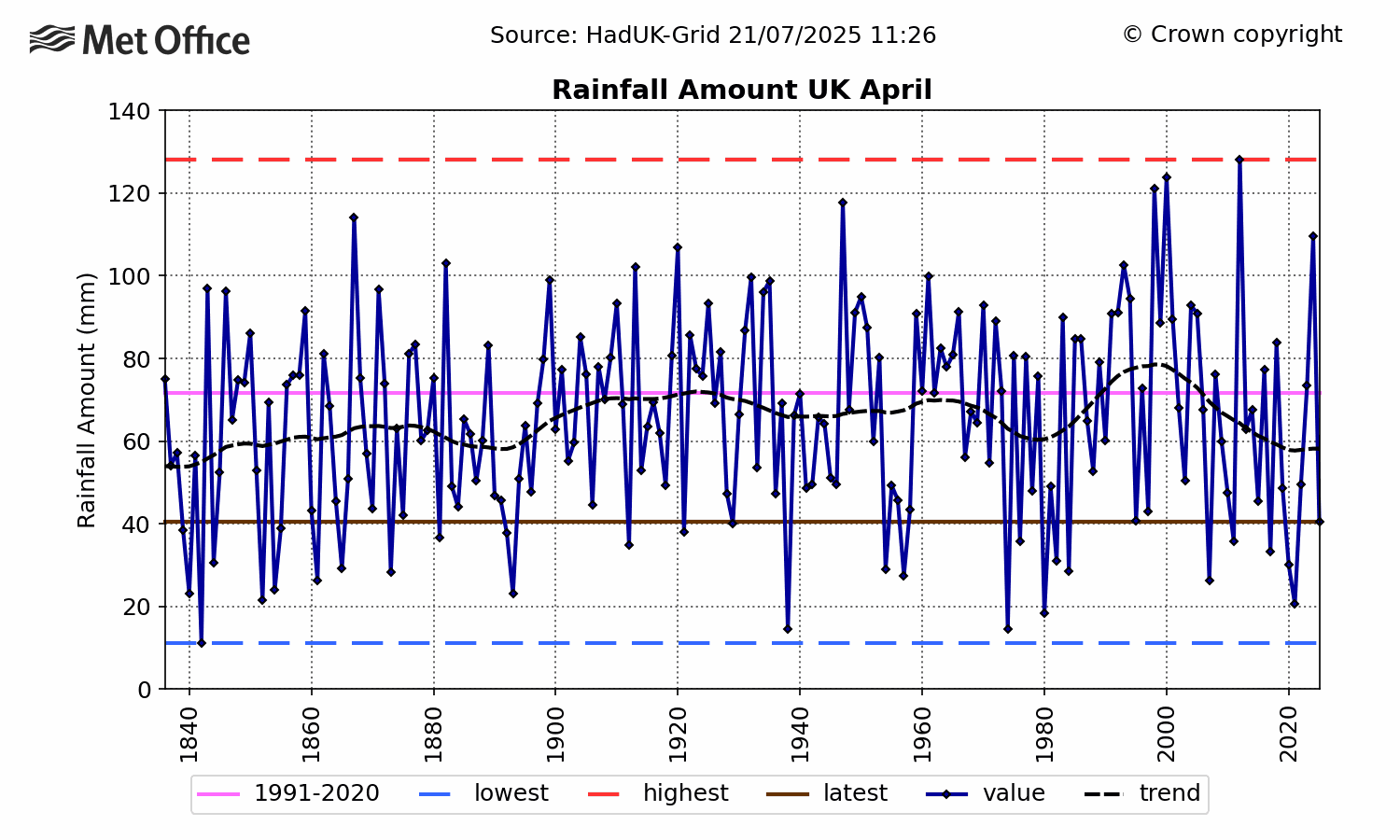
If that were true, the Met Office would have been forecasting it three months ago, but in fact they did just the opposite:


 image

image

image

All three months included in that Outlook – February, March and April were much drier than normal, a prospect the Met Office effectively dismissed at the end of January.

I have asked the Met Office to supply the March to May outlook, which does not pop up on Wayback, unlike the above one. When we get the actual numbers for May, I will update.

But these 3-Month Outlooks are clearly not worth the paper they are printed on if they cannot even predict weather events like this spring’s rainfall.

via NOT A LOT OF PEOPLE KNOW THAT

https://ift.tt/watxXWV

May 14, 2025 at 04:32AM

Biden Team Pumped $100 Billion Into NGOs, Green Energy Scams After Trump Win

From Legal Insurrection

Posted by Leslie Eastman

While determining the biggest loser in the Biden administration was challenging, it will be equally challenging to name the most effective and competent official in the current Trump administration.

Energy Secretary Chris Wright is undoubtedly a strong contender for this designation. He has been busy untangling the web of climate cult financing. He has discovered that in the final weeks of the Biden administration, the U.S. Department of Energy (DOE) accelerated the allocation of nearly $100 billion in green energy loans and commitments.

He reviewed the numbers while being interviewed by Maria Bartiromo on Fox Business. Wright noted that the $100 billion far exceeded the total amount the DOE’s Loan Programs Office (LPO) lent in the previous 15 years (about $42 billion).

…Let me repeat about a little over $40 billion was supplied in support through the loan program office in its 15 years of existence. A little over 40 billion and then almost a hundred billion in the 76 days after they lost the election and before President Trump’s inauguration.

Like if those were great ideas that were benefit to the America, why didn’t they do it in the two and a half years after the inflation reduction act was passed? What did they wait till they lost the election? They changed terms and loan covenants. They basically tried to set bombs to make it hard for us to unwind the mess they’d created.

That’s just not a responsible way to treat American taxpayer money and to move our energy system forward. So, yes, we’ve stepped into a lot of mess, but this stuff’s all fixable. We’ve got an aggressive team going after it. And you see already American energy prices are down. investments in America to bring jobs back are up. So, I think we’re going the right direction. But, yeah, we’ve got a lot to clean out.

During the interview with Bartiromo, Wright also stressed that the Trump administration supports the development of other energy sources besides solar and wind.

Well, the great news is all we really have to do is undo all the wrongheaded policies of the last administration. You know, they came in saying they promised they were going to get rid of fossil fuels. Well, they were a little over 80% of American energy when they were elected and they were a little over 80% of American energy when they left.

The thing they did do was make them all more expensive. And they did that by just getting policies to get in the way of the commercial production of energy. So we’re clearing out a lot of that underbrush to make it easier, reppering natural gas export terminals, common sense permitting and regulation on building pipelines.

We’re going to give a help and a nudge to kickstart nuclear energy in the United States. Again, very excited about that. Geothermal is a new emerging technology, but we’ll end this sort of obsession with only wind, solar, and batteries that are still less than 4% of American energy. But they were all in on just that tiny little quadrant of the energy sector.

All of this sounds great, but I share Bartiromo’s concerns about getting policies codified in Congress…in the event climate cultists get their hands on America’s treasury again.

Wright’s response was less clear, but it indicates that meaningful reforms should be passed during this term.

I would say there’s great interest in Congress to make long-term structural fixes. On the news, you hear a lot about what we’re doing in the short run because that’s moving fast. There’s also at least as much effort on these long-term structural codifications you just mentioned. So, you know, no specifics yet.

Nothing has been passed through Congress of meaning, but you’re going to see meaningful changes to our laws some this year and you will see it steadfast throughout this term. We will not be able to go back to the lunacy we arrived in whenever the Democrats come back to power. I think there’ll be some meaningful checks on the lunacy that can return.

Efficient and affordable energy is the lifeblood of the American economy. If Wright can claw back this money and remove regulatory blogs on nuclear and fossil fuel development, he will be a contender for the Top Trump Pick among the current crop of administrators and agency heads.

The full interview is here:


Discover more from Watts Up With That?

Subscribe to get the latest posts sent to your email.

via Watts Up With That?

https://ift.tt/KkyPXEi

May 14, 2025 at 04:05AM

How the weather got ‘stuck’ over the UK—and produced an unusually dry and warm spring


As usual The Conversation uses any opportunity to promote its climate change dogma, even while admitting it has no specific evidence. Weather blocks are a well-known phenomenon and always have been. They resort to vague claims, for example saying computer models ‘suggest future changes in the occurrence of blocking’, which doesn’t impress much. Also ‘weaker jet stream’ theory has taken a knock as recent observational evidence points to the opposite.
– – –
A “blocking” weather system lingering high above the UK has produced one of the driest, warmest and brightest starts to spring on record.

April 2025 was the sunniest since records began in 1910. This followed the third-sunniest March, and both months saw temperatures well above average nationwide. On May 1, the temperature reached 29.3°C in Kew Gardens in London—a new record for the date.

Meteorologists are warning of the potential for a summer drought, as the UK has seen roughly half its usual amount of rainfall for March and April.

While farmers fret about this year’s harvest, some water companies are urging customers to help reservoir levels recover by limiting water use.
. . .
For several weeks, a stubborn area of high pressure over the UK has diverted the usual flow of mild, moist air from the North Atlantic like a boulder in a river. This is known as a blocking weather system.

Within it, air descends, warms and dries, which is why this weather pattern tends to be linked to heat waves and drought. Blocking is usually persistent, making it seem like the weather is stuck.

Here’s how climate change may have played a role in setting up this unusual spring. [Snip]
. . .
Keeping track of the jet stream
The movement of weather systems in Earth’s mid-latitudes—including over the UK—is linked to the jet stream, which is a fast-flowing river of air driven by the contrast in temperature between the poles and mid-latitudes.

Some researchers have suggested that, because the Arctic is warming faster than the tropics, the jet stream may weaken and become more “wavy”, increasing the occurrence of blocking events, contrary to what most climate models show.

Outside of the scientific community, this idea has become popular. However, the hypothesis remains controversial among scientists, and observational evidence has weakened in recent years.

In fact, around 10 kilometers above Earth’s surface, near commercial aircraft cruising altitudes, the opposite trends are occurring: the temperature difference between the Arctic and mid-latitudes is increasing, acting to increase the strength of the jet stream.

There are considerable challenges with understanding how climate change is affecting the large-scale atmospheric patterns which drive the weather we experience. These include large natural variability and imperfect climate models.

Models mostly suggest a decline in blocking events with climate change, though this remains relatively uncertain compared with other aspects of the science.

Full article here.
– – –
Image: Omega blocking highs can remain in place for several days or even weeks [credit: UK Met Office]

via Tallbloke’s Talkshop

https://ift.tt/BwnQrKU

May 14, 2025 at 03:48AM