New Texas Law To Force Renewables To Be Dispatchable

By Paul Homewood


Sounds like Texas is getting fed up with its electricity system being increasingly put at risk by wind and solar power.

After years of papering over the cracks with half hearted proposals, it appears that the State Legislature will formally pass a law requiring all generators, not just new ones, to be fully dispatchable.

Ed Ireland has the story:

In 2021, Winter Storm Uri pushed Texas’s electricity grid to the brink, with just 4 minutes and 37 seconds from total collapse. Snow, ice, and freezing temperatures covered all 254 counties in the State for five days, starting February 13. Wind turbines froze, overcast skies incapacitated solar panels, some natural gas wells experienced freeze-offs, and even coal plants struggled with frozen equipment.

As power generators failed and electricity demand skyrocketed, the Electric Reliability Council of Texas (ERCOT) ordered rolling blackouts across Texas. Some local utilities unknowingly cut power to areas with electric natural gas compressors, which stopped gas flows to generating stations, causing more outages. (The Railroad Commission of Texas created a new division, Critical Infrastructure, so this problem would never happen again.) The grid’s frequency dropped dangerously below 60 hertz, nearly crashing, but a slight drop in demand and the recovery of some generation saved the grid from total collapse, which could have required weeks to recover from a “black” start of the grid.

Since then, ERCOT, the Public Utility Commission of Texas (PUCT), and lawmakers have repeatedly vowed to prevent another near-disaster. They have proposed ideas such as:

  • Weatherization requirements for power plants to handle extreme cold (passed in 2021 via Senate Bill 3).

  • Incentives for building more dispatchable power, specifically natural gas plants, such as the Texas Energy Fund (House Bill 1500, 2023).

  • Market reforms prioritize reliable power, such as the Performance Credit Mechanism, which was debated but not implemented.

None of these proposals squarely addressed the grid reliability problem until Texas House Bill 3356 and Senate Bill 715 were recently approved by legislative committees and could become law. These bills set new reliability rules for all ERCOT power generators, not just new ones. They require all power generators on ERCOT, including wind and solar, to be dispatchable, meaning they can quickly adjust to meet demand.

To comply, generators must either build their own backup power, such as battery energy storage systems (BESS), or contract with others to provide their backup power.

Read the full post here.

It’s time we did the same here!

via NOT A LOT OF PEOPLE KNOW THAT

https://ift.tt/YRG0Wm8

May 13, 2025 at 03:00AM

Why Electricity Prices Are So High – NZW

By Paul Homewood

London: 13 May 2025
For immediate release
Net Zero, not gas, causing bill increases

A new factsheet from Net Zero Watch shows claims that high electricity prices are due to the influence of gas prices on wholesale markets are almost entirely false.

Through detailed analysis of Ofgem price cap data and, uniquely, an estimate of the effect of carbon taxes on wholesale markets, it reveals that the gas price is now having only a marginal effect on household electricity bills compared to the situation ten years ago. Around three quarters of the increase in bills since 2015 can be attributed to Net Zero.

The most important factors in the £327 real-terms increase are:

  • Renewables subsidies (£83)

  • Carbon taxes (£39)

  • Grid balancing (£26)

  • Capacity Market (£26)

  • Grid strengthening (£23).

The direct cost – the element that can reasonably be attributed to the cost of gas – only accounts for £45 of the increase.

Notes for editors

The factsheet can be downloaded from the Net Zero Watch website.

via NOT A LOT OF PEOPLE KNOW THAT

https://ift.tt/QRaUNOZ

May 13, 2025 at 02:29AM

The climate war of exaggeration has to be stopped

Climate alarmists are waging war against against human progress with a complicit, sensationalist meteorological media providing the ammunition—will likely be remembered as a force that hindered humanity’s advancement as much as any armed conflict. 

via CFACT

https://ift.tt/6I2PMip

May 13, 2025 at 02:10AM

European Blackout Update (yes, it was solar)

“Could the reliability of the Iberian Peninsula grid be ensured by introducing new technical solutions? Technically, yes—but economically, the feasibility is more challenging.” ( – J.K. Nøland, below)

Jonas Kristiansen Nøland, associate professor at the Norwegian University of Science and Technology, has a verdict on the Iberian Peninsula blackout. His take follows:

Recent evidence indicates that Europe’s worst blackout, occurring in the Iberian Peninsula, originated from an unstable power grid. This instability likely triggered the cascading chain of events that followed.

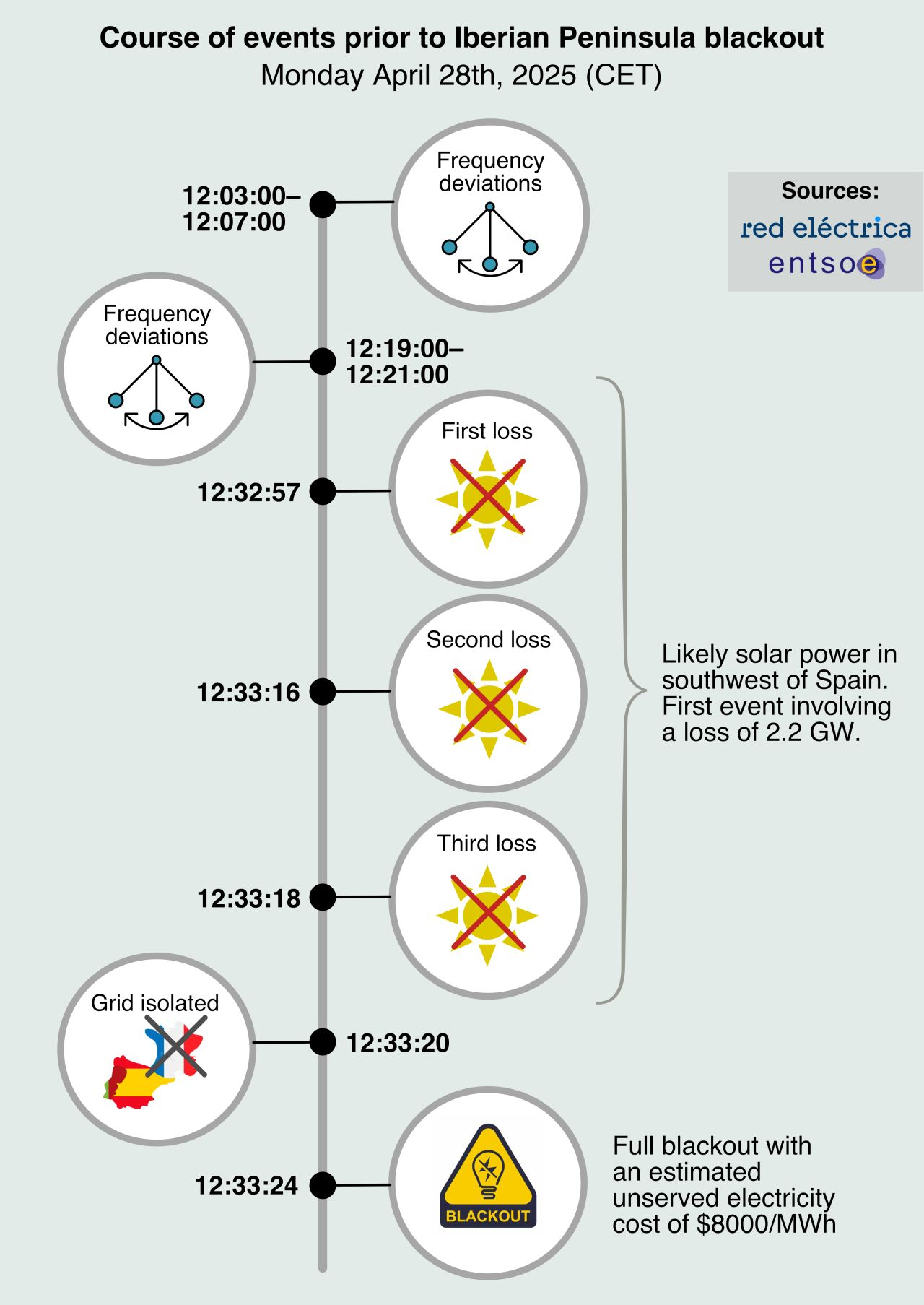
In the half-hour leading up to the blackout, two episodes of power and frequency oscillations were observed in the Continental European synchronous area. Grid operators took actions to mitigate these oscillations.

The likely root cause of these undamped “inter-area oscillations” was the inherently low inertia of the Spanish power grid at midday, with approximately 70% of generation provided by inverter-based solar and wind. Such renewable sources lack the spinning reserve needed to effectively resist frequency oscillations.

Due to these unstable grid conditions, exceptionally high rates of change of frequency (RoCoF) occurred, which became the final nail in the coffin. As a result, low-frequency load shedding (UFLS) were not able kick in to save the day.

The critical tipping point came with the first generation loss at 12:32:57, involving roughly 2.2 GW, likely from solar PV generation in southwest Spain—a region dominated by solar power.

This generation loss, occurring under already unstable conditions (likely owing to overvoltages, which is the hypothesis of Luis Badesa) accelerated a rapid frequency collapse within the inertia-deficient system. Officials from Red Eléctrica (REE) noted a “strong oscillation” precisely at this point, leading to protective disconnections cascading across the grid due to high RoCoF.

Could the reliability of the Iberian Peninsula grid be ensured by introducing new technical solutions? Technically, yes—but economically, the feasibility is more challenging.

Notably, REE had already installed synchronous condensers and leveraged existing synchronous generation (nuclear, hydro, solar thermal) to bolster inertia and voltage stability. Unfortunately, these measures proved insufficient.

Nonetheless, deploying additional synchronous condensers or procuring fast frequency reserves (FFR) to provide virtual inertia through balancing markets significantly increases system costs.

Currently, FFR is typically procured only during short intervals of low inertia. Operating a consistently low-inertia grid would demand permanent, costly frequency support mechanisms, potentially making such a solution economically challenging.

Sources:
[1] 𝐄𝐍𝐓𝐒𝐎-𝐄 𝐞𝐱𝐩𝐞𝐫𝐭 𝐩𝐚𝐧𝐞𝐥: https://lnkd.in/dajvNZ3f
[2] 𝐞𝐥𝐄𝐜𝐨𝐧𝐨𝐦𝐢𝐬𝐭𝐚.𝐞𝐬 𝐚𝐫𝐭𝐢𝐜𝐥𝐞: https://lnkd.in/dmRHp5Zz
[3] 𝐑𝐞𝐬𝐞𝐚𝐫𝐜𝐡 𝐨𝐧 𝐢𝐧𝐭𝐞𝐫-𝐚𝐫𝐞𝐚 𝐨𝐬𝐜𝐢𝐥𝐥𝐚𝐭𝐢𝐨𝐧𝐬: https://lnkd.in/dCEVR549
[4] 𝐑𝐞𝐬𝐞𝐚𝐫𝐜𝐡 𝐨𝐧 𝐫𝐨𝐭𝐚𝐭𝐢𝐨𝐧𝐚𝐥 𝐢𝐧𝐞𝐫𝐭𝐢𝐚 𝐟𝐨𝐫 𝐠𝐫𝐢𝐝 𝐫𝐞𝐥𝐢𝐚𝐛𝐢𝐥𝐢𝐭𝐲: https://lnkd.in/d8YXEumZ
[5] 𝐑𝐞𝐬𝐞𝐚𝐫𝐜𝐡 𝐨𝐧 𝐫𝐞𝐧𝐞𝐰𝐚𝐛𝐥𝐞-𝐫𝐢𝐜𝐡 𝐩𝐨𝐰𝐞𝐫 𝐠𝐫𝐢𝐝𝐬: https://lnkd.in/ghMYqhsq

——————-

Also see:

Inertia in One Lesson (Dave Edwards on LinkedIn) May 6, 2025

The post European Blackout Update (yes, it was solar) appeared first on Master Resource.

via Master Resource

https://ift.tt/VFrqJ1Z

May 13, 2025 at 01:06AM