A Study Has Shown

The Guardian has found a new report that has caused it much excitation, and it is easy to see why:

The paper, published on Friday in the journal Nature Communications Earth & Environment, found that from 2006 to 2020, the climate crisis contributed to about 15,000 deaths from exposure to small particulate matter from wildfires and cost about $160bn. The annual range of deaths was 130 to 5,100, the study showed, with the highest in states such as Oregon and California.

Scary stuff, I’m sure you will agree. But before discussing the report’s findings in any detail, it is perhaps worth reflecting upon the nature of the study undertaken. Whilst you might be forgiven for believing that scientific measurements lay behind the grim proclamation of a climate change-driven increase in pulmonary deaths, the truth is that the paper is based heavily upon mathematical modelling – or more to the point, mathematical modelling layered upon mathematical modelling. In fact, they used a clinical model to predict the health impacts resulting from wildfire smoke dispersion that had itself been modelled. This modelling took as its starting point a posited climate-driven increase in burn area as calculated from ecoregion-level empirical models using fire weather index (FWI) and precipitation from ERA5, whilst using counterfactual analysis based upon a climate model ensemble (CMIP6). With so many models to work with, what could possibly go wrong? Well, plenty from where I am standing.

Before going any further, I should point out that I’ve got nothing against mathematical modelling. I would say that if it is all you have to work with, then work with it. But should you do so, it is very important to keep a clear idea as to how much credence one can place in the modelled results. Even worse, when modelling is layered upon modelling, you end up with an exercise that is likely to be riven with compounding uncertainties. Given that we are dealing here with three layers of modelling, I think it is fair to say that the result could be characterised as modelled speculation.

Predictably, the Guardian article chooses not to highlight the study’s speculative nature, preferring instead to lead with confident statements that emphasise the hazards posed by the “climate crisis”. It isn’t until one reads towards the bottom of the article that the reality starts to find its voice. Specifically, the article reports that Marshall Burke, global environmental policy professor at Stanford University, feels that whilst evidence linking climate change to burned areas was “rock solid”, the modelling layered on top was a bit flaky:

“Linking burned area to smoke is trickier because you never know exactly which way the wind’s going to blow,” he said, and he wondered how the death estimates compared with fatalities tied to general air pollution.

Even then, we are only beginning to unearth the truth with this quote. I can easily see why the smoke dispersal modelling should be highly dubious, but the idea that this contrasts with a “rock solid” foundation of FWI calculations is simply absurd. That may be the hype issued by outfits such as the World Weather Attribution (WWA) centre but the reality could not be further from the truth. In the recent WWA attribution study of the 2025 LA wildfires the uncertainties associated with the FWI calculations were such that they actually rendered the results statistically insignificant. I’ll repeat that: whilst the paper said that the FWI was made 35% more probable under climate change, the results were equally consistent with the idea that climate change played no role whatsoever! So let us be realistic here; there is actually nothing in the Communications Earth & Environment study that can be referred to as rock solid.

So what exactly did the paper say? If you recall, the Guardian spoke of a “climate crisis” that has contributed to about 15,000 deaths between 2006 and 2020. Let’s put aside for one moment the vagueness behind the concept of contributing towards death, and focus instead upon how such a contribution might fit into the scale of things. After all, even in a counterfactual world in which climate change didn’t happen, wildfires would still have blown their smoke over populated areas leading to pulmonary illnesses. So what is the scale of the increase attributed to climate change? The answer to that question can be found in figure 4 of the report: ‘Increasing climate change contributions to wildfire PM2.5 mortality for CONUS between 2006 and 2020’.
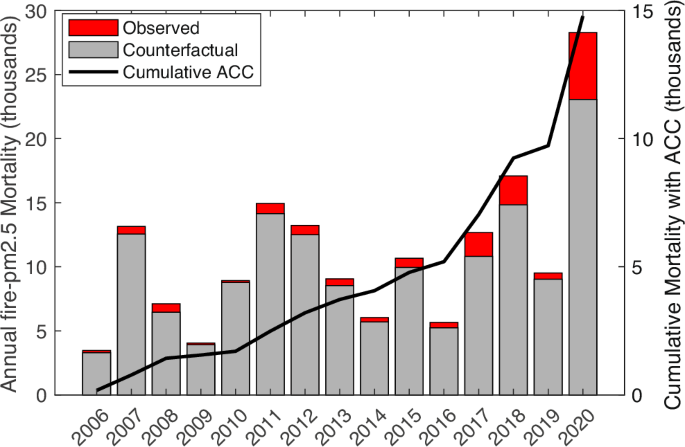
I don’t wish to sound complacent here, but apart from a very odd looking glitch in 2020, the climate-driven contribution doesn’t look that spectacular to me. In fact, what this graph does rather well in my opinion, is draw attention to the scope of contributions from non-climatic factors. For example, what would the graph have looked like if the counterfactual analysis addressed instead the impact of trends in arson, or trends in urban sprawl adjacent to fire risk areas? But of course, in asking those questions, one comes up against the revelation of a misplaced focus, for which we have Professor Patrick T. Brown to thank. It is no surprise whatsoever that the study quantifies only the climatic contribution – after all, that’s what all similar studies do. You will never see a figure akin to the above that quantifies the wildfire mortality due to human decision-making, other than, of course, the decision to burn fossil fuels.

To be fair to the Guardian, they do actually quote Professor Brown, albeit deep within the bowels of the article:

Patrick Brown, a Johns Hopkins University lecturer in climate and energy policy, said he had some concerns about the study. One was conceptual. The study acknowledges the power non-climate drivers have on wildfires, but it doesn’t give them proper weight, he said in an email. Brown, who was not involved in the study, worries decision-makers could wrongly conclude that mitigating planet-warming carbon emissions is the only solution. “Yet in many regions, the more immediate life‑saving action may be fuel breaks, prescribed burns, ignition‑source regulation, public health efforts, etc,” he said.

Even so, the delicate Guardian reader is provided with an immediate antidote to deal with Brown’s heretical poison:

But ultimately, the study notes, the problem of deaths from wildfire smoke will only get worse without the reduction of greenhouse gas emissions.

And I suppose, to the Guardian reader at least, that is all that you should be worrying about. Besides which, it’s all science, don’t you know. You may scoff, but you’re probably just an orc like me. We just need to understand that ‘a study has shown’. And that’s an end to it.

via Climate Scepticism

https://ift.tt/2r1EmhZ

May 11, 2025 at 04:41AM

Open Thread


Discover more from Watts Up With That?

Subscribe to get the latest posts sent to your email.

via Watts Up With That?

https://ift.tt/36EgoMl

May 11, 2025 at 04:02AM

Watch Gabriella Hoffman talk energy and economy

With headlines swirling about former President Donald Trump halting offshore wind projects, Gabriella breaks down the facts behind Dominion Energy’s plans.

via CFACT

https://ift.tt/0fjtUdw

May 11, 2025 at 03:56AM

Nature Paper Claims to Pin Liability for ‘Climate Damages’ on Oil Companies

From THE DAILY SCEPTIC

The drumbeat of climate litigation has grown louder in recent years, fuelled by activists and dubious science. In this crusade against major oil and gas companies, ‘attribution science’ has been a fast-growing field of climate research which is explicitly meant to serve legal ends. According to the World Weather Attribution initiative, “Unlike every other branch of climate science or science in general, event attribution was originally suggested with the courts in mind.”

According to ‘Carbon Majors and the Scientific Case for Climate Liability‘, a paper published in Nature last month, it is now possible to quantify the climate damages caused by each of the world’s biggest oil and gas companies. Christopher Callahan and Justin Mankin, co-authors of the peer-reviewed paper, argue that “the scientific case for climate liability is closed”. In their paper, they claim to link oil and gas companies’ CO2 emissions to specific weather events and trillions in economic damages.

This audacious attempt to pin tort liability on oil and gas giants like Saudi Aramco and ExxonMobil rests on shaky economic and scientific grounds and ignores the immense benefits of fossil fuels.

Given the high stakes in the litigious turn of climate change alarmists, this paper’s assertions, flawed assumptions and the embedded activist machinery deserve a thorough debunking

The ‘Carbon Majors’ Paper: A Blueprint for Climate Litigation

The central assertion of Callahan and Jenkin is that advancements in climate attribution science enable courts to hold fossil fuel companies liable for damages caused by global warming. The authors propose an “end-to-end” attribution framework that links emissions from major oil and gas firms to specific extreme weather events — such as heatwaves, floods and droughts — and quantifies resulting economic losses. Using “scope 1” (direct emissions from producing oil and gas) and “scope 3” (consumer emissions from combustion of fuels) data, peer-reviewed climate models (e.g. CMIP6) and econometric methods, the paper estimates, for instance, that Chevron’s emissions from 1991 to 2020 caused $791 billion to $3.6 trillion in heat-related losses.

The framework relies on three key steps:

  • Attribution of CO2 to Global Mean Surface Temperature (GMST): The authors use models to estimate how companies’ emissions contribute to global warming.
  • Pattern Scaling for Local Weather: They apply “pattern scaling” methods to translate GMST increases into regional temperature extremes, such as the hottest five-day period (Tx5d).
  • Empirical Damage Functions: Econometric models estimate economic losses (e.g. income declines, agricultural losses) from these extremes, drawing on regional GDP per capita data.

The paper positions this framework as a legal game-changer for climate liability. It cites ongoing lawsuits such as an Oregon county’s claim against oil companies for the 2021 Pacific Northwest heatwave. The paper advocates its “end-to-end attribution framework” to align with the many activist lawsuits targeting major energy producers. The authors argue that tort law, akin to tobacco litigation, can hold companies accountable for “particularised harms”, offering a transparent, reproducible method for courts to assess liability.

A Flawed Economic Case: Unravelling the Assumptions

The paper’s assertions rest on three contested causal chains — CO2 to global mean surface temperature (GMST), GMST to extreme local weather events, and extreme weather events to human welfare — each riddled with uncertainty. Meanwhile, it dismisses the greening effects of CO2 and the foundational role of fossil fuels in modern civilisation, skewing the cost-benefit analysis (CBA) central to sound economic policy.

The paper assumes a direct link between CO2 emissions and GMST, but this relationship is far from settled. Climate sensitivity — how much warming results from a doubling of CO2 and other greenhouse gases of which water vapour is the most significant — remains a subject of unresolved scientific debate. Estimates range from 1.5°C to 4.5°C, with some studies, like those by Nic Lewis and Judith Curry, suggesting lower sensitivities based on observational data rather than computer model simulations.

The paper’s reliance on CMIP6 models, which often overestimate historical warming, introduces significant uncertainty. Natural factors, such as solar variability, celestial orbits and volcanic activity, further muddy the attribution of GMST changes to CO2 or greenhouse gases alone. By treating COas the sole driver of warming, the authors overstate the causal role of fossil fuel companies, ignoring the complex, multivariate nature of climate dynamics. This oversimplification inflates economic damage estimates and misguides courts into assigning liability based on unproven premises.

Even the very concept of a global mean temperature is subject to much qualification as an actual measure. It is often wrongly treated as a kind of single, direct instrumental measurement when it is really the average of widely scattered station data. As Richard S. Lindzen and John R. Christy suggest, at least thus far, “the one-degree Celsius increase in the global mean since 1900 is swamped by the normal variations at individual stations, and so bears little relation to what is actually going on at a particular one”.

The paper’s use of “pattern scaling” to relate GMST to local weather extremes is even more problematic. Pattern scaling assumes a linear relationship between global temperature increases and regional weather patterns, but this method oversimplifies the chaotic and non-linear nature of climate systems. Local weather events are influenced by regional factors that global models struggle to capture. Studies by the IPCC and Roger Pielke Jr, for instance, highlight that extreme weather trends (e.g. hurricanes, heatwaves) show no consistent increase attributable to climate change when normalised for population and economic growth.

The paper’s wide damage ranges ($791 billion to $3,600 billion for Chevron) reflect this uncertainty, yet it presents these figures as actionable for litigation. From an economic perspective, such speculative estimates fail to meet the precision required for tort law’s ‘but-for’ causation (which would show that the plaintiff would not have suffered damages but for the actions of the defendant). This renders the attribution of specific events to individual companies a legal and scientific fantasy.

The final link — local weather extremes to human welfare — is just as weak. The paper’s econometric models estimate losses like income declines or crop failures, but these rely on speculative counterfactuals and data-scarce regions. The law and economics literature, exemplified by Richard Posner’s seminal work, demands that damages be quantifiable and directly attributable, yet the paper’s estimates are probabilistic and diffuse.

Moreover, the paper ignores societal adaptation measures — improved infrastructure, air conditioning, crop resilience — that mitigate weather impacts. Economically, these models overstate costs by neglecting the dynamic adaptability that has historically reduced weather-related mortality and economic losses, as documented most consistently by Bjorn Lomborg. It is indeed perverse to argue for constraints on the supply of fossil fuels when it is their very accessibility that allows humans to adapt to adverse weather events. Building shore and flood protection structures, drainage and irrigation infrastructure and sturdier housing — should they be necessary – need cheap energy.

The Greening Effect of CO2: A Net Benefit Ignored

Perhaps the most glaring omission is the paper’s failure to acknowledge the positive effects of CO2. Far from being a pollutant, the trace gas CO2 is a ‘plant fertiliser’ required for photosynthesis, driving global greening and agricultural productivity. NASA satellite data show a 14% increase in global leaf area from 1982 to 2015, largely due to CO2 fertilisation, boosting crop yields by 15-30% for staples like wheat and rice. Studies by Craig Idso and the CO2 Coalition suggest that CO2’s benefits — enhanced food security, reduced hunger — outweigh its costs, particularly in relatively arid developing nations. Proper cost-benefit analysis of climate-economy models, as advocated by economics Noble laureate William Nordhaus, weigh these benefits against alleged harms. By omitting CO2’s positive externalities, the paper distorts the net economic impact of fossil fuel emissions, undermining its liability claims.

In their failure to include the direct benefits of fossil fuels to willing buyers, the authors of ‘Carbon Majors’ betray the egregious nature of their intent in engaging in tactical ‘attribution science’. In their dismissal of fossil fuels’ role in underpinning modern civilisation, their advocacy against oil and gas companies also reveals their profound lack of concern for human flourishing.

Since the Industrial Revolution, oil, gas, and coal have powered economic growth, lifting billions out of poverty. Global real GDP per capita soared from $1,500 in 1820 to over $10,000 by 2020, driven by fossil fuel-enabled urbanisation and industrialisation. In 2023, these fuels met over 80% of global energy needs, providing heating, cooling, cooking, mobility and fertilisers critical for agriculture. The ‘four pillars of modern civilisation‘ – ammonia (for fertilisers), cement, steel and plastics — require ready access to cheap fossil fuels. The petrochemical industry, reliant on oil, produces plastics, pharmaceuticals and materials essential to modern life.

The ‘Carbon Majors’ paper is not a neutral academic exercise but a cog in a climate-activist machine. The paper’s trillion-dollar damage claims against oil and gas companies ignore the benefits they confer on willing buyers. If successful in proposing liability against fossil fuel companies, climate litigation will raise energy costs, harm consumers and stifle development.

The economic consequences of the paper’s liability framework are dire. Holding companies liable for historical and lawful emissions risks bankrupting key industries, raising energy prices and disrupting supply chains. Low-income households and developing nations, reliant on affordable energy, would bear the brunt, but everyone will be affected. The paper’s retrospective approach violates fairness, as fossil fuel use is a collective societal choice in free market economies, not a corporate conspiracy. Litigation diverts resources from innovation and adaptation — better infrastructure, resilient crops — to legal battles that enrich activist firms.

A Call for Economic and Scientific Integrity

The climate lawsuits that Callahan and Mankin support are driven by firms like Sher Edling LLP and funded by billionaire foundations such as the Rockefeller Family Fund. These groups, alongside NGOs like ExxonKnew, pursue ‘legislation through litigation’, bypassing democratic processes. The US Department of Government Efficiency (DOGE) has raised concerns about USAID funding activist environmental NGOs.

The US Justice Department filed lawsuits against four states last week, claiming their climate actions conflict with federal authority and President Donald Trump’s energy dominance agenda. On April 30th, the DOJ filed lawsuits against Hawaii and Michigan over their plans for legal action against fossil fuel companies for harms caused by climate change. A day later, the department sued New York and Vermont, challenging their climate superfund laws that would force fossil fuel companies to pay into state-based funds based on previous greenhouse gas emissions.

This activist-driven approach distorts any fair consideration of cost-benefit trade-offs by prioritising ideological goals — demonising fossil fuels — over objective analysis. Contingency fees and foundation grants for law firms incentivise exaggerated claims, inflating damages while ignoring benefits, contrary to tort law’s compensatory purpose. The paper’s silence on these influences betrays its complicity in this agenda, undermining its credibility.

The ‘Carbon Majors’ authors’ attempt to pin climate liability on fossil fuel companies is an economic and scientific folly. Its causal chains — CO2 to global temperature (GMST), GMST to local weather, local weather to welfare — are fraught with uncertainty and fails to meet tort law’s rigour. Its economic reasoning collapses under scrutiny, built on a house of cards with dubious scientific assertions and activist bias.

By ignoring CO2’s greening benefits and fossil fuels’ foundational role in modern civilisation and by presenting a one-sided case against oil and gas companies for trillion-dollar damages, the paper skews any reasonable assessment of trade-offs facing society. Policymakers should reject this spurious crusade and embrace market-based solutions that balance costs, benefits and the undeniable contributions of fossil fuels to human progress.

Dr Tilak K. Doshi is the Daily Sceptic‘s Energy Editor. He is an economist, a member of the CO2 Coalition and a former contributor to Forbes. Follow him on Substack and X.


Discover more from Watts Up With That?

Subscribe to get the latest posts sent to your email.

via Watts Up With That?

https://ift.tt/Ld9tAvZ

May 11, 2025 at 12:01AM