I’m a power engineer. The Iberian grid collapse makes me very afraid for Britain

By Paul Homewood

image(3)

The Telegraph has reported that even NESO are now warning about potential blackouts:

The grid operator has raised concerns that the switch from dependable gas to intermittent wind and solar power would “reduce network stability” and said the cost to taxpayers of funding measures to prevent the system crashing was set to “increase significantly” to £1 billion a year.

https://www.telegraph.co.uk/news/2025/05/10/britain-blackouts-net-zero-ed-miliband/

But even now they are still underestimating the size of the problem. Here is what the power engineering expert, Capell Aris, wrote in the Telegraph last week:

Last Monday, the Iberian grid suffered a disturbance in the south-west at 12:33. In 3.5 seconds this worsened and the interconnection to France disconnected. All renewable generation then went off-line, followed by disconnection of all rotating generation plant. The Iberian blackout was complete within a few seconds.

At the time the grid was producing 28.4 GW of power, of which 79 per cent was solar and wind. This was a problematic situation as solar and wind plants have another, not widely known, downside – one quite apart from their intermittency and expense.

This is the fact that they do not supply any inertia to the grid. Thermal powerplants – coal, gas, nuclear, for example – drive large spinning generators which are directly, synchronously connected to the grid. If there are changes which cause a difference between demand and supply, the generators will start to spin faster or slower: but their inertia resists this process, meaning that the frequency of the alternating current in the grid changes only slowly. There is time for the grid managers to act, matching supply to demand and keeping the grid frequency within limits………..

But there are places where things are worse. The UK and Ireland are island grids. They do have undersea power interconnectors to Europe but these are non-synchronous DC links and transmit no grid inertia. There’s little prospect that this will change.

Nowadays, 55 per cent of our generation mix (wind, solar, DC imports) cannot supply inertia to the grid. Are we approaching a system that compares with Spain and Portugal on Monday?

It certainly looks that way. In 2012 the National Grid produced a solar briefing note for the government which is still available online. In that note they imagine a system that has 22 GW of solar power attached to the grid. They demonstrate their concerns based on a sunny summer day when demand is low. The sun rises at 5 o’clock when little or no synchronous plant other than nuclear generation will be on line and at midday, solar is 60 per cent of all generation. The Grid’s engineers then considered that situation “difficult to manage” and concluded that wind+solar power must never exceed 60 per cent of generation.

We now have 17.7 GW of grid-connected solar farms to which we must add all rooftop solar installations. At midday on Tuesday according to Gridwatch the UK’s asynchronous, no-inertia generation was at 66 per cent of total generation.

After nearly 50 years of operation, Dinorwig Power Station is currently shut down for major repairs and there has been no information on when it will re-open. Over the next five years all of our nuclear stations, bar Sizewell, will be closed. Over the same period our combined cycle gas generator fleet will halve from 30 GW to 15 GW. (It takes 5 years to build a new CCGT even using an existing site. The new ones are 66 per cent efficient and cost less than £1 billion to build a 1 GW plant – one third the cost of an offshore windmill.)

We will lose huge amounts of grid inertia. Low-inertia operation will become routine. It is hard to imagine that we won’t start to suffer complete national blackouts like the Iberian one.

One last piece of doom: the recovery of Spain’s grid in just one day is impressive. This speed is certainly due to the assistance of a large, stable grid reconnecting into the Iberian system thus allowing recovery in a series of stable steps as each grid area is recovered. We will not have that facility in the UK with our asynchronous interconnectors.

Read the full story here.

Flywheels

One final comment.

There has been talk that the army of giant flywheels Miliband is planning to instal at a cost of billions will replace the inertial from nuclear and gas plants.

It won’t, not totally anyway.

Flywheels run on electricity, so as soon as this is turned off the flywheels will quickly stop as well. This may allow enough time for grid engineers to react in an emergency, the grid also needs that inertia maintaining, which only the likes of gas and nuclear can provide.

via NOT A LOT OF PEOPLE KNOW THAT

https://ift.tt/ytNWQLJ

May 10, 2025 at 12:15PM

STEVE MILLOY: What Exactly Have NIH Grants Got Us?

From THE DAILY CALLER

Daily Caller News Foundation

Steve Milloy
Contributor

The US is by far the world’s leading funder of biomedical research. But the Trump administration reportedly plans to ask Congress to cut the budget of the National Institutes of Health from $47 billion to $27 billion as part of its effort to rein in out-of-control federal spending.

Not unexpectedly, grant recipients and their support communities are up in arms. They claim that the proposed cuts would deprive researchers of the funding they need to find cures. They say the US will lose its global dominance in the field, along with enormous profits.

But the critical questions are: “What does NIH-funded research actually accomplish?” and “Are the accomplishments worth the money?” The answers, at least according to NIH itself, seem to be shockingly little for the vast sums spent. (RELATED: STEVE MILLOY: Trump’s EPA Is Right To Be Skeptical Of ‘Sun-Blocking’) 

On its website, NIH divides its accomplishments for 2024 under three headings: (1) “Human Health Advances”; (2) “Promising Medical Findings” and (3) “Basic Research Insights.” Under each heading are five NIH-touted accomplishments.

The first item listed under “Human Health Advances,” a category that represents the latest and greatest from NIH research, is “Accurate blood test for Alzheimer’s disease.” After listening to a leftist talking head attack President Trump and Elon Musk for “setting back Alzheimer’s research 20 years” with funding cuts, I looked into the Alzheimer’s advance that NIH had touted at the top of its list of accomplishments.

The advance referred to a July 2024 study published in the Journal of the American Medical Association reporting on a new blood test that had, with 90 percent accuracy, correctly diagnosed Alzheimer’s among 1,213 Swedish Alzheimer’s patients.

While that may sound impressive, the study authors qualified their results with two key caveats: (1) More testing was needed in other cohorts of patients to confirm their results; and (2) “Future studies should evaluate how the use of blood tests for these biomarkers influences clinical care.” Far from being a “Human Health Advance”, the researchers admitted that they still needed confirmation of their results and that they’re not sure the blood test will have any usefulness even if the results are confirmed.

As to NIH taking credit for the “advance,” such as it is, NIH was just one of 20 different funders of the research. It awarded a total of $993,478 to two Swedish researchers. The other 14 Swedish researchers on the study were apparently funded by the other 19 or so Swedish funders.

The study is really only noteworthy because NIH anointed it as the top “advance” for 2024. But what does that say about the other $36.8 billion NIH spent on 60,000 other grants? A not-ready-for-prime-time Alzheimer’s blood test is its pride and joy among all that funding?

A recent Washington Post op-ed entitled “Science needs more shrimp on treadmills” opined that “the National Institutes of Health isn’t funding too much silly science. It’s not funding enough.” The author tried to credit NIH with the development of weight loss drugs like Ozempic. In 1984, an itinerant NIH researcher published a study on Gila monster venom. After four decades of research elsewhere, others used the finding to develop the now blockbuster GLP-1 drugs. In some ways, that’s an amazing story. On the other hand, it’s not evidence that NIH’s huge spending is producing results for taxpayers.

President Nixon launched the “War on Cancer” in 1971, Every President since has tried to make his mark in that effort, but breakthroughs have limited. In 1986, all-star biostatistician John Bailar observed that cancer remained undefeated. In 2018, cancer researchers reported in the British Medical Journal that the expensive drugs recommended by US cancer treatment guidelines were based on “weak evidence.” President Biden’s “Cancer Moonshot” has produced essentially zero.

NIH mentioned no cancer progress under “Human Health Advances” or “Promising Medical Findings” for 2024. The sole mention of cancer comes in “Basic Research Insights” under “Mapping how cancers form and spread.” Fifty-four years after the War on Cancer was launched, that is where we are.

None of this is to say that NIH shouldn’t fund medical research. But if NIH continues spending taxpayer money, there must be some auditing of expenditures and reconciling of accomplishments. We are $36 trillion in debt and cannot afford to spent never-ending billions of dollars on non-productive research in hopes that something will eventually turn up.

And no, there is no need to worry about foreign competition. We spend about 18 times more than the UK, our nearest competitor with respect to medical research. It may be that the rest of the world is free-riding on the backs of US taxpayers. It may also be that the rest of world has realized that there are more productive ways to spend their taxpayer dollars.

Steve Milloy is a biostatistician and lawyer, publishes JunkScience.com and is on X @JunkScience.

The views and opinions expressed in this commentary are those of the author and do not reflect the official position of the Daily Caller News Foundation.

All content created by the Daily Caller News Foundation, an independent and nonpartisan newswire service, is available without charge to any legitimate news publisher that can provide a large audience. All republished articles must include our logo, our reporter’s byline and their DCNF affiliation. For any questions about our guidelines or partnering with us, please contact licensing@dailycallernewsfoundation.org.


Discover more from Watts Up With That?

Subscribe to get the latest posts sent to your email.

via Watts Up With That?

https://ift.tt/u6XHxB4

May 10, 2025 at 12:06PM

BBC Think They Know More About Hurricanes Than NOAA

By Paul Homewood


You may remember this BBC story about the Atlantic hurricane season last year, which then went into great length to claim that global warming warming is making more powerful:


image

image

https://www.bbc.co.uk/news/world-us-canada-42251921


Their fake claim is totally at odds with what NOAA actually said earlier this year:

image

https://www.gfdl.noaa.gov/global-warming-and-hurricanes/

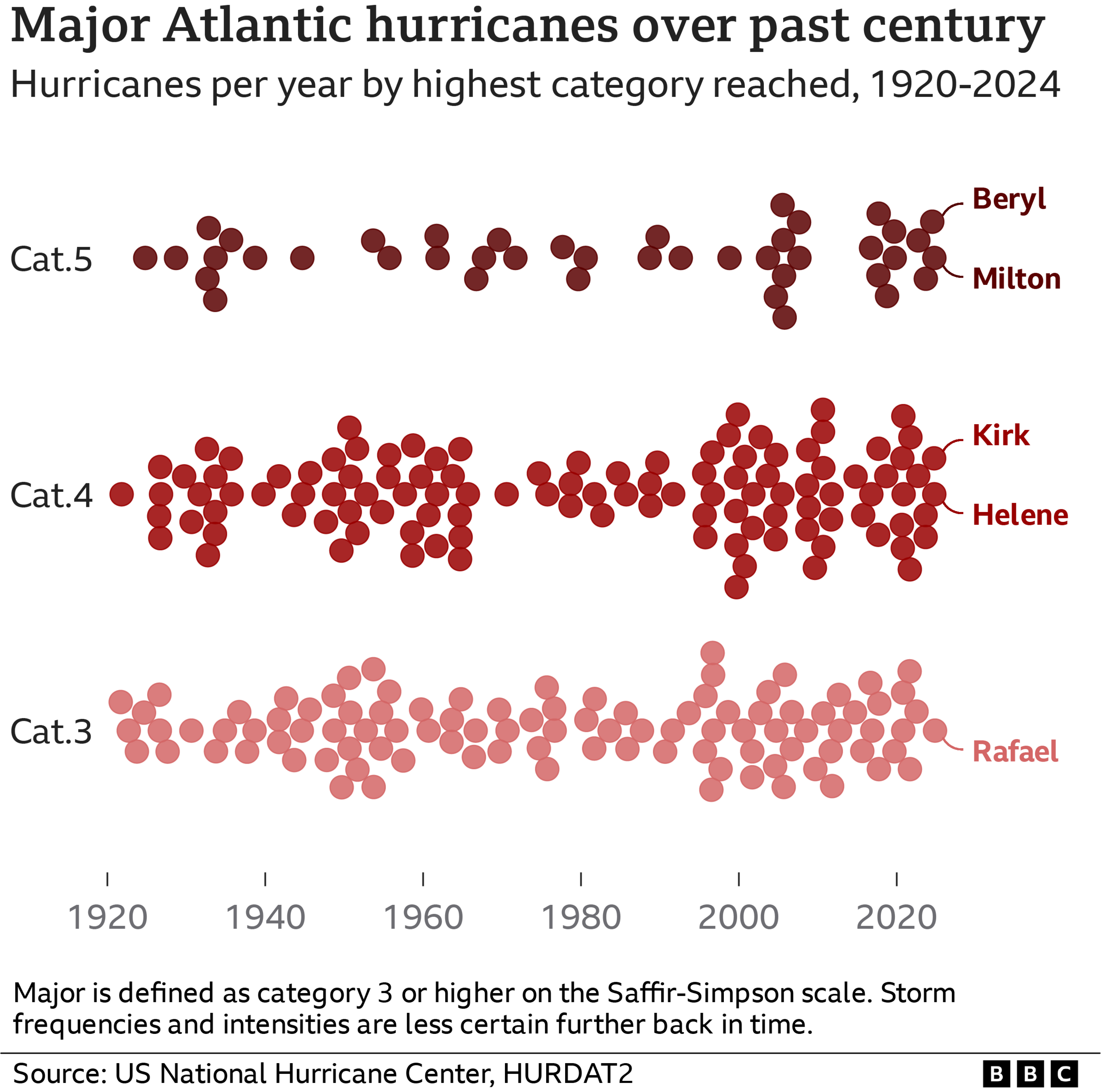
Disgracefully they even presented this graph, purportedly showing an explosion in the number of major hurricanes in the last three decades. The graph is, of course, fake because it compares satellite era data with pre-satellite, when many hurricanes were never spotted:


Graphic showing the increasing number of category three, four and five hurricanes in the North Atlantic

They have now responded to my complaint, which pointed out NOAA’s assessment:

We are sorry we were unable to resolve your concerns with our last email and hopefully this response will rectify that situation.

In considering your email’s concerns we have looked at the article, other content on this issue and discussed the issues with the author of the BBC’s report.

Please consider this response in tandem with our original response to your email of complaint.

Regarding the comments your email makes about the graphic, we consider it is, it is an accurate representation of NOAA’s dataset, and we have a footnote acknowledging that storm frequencies and intensities are less certain further back in time.

The article is clear that the number of tropical cyclones globally has likely not increased, and that long-term data is limited in some regions.

We’d also like to draw your attention to a key statement from the IPCC (an authoritative source on climate science) is “It is likely that the global proportion of Category 3–5 tropical cyclone instances has increased over the past four decades.”

I have now sent my complaint up to the ECU. This is what I have written to them:

The BBC article is principally about the Atlantic hurricane season, so the IPCC references to global trends which you quote have no relevance.

As far as Atlantic trends are concerned, NOAA, who are the recognised authority in this area, are absolutely clear:

“There is no strong evidence of century-scale increasing trends in U.S. landfalling hurricanes or major hurricanes. Similarly for Atlantic basin-wide hurricane frequency (after adjusting for changing observing capabilities over time), there is not strong evidence for an increase since the late 1800s in hurricanes, major hurricanes, or the proportion of hurricanes that reach major hurricane intensity.”

“A number of measures of Atlantic hurricane activity have increased since 1980, but in the of case of metrics where much longer records are available, trends since 1980 are not representative of longer (e.g., century-scale) trends.”

“there is no significant long-term trend (since the 1880s) in the proportion of hurricanes that become major hurricanes”

“As far as Category 4-5 intensity storms, basin-wide unadjusted storm counts show a pronounced increase since the mid-1940s (Bender et al., 2010), but those authors cautioned that the data from such earlier decades needs to be carefully assessed for data inhomogeneity problems before such trends can be accepted as reliable “

https://www.gfdl.noaa.gov/global-warming-and-hurricanes/

In other words, hurricanes are not getting stronger.

You refer to an increase in hurricane intensity in the last 40 years, but this is just a recovery from a deep minimum in the 1960s to 80s, before which intensity was at similar levels to now:

“increases in basin-wide hurricane and major hurricane activity since the 1970s are not part of a century-scale increase, but a recovery from a deep minimum in the 1960s–1980s.”

https://www.nature.com/articles/s41467-021-24268-5

This deep minimum is connected to the Atlantic Multidecadal Oscillation (AMO), which NOAA explain:

“During warm phases of the AMO, the numbers of tropical storms that mature into severe hurricanes is much greater than during cool phases, at least twice as many. Since the AMO switched to its warm phase around 1995, severe hurricanes have become much more frequent and this has led to a crisis in the insurance industry.”

https://www.aoml.noaa.gov/phod/faq/amo_faq.php

The AMO was in cold phase in the 1960s to 80s.

As NOAA have stated, while there are short term cyclical ups and downs, they can find no evidence on longer term trends in the number of major hurricanes or the proportion which are major. Hurricanes are not getting more intense, in other words.

As for the graphic of major Atlantic hurricanes, you state that it is based on NOAA’s dataset. However NOAA clearly state that many hurricanes were not spotted prior to the satellite era:

“However, the density of reporting ship traffic over the Atlantic was relatively sparse during the early decades of this record, such that if storms from the modern era (post 1965) had hypothetically occurred during those earlier decades, a substantial number of storms would likely not have been directly observed by the ship-based “observing network of opportunity”

https://www.gfdl.noaa.gov/global-warming-and-hurricanes/

There is also considerable evidence that hurricane intensity was under recorded in the pre satellite era because of observational limitations. One study by NOAA hurricane scientists found that of ten recent Cat 5 hurricanes, only two would have been recorded using 1940s technology. They concluded:

“The results suggest that intensity estimates for extreme tropical cyclones prior to the satellite era are unreliable for trend and variability analysis”

https://journals.ametsoc.org/view/journals/clim/25/13/jcli-d-11-00420.1.xml

Plainly it is simply wrong to compare satellite era data with pre-satellite data.

Of course the fact that Atlantic hurricanes have not been getting stronger rather makes a nonsense of the report’s theories about warmer oceans. Either the theory is wrong or the seas were just as hot as now a century ago!

A conundrum for your Climate Reporter, I would suggest!

via NOT A LOT OF PEOPLE KNOW THAT

https://ift.tt/gnX3pCL

May 10, 2025 at 11:44AM

Marham WMO 03482 – A cautionary example of how deceptive Met Office records can be.

52.65132 0.56609 Met Office CIMO Assessed Class 3 Installed 1/1/1951 (Digital archived temperature records only from 1/1/1957)

When Tim Channon assessed this site in 2012 he correctly assessed it as a marginal Class 3 not quite making Class 2. The 10 metre and 30 metre radius circles above show it just fails the better category on slightly more than 10% hard-standing within the 30 metre zone though had the Met Office claimed Class 2 it would have been a tough one to argue with without a detailed on site inspection. RAF Marham was established in WW2 thus the site has a longstanding record (according to the Met Office at least) so this should be a reasonable candidate for long term climate averages – until the site history in studied in forensic detail.

Why should anyone dispute the sort of detailed data supplied by a government agency and so beautifully presented as this below.

The second decimal place “accuracy” of even tiny units is impressive. Given that the human naked eye cannot discern less than one tenth of a millimetre – those 10µm monthly rainfall differentials must be very “scientific” and important to establish. Is any of the above really accurate at all though? Any representation of a genuinely scientific data set must have certain important key factors – undisputed accuracy and consistent reliability of the raw data to be analysed. “Near enough for Jazz” is a term not even jazz musicians use.

The CEDA archived data shows an installation date for the Marham site of 1/1/1951, however the downloadable digital temperature records only start from 1/1/1957 and ALL of those from then on show the coordinates of the current site and not where it actually was {an important point to remember}. An issue I often emphasise is why should anyone question the “official” record – certainly no modern day student would. The climate averages show 60 years worth of warming thus the “science is settled”. For “swivel eyed loons” like myself I tend to dig deeper and when I do some surprising things come to light.

So now we have established that temperature records do exist from 1951 onwards but have simply not been transcribed (and thus not adjusted by converting from Fahrenheit to Celsius) into the digital archives. Being written at the time they also show the original location and NOT the one quoted on all the digital records. So where was this original location for the Stevenson Screen?

The original site at 52.648382 0.569747 also had a different identifier number of DCNN 3024 indicating a different climatology under Met Office site numbering rules. Not only was it located over 400 radial metres from its present location, historical images show a severely compromised site with buildings and road ways surrounding it. – Class 4 or even 5 was more appropriate.

Re-locations did not stop there. The original location ran from 1/1/1951 to 30/11/1966 thus most of the first 6 years of that 60 year climate average data came from the original site which then closed. The replacement site does not have any data at all until 1/8/1969 almost another 3 years completely missing. This is where it went to.

52.654856 0.5502923 and without a shadow of doubt this would have been yet more class 5 Junk. How do I know that? Well Google historic imagery indicates those buildings and car parking predated the site’s time there. This relocation was very significant indeed being almost exactly 1,500 metres from that 1951 first site.

Readings were taken from this site from 1/8/1969 to final relocation to the present site in 1982 moving this time 1,120 metres (and those 410 metres from where it originally started.)

However it does not just stop with these three completely undisclosed re-locations over varying altitudes and completely different climatology, the frequency of readings and recordings also changed over time. For reasons not explained anywhere I can find, archive readings regularly changed from once a day to twice daily and back again. This has a relevance as described in my review of Lerwick where readings can be attributed to different days.

Column D indicates hourly reading frequency with an unexplained change for twice daily (12) to once daily (24). This subsequently changed back with no known site or instrumentation change.

In conclusion and returning to the start point, whilst Marham superficially looks a reasonably good site and the Met Office has authoritatively displayed incredibly accurate climate averages to it for a sixty year period, what we actually have is

  1. A site originally recording to the first decimal place of a Fahrenheit degree down grading readings to a tenth of a celscius degree.
  2. Two known re-locations to areas of different climatology none of which are indicated in open records.
  3. Extensive missing data, some years long.
  4. Unexplained variation in reading frequency.
  5. Instrumentation changes from Liquid in Glass thermometers to Platinum Resistance Thermometers.

And yet despite all this we should simply trust the Met Office when they assure us it follows stringent scientific process of world ranking quality……and if you ask for any clarification they refuse to divulge any of their data.

via Tallbloke’s Talkshop

https://ift.tt/x6zQ4VM

May 10, 2025 at 11:24AM