Antarctic Wilkes Land-Queen Mary Region Sees 100 Billion Tonne Ice Mass Increase

Recent studies shows that the Arctic and Antarctic have cooled over the past 2 decades, and that ice mass has gained in the Antarctic Wilkes Land-Queen Mary Land region.

Hat-tip: TKP

The study, “Spatiotemporal mass change rate analysis from 2002 to 2023 over the Antarctic Ice Sheet and four glacier basins in Wilkes-Queen Mary Land” in the journal Science China Earth Sciences authored by Wei Wang et al looked at the AIS mass change series from April 2002 to December 2023 with the focus on four glacier basins in the Wilkes Land-Queen Mary Land (WL-QML) region: Denman, Moscow, Totten, and Vincennes Bay glacier basins.


Chart source: TKP

Recent ice mass growth

In the period of 2002-2010, there was moderate ice loss of -73.79 ± 56.27 gigatons per year, which contributed to 0.20 ± 0.16 mm per year to global sea level rise.

From 2011-2020 there was almost twice as much ice loss of -142.06 ± 56.12 gigatons per year, contributing 0.39 ± 0.15 mm per year to global sea level rise.

But in the period of 2021-2023, there was a surprising a mass gain of 107.79 ± 74.90 gigatons per year that offset global sea level rise by 0.30 ± 0.21 mm per year.

 Cooling at rate of 5°C per century since early 1980s 

In a study published in 2023, “Significant West Antarctic Cooling in the Past Two Decades Driven by Tropical Pacific Forcing”, authored by Xueying Zhang et al, analyses showed that the West Antarctic cooled over the past 2 decades: “In particular, during 1999–2018, the observed annual average surface air temperature had decreased at a statistically significant rate, with the strongest cooling in austral spring.”

The results show that most of the Antarctic continent has cooled by  2 °C since the early 1980s. That translates into a rate of 5°C per century.

Donate – choose an amount

via NoTricksZone

https://ift.tt/I4xt7PM

May 7, 2025 at 12:13PM

Orsted Cancels Hornsea 4 Wind Farm – and Kills Miliband’s ‘Clean Power 2030’ Agenda Dead

From THE DAILY SCEPTIC

by David Turver

Today, Orsted has announced that it is pulling out of its flagship 2.4 GW Hornsea Project Four offshore wind farm that was granted a contract only last year in AR6. It said:

After careful consideration, we’ve decided to discontinue the development of our Hornsea 4 project in its current form, well ahead of the planned FID later this year. The combination of increased supply chain costs, higher interest rates and increased execution risk have deteriorated the expected value creation of the project.

Orsted’s statement comes just a day after Ed Miliband announced the results of his consultation into Contracts for Difference (CfDs) for Allocation Round 7 (AR7) and committed to changes to deliver more offshore wind capacity. The DESNZ announcement said that 31 GW of offshore wind capacity has been constructed or contracted and at least 12 W of offshore wind capacity needs to be secured in AR7, AR8 and AR9 to meet its 43-50 GW target by 2030. Now 2.4 GW of that 31 GW has been removed from the pipeline.

Hornsea 4 made up the bulk of the 3.4 GW of the new offshore wind capacity awarded in AR6, so its removal is a big blow to Miliband’s Clean Power 2030 plan. In fact, the NESO target for offshore wind in 2030 is 50.7 GW, so until today almost 20GW was required from the new allocation rounds. Now 22.1GW is required. Moreover, as we discussed last month, Miliband is already falling short of his target.

Figure 1 – Offshore Wind Installed Capacity and Trend vs CP2030 Plan (MW)

Miliband has agreed to publish the budget for AR7 much later than normal and is giving himself powers to see anonymised bid information on prices and capacity before announcing the budget. It is interesting that he made no announcement about the proposal to increase the contract term from 15 to 20 years and there is still no news on the Administrative Strike Prices.

However, today’s news from Orsted means he cannot rely upon projects getting built even if he awards contracts. And of course, this news comes after Norfolk Boreas was cancelled last year after being awarded a contract in AR4 in 2022. Moreover, parts of other AR4 projects were rebid at higher prices in AR6, such as Moray West and Inch Cape. Orsted’s Hornsea Project Three has even been awarded contracts for more capacity than is being built.

If we cannot rely upon either the capacity being delivered nor the price being honoured then the whole Allocation Round process has become a farce. It is time for Miliband to declare that his Clean Power 2030 plan is dead. It is no more, it has ceased to be, it’s expired and gone to meet its maker.

David Turver writes the Eigen Values Substack, where this article first appeared. 


Discover more from Watts Up With That?

Subscribe to get the latest posts sent to your email.

via Watts Up With That?

https://ift.tt/w4TJLNQ

May 7, 2025 at 12:01PM

Hottest Start To May?

By Paul Homewood


  https://tallbloke.wordpress.com/wp-content/uploads/2025/05/image-11.png

The Met Office gleefully declared the hottest start to May on record last Thursday.

This is the usual “One Day = Climate” hooey we are used to seeing from the Met Office, which appears to think we have not worked out there are 364 other days in the year!

In fact a temperature of 29.3C in the London urban heat bubble is not remarkable at this time of year. It was not even as hot as the 16th April was in 1949.

image

Away from the urban heat island, temperatures only hit 26.1C at Rothamsted, the high quality Class 1 site, thirty miles north in the Hertfordshire countryside.

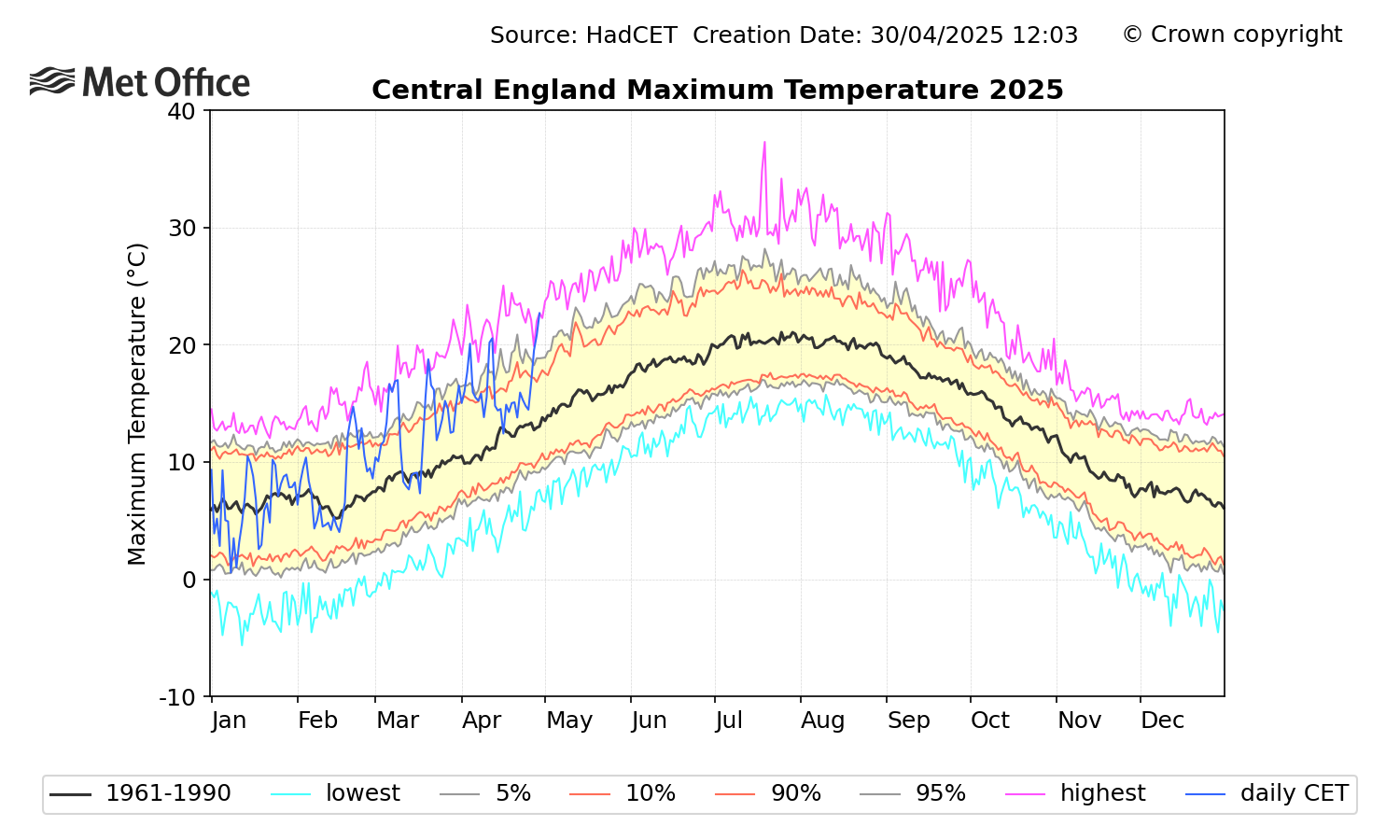
CET reached 25.4C that day, the sort of temperature not uncommon in the first week of May:

https://www.metoffice.gov.uk/hadobs/hadcet/graphs/2025/daily_maxtemp_cet_2025.png

https://www.metoffice.gov.uk/hadobs/hadcet/cet_info_max.html

But much more important than one day’s weather is what the long term trends tell us – and here we have a surprise.

Although average Spring temperatures have been on the rise in recent decades, there has been no upward movement in the highest temperatures set each year in any of the three months:

TXX_257__Mar

TXX_257__Apr

TXX_257__May

The chart for March includes this year. April, which is not in, hit a high of 24.5C, and as we have seen the highest so far this month is 25.4C, neither of which are records.

As we always seem to see when we do these sort of analyses, warmer weather tends to be more frequent, and colder weather less so. What we don’t see is an upward shift in all temperature bands.

In other words – WEATHER.

We can see this clearly in the temperatures so far for spring this year:

https://www.metoffice.gov.uk/hadobs/hadcet/graphs/2025/daily_maxtemp_cet_2025.png

Virtually every day has been in the top half of the 1961-90 distribution, but none have broken through the ceiling.

It is a truth that the Met Office would rather suppress, as it destroys their “climate change” narrative.

Instead they would rather fool you selecting odd days at some of their junk sites, which should not be used for climatological purposes.

via NOT A LOT OF PEOPLE KNOW THAT

https://ift.tt/kT1XML6

May 7, 2025 at 10:05AM

Thursday

0 out of 10 based on 0 rating

via JoNova

https://ift.tt/rwVPnM5

May 7, 2025 at 09:47AM