The story of the collapse of the Spanish and Portuguese grids with the resultant blackout and damage to their economies has seem to have disappeared from the mainstream media very swiftly. I wonder if this could in any way be due to the fact that the main reason for it was an over-reliance on renewable energy? Something which would be likely to cause a loss of confidence here in the UK in our own grid. The following article takes a good look:
“The challenge with rising renewables: As power systems rely more on asynchronous generation, frequency changes can occur much faster, increasing the risk of grid instability.” (- Dave Edwards_
Dave Edwards post begins: “As an engineer I like to understand how systems operate, this is useful for fault diagnosis, especially when a system fails and a Root Cause is needed, though maybe more than one contributing factor. So let’s Talk “Inertia” Everyone’s Saying It, But Who Really Understands It ”
The floor is his:
“Inertia” is getting a lot of airtime in power system discussions lately, but what is it, really, and why is it so critical for grid stability on an electrical power generation system.
More importantly, which generation technologies actually provide useful inertia
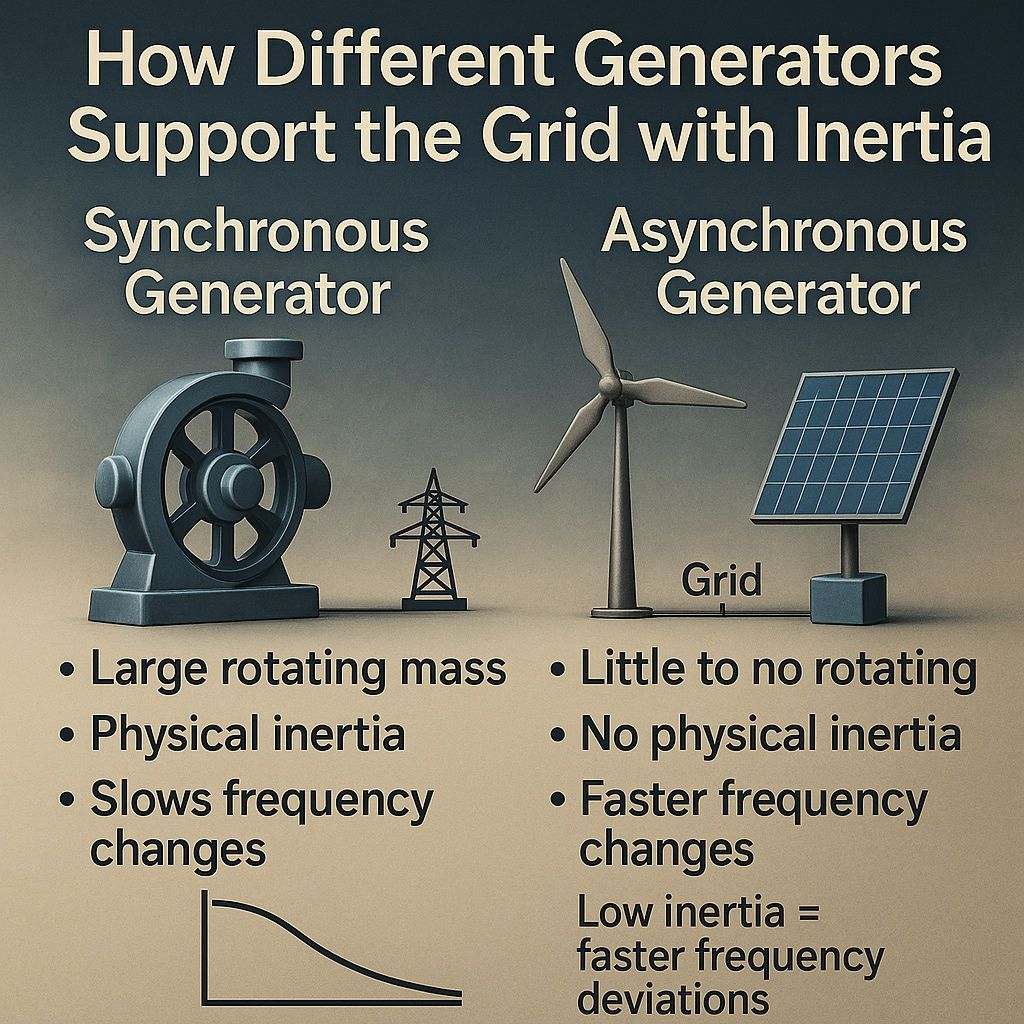
Image created using Chapt GPT 4o
What is inertia?
Think of inertia a bit like us seasoned engineers on LinkedIn: “It’s the ability of an object (engineer) to resist change.”
For rotating objects (like generator rotors), this is called rotational inertia or moment of inertia.
Two key factors influence it:
• Mass • Mass distribution (i.e., the object’s shape)
Example: A solid disk and a ring with the same mass and radius have different moments of inertia.
• Solid disk: Mass is closer to the center = lower inertia
• Ring: Mass is farther from the axis = higher inertia, result, the ring is harder to start or stop spinning.
Why does this matter in power systems? The spinning parts of generators store kinetic energy, which helps stabilise grid frequency during sudden events, like a generator or interconnector tripping offline.
• Spin in sync with grid frequency (e.g UK: 50Hz, US: 60Hz) • Have large rotating masses, provide physical inertia. • Help slow down frequency changes, giving time for systems to react, either demand or generation.
Asynchronous generation (most wind turbines, all solar PV):
• Magnetically decoupled from grid. • Has little or no rotating mass. • Provide minimal to no physical inertia.
The challenge with rising renewables: As power systems rely more on asynchronous generation, frequency changes can occur much faster, increasing the risk of grid instability.
Puerto Rico withdrew its $1 billion climate lawsuit against the oil and gas industry on Friday following the Trump administration’s move to block two states from seeking legal damages for similar alleged environmental damages.
Filed in the U.S. District Court for the District of Puerto Rico, the territory’s government said in the notice that it “voluntarily dismisses this entire case,” with no further elaboration as to why. President Donald Trump has repeatedly condemned state-level climate policies that impact domestic energy production, and on April 30, his Department of Justice (DOJ) filed two separate lawsuits against Hawaii and Michigan after both states considered filing similar complaints against the oil and gas industry.
“This dismissal adds to the growing momentum among federal and state courts holding that states and municipalities cannot use state laws to sue over climate change,” Theodore J. Boutrous, Jr. of Gibson, Dunn and Crutcher LLP, counsel for Chevron Corporation wrote in a statement provided to the Daily Caller News Foundation. “These claims are precluded and preempted by federal law and must be dismissed under clear U.S. Supreme Court precedent.” (RELATED: Puerto Rico Hits Oil Industry With $1 Billion Lawsuit Over ‘Climate Change’ Effects)
The notice to dismiss the suit was filed “without prejudice.”
The lawsuit, originally filed in July 2024 by Puerto Rico’s Secretary of Justice Domingo Emanuelli Hernández, alleged BP, Chevron, ExxonMobil and a number of other energy companies engaged in using unfair and dishonest trade practices by allegedly failing to provide warnings about the environmental risks of fossil fuel use, according to an E&E News translation.
Trump, taking a firm stance against state-led climate initiatives that may inhibit domestic energy production, signed an executive order on April 8 directing the attorney general to “identify all State and local laws, regulations, causes of action, policies, and practices” that might be “unconstitutional” or “burdening” energy production.
“An affordable and reliable domestic energy supply is essential to the national and economic security of the United States, as well as our foreign policy,” the order reads. “Simply put, Americans are better off when the United States is energy dominant.”
U.S. President Donald Trump holds up an executive orders about classroom discipline in the Oval Office at the White House on April 23, 2025 in Washington, DC. (Photo by Chip Somodevilla/Getty Images)
Hawaii filed its legal complaint against several large oil companies just hours after the DOJ filed its suit against the state. Hawaiian officials condemned the the DOJ’s lawsuit in a press release shared May 1.
“We have an obligation to the people of Hawaii, to do everything in our power to fight deceptive practices from these fossil fuel companies that erode Hawaii’s public health, natural resources and economy,” Hawaii Attorney General Lopez said in the release. “The federal lawsuit filed by the Justice Department attempts to block Hawaii from holding the fossil fuel industry responsible for deceptive conduct that caused climate change damage to Hawaii,” he continued.”
The American Energy Institute (AEI) sent a letter asking Puerto Rico Gov. Jenniffer González-Colón to drop the lawsuit on April 25, writing that “climate lawfare threatens to derail your administration’s common-sense approach. The climate plaintiffs are advancing a fundamentally neocolonial agenda. They are steering Puerto Rico toward a ‘green’ energy future it did not choose — one that ignores the basic needs of its people, who simply require cheap and reliable electricity.”
“The American Energy Institute applauds the withdrawal of Puerto Rico’s climate lawsuit,” founder and CEO of AEI Jason Isaac wrote in a statement to the DCNF. “This decisive step — taken shortly after our correspondence with Governor González-Colón — shows she’s putting Puerto Rico’s energy needs ahead of fringe climate ideology. By rejecting the alarmist lawfare agenda, the Governor is backing President Trump’s energy dominance strategy and standing up for affordable, reliable power for her constituents. It’s a big win for energy sanity and the people of Puerto Rico.”
The Puerto Rico Department of Justice did not immediately respond to the DCNF’s request for comment.
All content created by the Daily Caller News Foundation, an independent and nonpartisan newswire service, is available without charge to any legitimate news publisher that can provide a large audience. All republished articles must include our logo, our reporter’s byline and their DCNF affiliation. For any questions about our guidelines or partnering with us, please contact licensing@dailycallernewsfoundation.org.
Discover more from Watts Up With That?
Subscribe to get the latest posts sent to your email.
The ACLU says “climate protections” and DEI are “fundamental pillars of our free and democratic society.” ACLU: The Rule of Law Is Non-Negotiable | Opinion – Newsweek

 Everyone’s Saying It, But Who Really Understands It
  ”
”
 What is inertia?
 Two key factors influence it:
 The challenge with rising renewables: As power systems rely more on asynchronous generation, frequency changes can occur much faster, increasing the risk of grid instability.
 Fast battery response
 Synthetic inertia
 Grid-forming inverters
 Synchronous Compensators

