Tesla had a 71% drop in first quarter profits compared to last year, but those losses were minimised because they picked up $595,000,000 US in regulatory credits for the quarter.
Indeed, according to Tesla’s Q1 2025 earnings, net income fell 71% to $409 million from $1.39 billion the previous year, driven by a 13% drop in vehicle deliveries (336,681 vehicles) and a 20% decline in automotive revenue to $14 billion.
Regulatory credits, however, did bring in $595 million, up from $442 million the prior year, which was critical—without those credits, Tesla would’ve posted a loss for the quarter.
So, the credits acted like a financial lifeboat, keeping Tesla in the black despite weak sales and operational challenges, like updating factory lines for the refreshed Model Y and lower average selling prices due to discounts.
What Are Regulatory Credits, and Are They “Free Cash Ripped Off” from Petrol Car Makers?
Regulatory credits aren’t exactly “free cash” handed to Tesla like a government cheque, but they’re not pure market magic either. Here’s how they work:
The System: In places like the U.S., EU, and China, governments set emissions standards for automakers. Companies that sell zero-emission vehicles (like Tesla’s EVs) earn credits. Automakers who miss emissions targets—often those heavily reliant on gas-powered cars—must buy credits to avoid fines or bans. Tesla, producing only EVs, generates surplus credits and sells them to legacy automakers (e.g., Stellantis, GM, or Volkswagen). In Q1 2025, Tesla earned $595 million this way.
All prefaced on the need for an energy transition because apparently we have a climate catastrophe.
In “Climate Change Is Stressing the World’s Blood Supplies,” the New York Times (NYT) claims that global warming is now threatening the blood supply by causing extreme weather events that disrupt donations, transport, and safety. This is misleading at best. Since extreme weather events aren’t increasing or becoming more severe, it is unclear how climate change could be causing unusual disruptions in the blood supply.
The NYT article’s central thesis—that climate change is to blame for blood shortages during weather events—ignores a mountain of context and contradicts broader data on both weather trends and health system resiliency. Extreme weather has always existed and when it strikes it disrupts normal services, nothing has changed. Extreme weather does NOT equate to evidence of climate catastrophe. Also, there is no scientific evidence that CO₂-driven climate change is causing a new global blood crisis.
The assumption made by the writers in the NYT article that extreme weather events are increasing globally due to climate change is specifically refuted by widely available data. As this article from Climate Realism explains, there is no long-term trend showing increases in the number or severity of hurricanes, floods, or wildfires when corrected for improved detection and population growth in high-risk areas.
The Intergovernmental Panel on Climate Change—the United Nations’ body often cited as the climate authority—admits in its AR6 report that trends of most types of extreme weather events such as hurricanes and tornadoes are low confidence or have not increased globally. Also, data from the U.S. National Oceanic and Atmospheric Administration shows a flat or declining trend in U.S. hurricane landfalls over the last century.
The article references Hurricane Helene and California wildfires causing canceled blood drives. Blood drives get canceled during any large-scale disaster, regardless of cause. Earthquakes, power outages, cyberattacks, and even snowstorms can have the same effect. Weather-related disruptions have always occurred, and blaming every instance of logistical difficulty on “climate change” is not scientific; it’s opportunistic.
Attributing specific disasters or their effects to global climate trends involves significant uncertainty and usually relies on speculative models—not observed data. Most of these studies, like the one cited in The Lancet Planetary Health, suffer from selection bias, vague definitions of “extreme,” and worst-case emissions scenarios that do not reflect actual trends either emissions or weather.
The editorial also throws in another fear: that warming is causing a rise in blood-transmissible diseases like West Nile, Zika, and dengue. This conflates local outbreaks with global climate trends. Climate Realism has debunked this claim numerous times, pointing out that these diseases are far more influenced by land use, sanitation, and international travel than by temperature changes. Even the World Health Organization acknowledges that urbanization, deforestation, and global mobility play larger roles in disease spread than global climate change.
Linking disruptions in the blood supply to global warming is problematic for other reasons as well. For instance, it fails to rule out other factors which limit or expand the pool of eligible donors. Blood screening technologies continue to improve, and the pool of eligible donors adjusts based on public health guidelines. The article discusses the pandemic’s impact on blood donations, but that had nothing whatsoever to do with climate change so bringing it up in this article is simply misdirection and misplaced attribution to advance the popular but false mainstream media narrative that climate change is linked to everything bad.
The article closes with vague suggestions that AI might help us predict blood supply disruptions due to climate events. This techno-optimism is a smokescreen, conveniently ignoring that we already have predictive tools for weather, logistics planning, and blood supply management. There’s no new threat being introduced here—just the rebranding of ordinary healthcare system challenges as climate emergencies.
This article shows that the NYT continues to be wedded to promoting pseudoscientific climate alarmism. Rather than investigating the real causes complicating and limiting blood donation and delivery, ranging from donor apathy to poor planning, NYT chose to blame climate change: the convenient boogeyman for everything from crime, to immigration, to acne—now apparently, it’s coming for your blood. This NYT article is a perfect example of confirmation bias, cherry-picked anecdotes, and appeals to authority masquerading as science. This story lacks journalistic rigor. The story’s author uncritically parrots yet another flawed, agenda-driven study, without apparently investigating and confirming any of its assertions. Had she done even a modicum of research into the issue, and the writer were an honest broker, she would have been forced to conclude that because data shows that climate change isn’t causing more extreme weather, it can’t be creating new problems for the blood supply system.
Anthony Watts is a senior fellow for environment and climate at The Heartland Institute. Watts has been in the weather business both in front of, and behind the camera as an on-air television meteorologist since 1978, and currently does daily radio forecasts. He has created weather graphics presentation systems for television, specialized weather instrumentation, as well as co-authored peer-reviewed papers on climate issues. He operates the most viewed website in the world on climate, the award-winning website wattsupwiththat.com.
The Gods in the UK Parliament plan to spend £50 million in a quest to control sunlight, because obviously, the UK is too sunny
Also obviously, there is nothing more useful the United Kingdom could spend money on than pie-in-the-sky plans for weather-control. It’s not like people are struggling to heat their homes or put food on the table.
And it’s not like anything could go wrong, or plants use sunlight.
It’s not like the UK just installed 1.5 million solar panels on homes and is now paying money to reduce the sunlight falling on them.
In the end, this is just another Grow-The-Government-Blob job, but it’s also an escape plan. Wait for it. Twenty years from now, if the world is cooler due to solar activity or cosmic radiation, they’ll say the Geoengineering saved the world from global warming.
Scientists consider brightening clouds to reflect sunshine among ways to prevent runaway climate change
By Sarah Knapton, The Telegraph
Experiments to dim sunlight to fight global warming will be given the green light by the Government within weeks.
Outdoor field trials which could include injecting aerosols into the atmosphere, or brightening clouds to reflect sunshine, are being considered by scientists as a way to prevent runaway climate change.
But it’s all really safe and effective “by design” (unlike all those other experiments which were designed to be dangerous):
Prof Mark Symes, the programme director for Aria (Advanced Research and Invention Agency), said there would be “small controlled outdoor experiments on particular approaches”. “We will be announcing who we have given funding to in a few weeks and when we do so, we will be making clear when any outdoor experiments might be taking place,” he said.
“One of the missing pieces in this debate was physical data from the real world. Models can only tell us so much.
“Everything we do is going to be safe by design. We’re absolutely committed to responsible research, including responsible outdoor research.
Now they tell us? Suddenly (when a grant depends upon it) researchers remember that “Models can only tell us so much” and they need real data. Where were you Professor Symes for the last 30 years while national economies were being crushed on the alter of climate modeling.
Looks like the big plan to use pollution to fight “pollution”
The press release coyly talks about “aerosols” being injected into the sky, like it might be an giant air-misting device, or aromatherapy for the atmosphere. They don’t want to name the actual aerosol these experiments will dump in the sky — not in one sentence. Instead, they hint suggestively that sulfur dioxide comes off ships and makes clouds brighter from space, which is a nice way of saying that pollution from diesel makes clouds darker from Earth. See how this works? Bad-sulfur-dioxide needed regulation and created jobs (and the UN was very proud of itself for getting rid of SO2). Now good-sulfur-dioxide needs grants and creates even more jobs. SO2 just needs a makeover. So, gasp, it’s a common thing in jet exhaust. Did he just admit that we could all fly more an “save the planet”?
Dr Sebastian Eastham, a senior lecturer in sustainable aviation at Imperial College London, said: “Every time you fly, sulphur, which is naturally present in jet fuel, is emitted into the lower most stratosphere causing a small cooling effect.
So they don’t specifically say they’ll be adding pollution to the sky that we’ve spent the last 100 years trying to get out of shipping. But it’s likely that’s exactly what they’re thinking of. Nearly all stratospheric aerosol injections use sulfur dioxide. “The project called “Make Sunsets” in the US uses weather balloons to drop sulfur dioxide in the sky to “cool the world”.
The latest papers blame their success at getting SO2 out of shipping as the reason we got freakish warming that their models didn’t predict.
For the record, some crazy geoengineering schemes may involve chalk dust, titanium dioxide, and sea salt. Perhaps they’ll try them all? Either way, farmers might not be impressed.
And as the commenters on X are saying, I do not consent!
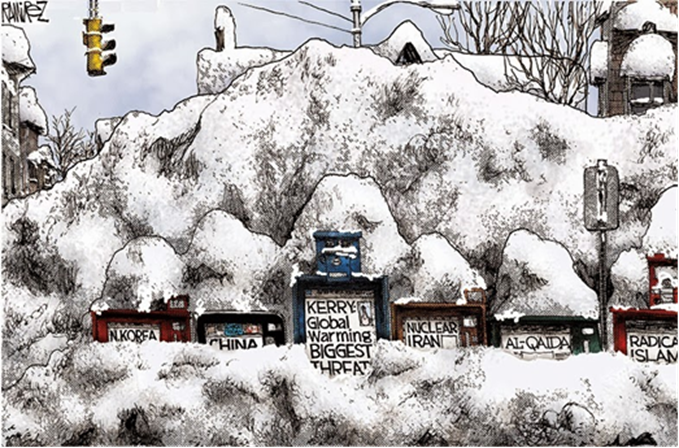
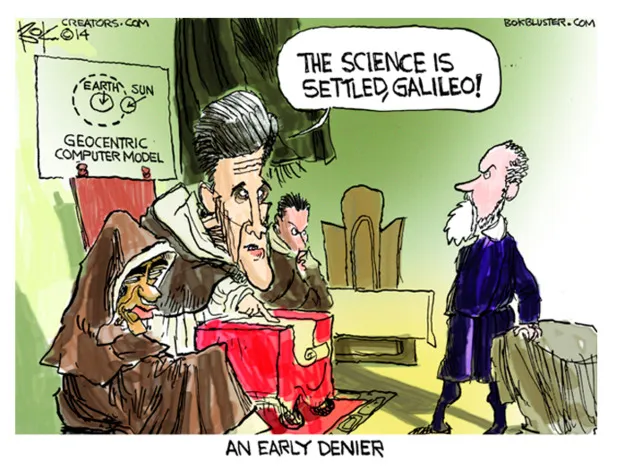
John Kerry speaking in Dublin June 11, 2019: “World leaders are lying to the public about the climate crisis and dismissing scientific evidence.” The climate activist failed to recognize his own speculative and exaggerated statements.
State Department official says climate office was ‘captured by ideology’
The State Department is formally removing the Office of the Special Presidential Envoy for Climate, the office former president Joe Biden created and appointed John Kerry to lead as part of his aggressive agenda to combat global warming, the Washington Free Beacon has learned.
Overall, the Office of the Special Presidential Envoy for Climate
was given an annual budget of nearly $17 million and
a staff of about 30 officials during the Biden administration.
In a statement to the Free Beacon, a senior State Department official confirmed the office has been shuttered, noting that its mission did not align with the Trump administration’s agenda. Webpages for both Office of the Special Presidential Envoy for Climate and the State Department’s initiatives relating to the environment were recently deleted.
“This climate office has long been captured by ideology instead of common sense policy. The new chapter of the State Department will not include this office,” the official told the Free Beacon. “This is part of a broader effort to empower regional bureaus and embassies to effectively carry out diplomacy.”
The action is part of a broader effort the sprawling agency announced Tuesday morning to streamline its operations, save taxpayers money, and ensure it is capable of delivering on President Donald Trump’s foreign policy agenda. “In its current form, the department is bloated, bureaucratic, and unable to perform its essential diplomatic mission,” Secretary of State Marco Rubio said, adding that the agency has become “beholden to radical political ideology.”
And it signals the Trump administration’s continued departure from the Biden-era approach to foreign policy that made climate change a centerpiece of its engagements with foreign nations. In one of his first actions leading the State Department, for example, Rubio initiated the immediate withdrawal of the United States from the 2015 Paris Climate Agreement, which he said undercut the nation’s intention to become the world’s most dominant energy producer.
“The Trump Administration is focused on reducing the everyday cost of living for the American worker, not apologizing to foreign governments for unleashing America’s energy dominance,” a senior White House official told the Free Beacon.
In naming Kerry the first-ever special presidential envoy for climate, Biden gave him a seat on both the White House cabinet and National Security Council, and empowered him to spearhead international negotiations, engage directly with foreign heads of state, and lead American delegations at numerous global climate conferences.
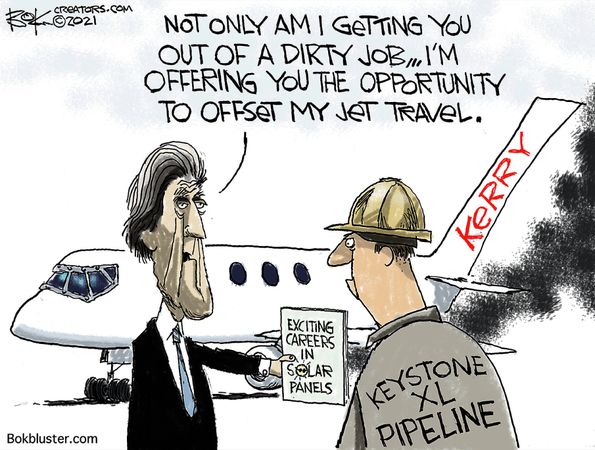
Kerry—who served in the role for three years between January 2021 and early 2024—used the position to wage an all-out assault on fossil fuels and aggressively push a transition to green alternatives like solar panels. Kerry also targeted the agricultural industry for its carbon footprint, leading to calls from dozens of lawmakers for Biden and then-agriculture secretary Tom Vilsack to disavow the comments.
The Free Beacon previously reported that Kerry’s office regularly consulted with far-left environmental organizations as he pursued his green agenda.
Kerry also faced criticism from Republican lawmakers and energy experts for lambasting fossil fuel reliance in the West, but seemingly looking the other way as China rapidly expanded its reliance on coal power to sustain its growing manufacturing sector. The House Oversight Committee opened a probe into Kerry’s talks with his Chinese counterparts in 2023 and later threatened to subpoena him after his office failed to hand over requested documents.
Despite its high-level role in American foreign policy, the Special Presidential Envoy for Climate Office remained tight-lipped about its staff and operations throughout the Biden administration.
The Free Press first reported Rubio’s actions to streamline the State Department’s structure. The outlet cited internal documents showing the agency’s plans to close 132 offices, including those launched to further human rights, counter extremism, and prevent war crimes.
Kerry was also accused of hypocrisy—the climate conferences he attended were often hosted at upscale resorts and he racked up tens of thousands of flight miles on gas-guzzling jets. Kerry’s family also owned its own private jet for much of his tenure as special presidential envoy for climate.
Footnote: Yes, Prime Minister foresaw this saga.
A humorous look at why the global warming campaign and the triumphal Paris COP make sense. Yes Minister explains it all in an episode from 2013. (The final episode of the TV series was The Climate Czar) Transcription from captions is here: Yes PM Pokes Fun at Climatism