The Truth About University Overhead Costs

Guest Post by Willis Eschenbach
The noted climate alarmist Andrew Dessler has written a Substack post bemoaning the Trump Administration’s decision to cut the “overhead” in Federal research grants to universities from ~ 50% to 15%. He claims that this cost-cutting measure “will determine whether breakthrough technologies emerge in American labs or Chinese ones.”

So let’s see if that scary claim about China is reasonable. For starters, what’s “overhead” when it’s at home? It’s the cost of support services for the organization as a whole. Here’s Andrew’s reasonable description:

Overhead is “the countless support systems making that research possible. Air conditioning, electricity for lighting, wifi, janitorial services, administrative support for payroll and purchasing, and a million other things that cannot be neatly assigned to a particular research project but without which research cannot be done.”

Now, I have more than a passing knowledge of this issue of overhead amounts. In my work running an NGO, I wrote grants that raised over USD$2 million over three years from donors in Australia, New Zealand, Denmark, and the US for our village-level development projects in the Solomon Islands, and guess what?

Every single one of the donors, regardless of country, limited our overhead to 15%.

And despite that crushing blow, the 15% overhead maintained the office, paid for the lighting, the air conditioning, the accountant, the janitor, and the “million other things” Andrew lists above.

So to start with, his claim that it is somehow impossible to get by on less than 50% overhead is a joke. In fact, as near as I can find out, universities are almost the only institutions that get to use an overhead which is 50% on top of their direct costs to support those things … and unlike my projects, they have a whole host of other sources of funding.

Next, he says there are three ways that the Universities could respond to that reduction in funding … but guess what?

Not one of the three ways he lists as proposed responses to the reduction in funding involves the University doing what you or I would do in that situation—reduce expenses, duh.

You can tell that Andrew is living high off the government hog when the idea of cutting costs doesn’t even occur to him. I mean, cutting costs might mean you’d need to fire a bunch of pluted bloatocrats living the good life off of government grants, can’t have that.

So I looked up the numbers. Texas A&M, which is Andrew Dessler’s employer, has a total of 13,712 faculty and staff. Of these, 4,111 are teachers, some unknown number of whom are also researchers. It’s likely not more than half, so we can say there are maybe 2,000 researchers.

And there are 9,351 staff, not including janitors and maintenance workers… so they have 2+ administrators for each teacher, which means 4+ administrators for each researcher. Are we starting to understand why they say they need 50% overheads?

Dessler’s next claim is hilarious. Discussing one of the three ways universities could respond to the cut in overheads, he says:

“Second, universities could find another source of money to cover these costs. But money needs to come from somewhere, and Texas A&M doesn’t have a pile of it sitting around waiting to be spent.”

So I looked up Texas A&M’s funding. To start with, Texas A&M has a trust fund from which it receives about $200 million per year … p;us, over the 2024 – 2025 two year period, total Texas State appropriations to the Texas A&M University System are $3.78 billion, reflecting an increase of $1.19 billion over the previous biennium.

In addition, there are a variety of other sources of money for Texas A&M. Here are the funding sources and annual income amounts for the University:

Trust Fund                            $200,000,000
State Grants                        $1,890,000,000
Tuition & Fees                      $1,354,000,000
Research Grants (including overheads) $845,900,000
Direct Federal Funding                $704,000,000
Gifts & Donations                     $149,100,000
Auxiliary Enterprises                 $462,600,000
Investment Income                     $403,200,000
Other Sales/Services                   $29,300,000
TOTAL                               $6,038,100,000

Next, only about half of the Texas A&M research is funded by the Federal Government. So if Federal overhead for A&M research is cut from 50% to 15%, their total income would be reduced by a whopping … wait for it …

… 1.6%.

I’m sorry, Andrew, but on my planet a 1.6% reduction in university income is not some emergency that will drive all research to China. That’s an easily solvable problem.

They might start with the fact that 43% of their annual expenses go to salaries and that the average professor makes about $130 per hour. But there’s more. Here are the top salaries at Texas A&M:

1 Daniel Durkin Assistant Football Coach    $1,425,000
2 Carl Bjork Athletic Director              $1,343,750
3 Joni Taylor Head Women's Basketball Coach $1,341,667
4 James Schlossnagle Head Baseball Coach    $1,198,296
5 Elijah Robinson Assistant Football Coach  $1,058,333
6 James Coley Assistant Football Coach        $870,833
7 Margaret Banks President                    $822,222
8 Robert Petrino Assistant Football Coach     $806,061
9 Darrell Dickey Assistant Football Coach     $753,297
10 Dameyune Craig Assistant Football Coach    $618,750
11 Karen Wooley Distinguished Professor       $521,247
12 Gregory Hartman COO & Senior VP            $504,167
13 Tommie Robinson Assistant Football Coach   $502,083
14 Trisha Ford Head Softball Coach            $477,500
15 Terrall Rushing Assistant Football Coach   $466,667

Yeah, they’re broke all right … so broke that an Assistant Football Coach tops their salary list at $1.4 megabucks per year and in total, they’re paying their sports-related personnel (coaches, assistant coaches, etc.) over sixteen million dollars per year…

… and Andrew is crying poverty?

The discouraging part is that all these folks living on government money are doing their best to ignore the ugly reality—here in the US, we’re not only broke, we’re in debt up to our eyeballs. We need to, have to, must cut Federal spending wherever we can, including reducing ludicrous overheads for university research. And the inescapable truth is, some cuts will require universities to reduce expenses and fire people. Andrew doesn’t like it, I don’t like it, but it is the brutal reality. The good news is, surviving a cut in overheads is not some impossible task. Thousands and thousands of NGOs survive happily on grants with 15% overheads.

Finally, I would suggest that the hidden truth behind Andrew’s post is that Andrew sees the writing on the wall—his long, lucrative government-funded advocacy for the climate scam is coming to an end. I can understand his concern; he makes on the order of a quarter of a million dollars per year, and his gravy train is about to hit an immovable object in the form of the national debt.

However, I fear that’s an Andrew problem, not a US research problem or a US taxpayer problem.

Best to all,

w.

The Same Boring Request: When you comment, please QUOTE THE EXACT WORDS THAT YOU ARE DISCUSSING. I can defend my own words. I can’t defend your interpretation of my words. Thanks.


Discover more from Watts Up With That?

Subscribe to get the latest posts sent to your email.

via Watts Up With That?

https://ift.tt/Raw9yrh

April 22, 2025 at 12:08PM

Abolishing the Climate Politico-Legal-Media Complex

Linnea Lueken describes the nullification in her Town Hall article The Savaging of the Climate Politico-Legal-Media Complex.  Excerpts in italics with my bolds and added images.

The Trump administration’s crackdown on waste and harmful
policies has given so-called “green” politics a rude awakening.
 

The administration is savaging the climate complex of lobbyists and NGOs, politically connected profiteering companies, and virtue signaling politicians bent on ending fossil fuel use. The greens are on the defensive and have yet been unable to form a cohesive response. For the good of humanity and the planet, let’s hope the disarray continues.

I almost hesitate to talk about this, lest the climate grifters in the media suddenly realize they are spending too much time focusing on tariffs and immigration and are forgetting one of the pillars of the globalist secular religion: climate alarmism. They still seem to be reeling, and it is amazing to see.

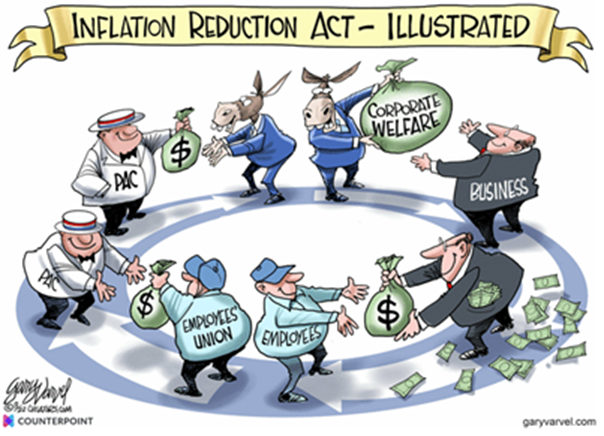
Note: The $$$ in the diagram are in 2010 $, not including consultancies and a plethora of NGOs. Likely it is today a multi-trillion dollar industry.

The Trump administration has been systematically ripping apart the politico-legal elements of what Michael Crichton once dubbed the climate “politico-legal-media” complex. This climate-focused approach to environmental extremism was meticulously constructed over the course of decades by previous Republican and Democrat administrations alike. No one else has taken the green scam to task the way Trump is.

Trump immediately rescinded Biden’s EV targets, as well as mandates for solar and wind and heat pumps. He removed the USDA’s website pages dedicated to climate change. He took an axe to Department of Energy (DOE) funding of climate-focused university research, which is still being battled in the courts (maybe this will end the apparent trend of scientists tying everything to climate just to get those grants).

Trump also got rid of the mandated use of paper straws in federal buildings, which is pretty funny.

While the climate-obsessed media were busy bleating about those insults to climate orthodoxy, DOGE tackled the climate slush fund known as USAID. USAID, it turns out, was sending billions of dollars for climate pet projects. Who knows how much of that went to overhead and graft with nothing to show in terms of mitigating climate change.

Interestingly, the extremist group Just Stop Oil closed shop shortly after cuts to USAID began. They claim it is because they have been victorious in keeping UK oil in the ground, but it is likely no coincidence that climate activists and protestors are increasingly finding themselves behind bars as the public tires of disruption and destruction and funding is drying up from governments, sometimes funneled through NGOs.

EPA Administrator Lee Zeldin also announced that the administration is considering eliminating the greenhouse gas reporting requirements for power plants, and then hit the greens with another major blow. He reiterated to Breitbart News that he intends to look at the carbon dioxide Endangerment Finding – which has been used to craft regulations based on the idea that carbon dioxide and other greenhouse gasses represent a significant threat to human health… despite the fact that they are necessary for life on Earth. This comes after Trump signed an executive order asking the EPA to review the finding. Eliminating it would undercut the basis for all climate related regulations, from restrictions on power plants, to vehicle restrictions and mandates, to appliance restrictions, and beyond.

The end of the Endangerment Finding would be a big blow against
climate alarmism and an even bigger win for freedom.

I could almost feel bad for the greens, except that they have done nothing but suck up our hard-earned cash and increase human misery in the United States and abroad by pushing suicidal and stagnating policies. They fund programs aimed at stopping poorer countries from developing their own resources. They attack farming and endorse restrictions on the kind of appliances and cars average people can buy. They push policies limiting what one can eat and how food is grown, and restrictions on electric power production, all in the name of changing future weather.


This is not to say the Trump administration is anti-environment; to the contrary, under his first term, the EPA focused heavily on streamlining the clean-up of superfund sites. Zeldin is already putting cleanups of superfunds on an accelerated timeline. Trump and his team have reiterated that they are interested in maintaining clean air and water, and preventing wildfires that Democrat policies have worsened.

Time will tell if these attacks on the climate cult will prove fatal,
but thus far it has been incredible to witness.

Oh yeah; Happy Earth Day.


via Science Matters

https://ift.tt/Xif6qEG

April 22, 2025 at 09:25AM

The Solar Panel That Ain’t One

Kevin Kilty

Crises produce a lot of dubious effort to supposedly solve them. The long past energy crisis of the 1970s for example, the one that actually started as a utility crisis in the 1960s, caused many completely mad proposals for how to generate useful energy without using petroleum liquids. Limestone caverns filled with air during high pressure, let back out through a turbine when pressure is low; air foils propelled by wind around an elongated railroad track; magnets placed on automobile fuel lines to do something, never clearly explained, with the electrons in gasoline to improve mileage – that sort of stuff.

That 1960s-1970s crisis ended, I would argue, once we began burning coal in great quantities to generate electrical energy. We solved the crisis by simply substituting a plentiful fuel without having to adopt complicated schemes. Yet, those less-than-useful ideas live on and we see some of them today now proposed to solve the alleged CO2 crisis.

Unworkable schemes come in two flavors. The first involves schemes too mad capped to work because they have no principle of operation behind them or they violate how the universe works – they violate one of the laws of thermodynamics, for example. The second includes schemes that could work in principle, but could never be made to operate economically.

When I read this headline in the Cowboy State Daily “Research Shows Solar Panels Can Also Generate Electricity At Night”; I figured this to be a routine bout of physics madness. It turns out, though, that this is a case of saying it’s a solar panel that works at night, when, in fact, it is a totally different device. Let’s figure this out.

How does a solar panel work?

Figure 1 shows the cross section of a crystalline silicon solar cell. There are five layers of material; 1) a conductive surface to make device contact; 2) a thin layer of n-type silicon (silicon doped with a bit of phosphorus); 3) a space charge region created at the interface of p-type and n-type material (a pn junction) by diffusion of charge carriers from concentration gradient; 4) a p-type silicon (silicon doped with a bit of boron); 5) finally a lower layer of conductive material to make device electrical contact.

Reading from left to right, Figure 1 illustrates a minimal explanation of solar cell operation. In its equilibrium state on the left, the space charge region sports an electric field that acts counter to the diffusion of charge carriers to establish equilibrium. A photon of sunlight enters the device, and if absorbed delivers enough energy to lift an electron from the valence (bonding) band into the conduction (mobile) band. Raising this electron into a mobile state leaves behind an empty mobile charge known as a hole. The internal electrical field separates the paired electron and hole to prevent them from recombining (maybe 90% effective at this task). Finally, on the right side of the diagram the electron is able to join a current flow through an external load to recombine with the hole.

Figure 1 shows plainly why solar cells don’t work at night. Photons from sunlight provide the fuel to produce mobile charge pairs. There are none at night.

As an aside, knowing that there is an intense radiative flux from the sky to ground during all hours (the greenhouse flux), why don’t the photons in this flux generate an electrical current?

The answer here lies in how much energy a photon absorbed can deliver in relation to the valence to conduction band gap. In a silicon solar cell this band gap energy is about 1.1 electron volts (eV). The energy a photon carries is E=hc/λ; where h is Planck’s constant, c is the speed of light, and λ is the wavelength of the photon. A photon of 1.0 micrometer wavelength, which is in the near infrared part of the spectrum, carries energy of 1.24eV, enough to create a conduction charge pair. A photon from the peak of the Planck function at a temperature of 288K, on the other hand, has wavelength (per Wien’s law) of 10 micrometers and carries energy of only 0.124eV, far too little to create a pair. No photons coming from terrestrial radiation ever supply 1.1eV. These photons can only interact with lattice vibrations (phonons) in the solid material to maintain temperature equilibrium with its surroundings.

Figure 1. The space charge region at the pn junction balances the tendency of charge carriers to diffuse in response to concentration gradient against a growing internal electric field. It is essential to the separation of mobile charge carriers (red/blue dots) once an absorbed photon creates a pair.

Adding a Completely Different Device to Generate at Night

This should put to rest any notion that the solar panels generate energy at night from, what the article says, and the Stanford PR amplifies, radiation. What our researchers have done is to add a separate device to the solar panel, one that operates with temperature differences, and the journalists call it a solar panel for nighttime operation. It’s a collision of science with journalism.

This device is actually a thermoelectric generator. It produces electrical energy from heat flow, or from a temperature difference. The physical basis of this is the Seebeck effect, a voltage that appears along with a difference in temperature – i.e. V=B(Th-Tc), where B is the Seebeck coefficient.

The Seebeck coefficient in metals is small, less than a limiting value of 87 microvolts per Kelvin (uV/K). So metal junctions are used only for temperature measurement as the lower part of Figure 2 shows. Some semiconductors, on the other hand, have much larger Seebeck coefficients (300 uV/K), making them useful for energy generation in some situations; mainly where waste heat is available and when no other, less expensive, method of producing a small amount of electrical energy is available.

For example, the Galileo mission to Jupiter in 1989 used a thermoelectric generator powered by the radioactive decay of plutonium 238. The 41 kg system in this case produced 5W per kg and ran flawlessly for 7 years. No other system available from 1980 era technology could have done the same.

The upper part of Figure 2 shows a long series of pn junctions connected in series to produce a voltage large enough to be useful. This is a thermoelectric generator.

Figure 2. The thermocouple is very widely used to measure temperature in industry and consumer goods.

Since a thermoelectric generator operates from heat flow, it is subject to a maximum efficiency that includes the Carnot factor. Neff=K(1-Tc/Th); where the K factor involves what is known as the figure of merit, ZT, of the thermoelectric materials. Current thermoelectric materials have a poor figure of merit, and then considering the small temperature differences in the Carnot factor on a typical solar panel, almost everything works against this energy scheme.

Although no diagram of the “night-time solar panel” was available in the news article, Stanford PR, or other PR, a person can surmise that the device would resemble Figure 3.  

Figure 3 shows a solar panel. Heat fins on the lower face of the panel maintain a temperature near ambient. Sandwiched in between is a thermoelectric generator like that in Figure 2. The upper surface of the panel might have a temperature 40C above ambient when exposed to the full day sun. Or, it might have a temperature 10C below ambient on a clear night in the arid and elevated portions of the West and Southwest. The temperature difference powers the thermoelectric circuitry.

There is no doubt the additional equipment will produce some power in addition to or in place of the solar generator. But this is not a solar panel that works at night. It doesn’t use starlight or moonlight. It doesn’t even necessarily use radiation as some of its PR claims. It works from a temperature difference.

Figure 3. Points labeled ‘A’ are the power circuit for the thermoelectric generator.

In what I view as a misleading claim, the press release states this (bold text is mine):

Advantages

  • Low cost, off-grid
  • Nighttime 2.2 W/m2 power density
  • Outperforms other ambient energy harvesting techniques like wind or radio frequency
  • Daytime performance estimated to be 3-4x higher than nighttime

Wyoming wind plants currently dedicate about 100 acres, or about 40 hectares, to each MW of nameplate wind. Since wind plants have an annual average capacity factor of about one-third, the power density computed from dedicated land area is about 0.7W/m2. So, the claim that this 2.2W/m2 of thermoelectric power exceeds the power density of wind is true. Yet, then what must also be true is that the panels having  thermoelectric generators must cover the entire 40 hectare area with modified panels to “outperform wind”.

Even though the PR says that the thermoelectric modules need only cover 1% of the solar panel area, many must be connected in series to reach a usable voltage. It seems like a lot of trouble and expense in a weak attempt to address the intermittency of solar energy.


Discover more from Watts Up With That?

Subscribe to get the latest posts sent to your email.

via Watts Up With That?

https://ift.tt/960U13W

April 22, 2025 at 08:01AM

Secretary Burgum: If offshore wind Is wrong for New York, it is also wrong for Virginia!

The Coastal Virginia Offshore Wind (CVOW) project, which is being built by Dominion Energy off the coast of Virginia Beach, Virginia, is the largest boondoggle project of all, and it is subject to all of the same concerns about offshore wind.

via CFACT

https://ift.tt/ZJ7n9H6

April 22, 2025 at 07:12AM