Scientists React to US Climate Research Program Cancellation

Essay by Eric Worrall

Michael Mann: “It is pure villainy. A crime against the planet – arguably, the most profound of all crimes.”

White House ends funding for key US climate body: ‘No coming back from this’

Nasa cuts contract that convened USGCRP, which released assessments impacting environmental decision-making

Dharna Noor and Gabrielle CanonThu 10 Apr 2025 06.11 AEST

…

The next assessment is due by 2027. But now, Nasa has ended its contract with the consulting firm ICF International, which convened the USGCRP and coordinated the federal agencies that contribute to the quadrennial report.

“There’s really no coming back from this, and it means we are all less informed about climate impacts, and won’t have the most up-to-date information on risks and threats,” said one federal staffer who was engaged in USGCRP activities, and who requested anonymity to avoid retribution. “USGCRP helped me to leverage resources from other agencies for use in my own work. But without these networks, I’m left without a support system and the latest science on climate change.”

…

“Extreme weather disasters displaced millions of people and caused billions of dollars in damage in 2024 alone,” said Katharine Hayhoe, a Texas Tech University climate scientist who has served as lead author on three national climate assessments. “Given the accelerating pace and scale of climate impacts today, a sustained and more comprehensive national climate assessment process is so essential,” Hayhoe said. “We need it today, to build a better future tomorrow.”

…

“It is pure villainy,” said Mann. “A crime against the planet – arguably, the most profound of all crimes.”

Read more: https://www.theguardian.com/us-news/2025/apr/09/trump-national-climate-assessment-usgcrf

Obviously Mann describing something as an act of “pure villainy” is quite an endorsement.

I had a flip through the national assessments, and in my opinion they could have saved a bundle of money by asking ChatGPT to paraphrase the previous report and changing the dates.

The Fifth National Climate Assessment

How the United States Is Addressing Climate Change

The effects of human-caused climate change are already far-reaching and worsening across every region of the United States. Rapidly reducing greenhouse gas emissions can limit future warming and associated increases in many risks. Across the country, efforts to adapt to climate change and reduce emissions have expanded since 2018, and US emissions have fallen since peaking in 2007. However, without deeper cuts in global net greenhouse gas emissions and accelerated adaptation efforts, severe climate risks to the United States will continue to grow.

…

Read more: https://nca2023.globalchange.gov

Fourth national assessment executive summary;

Highlights of the Findings of the U.S. Global Change Research Program Climate Science Special Report

Recommended Citation

The climate of the United States is strongly connected to the changing global climate. The statements below highlight past, current, and projected climate changes for the United States and the globe.

Global annually averaged surface air temperature has increased by about 1.8°F (1.0°C) over the last 115 years (1901–2016). This period is now the warmest in the history of modern civilization. The last few years have also seen record-breaking, climate-related weather extremes, and the last three years have been the warmest years on record for the globe. These trends are expected to continue over climate timescales.

…

Read more: https://science2017.globalchange.gov/chapter/executive-summary/

Was USGCRP spending or causing the expenditure of $4 billion dollars per year to produce that report?

I tried to discover the USGCRP budget. The page I found was a cross budget page. I captured a screenshot of the entire USGCRP page, because the USGCRP website might not be with us for long. Some of the links already no longer work.

I doubt the USGCRP was solely responsible for the full $4 billion in the cross budget. Some of the support expenditure might be activities which would be performed anyway, such as weather monitoring performed by the U.S. Department of Agriculture.

But when you add up all the cushy salaries, the flights to climate conferences some members likely accepted, and all the other paraphernalia of a large climate activity group, it seems likely DOGE just saved US taxpayers a whole pile of money. Not to mention all the carbon emissions which will be saved by cancelling those climate conference flights.


Discover more from Watts Up With That?

Subscribe to get the latest posts sent to your email.

via Watts Up With That?

https://ift.tt/r4zTW92

April 13, 2025 at 04:05PM

Why Must Repeal Biden’s IRA

Frank Lasee explains why Republicans Must End Democrats’ IRA Caused Inflation.  Excerpts in italics with my bolds and added images.

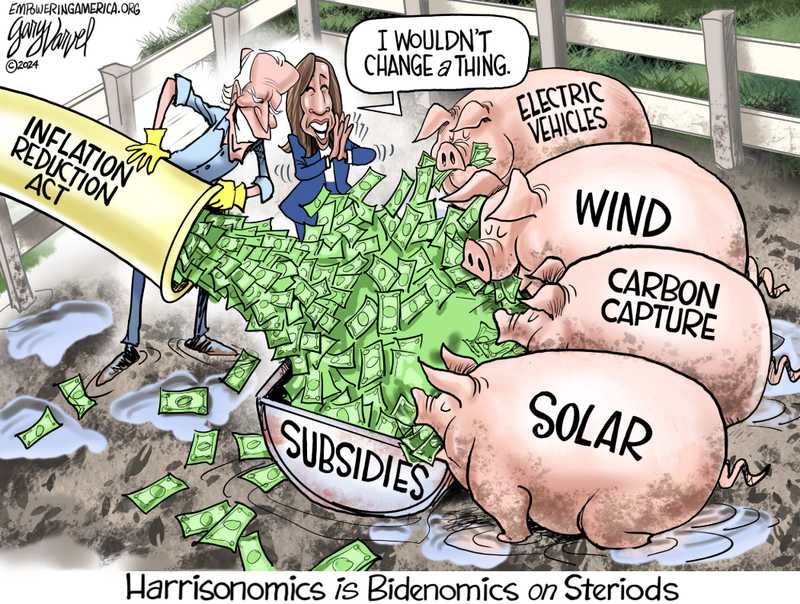
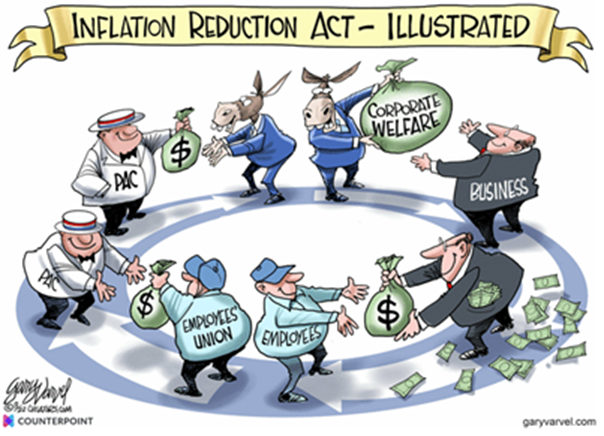
The Democrats passed the Orwellian named inflation Reduction Act (IRA) without a single Republican vote. They told us that it would be a $369 billion spending package. In fact, it could cost nearly $5 trillion adding to our debt.

The United States now has a $36.5 trillion national debt,
with a trillion dollars in annual interest payments.

The money for the IRA is all borrowed money. It causes more unnecessary energy spending, driving up electric rates and increasing inflation. This overspending is unsustainable and harmful to the United States; inflation is putting pressure on families’ budgets.

The subsidies in the IRA are incredible. Wind and solar get a 50 percent tax credit to build and a 30 percent subsidy for the electricity they produce. Trump and Congress need to end these subsidies. Not only for wind and solar, but for all the other supposedly green initiatives, like battery factories, electric vehicle manufacturing components, and hydrogen. We simply can’t afford it. 

This “green” borrowing is driving up our electric rates. Because wind and solar power are part-time and intermittent, they cannot provide full-time, keep the lights on all the time electricity generation. They do not replace any natural gas, coal, or nuclear power they just add costs.

It is like a household that has two on demand gas cars that serve their needs. They think they can save money with another car. Because of the 50 percent tax subsidies and propaganda they buy a solar car. 

They find that the solar car doesn’t work the first and last hour of the day, or when it is raining, or cloudy and not at night. The sun isn’t powerful enough. They learn they cannot replace any of their gas cars with the solar car.

So, they buy a wind car that only works the 30 percent of the time the wind blows. They find they can’t get home from their kids’ soccer game or from work because the wind stopped blowing.

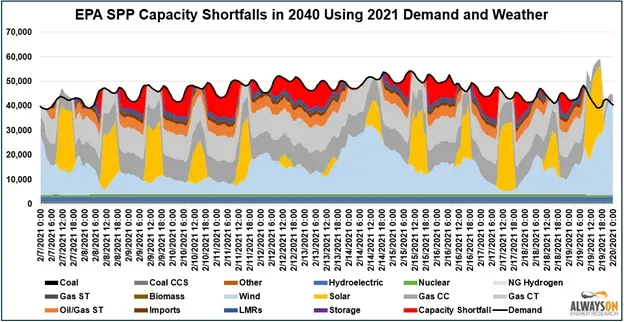
Capacity shortfall events – or blackouts – in Southwest Power Pool (SPP) when we modeled EPA’s proposal for carbon mandates, stemming from the agency’s use of 80% or higher capacity values for solar energy.

They are now paying for four cars instead of two. This is exactly what is happening to our electric grid. We are paying for a full-time and part-time electricity production. 

To make matters worse, the way that regional transmission organizations (RTOs) pay for our electricity doesn’t allow us to realize any savings from the heavily subsidized wind and solar generation. 

The industry calls it take and pay. The most expensive form of electricity the RTO purchases is what they pay all electricity providers. This means that there is no savings from wind and solar for electric consumers, only increased costs.

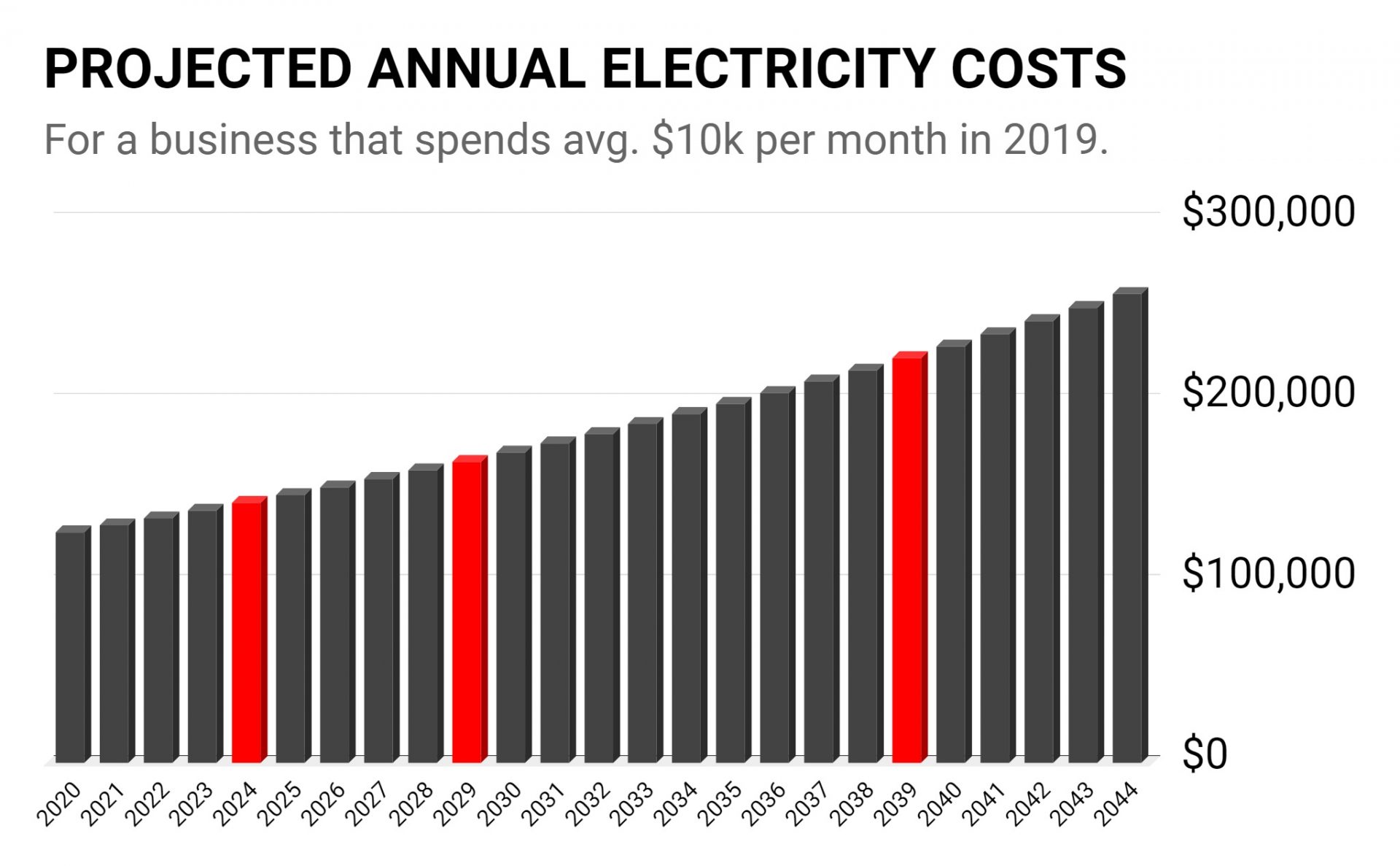
Projected Business Electricity Expenses in California based on increasing commercial rates.

No other industry pays the highest bid price to all suppliers, regardless of what they bid. But that’s what they do in the electric world. We are paying higher electricity rates because of this practice.

This begs for state legislative action to correct this expensive payment scheme. 

Wind and solar further drive up the price of electricity because they require many miles of expensive transmission wires and displace full-time electric generation. Forcing it to run less than it would if they were not on the electric grid.

As natural gas and coal power plants run more part-time, every electron they sell must have a higher price to cover their costs. Their maintenance costs will only increase, too, because they were never designed to run intermittently.

Trump understands that wind and solar drive up the cost of our electricity, particularly offshore wind, which costs five times more than natural gas electricity, and are built in hurricane alley. What could go wrong? The simple answer is to stop subsidizing all electric generation with our borrowed inflation causing tax dollars. And states should end favorable regulations that require the purchase of wind and solar first. 

There are 21 House Republicans that have signed a letter saying they don’t want to repeal the IRA, even though they didn’t vote for it. Because it is fostering wasteful pretend “green” spending in their districts. Clever Democrats have the bulk of the spending going into these Republican districts in order to preserve this green slush fund.

President Trump needs to use his considerable persuasion and political muscle to end this Democrat boondoggle, which adds to our $36.5 trillion national debt.

Frank Lasee is a former Wisconsin state senator and former member of Governor Scott Walker’s administration. The district he represented had two nuclear power plants, a biomass plant and numerous wind towers. He has experience with energy, the environment, and the climate. You can read more energy and climate information at www.truthinenergyandclimate.com which Frank leads.

via Science Matters

https://ift.tt/BhRVnl7

April 13, 2025 at 01:46PM

Implication of Assessment of Extreme Renewable Resource Lulls

Roger Caiazza

Francis Menton (here) and I (here and here) have previously written about the magical dispatchable emissions-free resource (DEFR) technology that New York State agencies are using to describe the resource needed during periods of extended low wind and solar resource availability for an electric system that relies on wind, solar, and energy storage.  This post describes another flaw in the magical DEFR solution that advocates ignore.

David Truver writing at the Eigen Values Substack wrote an overview article about the Royal Society Large Scale Electricity Storage report that predicts how much large-scale hydrogen storage (fulfilling the DEFR role) will be needed for a British electric system dependent upon wind and solar.  A more recent Turver article follows up on his attempts to get the Climate Change Committee (CCC) to address the problems he identified.  Both of his articles are well worth reading on their own because he identifies weaknesses in the reports being used to establish targets into law that I think are common problems wherever net-zero transition plans are in place.

Quantifying the Renewable Resource Gap

In Turver’s first article he hinted that the CCC had made an error in its calculations about how much storage is needed to keep the lights on with a grid powered mostly by intermittent renewables. He explained that the Royal Society (RS) Large Scale Electricity Storage report authored by Professor Chris Llewellyn-Smith claims that Great Britain can meet its demand for electricity with wind and solar, supported by large-scale hydrogen storage.  Large-scale hydrogen storage is the placeholder DEFR technology in New York’s plan, so this is directly applicable to New York.

Turver argues that the RS report is deeply flawed and makes extraordinary claims that are not backed up. Among his concerns are the following:

They begin by assuming that electricity demand will be 570TWh in 2050 which represents roughly halving the energy demand across residential, transport and industrial and commercial categories. The evidence from Our World in Data shows that rich economies require high energy consumption to thrive. There are no rich countries with low energy consumption and those countries that have reduced energy consumption have grown more slowly, or even shrunk. The first extraordinary claim of low energy consumption fails because the evidence shows that if we allow that to happen, we will be much poorer.

The report then goes on to assume that the profile of electricity demand will be the same as today. However, as we move from gas to electricity to heat our homes and offices, the winter surge in electricity demand will be further exaggerated. Moreover, demand will change from year to year such as during the cold winter in 2010 that also coincided with a calm period when we would have generated much less renewable electricity. These variations in demand profile will lead to more generation capacity and an even bigger energy store than RS assumes, pushing up costs.

He goes on to argue that there are other flaws.  The report assumes unrealistic load factors for both onshore and offshore wind. It underestimates the amount of offshore wind needed and goes on to assume efficiencies and costs for hydrogen electrolyzers, storage, and generation that do not stand up to scrutiny.  He also points out that the economic assumptions are flawed. 

I was interested in the “main positive aspect of the report”:

The thing that stands out most is the painstaking analysis that has been conducted to understand the very significant changes in the weather that occur on yearly and decadal timescales. They analysed wind and solar records over 37 years to estimate the level of variation we might expect from wind power.

I have commented numerous times in New York proceedings that a similar analysis is necessary. The analysis of 37 years is longer than anything done to date for New York.  He also points out an aspect of DEFR that relies on hydrogen storage that I had not considered previously.  It is not just the annual worst-case episode but there can be multi-year issues:

They found that we can sometimes have several consecutive years where the wind speed is lower than average. This means that if we are to have a grid powered solely by wind, solar and storage, then we need to build up massive stores of energy in the windy years to be used in the calmer years. They conclude that to consistently deliver their 570TWh of electricity each year, we would need 123TWh of hydrogen storage. Some of that hydrogen may have to be stored for a decade or more before it is used.

He also points out that the requirement for decadal storage is another flaw for any DEFR backup resource that I think is applicable to all DEFR technology viability:

This has important implications for the economics of storage and effectively rules out batteries as the storage medium. Who would want to spend millions on building a battery or hydrogen storage cavern, even more to fill it and maintain it, yet not see any revenue from it for years after it was completed?

DEFR Backup Reliability Risk

Turver’s article raises what I think is the ultimate reliability risk for any weather-dependent electric system.  Today’s electric system resource planners for a conventional system base the amount of capacity that they determine will be needed based on decades of observations of the fallibility of power plants.  The result is that they have a good understanding about the probability there will be a shortage of available capacity to meet load when the installed reserve system capacity margin is a fixed percentage of the expected load.  In New York State the installed reserve margin to meet the accepted probability of a loss of load expectation of an outage no more than once in ten years reliability metric is around 20%.

A fundamental observation of that approach is that there is no expectation that the failure of conventional power plants will be correlated.  We do not expect that many will fail at the same time for similar reasons.  That in turn means that even if we decided to set the reliability metric using a longer period there would not be much of an increase in the installed reserve margin needed.

That all changes when the electric system transitions to one dependent upon correlated wind and solar weather-dependent resources.  We know that solar energy is zero and night and much lower in the winter.  Similarly, we know that wind energy is much lower in a high-pressure system, and that those systems are huge and cover all Great Britain and much of western Europe or eastern North America at the same time.  Exacerbating the problem is the fact that those conditions are associated with the hottest and coldest episodes with the greatest expected electric loads.

This impacts the amount of DEFR expected to be needed.  For example, the Independent System Operator of New England (ISO-NE) Operational Impact of Extreme Weather Events  completed an analysis that addresses the DEFR requirement needed in New England.  The study evaluated 1-, 5-, and 21-day extreme cold and hot events using a database covering 1950 to 2021. The results found that the system risk or “the aggregated unavailable supply plus the exceptional demand” during an event increased as the lookback period increased.  If the resource adequacy planning for New England only looked at the last ten years, then the system risk would be 8,714 MW, but over the whole period of record, the worst system risk was 9,160 MW which represents a resource increase of 5.1%. 

Turver’s post explains that the CCC did not even use the worst identified in the Royal Society report: “They used 1987 as a 1-in-20 year stress test, when they admit that 2010 was a 1-in-50 year event”.  His requests to address that problem and others identified have been ignored and concludes that if an “incompetent and damaging” analysis is used to set the law that the results would be impractical.

I believe his analysis raises the point that the DEFR gap is an insurmountable problem.  We know that if an even longer record of weather observations is used to identify the gap that there would very likely be an even worse event.  Instead of the confidence in the current planning process that increasing the lookback period will not markedly change the resources needed for the worst case, relying on weather-dependent resources means that it will increase substantially.  Inevitably there will be a period of extreme weather that exceeds the planning criteria chosen and the expected resources deployed based on the chosen criteria.  The costs to provide DEFR backup support will be extraordinary and building excess capacity for a very rare event will significantly add to those costs.  Providing even larger capacity for an even rarer event is untenable.  This trade-off means that eventually there will be a catastrophic blackout when the load exceeds DEFR capacity.

Conclusion

Turver’s articles are further evidence of the DEFR “gap” problems for any electric system that relies upon weather-dependent renewable resources.  The first problem is that you must determine how much DEFR capacity is needed which is limited by the amount of available data.  The second problem is that there is no commercially available DEFR technology that is available to deploy for the aspirational 2050 net-zero targets.  Thirdly, until a DEFR strategy is proposed we have no idea how much this will all cost so any claims that the 2050 net-zero transition will be “affordable” are incomplete.  Finally, there is the insurmountable weather-related probability that eventually there will be a unusual set of weather conditions coupled with extreme load requirements that exceed the DEFR resources deployed. 

To sum up: we know that a new resource will be needed, we don’t know how much, what it will be, how much it will cost, and that whatever we do some day it won’t be enough.  People will eventually die in a catastrophic blackout when electricity is unavailable when it is needed the most.  This is insanity.


Roger Caiazza blogs on New York energy and environmental issues at Pragmatic Environmentalist of New York.  The opinions expressed in this post do not reflect the position of any of his previous employers or any other organization he has been associated with.


Discover more from Watts Up With That?

Subscribe to get the latest posts sent to your email.

via Watts Up With That?

https://ift.tt/tVT1IY9

April 13, 2025 at 12:06PM

America returns to active forest management

Progressive federal and state government policies restricting common-sense logging and fuel breaks led to overgrown forests that quickly burn out of control.

via CFACT

https://ift.tt/L0NHKVW

April 13, 2025 at 10:05AM