A Washington, D.C., court rejected University of Pennsylvania climate scientist Michael Mann’s bid to postpone his required payment of hundreds of thousands of dollars to National Review on Thursday.
The Superior Court of the District of Columbia ruled in January that Mann owes National Review approximately $530,000 to cover the outlet’s legal fees after spending more than a decade locked in defamation litigation against the organization, and Mann subsequently requested a stay to postpone the payments. On Thursday, the court denied Mann’s request, meaning that he will likely have to pony up cash to an outlet he once described in emails as a “threat to our children.” (RELATED: DC Jury Found ‘Hockey Stick’ Critics Defamed Scientist. What Does That Mean For Scientific Discourse Going Forward?)
Mann initially sued National Review in 2012, when Canadian conservative Mark Steyn knocked Mann and his famed “hockey stick” climate model in a post on National Review’s website. National Review editor Rich Lowry then authored a follow-up post backing Steyn’s, and Mann decided to sue the outlet for defamation along with Steyn and Rand Simberg, a former adjunct for the Competitive Enterprise Institute. While Mann’s lawsuit against Steyn and Simberg prevailed initially, the superior court judge determined in January that Mann would have to pay the $531,000 within 30 days, National Review’s editors announced at the time.
In a filing opposing National Review’s request for compensation, Mann argued that the move was a “mean-spirited and unjustified request by a powerful organization” intending to intimidate and silence him.
Notably, Judge Albert Irving wrote in March that Mann and his lawyers had presented misleading information to the jury while the defamation case was at trial. Specifically, Mann and his representation misled the jury as to how much grant funding he missed out on due to the actions of the defendants, a key element of his defamation case, with Irving describing the deception as “extraordinary in its scope, extent, and intent.”
All content created by the Daily Caller News Foundation, an independent and nonpartisan newswire service, is available without charge to any legitimate news publisher that can provide a large audience. All republished articles must include our logo, our reporter’s byline and their DCNF affiliation. For any questions about our guidelines or partnering with us, please contact licensing@dailycallernewsfoundation.org.
Discover more from Watts Up With That?
Subscribe to get the latest posts sent to your email.
The progressive left has spent years sermonizing about the virtues of “buy local”—fewer carbon-spewing cargo ships, more jobs for American workers, a lighter footprint on Mother Earth. It was their climate gospel, right up there with electric vehicles (EVs) and organic kale. But now, with Donald Trump’s latest tariff push hitting foreign goods hard, the same crowd that once fetishized localism is clutching their imported lattes and crying foul. First, they turned on Tesla’s EVs, now they’re ditching “buy local”—and the irony is thicker than a smog cloud over Beijing.
Trump’s tariff offensive, rolled out with gusto in recent weeks, is designed to jolt American manufacturing back to life. The White House calls it a “liberation” for U.S. workers, targeting everything from foreign cars to cheap overseas parts. Tesla, with its factories humming in California and Texas, should be a winner here—more expensive imports mean a leg up for homegrown EVs. You’d think the climate crowd would cheer: fewer globe-trotting supply chains, less fuel burned, a win for their green utopia. After all, studies have long shown that local production can slash transport emissions—think of the diesel-chugging freighters idling off Long Beach. But instead of popping champagne, leftists are picketing Tesla dealerships and wailing about trade wars. What gives?
The answer’s simple: politics trumps principle. Tesla’s sin isn’t its carbon footprint—it’s Elon Musk, the man who dared to join Trump’s Department of Government Efficiency (DOGE) and swing an axe at sacred federal programs. Protests that started last year with “Honk if you hate Elon” signs have escalated in 2025 to smashed windows and torched showrooms, with Trump blasting the culprits as “domestic terrorists” at a March presser. Never mind that Tesla’s U.S.-made EVs align with the localvore dream—progressives dumped them the second Musk’s politics went rogue. Now, they’re turning on tariffs too, despite the climate perks of keeping production stateside. It’s a stunning reversal for a movement that once claimed the moral high ground on emissions.
The tariff backlash is peak hypocrisy. These are the same folks who’ve spent decades guilting us about “food miles” and the evils of globalization. Localism was their shield against Big Oil and corporate sprawl—until Trump made it his weapon. Now, they’re decrying the very policies that could shrink the carbon cost of goods, all because the wrong guy’s in charge. Canada’s retaliatory moves have them clutching pearls over higher prices, while EU threats of tit-for-tat duties spark fears of a “globalist” meltdown. Protests in Toronto even looped Tesla into the mess, tying Musk to Trump’s trade agenda. Suddenly, the climate alarmists who swore by local economies are rooting for the transatlantic supply chain. Who needs irony when you’ve got this?
Meanwhile, the climate math gets ignored. Shorter supply lines mean less shipping, less fuel, fewer emissions—stuff the left used to tattoo on their reusable tote bags. Tesla’s CFO griped earlier this year about supply chain hiccups from Canada and Mexico, but Musk himself admitted on X that local production could offset some pain. The tariff push might just force more companies to build here, not there. Yet the left’s too busy raging at Trump to notice—or care. They’d rather burn the localvore playbook than admit he’s stumbled into their own logic.
This is the real story: the left’s climate crusade was never about the planet. It was about control, optics, and punishing the right villains. When Tesla’s EVs stopped being their mascot, they trashed them. Now that tariffs threaten their borderless worldview, “buy local” is out the window too. Next, they’ll be boycotting farmers’ markets if Trump tweets about them. For a movement obsessed with saving the Earth, they sure love abandoning their own ideas the minute the politics shift. The climate’s just a prop—until it isn’t.
Discover more from Watts Up With That?
Subscribe to get the latest posts sent to your email.
A recent post by The Hill, “Disaster as Trump’s energy policy totally disregards climate change,” claims that President Donald Trump is implementing “irrational and profoundly destabilizing energy policies” by prioritizing traditional energy and deprioritizing renewables, leading to increases in weather disasters. This is false on all fronts.
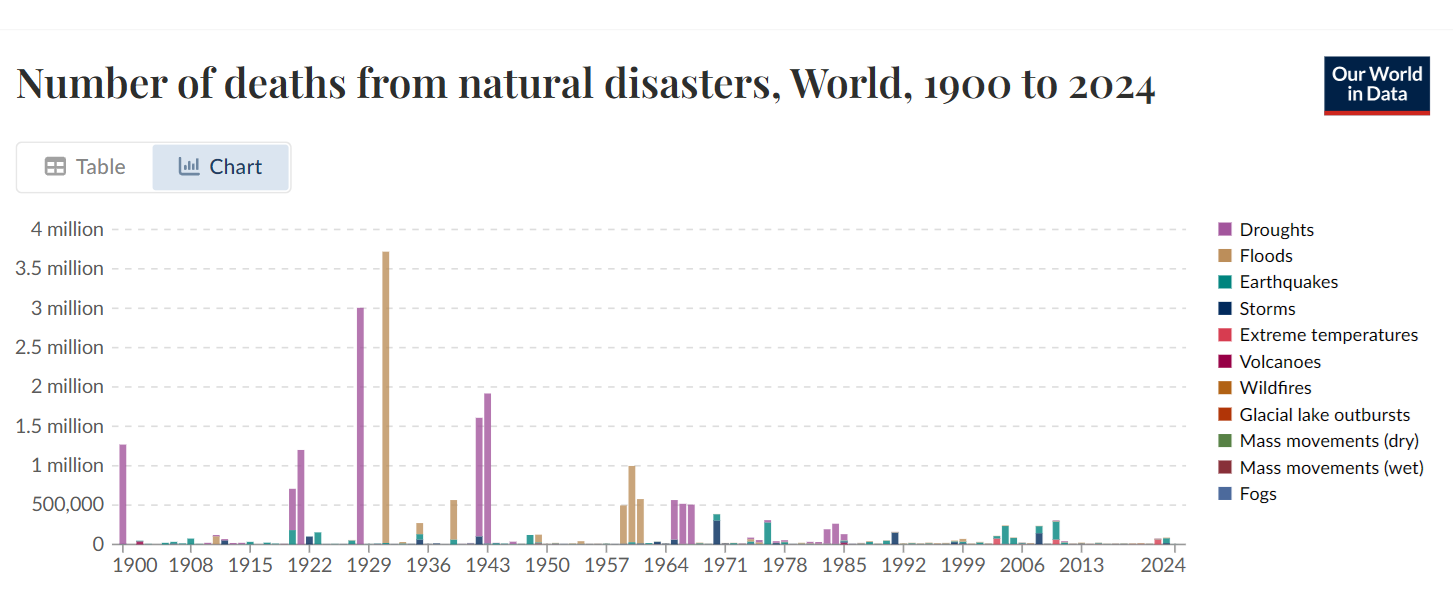
Data show that weather is not becoming more extreme. There is no evidence that the growth in wind and solar power has done or can do anything to alter the course of climate change. Trump’s America First agenda promotes energy dominance, focusing energy reliability and abundant, secure, domestic supplies. Trump’s energy plan is a stabilizing factor in energy costs.
William Becker, a former regional director at the U.S. Department of Energy during the Obama administration, makes many false claims in a rapid-fire fashion in his post in The Hill. For brevity’s sake and as a matter of focus, this Climate Realism post focuses on one segment of his article:
While we can thank fossil fuels for the lifestyles and conveniences most Americans enjoy today, the legacy of their long dominance is the destabilization and degradation of environmental systems critical to life. The atmosphere is one of those systems. Unprecedented weather extremes are the result of dumping fossil-fuel pollution into it. As the dumping continues, weather disasters become more frequent and destructive. The American people have been hit by an average of 23 major weather disasters (those with damages exceeding $1 billion) annually over the last five years, compared to only nine in the previous 45.
Every point Becker made in this statement after the opening clause of the first sentence is false. It is true that we can thank fossil fuels for our lifestyles and not just conveniences but essentials for modern life.
It is false that fossil fuel use is causing unprecedented weather extremes, and that they are becoming more frequent and destructive.
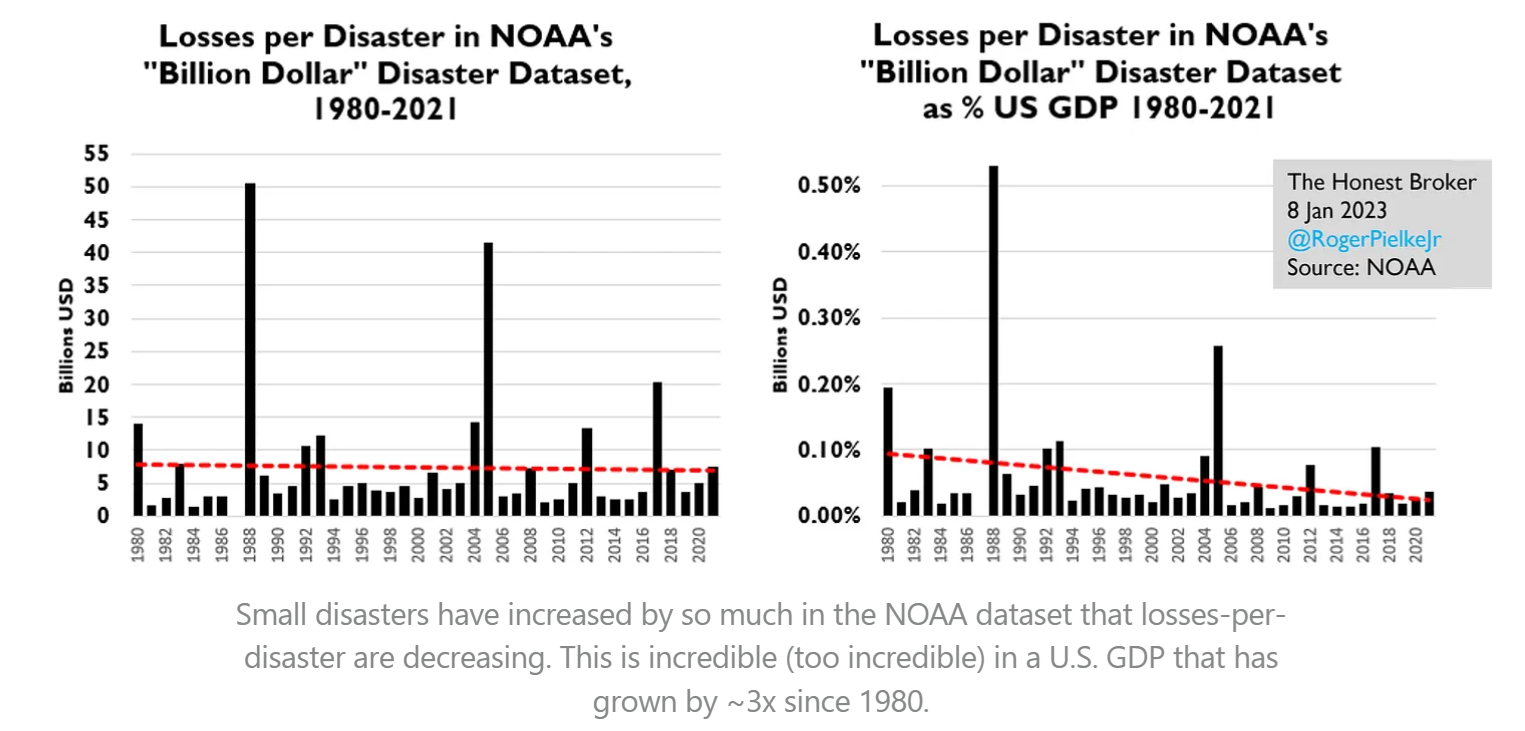
Becker, who currently runs a climate policy lobbying organization, uses a deceptive metric for calculating increasing weather disasters, which looks at the monetary value of losses due to weather. Becker does not attempt to claim that these weather events are becoming more frequent or extreme themselves – because they aren’t. Data on the most common weather extremes like hurricanes and wildfires show no increase, as Climate Realism has covered dozens of times. Instead, Becker cites misleading calculations of billion-dollar price tags from weather damage.
Scientist Roger Pielke, Jr., a professor emeritus at the University of Colorado Boulder, explains the misuse of the “billion dollar disaster” metric as a proof for dangerous climate change. He has called the U.S. National Climate Assessment (NCA) is “a national embarrassment,” for using that misleading metric, explaining that the NCA overestimated the number of disasters by a factor of three by re-counting individual events when they struck multiple states. So, if a hurricane passed through Florida, then into Georgia and South Carolina, the NCA would count this as three separate “billion dollar disasters” – even if the hurricane did not cause a billion dollar in of losses in each state it struck.
In reality, populations have increased in states like California and Florida, which are prone to extreme weather. More infrastructure has been built in susceptible areas, so there is more to annihilate when a storm strikes. To the extent that there has been any rise in billion dollar costs attributable to extreme weather events, as estimated by Becker and the sources he uses, it is due, not to changes in weather, but rather a well-known phenomenon labeled the “expanding bulls-eye effect,” which Climate Realism has discussed dozens of times previously, such as here.
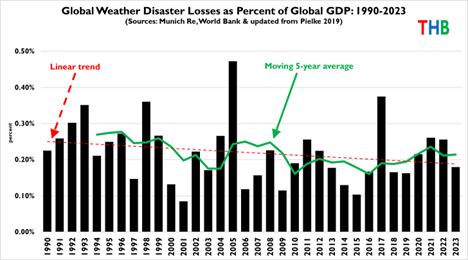
Going further, an analysis from Pielke, Jr. of insurance data presented in another Climate Realism post disputes the claim that the costs of natural disasters, when measured fairly, have risen. Relative to global GDP, the trend in property losses has declined as the Earth has modestly warmed over the last several decades. (See the graph, below)
Graph: Global disaster losses as a proportion of global GDP.
Becker’s additional claim that Trump’s focus on reliable energy rather than intermittent renewables will raise costs and result in less energy security, is as false as his claims about worsening disaster costs. The wind and solar technologies that Becker promotes rely heavily on materials and technologies produced by foreign powers that are not friendly to the United States, like China.
A grid powered by wind and solar is not cheaper than gas, it isn’t even cheaper than nuclear. A study by energy modelers at Always On Energy Research found that wind and solar both suffer from massive costs associated with the overbuilding necessary to overcome the intermittency issue. Load balancing, using battery storage, carries very high costs, as well. These make nuclear less expensive per megawatt hour than existing wind or solar, despite high upfront costs.
Similarly for fossil fuels, full system LCOE show that wind and solar in Texas costs far more per megawatt hour than nuclear, coal (of which the United States has hundreds of years of domestic supply that isn’t dependent on foreign sources), or the cheapest source – natural gas, which is also sourced domestically.
Grid stability is damaged by high penetration of solar and wind and the closure of traditional energy, according to utility companies and federal energy regulators.
Almost every claim made in Becker’s article in The Hill is provably wrong. The post is long on hyperbole and misinformation, but short on facts and data. Real world weather data shows no increase in extreme weather, incidences of weather disasters, or weather disaster costs as a percentage of economic growth. Trump’s reliability focused, America First, energy policy will not harm our energy security or the planet, but it will buttress the United States against the hostile intentions of any foreign government that might use our dependence on them for renewable energy materials and technology to extort economic or geopolitical concessions. It will also allow the U.S. to become energy dominant, a force for good in the world by supplying our abundant domestic energy supplies to allies, especially to developing countries in need of reliable energy sources to bring their populations out of energy poverty.
The Version 6.1 global average lower tropospheric temperature (LT) anomaly for March, 2025 was +0.58 deg. C departure from the 1991-2020 mean, up from the February, 2025 anomaly of +0.50 deg. C.
The Version 6.1 global area-averaged linear temperature trend (January 1979 through March 2025) remains at +0.15 deg/ C/decade (+0.22 C/decade over land, +0.13 C/decade over oceans).
The following table lists various regional Version 6.1 LT departures from the 30-year (1991-2020) average for the last 15 months (record highs are in red).
YEAR
MO
GLOBE
NHEM.
SHEM.
TROPIC
USA48
ARCTIC
AUST
2024
Jan
+0.80
+1.02
+0.58
+1.20
-0.19
+0.40
+1.12
2024
Feb
+0.88
+0.95
+0.81
+1.17
+1.31
+0.86
+1.16
2024
Mar
+0.88
+0.96
+0.80
+1.26
+0.22
+1.05
+1.34
2024
Apr
+0.94
+1.12
+0.76
+1.15
+0.86
+0.88
+0.54
2024
May
+0.78
+0.77
+0.78
+1.20
+0.05
+0.20
+0.53
2024
June
+0.69
+0.78
+0.60
+0.85
+1.37
+0.64
+0.91
2024
July
+0.74
+0.86
+0.61
+0.97
+0.44
+0.56
-0.07
2024
Aug
+0.76
+0.82
+0.69
+0.74
+0.40
+0.88
+1.75
2024
Sep
+0.81
+1.04
+0.58
+0.82
+1.31
+1.48
+0.98
2024
Oct
+0.75
+0.89
+0.60
+0.63
+1.90
+0.81
+1.09
2024
Nov
+0.64
+0.87
+0.41
+0.53
+1.12
+0.79
+1.00
2024
Dec
+0.62
+0.76
+0.48
+0.52
+1.42
+1.12
+1.54
2025
Jan
+0.45
+0.70
+0.21
+0.24
-1.06
+0.74
+0.48
2025
Feb
+0.50
+0.55
+0.45
+0.26
+1.04
+2.10
+0.87
2025
Mar
+0.58
+0.74
+0.41
+0.40
+1.25
+1.23
+1.20
The full UAH Global Temperature Report, along with the LT global gridpoint anomaly image for March, 2025, and a more detailed analysis by John Christy, should be available within the next several days here.
The monthly anomalies for various regions for the four deep layers we monitor from satellites will be available in the next several days at the following locations:


 Data show that weather is not becoming more extreme.



 Similarly for fossil fuels,