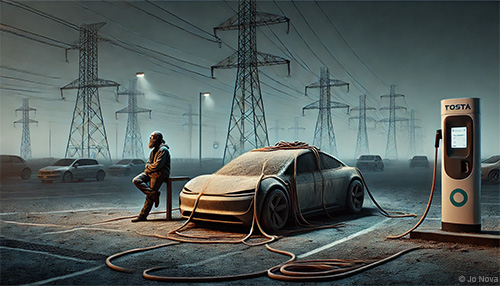
That’s right, the same folks who scolded that the world will “burn” unless the government forces every one of us to buy an EV or stop driving, are now torching the world’s best EVs with Molotov cocktails.
“Wow, you guys like petty acts of domestic terrorism, huh?” asked bemused Daily Show host Jordan Klepper when his audience hooted, cheered and applauded a news clip reporting “multiple cases of possible arson targeting Teslas and cyber trucks.”
Could it be that the anti-America, anti-capitalist Left’s obsession with electric vehicles was never about saving the planet at all?
Tesla CEO Elon Musk, America’s top entrepreneur, brought us reusable rockets, internet for all, amazing A.I., robots that actually work, and much more.
Elon just rescued Butch and Suni, two astronauts who were stranded on the I.S.S. for over nine months.
EVs were nowhere until Elon showed the world they could be amazingly innovative and incredibly cool. Tesla EVs may very soon be fully self-driving.
Making EVs cool was a tall achievement considering that EVs suffer from short range, long charging times, heavy weight, prohibitive expense, batteries that burn uncontrollably and require scarce rare earths that are too often mined under appalling circumstances.
Despite those challenges, Elon’s Tesla is now mass producing electric vehicles that are solid choices for some. They are not the best choice for all. Elon’s cool with that.
You’d think the Left would be erecting monuments to the man who made their EV dreams come true. Nothing could be further from the truth.
Protesters used a Tesla EV to carve “DON’T BUY A TESLA” onto a beach in Wales. They included an image of a man extending his arm out straight. This, despite the bizarre notion that Elon telling an audience that his heart goes out to them was somehow an authoritarian salute, has been massively debunked.
Tesla was removed from the Vancouver International Auto Show the day before it opened, reports The CBC. Organizers cited “safety” concerns. Tesla vehicles have also been removed from Vancouver’s EV subsidy program. “Safety” is frequently the rationale employed to justify institutions retaliating against free speech and has been used to silence speakers on college campuses.
Minnesota Governor and former V.P. candidate Tim Walz has been celebrating the recent drop in Tesla’s stock price. As if rooting against an important company that created 80,000 American jobs was not bad enough, Walz and the Left’s cheering against Telsa requires shamelessly cherry picking their stock data. Tesla stock may be down from the high it achieved in January resulting from the “Trump bump,” but remains up nearly 34% over the last year and 18,000% since it went public!
The Left cannot forgive Elon for bringing free speech to X/Twitter, endorsing President Trump, and now for applying his unmatched talent to rooting out waste and making government more efficient.
As Congressman Wesley Hunt put it, “Musk, Musk, Musk, Musk, Musk, Musk Musk. What’s funny about it to me is, you’re mad at the guy that found the fraud, but not mad at the people who wasted YOUR money.”
Discover more from Watts Up With That?
Subscribe to get the latest posts sent to your email.
New “emission” rules for cars started in January, but EV sales are falling and manufacturers are starting to panic
If the Labor government said it was going to make us pay a $10,000 fee on a fossil fuel car so it could give $10,000 to our rich neighbor to buy an EV, there would be mayhem and outrage in the streets. So instead they’ve come up with* a tricky scheme to force car manufacturers to do something like that, and they hope the complexity will fool the people. The new car tax and forced subsidy payments are called the “New Vehicle Efficiency Standard” (NVES) which makes it sound nicer and less Soviet, but really, the scheme is pure politburo management.
The Soviets were infamous for making 800 million pairs of shoes of the wrong sort . Somehow the Russian people had to stand for hours in queues to get one pair that they wanted, and so it is that Commissar Albanese has decreed the kinds of cars Australians will want, whether they like it or not. Like the Russians, we too will pay extra, or wait for years to get what we want.
As of January 1 2025, the government now is forcing manufacturers to sell “a balanced fleet” that meets the average emissions target the government set. In effect, they have turned the manufacturers into tax managers. The government tells Australians “you can buy whatever car you want” — but since the car companies can’t sell whatever car they want, it means customers have to change what they want. This is not a free market.
Obviously, companies selling too many “bad” high emission cars are going to have raise prices on those cars to slow down the sales, and they’ll have to drop the prices of the unpopular low emissions cars to boost them. Perhaps they’ll have to give them away to meet the targets? It might be cheaper than paying the fines.
In the end, it means only the rich will be able to afford the fossil fuel cars that most people want. The poor will have to settle for a subsidized EV, or they will have to pay more for the car they want, and subsidize the rich man buying the EV as a second car.
The car manufacturers face big fines if they can’t sell enough EV’s
The targets are delusional magic wand edicts — thou shalt reduce carbon emissions of new cars by 60% in five years! And the fines are savage. The new rule has only been in place for 3 months and already manufacturers can see, at this rate, they may end up paying $2.7 billion in fines. Insufferable:
by Greg Brown, The Australian
In a new front in the growing industry push for Anthony Albanese to revamp his climate and energy policy, Mitsubishi Motors Australia chief executive Shaun Westcott said the government needed to rethink the aggressiveness of its targets aimed at lowering the carbon footprint of new cars by 60 per cent by 2030.
The sector is anticipating the New Vehicle Efficiency Standard, which came into effect in January, would lead to car suppliers paying $2.7bn in fines by the end of the decade for missing carbon-emission requirements.
EV sales fell from 9.6% of the market a year ago, down to 5.9% last month:
The Driven
After a very slow start to EV sales in January 2025, the Australian EV market has shown another month of stagnant sales, with electric vehicles making up just 5.9 per cent of the country’s total new car market, which was also subdued.
The latest data from the Federal Chamber of Automotive Industries (FCAI) (released on Wednesday) and the Electric Vehicle Council (EVC – released on Tuesday) shows that a total of 5,684 full battery electric vehicles were sold in Australia in February, compared to 10,111 in the same month last year, when Tesla dominated and accounted for 5,665 units.
A total of 96,710 new vehicles were sold in Australia during the month, itself a fall of nearly 10 per cent from the same month a year ago.
Faced with these numbers Shaun Westcott said: “There is nothing we can do to force them to buy those vehicles.”
With typical gaslighting style, the “government spokeswoman said the NVES was providing Australians with “choices”.” While they take away the one choice Australians really want which is cheap large fossil fuel comfortable cars.
On the lowest population density country on Earth, with extreme heat, and no transmission lines in most of the country, let alone chargers, this is a dumb place to demand EV’s.
When Australians figure out this communist witchcraft, they are going to be livid.
____________
*Australian Labor didn’t come up with the idea, they stole it from the Democrats in the US who set up this up long ago.
Somewhere, probably in a temperature-controlled office lit by taxpayer-funded fluorescent lights, a gang of climate hysterics decided it was time to sound the next false alarm: global warming is coming for your dreams. That’s right. If the planet warms by a couple degrees, you won’t just sweat a little more—you’ll sleep less. And if you sleep less, according to these clowns, you might die. Cue the dramatic music and the UN PowerPoint.
Abstract
The impact of rising ambient temperatures on sleep and its phases under climate change is becoming increasingly concerning but remains underexplored. Sleep, consisting of non-rapid eye movement and rapid eye movement phases, is crucial for health, and insufficient sleep in either phase could have significant implications. Based on sleep monitoring data of 23 million days from 214,445 participants across mainland China, we investigated how daily average temperature affected sleep. For each 10 °C increase in ambient temperature, the odds of sleep insufficiency increased by 20.1%, while total sleep duration decreased by 9.67 minutes, with deep sleep declining the most (by 2.82%). Projections under the unrestricted (SSP5-8.5) greenhouse gas emission scenario suggest that by the end of the century, sleep insufficiency could rise by 10.50%, with an annual loss of 33.28 hours of sleep per person. These findings highlight the potential of climate warming to exacerbate sleep deprivation and degrade sleep quality, especially for the elderly, women, individuals with obesity, and regions of South, Centre and East.
This deeply unserious study out of China—blessed, of course, by Nature Communications (a publication that has long since traded rigorous science for progressive catechism)—makes the mind-numbing claim that rising temperatures are causing people to lose sleep. The culprit? Not noisy neighbors, too much screen time, or China’s brutal urban density. Nope. It’s “climate change,” the all-purpose demon invoked every time someone stubs a toe or misplaces their AirPods.
The study boasts about analyzing 23 million sleep records from over 214,000 people in China using Huawei smart devices. Because when it comes to objective medical data, nothing says “trustworthy” like consumer gadgets from a surveillance state.
The researchers conclude—with a straight face—that a 10°C increase in average temperature leads to a 20.1% increase in sleep insufficiency and a devastating (hold onto your pillow) loss of 9.67 minutes of sleep per night. Deep sleep is reduced by 3.58 minutes. Oh, the humanity.
If you’re laughing, you’re not alone.
You’d think a minor drop in deep sleep could be chalked up to a new mattress or your neighbor’s karaoke addiction. But no. These authors go full apocalyptic, projecting that under the IPCC’s most extreme emissions scenario (the infamous SSP5-8.5, aka the Mad Max fantasy lane of climate predictions), people could lose—wait for it—33.28 hours of sleep per year by 2099.
That’s right. In 75 years, if we don’t abandon airplanes and steak, Chinese adults might lose 30 hours of snoozing. That’s about two bad weekends of sleep. And this, apparently, is an argument for global emissions restrictions, carbon taxes, and presumably a government-subsidized pillow redistribution program.
But let’s not gloss over the real comedy here. The whole thing is based on correlation. The authors themselves acknowledge they didn’t measure indoor temperature, air conditioning usage, or even basic confounders like income or occupation. Their sleep data? Sourced from voluntary Huawei smartwatch users who had to opt in. You know, the exact kind of scientific randomness you’d expect from a TikTok challenge.
And the projections? Modeled using Shared Socioeconomic Pathways—that is, computer-generated crystal ball gazing that makes astrology look positively rigorous. Remember SSP5-8.5? The “unrestricted emissions” scenario even the IPCC admits is wildly implausible? These authors not only used it—they based their conclusions on it.
The punchline is in their own words:
“Our findings highlight the importance of mitigating greenhouse gas (GHG) emission and implementing tailored adaptive measures for vulnerable regions and subgroups to alleviate the sleep deprivation and degraded sleep quality associated with climate warming.”
Translation: Let’s throw trillions of dollars at net-zero policies because your smartwatch said you tossed and turned last night.
Here’s the truth: this isn’t science. It’s ideological performance art dressed up in spreadsheets. The climate priesthood isn’t content with claiming climate change will flood cities and kill polar bears—they now insist it’s responsible for insomnia, bad moods, and your toddler’s tantrum. If a leaf falls off a tree, it’s because you didn’t buy carbon credits.
There’s something deeply grotesque about using speculative future sleep loss to push present-day climate policies that will definitely destroy jobs, raise energy costs, and wreck the economies of the very people these “researchers” pretend to protect.
Enough. If your sleep is bad, try turning off your phone and using blackout curtains. But don’t let the climate cult tuck you in with fear-porn masquerading as science.
The only thing truly losing sleep should be this junk paper’s credibility.
Discover more from Watts Up With That?
Subscribe to get the latest posts sent to your email.
From the University of Michigan and the Eye-rolling Climate Science Department, because asking your doctor about severe weather is the dumbest thing you can possibly do.And for the zillionth time, WEATHER IS NOT CLIMATE!
Weather emergencies affect older adults’ views on climate and health
People over 50 who recently experienced an extreme weather event are far more likely to express concern about the effects of climate change on their health
Nearly 3 out of every 4 older Americans have experienced at least one extreme weather event in the last two years, a new University of Michigan poll finds. And living through such an event appears to make a big difference in how they view the potential impact of climate change on their health.
The new findings from the National Poll on Healthy Aging show that 59% of people aged 50 and over are concerned about how climate change could affect their health.
The percentage expressing concern was even higher among those who had recently lived through a weather emergency such as a wildfire, extreme heat, severe storm or power outage lasting more than a day. In all, 70% of those who had experienced at least one such event in the past two years expressed concern about climate change and their health, compared with 26% of those who had not lived through such an event.
Other groups of older adults were also more likely to say they are concerned about the effects of climate change on their health, including women, those reporting fair or poor mental health, and those who live in urban areas.
Only 6% of people over 50, though, had talked with a health care provider about how extreme weather might affect their health and how they could prepare or protect themselves.
This finding suggests more opportunity for older adults to ask their doctors and other health care providers about things like how to protect their lungs from wildfire smoke, how to prepare for prolonged disruptions to their supply of medications or the electricity that powers their medical equipment, or how to know where to find cooling centers, warming centers and emergency shelters in their community.
“Our findings suggest a need to help more older adults understand and take steps to prepare for the impacts of wildfires, hurricanes, tornadoes, extreme heat waves, winter storms and more, especially when it comes to the medications, medical supplies, electricity and access to care that these emergencies can disrupt,” says Sue Anne Bell, Ph.D., FNP-BC, a nurse practitioner and associate professor at the U-M School of Nursing who worked with the poll team. Bell specializes in studying the impacts of disasters and public health emergencies among older adults.
In addition to the national poll report, the team compiled data for Michigan adults aged 50 and older compared with those in other states; an interactive data visualization is available at https://michmed.org/MDKQ2. An article summarizing the Michigan findings is available at https://michmed.org/28dbD.
The poll was conducted in August 2024, before some of the most extreme climate-related emergencies of the past year, such as September’s Hurricane Helene – the deadliest hurricane to strike the U.S. since Hurricane Katrina in 2005 – and the wildfires in the Los Angeles area in January of 2025.
In addition to concern for their own health, 74% of people aged 50 and over say they are concerned about the potential impact of climate change on the health of future generations. That includes 43% who say they are very concerned, and 31% who are somewhat concerned.
Those older adults who had lived through a weather emergency in the past two years were more likely to express concern about future generations, with 83% of them saying they’re concerned, compared with 45% of those who had not experienced a weather emergency.
Extreme heat was the most common extreme weather event experienced by poll respondents, with 63% saying they had experienced at least one major heat wave in the past two years. Poor air quality due to wildfire smoke was next most common, at 35%, and 31% had been in the path of a severe storm. Prolonged power outages (lasting more than one day) were next most common, at 13%; power outages may be due to factors other than extreme weather.
The poll also asked older adults which potential future effects of climate change concerned them most. The most-cited potential future effect was more extreme heat events (70%), followed closely by air pollution and poor air quality (69%), loss of basic infrastructure like power and water (68%), more frequent severe storms (68%), and changes in infectious diseases (66%).
“These kinds of events can affect an older adult’s health directly – for instance, people with asthma and other lung diseases can have trouble breathing due to wildfire smoke, home medical equipment can be affected by power outages, and older adults can be more vulnerable to extreme heat and cold,” says poll director Jeffrey Kullgren, M.D., M.P.H., M.S., a primary care physician at the VA Ann Arbor Healthcare System and associate professor of internal medicine at U-M.
“But there are also indirect effects, including mental stress, lack of access to medications and medical care, and in extreme cases, lack of ability to evacuate safely or find shelter,” he added.
Bell notes, “Planning and preparing for emergencies is especially important for those with complex health conditions and disabilities, who should ask their regular health care provider for advice as well as seek information from their local and state emergency preparedness authorities.”
Poll respondents reporting a health problem or disability that limits their daily activities were slightly more likely than other older adults to say they had spoken with a health care provider about how to prepare for a climate-related emergency, at 8% vs. 5%. Among all older adults who had had such discussions, 64% had taken at least one action to prepare.
The U.S. government’s Ready.gov website offers information about how to prepare for and cope with extreme weather events and other emergencies.
Bell previously worked with the poll team to explore what older adults have done to prepare for emergencies; read the report here.
The poll findings come from a nationally representative survey conducted by NORC at the University of Chicago for IHPI and administered online and via phone in August 2024 among 3,486 adults ages 50 to 94 across the U.S. The sample was subsequently weighted to reflect the U.S. population. Read past National Poll on Healthy Aging reports and about the poll methodology.
Discover more from Watts Up With That?
Subscribe to get the latest posts sent to your email.