The Sunlit Uplands?

Professor Gordon Hughes recently posted an interesting article regarding the economics and utility of solar farms at higher latitudes. It’s well worth a read, but for me the key sentence was this:

Even on assumptions that are either extremely optimistic (based on actual evidence rather than fantasy forecasts) or inconsistent with current economic conditions, developing solar plants in locations north of 53°N makes no sense.

Why, then, is there a mad rush to build solar developments in Scotland? And why is there a sudden rush to build them in Cumbria? I live at well north of 54°N, and there are two massive projects planned a short distance from where I reside. The first (reported on here and here) is between Egremont and Dent Fell, on the edge of the Lake District National Park (my estimate is that it’s within two miles of the National Park boundary), and (quite apart from the latitude issue) is in a completely inappropriate location. At least, that’s what I think, and so do many people who live closer to the site than I do. At 200 acres, it’s the size (depending on how one measures these things) of 125 football pitches. It’s to be called (for no good reason, so far as I can see) Cobra Castle Solar Farm, and the developer’s website contains a number of what I regard as questionable statements:

This site has been carefully selected to deliver clean, renewable energy while supporting biodiversity, ecology and the local community.

“Clean” and “renewable” is a matter of opinion. I don’t know where the solar panels will come from, but given that the IEA reckons that more than 80% of such products are made in China, there has to be a good chance that some if not all of the Cobra Castle solar panels will be manufactured there – using electricity generated by coal, possibly using Uighur slave labour, and being transported halfway round the world in diesel-fuelled ships. That’s before we discuss the mining of the materials utilised in their manufacture.

The proposals are temporary…

I accept that forty years (the proposed life of the plant) is less than permanent, but it will span the active years of someone in their late teens when it’s built, so it’s not exactly short-term.

During this time, the land will maintain its greenfield classification…

What does that mean? Is that under planning legislation? It will certainly be converted to a massive industrial site, with associated Battery Energy Storage System (BESS).

Generating cheap, renewable energy…

This is a claim that is often made for renewables, but as we have seen it is certainly questionable.

The proposed 35MW, 200 acre solar farm would be able to generate enough green energy to meet the annual energy needs of approximately 15,000 homes.

This claim is dependent on it achieving electricity generation at the levels claimed, and I have no way of knowing how accurate the claim is. Naturally it makes no mention of the fact that it will produce next to nothing in winter, nothing overnight, and is generally unreliable. I can’t state with confidence how much capacity will be lost over time due to photovoltaic degredation, but over 40 years I imagine it will not be insubstantial. All of which means that the headline claims should be treated with caution. And even if the headline figure is accurate, it amounts to intermittent electricity for just 120 homes for every football field of solar panels.

Genuine benefits for local residents including a community benefit and education fund of £680,000 over the projects [sic] lifetime.

This should also be probed for clarity. £680,000 sounds like a lot of money, but over 40 years it represents just £17,000 p.a. or little more than £1 p.a. for each of those 15,000 homes whose energy needs the developers claim they will meet. And that assumes that we take the headline figure at face value. Is it to be index-linked? Is it to be spread over 40 years without indexation? If so, it will be virtually worthless before very long.

There is to be a community consultation which closes on Sunday 13th April. I hope the locals take the opportunity to probe the above claims and to make their opposition clear. The problem is, it doesn’t matter how many people object, and however lucid their objections. We all know that the consultation process involves little more than going through the motions, since with the government’s obsessive drive to grid decarbonisation and its proposed amendments to the planning laws, it will be nothing short of a miracle if this proposal does not receive planning permission.

Which is a long-winded way of leading in to the proposed solar farm development I really want to talk about, namely Lostrigg Solar. My interest in this development was piqued when I spotted a pile of glossy brochures in my local library the other day. They are hot off the press (dated March 2025) and are numerous copies of the Lostrigg Solar “Statement of Community Consultation”. If the prospect of Cobra Castle’s 200 acres is daunting to environmentalists, then Lostrigg Solar’s 417 hectares (or approximately 1,030 acres, or 584 football pitches) might induce a shudder. The glossy magazine tells us that in addition to the photovoltaic panels, there is to be a co-located BESS, an on-site sub-station, and a range of supporting infrastructure, including inverters, transformers, switchgear, and security measures such as fencing, CCTV and lighting.

Acronym alert: because the development is so vast (with a “potential generation capacity of up to 100 megawatts (MW)”), it is classified as a Nationally Significant Infrastructure Project (NSIP) – a designation triggered at 50 MW. This means that it requires a Development Consent Order (DCO) under the Planning Act 2008. As part of this process, a Statutory Consultation must take place for a minimum of 28 days, but first, pursuant to section 47 of the Planning Act the developer has to prepare a Statement of Community Consultation (SoCC), to explain how it will carry out the Statutory Consultation. This all seems very worthy, but also very bureaucratic, and rather pointless, given that under the current government the odds are that this development will be rubber-stamped by the Secretary of State in due course in any event, whatever well-founded objections local communities may raise during the Statutory Consultation.

There is a Preliminary Environmental Information Report (PEIR), with accompanying Non-Tecnical Summary (NTS) and other draft DCO documents, including draft Management Plans, Draft Design Approach Document (DAD) and draft Policy Compliance Document (PCD). With me so far? If not, this might help:

The PEIR sets out potential impacts and accompanying mitigation.

The draft Management Plans outline the proposed management regimes for the Proposed Development.

The draft DAD sets out the design approach and design parameters.

The draft PCD sets out a detailed schedule of all the relevant national and local planning policy and how the Proposed Development responds to these.

There is a Core Consultation Zone and a wider consultation area, plus “seldom heard, hard to reach, groups and wider outreach”. Commendably, these include the likes of West Cumbria Society for the Blind, Cumbria Deaf Association, Cumbria Academy for Autism, Alzheimer’s Society West Cumbria and North Cumbria West Community Team, and many others, who my instincts tell me probably won’t be very interested, but it appears to be inclusive and therefore looks good. Among those others, however, are a surprising number of bodies who I suspect are bound to be both interested and supportive. It’s only when you see them listed that you realise how far the Green Blob’s tentacles spread. Bear in mind that this is just in respect of west Cumbria: Bridgefoot and Little Clifton Energy Hub Working Group (Bridgefoot and Little Clifton Energy Hub is a working group of Bridgefoot and Little Clifton Parish Council, set up to look for ways the community and residents can reduce energy costs, improve energy efficiency and thereby reduce carbon emissions”); Cumbria Action for Sustainablity (“We are Cumbria’s climate change charity. We’re here to help Cumbrians to reduce their carbon footprint and prevent climate change.”); Cumbria Sustainability Network (The network meets monthly online and helps the groups to strengthen their influence on carbon reduction at a more strategic level in county, by working collectively as well as campaigning as individual groups. The CSN is an important part of the Zero Carbon Cumbria Partnership, helping to ensure that the voice of the community takes centre stage in the county’s carbon reduction plans. The CSN is supported by a coordinator, thanks to the Zero Carbon Cumbria funding from the National Lottery’s Climate Action Fund.”); Friends of the Earth – Cumbria; Cumbrian Energy Revolution (“We believe the best way to develop the West Cumbrian economy is through a green revolution concentrating on renewable energy rather than expanding the nuclear industry”); South Lakes Action on Climate Change (what’s it got to do with them? – they’re nowhere near the Proposed Develoment, though that didn’t stop them vociferously opposing the proposed coal mine); Zero Carbon Cumbria; and Cumberland Council Climate Team.

I think it’s fair to say that this “outreach” section of the exercise is aimed at reaching people with little or no interest (not likely to respond and not likely to object, but boxes duly ticked) and also in generating as many positive and supportive responses as possible from reliably vocal renewables cheer-leaders..

Back to the process. Once the consultation exercise has been completed, the application goes to the Planning Inspectorate (PINS), as the body responsible for managing the examination process for NSIPs. In the case of energy-related NSIPs, however, PINS acts on behalf of the Secretary of State for Energy Security and Net Zero (currently Mr Miliband). Should PINS accept the application for examination, an Examining Authority will be appointed, and the public will be able to submit a relevant representation and become an interested party. The application will then be examined and a recommendation made to Mr Miliband (assuming he’s still the relevant Secretary of State by then). He will review the recommendation and decide whether to grant consent. I don’t imagine William Hill will give me long odds on a bet on the outcome. In which case, really, what’s the point of all of the above?

By the way, the application is being submitted by a subsidiary of German company RWE, so this will be yet another piece of critical energy infrastructure owned by a foreign company. They’re a little more coy than the proposed developers of Cobra Castle, and they don’t commit to any specific sum with regard to community benefits, merely observing that the development “has the potential to support local initiatives through a community benefit fund which would take the form of annual payments spread across the 40-year operational period”. They have, however, used the same crib sheet as Cobra Castle (I suspect these are standard claims with developments of this sort, however outlandish they may be) – claiming the potential to boost local biodiversity such as by establishing wildflower meadows and grassland areas (despite the fact that much of the area they propose to blight already consists of such areas); explore opportunities to enhance green infrastructure, such as woodland blocks and hedgerow planting; explore opportunities for continued low intensity grazing during operation; and provide opportunities for enhanced public operation and access.

I note the lack of commitment – “explore opportunities” is not the same as saying they have firm proposals to put forward. It’s difficult to see how the industrialisation of a vast area of farmland can be described as enhancing biodiversity, but that’s the topsy turvy world we now live in.

Within fairly close proximity, then, we see two proposed developments that are at a northerly latitude where they make no sense, which when they go ahead will industrialise existing farm land, and which involve (especially in the case of Lostrigg) massive bureaucratic exercises that are surely nothing more than a charade, a pointless formality. My money is on both developments being granted planning permission without much difficulty. Should the local authority refuse permission for Cobra Castle Solar Farm I have no doubt permission will be granted on appeal, and Lostrigg, being a NSIP which will go to Mr Miliband and will be rubber-stamped with enthusiasm and alacrity.

I shall be watching developments. If it turns out that I am wrong, I will eat humble pie in a comment below the article. Watch this space.

via Climate Scepticism

https://ift.tt/Q9lFLkV

March 22, 2025 at 03:55PM

Beware: Flawed Energy Assumptions Incite Delusional Scenarios

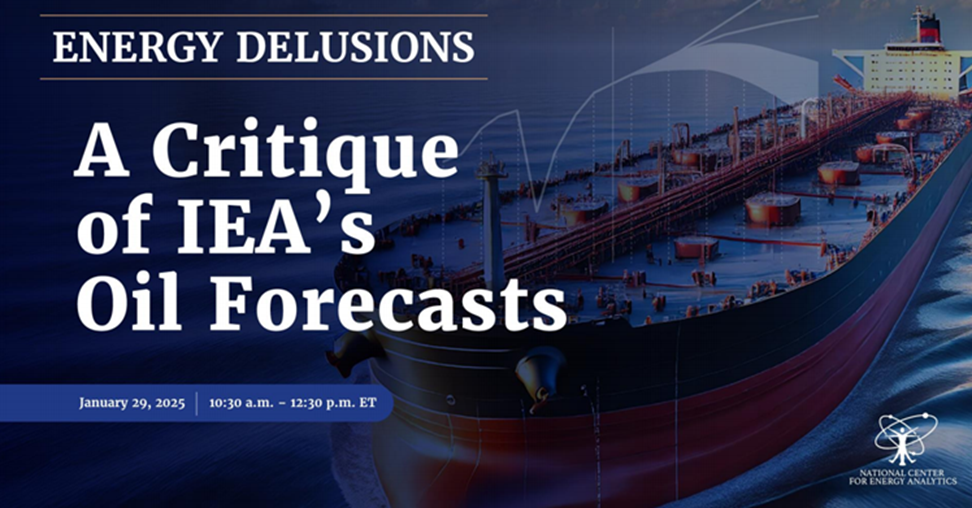
Mark P. Mills and Neil Atkinson blow the whistle on projections written in International Energy Agency’s (IEA) latest report, the World Energy Outlook.  Below is the announcement of the report findings key exhibits and Executive summary, excerpts in italics with my bolds and added images. Link to full study at the end.

Overview

Industry players consider the International Energy Agency’s signature annual report, the World Energy Outlook, to contain highly credible analyses. However, a new critique from the National Center of Energy Analytics experts finds the IEA’s latest scenarios on future oil demand to be problematic and potentially, dangerously wrong. 

“When it comes to policy or investment planning, there is a distinction with a critical difference when it comes to what constitutes a “forecast” (what is likely to happen) versus a “scenario” (a possibility based on assumptions). The challenge is not in determining whether the scenarios are completely factual per se, but instead whether they are factually complete,” wrote the authors in their report.

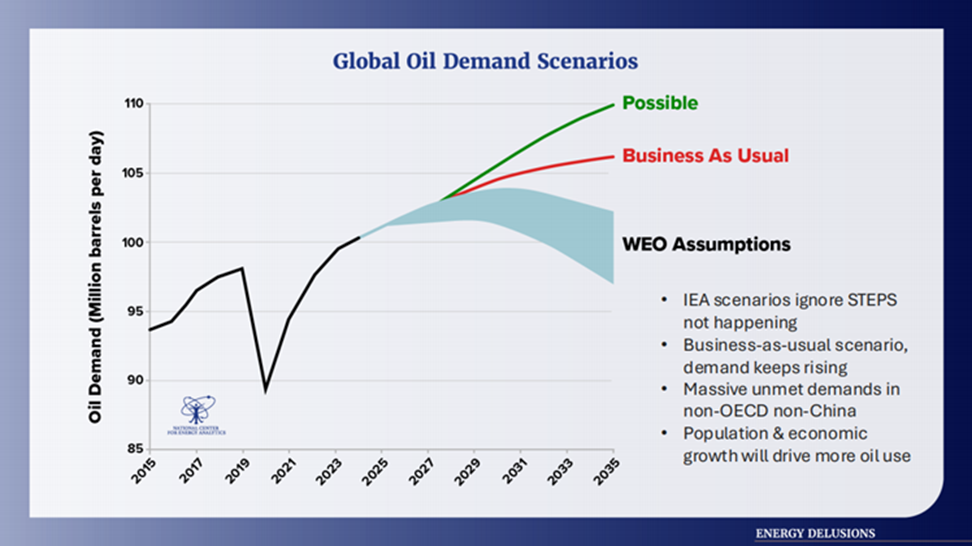
The most widely reported WEO scenario is that the world will see peak oil demand by the early 2030s. NCEA co-authors Mark P. Mills and Neil Atkinson believe that this conclusion is a prima facie case; minimally, the IEA should include business as usual (BAU) scenarios, not those based on all “high cases” or unrealistic possibilities.

Mills and Atkinson pinpoint 23 flawed assumptions used in the WEO scenarios to predict future oil demand, including:

  • IEA assumes: Corporate transition policies are real and durable. NCEA counterclaim: Myriad corporations, having earlier proclaimed fealty to “energy-transition” goals, are either failing to meet such pledges or overtly rescinding them.

  • IEA assumes: Transition financing will continue to expand. NCEA counterclaim: Alternative energy projects have become more expensive and difficult to finance, and wealthy nations are increasingly reluctant to gift huge amounts of money to the faster-growing but poorer nations, many of which have governance issues.

  • IEA assumes: China’s actions will follow its pledges. NCEA counterclaim: The scale of China’s role in present and future energy and oil markets requires scenarios that model what China is doing—and will likely do—rather than what China claims or promises.

  • IEA’s assumes: The oil growth in emerging markets will be low. NCEA counterclaim: The fact of low demand in some poorer regions—e.g., Africa uses roughly one-tenth the per-capita level in OECD countries—points to the potential for very high, not low, growth in those markets.

  • IEA’s assumption: Governments will stay the course on EV mandates. NCEA’s counterclaim: Recent trends in many countries and U.S. states show policymakers weakening or reducing mandates and subsidies.

Flawed Assumptions Lead to Flawed Conclusions

Listed below is a summary of the flaws in 23 (but far from all) of the assumptions used in the WEO scenarios that are relevant to guessing future oil demand. Meaningful scenarios for planning for future uncertainties should include a range of realistic inputs, not just those that are aspirational.

Assumptions about baseline factors that affect oil forecasts

  1. Assumption: STEPS is a useful baseline.
    Flaw: The baseline scenario, rather than “business as usual,” assumes a future based on countries’ Stated Policies Scenario (STEPS), which not one country is implementing in full.
  2. Corporate transition policies are real and durable.
    Flaw:  Myriad corporations, having earlier proclaimed fealty to “energy-transition” goals, are either failing to meet such pledges or overtly rescinding them.
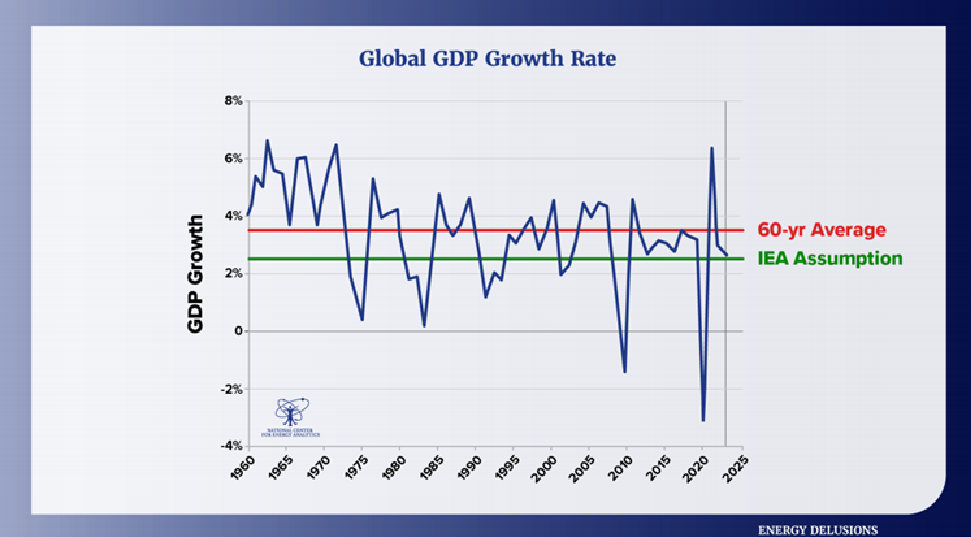
  3. Higher economic growth is unlikely.
    Flaw: Ignoring the possibility of higher economic growth, based on historical trends and the goals of all nations, leads to scenarios that underestimate future oil demand.
  4. Transition financing will continue to expand.
    Flaw:Alternative energy projects have become more expensive and difficult to finance, and wealthy nations are increasingly reluctant to gift huge amounts of money to the faster-growing but poorer nations, many of which have governance issues.
  5. Efficiency gains and structural changes will lower global demand for energy.
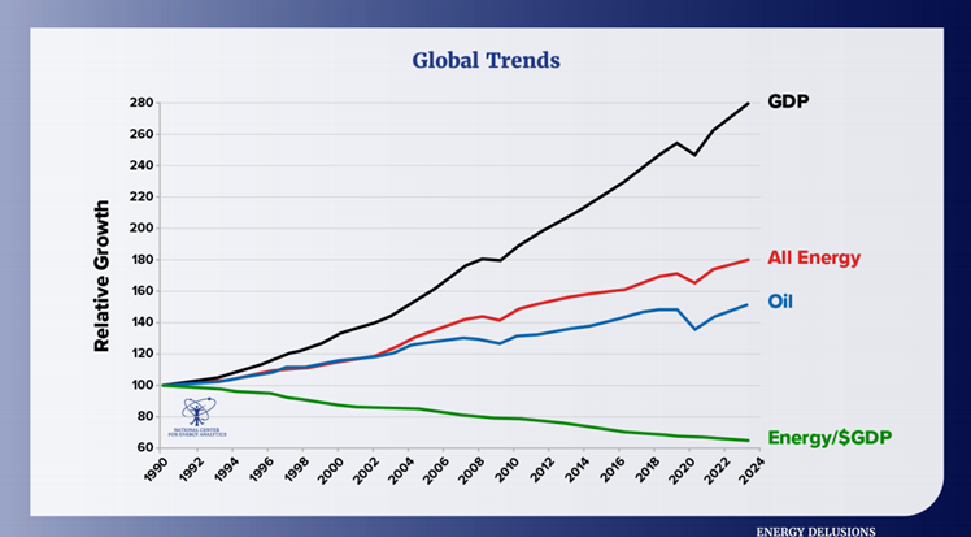
    Flaw:Long-run trends show that energy-efficiency gains make energy-centric products and services more affordable and thus do not reduce, but instead generally stimulate, rising demand.
  6. Solar and wind power are 100% efficient.
    Flaw: The WEO 2024 assertion that “most renewables are considered 100% efficient” contradicts fundamental physics and is, arguably, a silly PR-centric rhetorical flourish.
  7. China’s actions will follow its pledges.
    Flaw: The scale of China’s role in present and future energy and oil markets requires scenarios that model what China is doing—and will likely do, in fact—rather than what China claims or promises.

Assumptions regarding oil’s future

  1. The oil growth in emerging markets will be low.
    Flaw:  The fact of low demand in some poorer regions—e.g., Africa uses roughly one-tenth the per-capita level in OECD countries—points to the potential for very high, not low, growth in those markets.
  2. The EV market share will accelerate.
    Flaw:  Slowing market adoption and retrenchments in automakers’ EV plans or promises are evident, calling for scenarios that model realities that could persist.
  3. Governments will stay the course on EV mandates.
    Flaw:  Recent trends in many countries and U.S. states show policymakers weakening or reducing mandates and subsidies.
  4. China’s EV “success story” leads quickly to lower oil demand.
    Flaw:  Data point to the fact that in the real world, EV sales and gasoline consumption are both rising.

Assumptions about other transportation markets

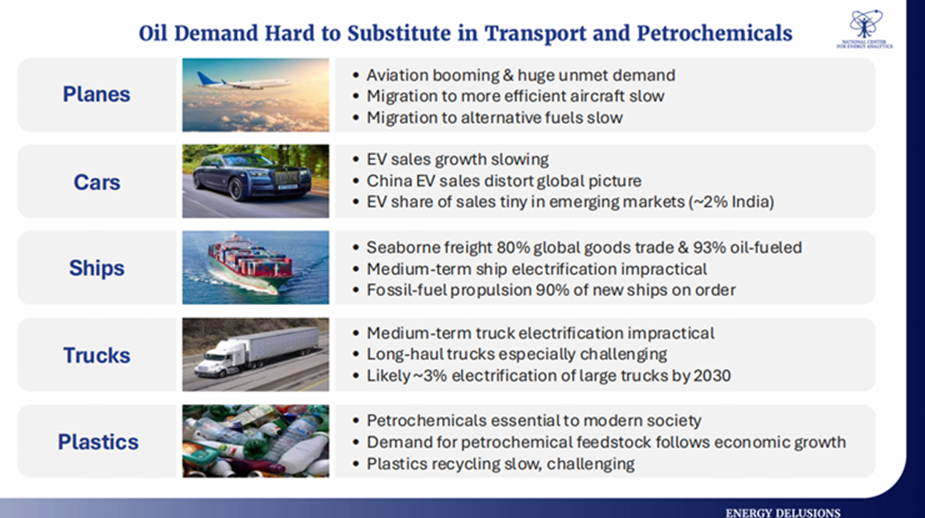
  1. There will be significant electrification of heavy-duty trucks.
    Flaw:  There is no evidence of market adoption for any fuel option that leads to far higher capital costs and enormous degradation in performance.
  2. There will be significant electrification and fuel alternatives in aviation.
    Flaw:  There are no trends showing non-oil options for even a tiny share of the aviation market, in an industry that forecasts booming demand.
  3. There will be significant electrification and fuel alternatives for ships.
    Flaw:  The only modestly significant change in oil used for global shipping comes from the use of liquefied natural gas, another (and generally more expensive) hydrocarbon.
  4. There will be a rapid decline in oil used for Middle East power generation.
    Flaw:  Despite pledges and pronouncements, the year 2024 saw continued, and even higher, use of oil for electricity generation.
  5. The growth in petrochemicals and plastics will be slow.
    Flaw:  Slower growth is anchored in recycling enthusiasms that markets are not adopting and expectations of new recycling technologies that remain expensive or unproved.
  6. All scenarios lead to peak oil demand by ~2030.
    Flaw:  A WEO core conclusion that “combing all the high cases” leads to “global peaks for oil” by ~2030 is, prima facie, not based on all “high cases” but on unrealistic scenarios.

Assumptions regarding associated industries

  1. The supply of critical minerals will meet transition goals.
    Flaw:  Myriad studies have now documented the fact of a looming shortfall in current and expected production and of the challenges in changing that status quo.
  2. Prices of critical minerals will be low.
    Flaw:  It is fanciful in the annals of economic history to imagine that record-high demands won’t lead to far higher prices for the critical minerals needed to build EVs (as well as for wind and solar hardware).
  3. China won’t exercise minerals dominance as an economic or a geopolitical tool.
    Flaw:  China has already signaled over the past year that it is willing and able to implement export controls, or pricing power on critical minerals, where it holds significant global share.
  4. Oil and gas annual investments are adequate to avoid economic disruptions.
    Flaw:  Current levels of investment are not adequate to meet demands under business-as-usual scenarios, especially when combined with likely decline rates of extant oil fields.
  5. The future decline rate from existing oil fields will continue historical trends.
    Flaw:  The much faster decline rate in output from now-significant U.S. shale fields has altered the global average decline rate, pointing to the need for increasing investments to avoid a shortfall.
  6. OPEC will be a reliable cushion to manage oil-supply disruptions.
    Flaw:  History suggests that scenarios should include alternative possibilities to relying on OPEC to provide a cushion for meeting unexpected shortfalls in production or increases in demand.

Executive Summary: Flawed Assumptions Lead to Dangerous “Forecasts”

For decades, the International Energy Agency (IEA) was the world’s gold standard for energy information and credible analyses. Following the commitment of its member governments to the 2015 Paris Agreement climate accords, the agency radically changed its mission to become a promoter of an energy transition. In 2022, the IEA’s governing board reinforced its mission to “guide countries as they build net-zero emission energy systems to comply with internationally agreed climate goals.”

The IEA’s current preoccupation with promoting an energy transition has resulted in its signature annual report, the World Energy Outlook (WEO), offering policymakers a view of future possibilities that are, at best, distorted and, at worst, dangerously wrong.

The 2024 WEO’s central conclusion, its core “outlook,” has been widely reported as a credible forecast, i.e., something likely to happen: “[T]he continued progress of transitions means that, by the end of the decade, the global economy can continue to grow without using additional amounts of oil, natural gas or coal.”

The WEO itself states that it doesn’t forecast but has scenarios—explorations or models of possibilities, and cautions: “Our scenario analysis is designed to inform decision makers as they consider options…. [N]one of the scenarios should be viewed as a forecast.” Scenarios that usefully “inform” need to be based on realistic possibilities and assumptions. But there is one foundational assumption—one that the IEA has for decades included in its scenarios and that has been banished from the WEO: the possibility of business as usual (BAU).

Instead, the WEO’s baseline scenario now assumes that nations are undertaking their specific energy-transition plans that they promised in order to comply with the 2015 Paris Agreement, i.e., “stated policies scenario” (STEPS). Yet none of the signatories to that Agreement is fully meeting its promises, and most are a long way behind schedule. Believing something that is not true is not just problematic; it meets the definition of a delusion.

It is fanciful to forecast that, over the next half-dozen years, the growth in the world’s population and economy won’t continue a two-century-long trend and lead to increased use of the fossil fuels that today supply over 80% of all energy, only slightly below the share seen 50 years ago. The data show that the global energy system is operating essentially along BAU lines and not only far off the STEPS, but even further away from the more aggressive transition aspirations that the WEO also models.

In this analysis, we focus on highlighting 23 problematic, flawed assumptions that are relevant specifically to the WEO’s oil scenarios and the widely reported “forecast” that the world will see peak oil demand by the early 2030s (see box on pp. 4-5, Flawed Assumptions Lead to Flawed Conclusions). While other scenarios about other energy sources are critical as well, oil remains a geopolitical touchstone and the single biggest source of global energy—10-fold greater than wind and solar combined. At the very least, this analysis points to the need for real-world scenarios in general and, in the case of oil, the much higher probability that demand continues to grow in the foreseeable future and, possibly, quite significantly (below, see Global Oil Demand: Future Scenarios).

Debating the intricacies in flawed assumptions about energy scenarios is no mere theoretical exercise. The IEA’s legacy reputation continues to influence not only trillions of dollars in investment decisions but also government policies with far-reaching geopolitical consequences.

Energy Delusions: Peak Oil Forecasts


via Science Matters

https://ift.tt/Sta9zcM

March 22, 2025 at 02:12PM

“usually the case”

On March 21, 1907 it was 103F in Oklahoma, and California was trying to start a war with Japan. “It is usually the case that the people who bring on a war are not the ones who fight the battles.” … Continue reading →

via Real Climate Science

https://ift.tt/3izbMTZ

March 22, 2025 at 12:45PM

Net Zero Will Pose Massive Risks For Global Economy

By Paul Homewood


Meanwhile the Earth Edition of the Telegraph discusses some of the real risks associated with the mad rush to Net Zero.

Associate Political Editor, Tony Diver, uncovers the government’s own report into Net Zero, which it tried to bury:

Labour’s net zero drive risks taking Britain back to the 1970s and could have the same effect as an “oil price shock” on the economy, leaked documents reveal.

A report by the Department for Business and Trade (DBT) found that the transition to net zero by 2050 could have a significant impact on growth and could spur inflation.

Officials warned that green policies “could act like a supply side shock, with some similarities to a standard oil price shock”, like the global financial crisis caused by the 1973 oil embargo imposed by Arab states on Israel during the Yom Kippur War.

The document, written in November 2023, reveals significant scepticism about the Government’s net zero plans by civil service analysts.

The report said that the shift to net zero could see a drop in private-sector consumption because companies will be forced to retire “stranded” machinery and other goods earlier than planned.

That will redirect money from spending into unplanned capital investment, which would pose a “particular challenge” to the economy, it said, adding: “Estimates suggest that by 2030, 10 per cent of GDP will have been subtracted from consumption to turn unsustainable output into sustainable output.

“A decrease in consumption levels poses a particular challenge following a decade of relatively weak real wage growth and households facing an extended cost of living crisis due to high inflation.”

Read the full story here.

And Matt Ridley also has a piece:

A leaked government analysis has found that Net Zero could crash the economy, reducing GDP by a massive 10 per cent by 2030. Yet the spectacular thing about this analysis is that it expects this to happen not if Net Zero fails – but if it succeeds. In effect, it is saying that if the government really does force us to give up petrol cars, gas boilers, foreign holidays and beef, then there would be perfectly useful things left idle: such as cars, boilers, planes and cows. Idling – or stranding – productive assets in this way is an expensive economic disaster.

Even more intriguing was the government’s economically illiterate response to the leak. A spokesman said: “Net zero is the economic opportunity of the twenty-first century, and will deliver good jobs, economic growth and energy security as part of our Plan for Change.”

Do they really think that economic growth is the same thing as spending money? Because it isn’t.

https://www.telegraph.co.uk/news/2025/03/21/net-zero-broken-window-fallacy-leaked-report-economy-gdp/

He uses the broken window analogy:

“Imagine the government saying that it is going to require the entire population to throw out all their socks and buy new ones by next Thursday. Under the logic it espouses for Net Zero, this would result in a tremendous burst of economic growth. Think of all the jobs created in the sock industry and the shops! They would be better off. Ah, but you, the consumer, would be poorer: you would have as many socks as before but less money. This is the broken window fallacy, exploded by Frederic Bastiat nearly 200 years ago: going around breaking windows makes work for glaziers but does not create growth.”

In reality the risk to the UK goes far wider than these domestic issues. The DBT report also highlighted global risks of stranded assets, from which the UK won’t be immune. If the global economy crashes, ours will as well.

Moreover UK banks and pension funds are heavily invested in all sorts of international businesses, many of which stand to be badly affected – and these won’t just be oil companies.

via NOT A LOT OF PEOPLE KNOW THAT

https://ift.tt/HX0MCmO

March 22, 2025 at 12:39PM