The Case for a US Disaster Review Board

Roger Pielke Jr.’s The Honest Broker Substack has a guest post by Mike Smith that’s well worth reading.

This is a guest post by Mike Smith. He is an incredibly successful scientist and entrepreneur, with 30+ U.S. and foreign patents, awards from three professional societies, and his publication record in the field of severe thunderstorms. He tells me that his proudest professional accomplishment is the thousands of lives saved by the forecasts made by Mike and his team at WeatherData — which he founded — and later at AccuWeather Enterprise Solutions, after his company was acquired. I served on his board of directors for several years and watched him work first-hand. We are fortunate to have his voice here at THB. —RP

The Case for a US Disaster Review Board, by Mike Smith

Compared to the past decade, the first quarter of 2025 has been terrible for America’s commercial aviation industry and its passengers. It has experienced:

  • near Washington’s Reagan Airport, the first mid-air collision involving an airliner since 1960 — with the loss of 67 lives;
  • a crash landing at Toronto’s Pearson Airport;
  • an extreme near-miss of a Southwest Airlines 737 and a business jet at Chicago’s Midway Airport;

There have been at least three other incidents involving emergency evacuations of aircraft with preliminary indications fires were in progress.

Yet, given the extensive media coverage, there has been little, if any, loss of passenger traffic since these accidents and incidents occurred.

Why?

I believe airline passengers have a great deal of confidence that these issues will be investigated and solved by the U.S. National Transportation Safety Board (NTSB). With legislative origins dating back almost 100 years, Congress created the NTSB as an independent agency of the federal government in 1974 and since then, the NTSB has developed an outstanding reputation for fair and accurate analysis of accidents and incidents involving all modes of transportation.

In my career, I assisted the NTSB in a small way with two of its investigations. In 1997, my company, WeatherData was investigated by the Board for our flash flood warnings and services offered to our railroad clientele after the derailment of Amtrak’s Southwest Chief near Kingman, Arizona. The board was thorough and professional and we received a clean bill of health (see their report).

Based on my considerable experience in both the workings of the NTSB and more than 50 years of experience in the field of consulting, forecasting, and warning of extreme weather and its effects, I believe that Congress should create a U.S. Disaster Review Board (DRB) modeled after the extremely successful NTSB.

Just as the first quarter of 2025 has been a bad run for U.S. aviation, the past 15 years have experienced a series of natural disasters with significant fatalities and billion-dollar-plus damage tolls (in 2025-dollar values). These include:

  • 2011 Joplin Tornado, 161 fatalities, $3.9 billion
  • 2018 “Camp” Fire, 85 fatalities, $17 billion
  • 2022 Hurricane Ian, 161 fatalities, $112 billion
  • 2023 Maui Wildfire, 102+ fatalities, $5.5 billion
  • 2024 Hurricane Helene Appalachian flooding, 230+ fatalities, final damage toll TBD
  • 2025 Los Angeles Wildfires, 28+ fatalities (more than 30 missing), preliminary financial loss is estimated to be between $250 and $275 billion dollars, which would surpass Hurricane Katrina as the most expensive natural disaster in United States history.

When a plane crashes, aviation officials know exactly what to do to identify what happened, why, and to use this information to propose and implement changes to prevent future occurrences.

What about disasters? As a popular movie once asked, “Who ya gonna call?”

Unlike other nations — such as the United Kingdom — the U.S. has no systematic process for investigating disasters and applying lessons learned to future mitigation. Based on my considerable experience in the workings of the NTSB and more than 50 years of experience in the field of consulting, forecasting, and warning of extreme weather and its effects, I believe that Congress should create a U.S. Disaster Review Board (DRB) modeled after the extremely successful NTSB.

The NTSB was established by Congress originally in 1967 within the U.S. Department of Transportation (DoT). Seven years later, Congress determined the potential for conflicts of interest existed when the NTSB investigated other agencies of the DoT such as the Federal Aviation Administration.

So, Congress made the NTSB an independent federal agency.

The DRB would be staffed with experts in applied (as opposed to theoretical) meteorology, geology, oceanography, emergency response, and related fields, with an ability to appoint relevant experts to its investigatory panels as appropriate. The purview of the DRB would be on natural disasters including:

  • Hurricanes and tropical storms
  • Tornadoes and other severe convective storms such as derechoes and downbursts
  • Tsunamis
  • Floods
  • Wildfires
  • Earthquakes
  • Volcanic eruptions

Major disasters such as medical pandemics or technology related disasters (i.e., a radiation leak or chemical spill) will be beyond the purview of the DRB. Some of these human-created disasters are already handled by the U.S. Chemical Safety and Hazard Investigation Board.

One of the reasons for the NTSB’s high level of success is the underlying focus on transportation. If the DRB were to be assigned, say, pandemics that would require a signifcantly different focus and expertise than natural disasters – however, clearly the US also needs a capability to evaluate responses to pandemics as well.

In October, 2021, California Representative Katie Porter introduced a bi-partisan bill to create a Natural Disaster Safety Board which passed the House of Representatives (but not the Senate). Her bill provided $70 million for first-year expenses and specified that the Board must be either co-located with an existing government research facility (which I oppose because of the potential for conflicts of interest, similar to those of the early years of the NTSB) or a university campus.

To help insulate a DRB from politics and to make it equally accessible to the entire nation, the DRB should be headquartered outside the Beltway and the constantly shifting winds of politics Washington. My recommendation is that it be in the central United States to insure equal access to all parts of the nation and that potential conflicts of interest be considered, and avoided, when a site is chosen.

Like the NTSB, the DRB would be an independent agency. The NTSB has five Board Members, each nominated by the President and confirmed by the Senate to serve 5-year terms. The President designates a Board Member as Chair and other a Vice Chair for 3-year terms. I recommend the same for the DRB. To their credit, both political parties have respected the essential requirement of the Board’s independence.

To read the rest, go to Roger Pielke Jr.’s The Honest Broker Substack


Discover more from Watts Up With That?

Subscribe to get the latest posts sent to your email.

via Watts Up With That?

https://ift.tt/Cg3i7ck

March 18, 2025 at 04:03PM

£102K For Two Days A Week At LCCC

By Paul Homewood


h/t Ian Magness


An astonishing revelation from the Express:


 image

Labour is facing a backlash over a key net zero role being advertised with an annual salary equivalent to £255,000. The Chair of the Low Carbon Contracts Company, sponsored by Ed Miliband’s Department for Energy Security and Net Zero, would earn £102,500 a year to work two days a week.

It is equivalent to a full-time salary of £255,000. But the job advert has sparked a backlash from politicians and campaigners.

Tory peer Lord Mackinlay, who chairs the Net Zero Scrutiny Group, told GB News: "The LCCC is yet another Government quango few will have heard of which is merrily adding to the black hole of Net Zero waste.

"This latest advertised role of chairman at a huge part-time salary speaks volumes about their approach.

Read the full story here.

This is absolutely scandalous. The LCCC does nothing of value, merely administering govt subsidy schemes for renewables, such as CfDs and Capacity Market payments. A junior civil servant could do the job perfectly competently.

But it seems where Net Zero is concerned, money does not matter!

via NOT A LOT OF PEOPLE KNOW THAT

https://ift.tt/mUjsuvS

March 18, 2025 at 03:42PM

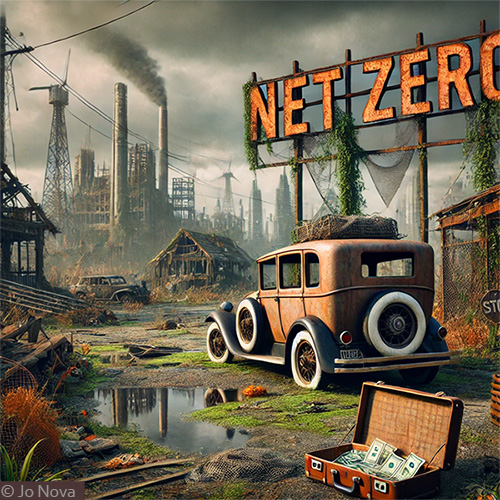
UK opposition leader dumps “impossible” climate plan: Net Zero fantasy will bankrupt us!

...

By Jo Nova

Hallelujah — Kemi Badenoch has thrown Net Zero under a bus

UK FlagFinally, 8 weeks after Donald Trump was sworn in, the UK conservative party says what skeptics and many conservatives have been saying for ten or twenty years. Perhaps jolted into action by the shocking polls that showed — from out of nowhere, the Reform Party was polling just as well, or even better than the 200 year old Conservative party.

Conservatives supporting global weather witchcraft and UN fantasies are facing an existential threat.

The GWPF is delighted, of course, having warned about the dire Net Zero outcomes for 15 years. And Kemi Badenoch blasts the old policies, calling them “fantasy politics” that cost the Earth, drive up the cost of electricity, while “not really” protecting the environment. She’s realized no one had a detailed plan, and if they did, sensationally, she says they wouldn’t talk about it because it would reveal “just how catastrophic the actual costs will be for families, for businesses, and for our economy.” In a blockbuster moment, she even admits the futility of it all saying that the UK has done more on carbon emissions that anyone in the developed world, but they were  only responsible for 1% of the worlds emissions, and the world isn’t following them.

Her three big reasons are that the plans have no details, the targets are unrealistic, and they’re far too dependent on China for everything, which is 60% powered by coal. Finally, a Western Leader admitting that “leading the way” on climate change is pointless if no one else is following you.

This marks a major change in the Tory party plan — and even though the UK election is not for another four years, it will finally allow the conservatives to point out all the silly flaws in the government climate plan, instead of just promising to be a different shade of crazy themselves.

Kemi Badenoch’s speech: (some excerpts)  

Net zero by 2050 “is fantasy politics. Built on nothing. Promising the earth. And costing it too.”

Today, I’m talking about one of the biggest ways we are destroying our children’s inheritance.

Let’s start by telling the truth on energy and net zero. Every single thing we do in our daily lives is dependent on cheap, abundant energy.

When energy became cheap and abundant, living standards began to rise, health and life expectancy grew. Cheap, abundant energy is the foundation of civilisation as we know it today. We mess with it at our peril. And that’s exactly what we’ve been doing for twenty years. And it’s now starting to cause real pain for everyday people and businesses. The cost of electricity – far too high – much higher than nearby and comparative countries with the real possibility of it going even higher with environmental levies.

It’s fantasy politics. Built on nothing. Promising the earth. And costing it too.

We’re falling between two stools – too high costs and too little progress.

And why?

Because there’s never, ever been a detailed plan.

She lays out the pointless hypocrisy of it all — though doesn’t twist the knife — did Nick Clegg care at all about CO2?

I remember Nick Clegg dismissing the idea of building new nuclear because it would not come online until 2022. That decision has cost us billions.

Given that the conservatives bought many of the suicidal Net Zero ideas themselves, they have a lot of work to do to convince voters they really mean it:

…the political class has lost trust. The only way that we can regain it is to tell the unvarnished truth. Net zero by 2050 is impossible.

I don’t say that with pleasure. I want a better future and a better environment for our children. But we have to get real.

Anyone who has done any serious analysis knows it cannot be achieved without a significant drop in our living standards or worse, by bankrupting us.

Let me give you three truths at the heart of net zero.

First: the published plans are completely muddled.

It is true that the UK has made the greatest progress on carbon emissions in the developed world. Yet we are only responsible for 1% of global emissions.Even if we hit absolute zero, we will not have net zero around the world, if other countries are not following us. And they are not. They certainly will not if they see us bankrupting ourselves to get there.

Our success at reducing emissions has also come at a significant cost: the highest electricity bills in the developed world.

…we must effectively build two systems of electricity generation – one based on renewables and one not. One for when the sun shines and the wind blows. And one for when they don’t.

The real reason no one in their government is talking about a proper overall plan is that they know it would reveal just how catastrophic the actual costs will be for families, for businesses, and for our economy. Those costs include families being forced to replace perfectly functioning cars, boilers, and cookers with more expensive, less reliable versions of the same thing.

[The Second truth]: even where there is a plan, we’re behind.

By 2040, the Committee on Climate Change says more than half of UK homes need to rip out their boilers and replace them with a heat pump.There is no way we can do this quickly enough on that timescale.17 million houses need to be fitted with an expensive heat pump in just 15 years. How many houses have one now? Fewer than 300,000 – because heat pumps run on a lot of expensive electricity and it turns out, many people just don’t like them.

But let’s look at the good statistics. Last year saw the highest number of heat pumps ever installed in the UK, 50,000. That’s the best we’ve ever done. So, at that rate it’ll take 340 years not 15 to get to the target.

The third truth.We are massively exposing ourselves to countries who don’t share our values.

Take solar panels – the good news is that costs have dropped in the last decade.

But here’s the less good news. Ten years ago, we were heavily dependent on China for all of the key components. Today we’re even more dependent.

….60% of their supply comes from coal fired power stations.

Those three truths are why I call myself a net zero sceptic. Muddled plans, unrealistic targets and deadlines, over-reliance on China.

We have got to start acknowledging what is in plain sight.

Nigel Farage blasted back with — “Fooling No One”

…Reform UK leader Mr Farage, whose party had already pledged to ditch the target, accused her of desperation. The Clacton MP said: “Kemi is fooling no one. Let’s not forget that she happily waved through Conservative government legislation on this, including enshrining net zero by 2050 into law. “If she truly believed this would bankrupt the country, why didn’t she voice her opposition sooner? This is a desperate policy from a leader and party floundering in the polls in an attempt to hitch themselves onto Reform’s momentum.

The Conservatives have a lot of work to do to earn trust after years of sabotaging their own country.

0 out of 10 based on 0 rating

via JoNova

https://ift.tt/GqV2ifc

March 18, 2025 at 03:28PM

Tropical Timings: Precessions of the Earth and Moon

Axial precession
‘Small cyclical variations in the shape of Earth’s orbit, its wobble and the angle its axis is tilted play key roles in influencing Earth’s climate over timespans of tens of thousands to hundreds of thousands of years’ says NASA.
– – –
In this post we analyse the periods of axial and perihelion (or apsidal) precessions, giving a perhaps surprising result.

Axial precession is described as ‘precession of the rotational axis’ and is often given the period of 25771.5 years. We take this as tropical years (TY) with an equivalent of 25770.5 sidereal years (SY), SY being one less than TY by definition of this precession cycle itself.

The three orbital precessions occur in periods when –
Axial: Tropical Years (TY) less Sidereal Years (SY) = 1
Perihelion: SY less Anomalistic Years (AY) = 1
Combined: TY less AY = 1

(Note: to skip the analysis, scroll down to Results.)

Earth analysis
Referencing our Jupiter-Earth-Mercury post, we showed there a repeating cycle of triple conjunctions, occurring 19 times every 1079 (83*13) tropical years, which we use here.

To get a whole number of years for axial precession, multiply by 2:
25771.5*2 = 51543 = 83*621.
To extend that to multiples of 1079 TY, multiply by 13:
13*83*621 = 670059 TY

Having multiplied by 2*13 = 26, it follows that the number of sidereal years = 670059 – 26 = 670033 (= 26 axial precession cycles).

To find the equivalent in anomalistic years:
670059 * (TY/AY) = 670027 AY
Calculation check:
(670059/670027 * TY(365.24219 days) = 365.2596337 days.
The link gives 365.25964 days for one AY. Check passed.

Results
These long periods may seem hard to relate to, but the interest for now is in the differences between the numbers. Given that a difference of 1 between two types of year is going to mean one orbital precession cycle we get:
670059 – 670033 = 26 axial precessions
670033 – 670027 = 6 perihelion precessions
670059 – 670027 = 32 combined precessions (26+6)
The period of each in tropical years is:
670059/26 = 25771.5 TY
670059/6 = 111676.5 TY
670059/32 = 20939.34375 TY

Confirming 6 perihelion precessions:
670033 / 6 = 111672.1667 SY
670027 / 6 = 111671.1667 AY
Difference = 1 between sidereal and anomalistic years.

Comparing the number of perihelion and axial precessions, the ratio in the full period is exactly 6:26 (32 combined) which reduces to 3:13 (16 combined). That’s the key finding in this post.

This is all based on accepted data for the year periods, plus the ephemeris used in Arnholm’s solar simulator for the 1079 TY cycle. We could call the full period the Great Precession Cycle (GPC), which also applies to the Moon judging by the data.

Lunar analysis:
The graphic on the right contains the full descriptions of the lunar periods shown below (click on image to enlarge).

670059 TY – the Great Precession Cycle (GPC – see above)
75734 LAC (GPC/LAC = 8.847532 TY)
35999 LNC (GPC/LNC = 18.613267 TY)
594325 FMC (GPC-LAC) = 1.1274286 TY)
706058 DY (GPC+LNC) = 0.9490141 TY)
111733 de Rop cycles (670059/dRC = 5.996966 TY)

More about what we mean by the de Rop cycle can be found in this Talkshop post, which has a link to astronomer Willy de Rop’s own short paper (2 pages including 3 diagrams).

Note – these results are as expected:
FMC/LAC is 1 less than TY/LAC (anomalistic).
DY/LNC is 1 more than TY/LNC (nodal, aka draconic).
——–
Based on these results we’ll extend the analysis to other aspect of Earth’s orbital parameters using ‘tropical timings’, and try to put forward something new in the next post.
– – –
Image: Precession of Earth’s axis [credit: NASA, Mysid @ Wikipedia]
******************
Footnotes
~~~~~~~~~
Some typical definitions of the three types of year:
TROPICAL YEAR: The time it takes for the Sun to return to the same position along the ecliptic, as viewed from the Earth.

SIDEREAL YEAR: The time required for one complete revolution of the earth about the sun, relative to the fixed stars.

ANOMALISTIC YEAR: The time of the earth’s revolution from perihelion to perihelion again.

(There are other wordings to define these periods, but no need to study them all as they amount to the same thing.)

***************

via Tallbloke’s Talkshop

https://ift.tt/8EvI43h

March 18, 2025 at 02:20PM