BMW Suspends Production Of Mini Models In Oxford…”Lower Than Expected Demand”

The original plan was BMW would start production of two all-electric Mini models in Oxford beginning 2026 and then to  produce only electric vehicles by 2030.

Drivers are not enthused about electric cars . Image generated by Grok AI.

But the latest report is that BMW is stopping production of the E-mini models at its Oxford plant “due to insufficient demand,” reports Blackout News here, citing automobilwoche: 24 February 2025. “BMW cites uncertainties in the automotive industry and lower than expected demand for electric vehicles as the main reasons for the stop.”

The announcement further underscores that the enthusiasm for electric vehicles remains sluggish as Europe labors ahead with decarbonization efforts.

Also global uncertainty has contributed to the sluggish BMW e-car demand as countries move to impose tariffs amid trade disputes.

“The Mini plant in Oxford will continue to produce models with combustion engines for the time being. However, BMW emphasizes that the plant will continue to play a central role for the Mini brand in the future, Blackout News adds.

Donate – choose an amount

via NoTricksZone

https://ift.tt/tfa1wF6

March 11, 2025 at 02:45PM

Woodland Trust Worried About Early Springs

By Paul Homewood


You may have heard a cringeworthy advert on the radio recently from the Woodland Trust.

It features a woman putting on a soppy voice droning on about the “climate crisis”. She is advertising this campaign:


 image

The climate crisis is having a profound impact on nature. It’s urgent that we understand how wildlife is coping with shifting seasons, warmer temperatures and unpredictable weather patterns. 

Climate change has already accelerated spring’s arrival by an average of 8.4 days compared to the early 1900s. Now, we need you to help us find out whether the signs of spring are changing too.

Let us know whether you’ve spotted any of spring’s three vital signs – frogspawn, a singing song thrush or flowering blackthorn. Your records are crucial in helping us understand current threats and how climate change is affecting the health of nature.

So don’t wait – scroll down to submit your records before 31 March 2025 and play your part in nature’s recovery. 

https://www.woodlandtrust.org.uk/visiting-woods/things-to-do/natures-calendar/springs-vital-signs/

Is that the extent of the crisis then? Spring coming 8 days earlier than a century ago?

In other words, we now typically get the sort of temperatures on 1st March that our great grandfathers had on the 8th March!

Or to put it another way – Oxford now gets the same temperatures in spring that London had a century ago.

And this is causing a “profound impact” on nature? Seriously?

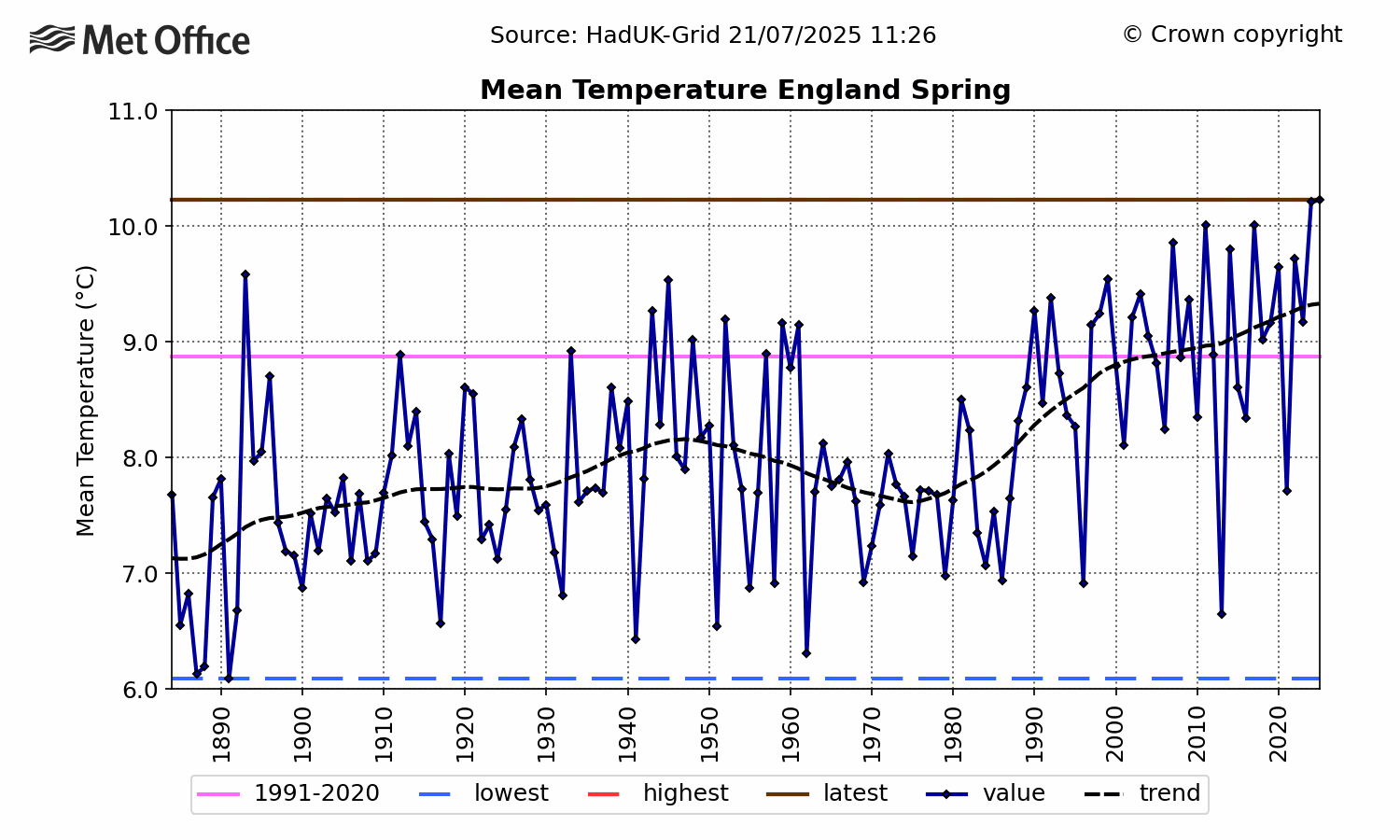
In any event, as we have always known, nature does not do averages. Spring temperatures have swung up and down by as much as three degrees from year to year. Yet nature seems to have managed perfectly fine.

Indeed it is arguable that spring weather is much more predictable now than in earlier decades:


But the facts don’t fit with the Woodland Trust’s climate agenda.

via NOT A LOT OF PEOPLE KNOW THAT

https://ift.tt/iQVgL40

March 11, 2025 at 12:17PM

Should California Ship Water to the Pacific Northwest?

From the Cliff Mass Weather Blog

Cliff Mass

President Trump has suggested that water be transported from the Pacific Northwest to California to help fight fires and for agricultural use.

This idea was strongly criticized by many, including the authoritative Seattle Times ClimateLab, which is supported by disinterested, civic-minded advocacy groups and individuals (see below).

But perhaps, examining the weather situation this year, President Trump’s error was not in the general idea, but in the direction of water flow.  

Specifically, California should consider sending water to the Pacific Northwest, particularly this year.

To illustrate, below is the latest 180-hour forecast precipitation accumulation over the western U.S.  

The mountains of northern California and the Sierra Nevada will receive at least twice what will fall on the Cascades and Olympics. 

Los Angeles, yes, LA… will get about the same precipitation amount as Seattle.

Do you want to be shocked?    If so, look at the forecast precipitation during the next week at Blue Canyon Airport on the western slope of the Sierra Nevada (just northwest of Lake Tahoe).  The high-resolution US GFS model is going for about 50 inches of snow!

This pattern has happened again and against this winter.   As a result, the reservoirs in California are above average, with some close to being full, EVEN BEFORE the massive CA snowpack starts to melt.

Contrast California’s wet bounty with the current situation of the Yakima drainage, which is currently well below normal (see below).

Now that I have convinced many of you of the necessity of shipping water north from sodden northern California to the parched Pacific Northwest, is this idea practical?

It may be! 

Far easier than the famous water works of southern California, in which water from the Owens Valley was shipped hundreds of miles to LA across formidable terrain.

Using Google Maps,  it only took me seconds to find a nice route from the wet northern CA mountains to the dry domain of Yakima and eastern WA.  I am sure many of you could do better.

Mostly level or downhill…and I have hardly optimized the route!

In short, out-of-the-box thinking is needed to allow the West Coast to deal with the frequent north-south imbalances in precipitation.  Northern CA water is not fated to only go south.  In many ways, going north is more practical.


Discover more from Watts Up With That?

Subscribe to get the latest posts sent to your email.

via Watts Up With That?

https://ift.tt/arqQs4m

March 11, 2025 at 12:07PM

Huntsham DCNN 8893 – Another unenclosed site by the vegetable plot with a neighbouring trend.

50..95310 -3.43853 Met Office CIMO assessed Class 5 Installed 1/1/1964 Temperature readings from 16/3/2006

Although shown as an original installation date of 1964, the Huntsham site has only been reporting temperature readings since 16/3/2006. It is a manually reporting station that obviously has a diligent observer who does not appear to have missed a single day’s observations for a long time. Despite this diligence I find it remarkably hard to accept that the Met Office feels data from such Class 5 sites is eligible for entry into the national historic temperature record.

It is clear from the headline image that this screen is very close to a large building, surrounded by hedging and large trees especially to the south east and alongside regularly changing ground cover. Google historic images confirm it was not in situ prior to 2006 confirming that it was a modern Met Office decision to add this site to an area already having an unusually high proportion of English weather stations. Devon has almost 10% of all England mainland official weather stations despite representing less than 5% of the land area. The Met office makes a big issue regarding Devon in one of the “factsheets” it produces.

Obviously there are no problems at all with lots of weather stations everywhere, however, the distribution of those whose data is used for climate recording purposes is important – too many in one area (be they warmer or cooler recording) can slew both regional and national “averages”. Huntsham itself is actually in a cooler reporting part of Devon being inland at 237 metres amsl. Over the years 2021 to 2023 this site’s annual average was typically 1.5°C cooler than the coastal resort of Teignmouth. Conversely Huntsham is likely very much warmer than rural Shropshire in winter. {Talkshop note: Huntsham warming up to Teignmouth’s climate is hardly a terrifying prospect for the local residents!}

The issue for the Surface Stations project is whether or not this site is suitable for inclusion as a climate reporting station. To help judge that, below is an older and clearer image from September 2019.

This site is rightly classified as the lowest possible rating and really cannot be considered acceptable as representing the wider natural environment in any way. Its readings will no doubt accurately reflect its immediate vicinity but that area is completely unrepresentative of anywhere else. Readings will be very likely to record warmer than outside its own garden. However there are other issues than the recent installation of this site just 15 years ago. Another official manual climate reporting weather station has just been added to the list of Devon sites just 5.7km (3.5 miles) away at an only marginally better location. I have, at present, limited information, but a new CIMO assessed Class 4 screen at Stoodleigh with temperature readings being reported from 18/3/2024 is as indicated below.

Another trend seems to be developing – new/reopened screens in very close proximity to existing longer term ones. This Huntsham/Stoodleigh situation was also demonstrated at Wainfleet/Gibraltar Point and I will shortly be reviewing the new installation at North Somercotes, Church End which is a very short distance from the long term Donna Nook site. There may be sound meteorological reasons for these location choices, however, I am not finding this trend in cooler locations only warmer reporting ones. A site selection adjustment to averaging seems increasingly hard to dismiss.

via Tallbloke’s Talkshop

https://ift.tt/A2LHdTg

March 11, 2025 at 10:44AM