Will the President pursue grid reliability?

From CFACT

By David Wojick

In an Executive Order (EO) the President is asserting a new degree of control over what are called the independent federal agencies. There are about 100 of these some of which have tremendous regulatory authority.

Of particular interest is the Federal Energy Regulatory Commission (FERC). A central mission of FERC is maintaining the reliability of America’s electric power grid. This mission has clearly failed as the grid has become dangerously unreliable.

The question is whether the President will use his authority to lead FERC to restore reliability? There are several ways he might do this which are discussed briefly below.

But first there is a much deeper issue that needs to be kept in mind, which is the questionable Constitutional legitimacy of these agencies. What are they independent of? The Constitution only provides for three branches of Government — Congressional, Judicial and Executive.

Claims that these agencies are somehow independent of these branches suggest a murky fourth branch which may be unconstitutional. In fact Justice Scalia said they were unconstitutional and we now have a conservative Supreme Court. So anyone thinking of suing to stop the President should be careful what they wish for.

Getting back to FERC the question is whether the President will get them to take the steps needed to restore grid reliability. I have previously written about two approaches which might work.

The first is very simple in that FERC merely declares a moratorium on connecting to the grid those large generators that are unpredictably intermittent by design. The increasing fraction of grid connected generators that are systemically intermittent is a major factor in the loss of reliability. See my “A simple way to save the grid from more wind and solar” here: https://www.cfact.org/2025/02/17/a-simple-way-to-save-the-grid-from-more-wind-and-solar/

A more elaborate approach is to activate FERC’s reliability regulation system in new ways. This system has failed to date but maybe it can be made to work.

The central figure in the reliability system is the North American Electric Reliability Corporation (NERC) which consists of eight regional reliability entities covering the interconnected power regions of the US, Canada, and Mexico. Other key figures are the Independent System Operators and Regional Transmission Operators as well as the numerous electric utilities.

NERC is authorized under the Energy Policy Act of 2005 and FERC rules to maintain and improve the reliability of the grid by issuing standards and procedures that grid users must follow. Clearly NERC has failed its statutory mission as grid reliability has declined to dangerous levels.

I analyzed NERC some time ago and while they have around 100 reliability standards and procedures there is nothing whatever on preventing intermittency from degrading reliability. Such standards are desperately needed to restore reliability.

See my “Constraining Renewables is a National Need” here:

http://www.cfact.org/wp-content/uploads/2023/02/WOJICKREPORT.pdf

So one approach is to simply stop connecting new intermittent generators to the grid. Another which might be more refined and could also apply to existing generators is for NERC to develop new standards to constrain the impact of intermittency.

Both of these approaches to restoring reliability require orders from FERC which the President might motivate under the new Executive Order. The present Chair of FERC which the President named to that position on Day One has been very vocal regarding the dangerous decline in grid reliability. Working together they just might put America on the path to restored reliability.

If the President wants to fix the grid FERC is the place to start. Stay tuned to CFACT.


Discover more from Watts Up With That?

Subscribe to get the latest posts sent to your email.

via Watts Up With That?

https://ift.tt/F2IKwni

February 27, 2025 at 08:01PM

Shocking Heatwave In India

“February heat at 38°C is shocking. It’s a clear sign we need to act now to protect our planet and its people. Let’s push for sustainable solutions together!” (10) Peter Dynes on X: “Heat waves are hitting India early, with … Continue reading →

via Real Climate Science

https://ift.tt/ldS19tA

February 27, 2025 at 07:34PM

Climate Council: If The World Follows Trump’s Climate Lead, Australia will Have More Beach Weather

Essay by Eric Worrall

They actually said “Extreme Heat”, but what else do you do on a hot day?

From drill to grill: Continued fossil fuel use puts us all in the hot seat

The Climate Council is warning that Australia’s biggest cities could face dangerously hot temperatures, unless action is taken to slow down climate change. The Council has released a ‘heat map’ which also shows that continuing to cut climate pollution can safeguard Australians from the worst impacts of soaring heat.

“The inflation crisis was caused by massive overspending and escalating energy prices. And that is why today I will also declare a national energy emergency. We will drill, baby, drill.” (Applause)

US President Donald Trump, speaking in January, promised to withdraw from the Paris accord and exploit its large oil and gas reserves.

The Climate Council says if the world follows that lead and fails to cut back on burning fossil fuels, Australia will suffer from extreme heat for more than half of every year.

There are already signs of increasing heat, with last month recorded as the world’s hottest January on record.

Samantha Burgess is the deputy director of the Copernicus Climate Change Service. She says the trend is set to continue.

“We know that the extreme events, which is where humans are most impacted, humans, society and ecosystems are most impacted by extreme events. They happen more frequently and with more intensity the warmer our climate is. So at the moment we’re at 1.3 degrees (Celsius) of warming and in 2024 we’ve seen record losses from extreme events, from hurricanes, from wildfires, from storms. These are projected to become more frequent and more intense with a warmer world.”

…

Read more: https://www.sbs.com.au/news/podcast-episode/from-drill-to-grill-continued-fossil-fuel-use-puts-us-all-in-the-hot-seat/rauyv5ssi

Do try to keep up Climate Council, the CSIRO tells us we have already passed the 1.5C threshold you warned us would bring disaster.

So far the only disaster I’ve experienced is I’ve lost control of the algae in my pool, though I’m slowly winning the battle, with the aid of lots of chemicals.

The beer fridge still works – so not all is lost.

Obviously if Australia was to experience more hot weather, it would only be a disaster if nobody could afford air conditioning. Sadly a number of Australians are already in this situation thanks to soaring energy prices.

If only there was a way to rapidly bring down those energy prices, so all Australians could shield themselves from the heat with affordable air conditioning.


Discover more from Watts Up With That?

Subscribe to get the latest posts sent to your email.

via Watts Up With That?

https://ift.tt/jbMEHzR

February 27, 2025 at 04:02PM

Shh, don’t tell the children sea levels were higher

Shh, don’t tell the children sea levels were higher

By Jo Nova

People with a good education are harder to fool, which is why the curriculum buries the best stuff until it disappears under a kiloton of culture, engagement and sustainability blah. Then the media (with US government Blob funding) repeats the hypnotic trance line “seas are rising due to climate change” until anyone who was accidentally taught real science, forgets it.

How many children (how many adults) think that sea levels have been the same for a million years?  The travesty of 12 years of education is that 99% of people know nothing about 99% of history, and even less about prehistory. Every one of these defenseless souls is so easily fooled into panic attacks about  seas rising a millimeter a year. “Unprecedented” they say! Don’t use the hair-dryer!

Willie Soon has some fun in his time machine zipping through ancient Greece and Roman history, where ports were built 6 crazy kilometers from the sea…


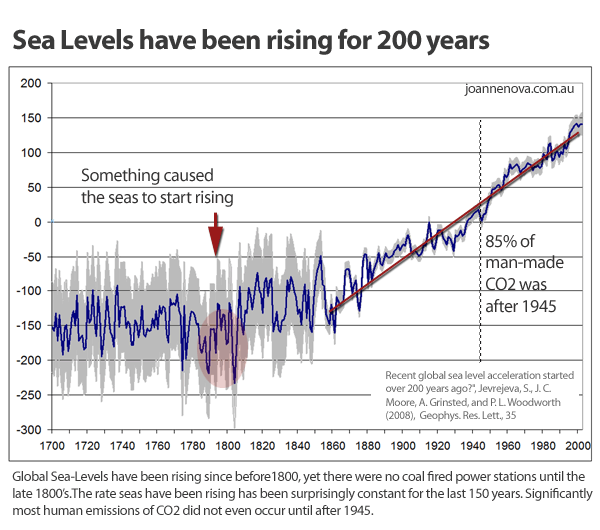
As Willie mentioned, it’s awkward that the rise started 100 years before cars, and coal power plants existed.

And after two world wars, 1.5 billion cars and 35 million planes a year, the rate of sea level rise is pretty much the same as it was in 1860 or 1870. It’s like we are irrelevant?

Sea Level

[Graphed by Joanne Nova based on data from Jevrejura et al located at this site PMSML]

Australian sea levels have been falling for 7000 years. Many of a thousand Pacific Islands appeared out of the sea in the last 5,000 years. Oysters used to live in the streets of Taiwan 7,000 years ago. And 50 million years ago New Zealand was as big as India, then the ocean swallowed Zealandia.

According to 1000 tide gauges, spread all over the globe, sea levels are rising slowly at around 1 sole mm a year. And a nerd-level intense study of 60 beaches in Northern Europe showed a similar rise. By a strange coincidence the Topex/Poseidon satellite sea-level data set also showed similar tiny rates of sea level change in the 1990s — after that, they tortured the data to fit climate models. (We hear they calibrated it to one sinking gauge in Hong Kong).

Other posts on Sea Levels


10 out of 10 based on 1 rating

via JoNova

https://ift.tt/GwPyMhK

February 27, 2025 at 02:08PM