No News is Good News on Polar Bear Day: Celebrate With 35% Off Polar Bear Evolution

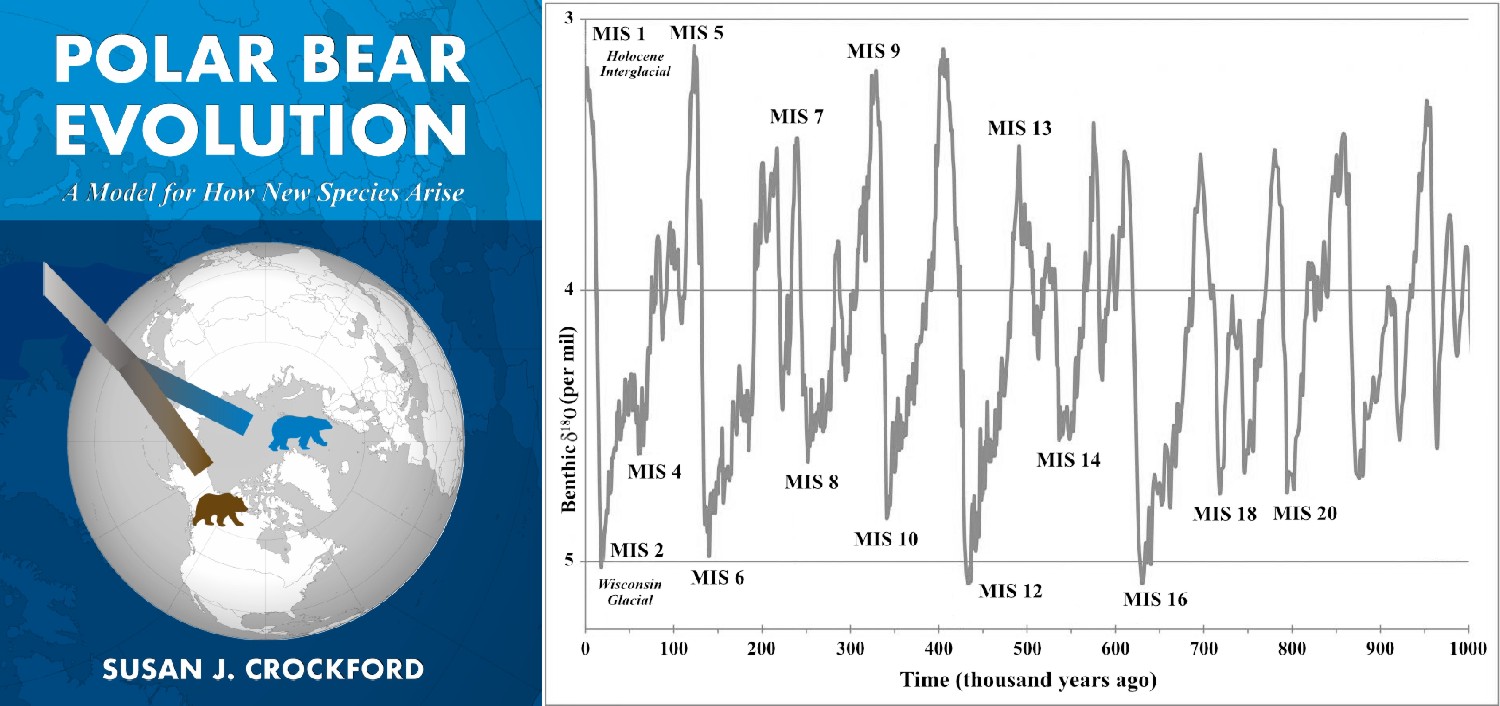
In honour of International Polar Bear Day coming up on Thursday February 27, I’ve discounted the price of my Polar Bear Evolution book by 40% for the next month in order to encourage evolutionary thinking about polar bears (in all markets: see links at the end of this post). Instead of asking whether polar bears will survive a bit of warming over the next few decades, ask yourself how they survived more than 100,000 years of unimaginable changes in Arctic climate (both much warmer and colder) before now?
No News is Good News

Aside from the usual rhetoric we’ve been accustomed to hearing from polar bear specialists—Hudson Bay bears on the verge of extinction! A new model predicts catastrophe for polar bears due to climate change! Vanishing sea ice threatens polar bear food chain! Polar bears suffering painful ice balls on their paws due to climate change!—nothing much new has happened since my State of the Polar Bear Report last year.

Conveniently, no new subpopulation survey results have been published, so polar bear specialists would still have you believe there have been no changes in global population numbers over the last 10 years. No reports of starving bears (or their new-age equivalent, wandering bears); no invasions of small Arctic towns or fatal attacks on people, both of which have been routinely blamed on lack of sea ice and so we’ve been told to expect increases due to declines in summer sea ice.

Presumably, then, polar bears are just getting on with their lives, dealing with small-scale changes in sea ice as they did during earlier parts of the Holocene and other warm interglacial periods (some lasting over 10,000 years) over the entire 100,000 years or so of their existence.

Getting on with life in East Greenland

Which brings me to this incident in East Greenland, in June 2024: more than 68 polar bears gathered to feed at a whale carcass embedded in the sea ice, including a sow with three cubs of the year, and were photographed by rich eco-tourists on a cruise (lots more photos than these two are available at the link).

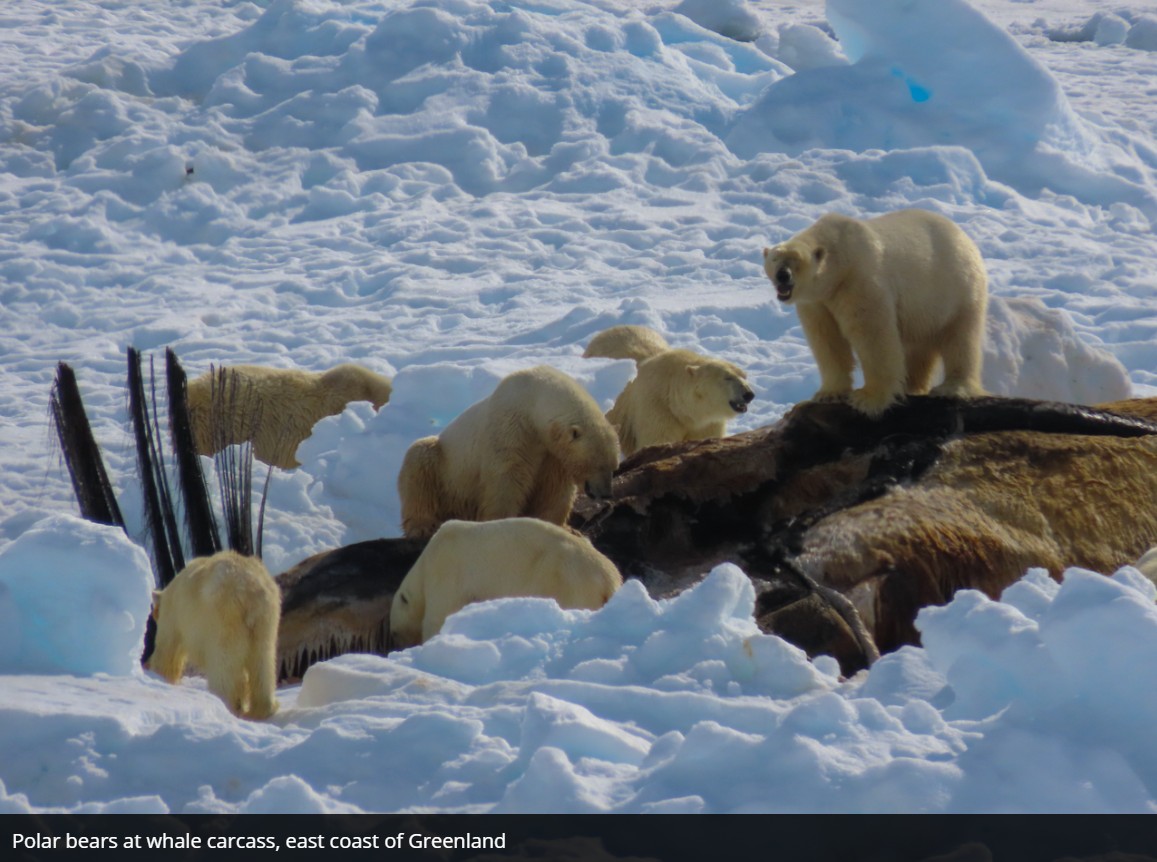
As the photos show, the sow with cubs appears to be in good condition but some others are quite thin. That’s usual for this time of year: most polar bears are in the worst shape of the year in late winter, which is why the boom of baby seals in spring is so important to their survival. Some young bears, who are not yet very good hunters and aren’t big enough to compete for scarce winter resources, routinely die of starvation: that the life of polar bears.1

See my video from 2018 on starving polar bears.

Apparently, the sea ice was so thick (up to 11m) off East Greenland in June 2024 that the ice-breaker the ecotourists were on couldn’t make it through to the little village in Scoresby Sound (Ittoqqortoormiit) the group had planned to visit:
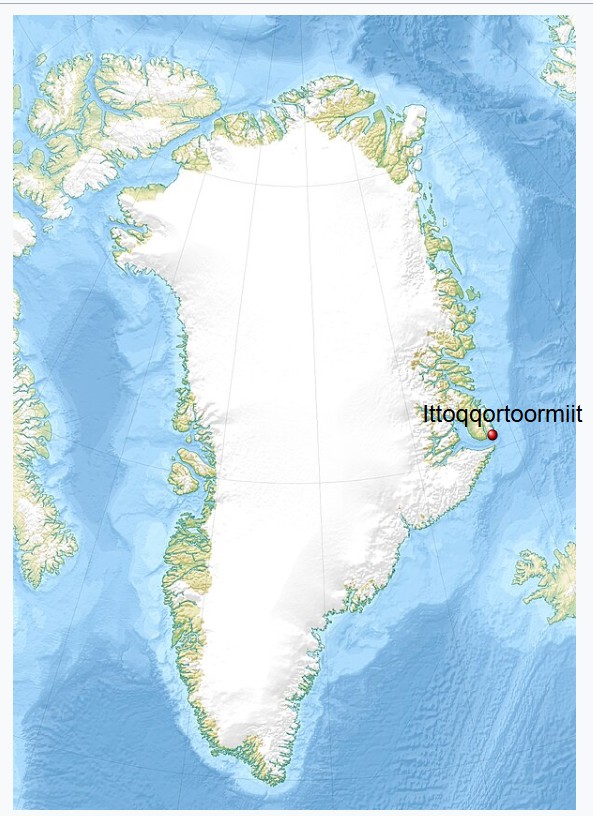
Sea ice conditions in East Greenland at mid-June 2024 don’t look so bad but apparently the ice was far thicker than expected:

Polar Bear Evolution on Sale!

You can quote me: “Modern polar bears are essentially pre-adapted to survive extended periods with ice-free summers because they lived through at least two of these events since they became a unique species. One of these, the Eemian, lasted at least 10 thousand years.” [Susan Crockford, 11 June 2023, author of Polar Bear Evolution: A Model for How New Species Arise]

This comprehensive look at polar bear evolution provides critical insight into why we should expect Ursus maritimus to survive in a warmer world. Polar bear physiology and behavior have been fine-tuned by natural selection to adapt the species to the highly dynamic Arctic environment of the late Pleistocene, including interglacial periods when sea ice was much scarcer than it is today and lasted thousands of years at a time.

Highlights

  • We have known for a long time that polar bears evolved from a brown bear ancestor because of the close similarities between fossil bones of ancient bears and biological features of living animals.
  • Despite more than a dozen genetic studies and several new fossil finds, before now no one has been able to reconcile all the evidence regarding when and where this speciation event happened.
  • This book argues that polar bears almost certainly evolved off Ireland about 140 thousand years ago, during a very cold ice age.
  • Uniquely, this account also provides an explanation for how this happened, using a testable theory that explains exactly how a brown bear could have transformed into a polar bear within a few generations.
  • The same theory also explains how virtually all other species came to be, including domestic dogs, flightless birds, and dwarf island species.
  • More than the complete story of polar bear origins, this book is a big-picture account of how evolution works for most organisms.
  • Given their evolutionary history, polar bears must be pre-adapted to extended periods of ice-free summers, since we know they have survived at least two of these events, the first of which lasted at least 10 thousand years.

Polar Bear Evolution: A Model for How New Species Arise is available via Amazon marketplaces worldwide, in print and ebook formats. Read a sample by clicking on the Kindle or paperback icons.

USA https://www.amazon.com/dp/1778038328

UK https://www.amazon.co.uk/dp/1778038328

Canada https://www.amazon.ca/dp/1778038328

Australia https://www.amazon.com.au/dp/1778038328

Germany https://www.amazon.de/dp/1778038328

via polarbearscience

https://ift.tt/S7YCvJV

February 26, 2025 at 11:56AM

Reasons Why Regulating CO2 Emissions Needs to be Reconsidered

Today, the Washington Post is reporting the EPA Administrator is considering recommending to the White House that the EPA’s 2009 CO2 Endangerment Finding be rescinded. Let’s look at a few of the reasons why this might be a good thing to consider.

The Science

The science of human-caused climate change is much more uncertain that you have been led to believe. The globally-averaged surface temperature of Earth seems to have warmed by 1 deg. C or so in the last century. The magnitude of the warming remains uncertain with a 30% range in different thermometer-based datasets, and considerably weaker warming in global “reanalysis” datasets using all available data types. But whatever the level of warming, it might well be mostly human-caused.

But we don’t really know.

As I keep pointing out, the global energy imbalance caused by increasing human-caused CO2 emissions (yes, I believe we are the cause) is smaller than the accuracy with which we know natural energy flows in the climate system. This means recent warming could be mostly natural and we would never know it.

I’m not claiming that is the case, only that there are uncertainties in climate science that are seldom if ever discussed. The climate models that are the basis for future projections of climate change are adjusted (fudged?) so that increasing CO2 is the only cause of warming. The models themselves do not have all of the necessary physics (mostly due to cloud process uncertainties) to determine whether our climate system was in a state of equilibrium before CO2 was increasing. (And, no, I don’t believe the warming caused the oceans to outgas more CO2 — that effect is very small compared to the size of the human source).

As most readers here are aware, for many years I’ve been saying the science of “climate change” has been corrupted by big government science budgets, ideological worldview biases, and group-think. Even my career has depended upon Congress being convinced the issue is worthy of big budgets.

It is almost impossible for new science to be published in the peer-reviewed literature that in any way runs counter to the current narrative which states that humans are causing a “climate crisis” from our CO2 emissions, a natural consequence of fossil fuel burning. That “peer review” is now in the hands of climate scientists whose research careers depend upon continuing government funding. If the “problem” of global warming were to be much less than previously believed, funding for that research could dry up.

The most alarmist science papers are the ones that get all of the press, which then get exaggerated and misrepresented by the news media. As a result, the public has a very skewed perception of what scientists really know.

As Roger Pielke, Jr. has been pointing out for many years, even the IPCC’s official reports do not claim that our greenhouse gas emissions have caused changes in severe weather. Every severe weather event in the news is now dutifully tied in some inferential way to human causation, but with public opinion of mainstream news outlets at an all-time low, fewer and fewer people take those news reports seriously. Severe weather has always existed, and always will. Storm damages have increased only because of increasing infrastructure and everyone wanting to live on the coast.

And about the only clear long-term change in severe weather I’m aware of is a 50% decline in strong to violent tornadoes since the 1950s.

But you would never know of any good climate news if your main source of information is Al Gore’s books, your favorite environmental think tank (that you contribute to so you can get their yearly calendar), or the mainstream media.

Costs vs. Benefits

If there was no cost to replacing fossil fuels with renewable sources of energy, I might be a little more supportive of regulations which choose winners and losers, rather than letting the marketplace decide. But everything humans do requires energy, and so human flourishing depends upon abundant and affordable energy. We in the developed world might have excess wealth to spend on pricey new forms of energy (although our rapidly increasing national debt argues we don’t have excess wealth to squander), but most of the world’s poor continue to struggle to pay for energy we have in relative abundance… if they even have access to it at all.

The 2009 Endangerment Finding

The Supreme Court has ruled that CO2 falls under the EPA’s Clean Air Act, and so EPA would need to regulate it if it was considered a threat to human health and welfare.

But this “threat to human health and welfare” business cuts both ways.

For example, I could argue that most human deaths are premature, and the causes of those premature deaths are dominated by illnesses caused by what we eat (or don’t eat). The incidence of obesity and related illnesses continues to rise. So, given the threat of food to human and welfare, why not just outlaw food? Food is a threat to human health and welfare, too.

Clearly we don’t do that because food is necessary for life. But so is CO2. CO2 is required for photosynthesis, which in turn is required for the food chain on land and in the oceans. NASA-based satellite measurements since the 1980s have documented global greening from increasing CO2. It has been estimated global agricultural productivity has increased by trillions of dollars from crops growing better (with more drought resistance) in a CO2-enriched atmosphere.

I’ve read the technical support document for the 2009 EF. It is full of gloom and doom. Any benefits to more CO2 are downplayed while costs are trumpeted. Its authorship appears to have been heavily influenced by environmental activists, most of whom have their own agendas and financial incentives. Much of the science in it now sounds more like Al Gore’s original alarmist book Earth In The Balance (which referenced me, but couldn’t get my science contributions right) than a balanced assessment of the science of climate change.

Fifteen years hence, we now know much more. None of the scary scenarios originally predicted have actually come to pass, or at a minimum they were greatly exaggerated. Ten-year deadlines to “do something” about the “climate crisis” have come and gone… a few times. Even the IPCC (which only allows alarmist-leaning scientists to participate) has admitted it is unlikely we will experience significant changes in severe weather by the year 2100 that can be tied to increasing CO2.

It makes sense to now reconsider the Endangerment Finding. Let the market, including consumer preferences, decide how much and what kinds of energy we use.

via Roy Spencer, PhD.

https://ift.tt/W9zZcX6

February 26, 2025 at 10:35AM

Thursday

0 out of 10 based on 0 rating

via JoNova

https://ift.tt/QjzPGlf

February 26, 2025 at 08:50AM

Nantwich, Reaseheath Hall DCNN 7343 – Yet another appallingly bad site.

53.08624 -2.52604 Met Office CIMO Assessed Class 5S Archived manual temperature records from unspecified location from 1/9/1988. Above location of unspecified origin with automatic readings from 30/9/2011.

The UK Met Office makes numerous claims regarding the premium quality of its sites that are blatantly untrue. Here, for example, is their online declaration of quality

https://www.metoffice.gov.uk/weather/learn-about/how-forecasts-are-made/observations/weather-stations

So I shall consider these claims in relation to Nantwich.

Nantwich Reaseheath Hall weather station is located in an agricultural college. Although the Met Office shows an installation date of 1/1/1895 it was probably only as a rain gauge and there are no indications whatsoever of where it actually was – more on that later. Archived temperature readings from 1/9/1988 were taken manually – or rather not taken at all. The archive shows no fewer than 95 excuses for readings not being taken (often for several days at a time) in just 3 years. This led to the site being automated with readings from 30/9/2011. In view of the prior appalling recording I feel only those readings over the last 14 years have any potential of being reliable – if readings are only intermittent the likely accuracy of those that are taken is highly questionable.

Going back to those “strict criteria”, all Met Office sites are regularly inspected by directly employed and “qualified” Met Office staff. Do these staff not actually look at the surroundings? Simply stating a site meets CIMO class 5S is risible as there are NO CRITERIA to meet – taken directly from the CIMO guide:

Anywhere can meet that definition simply because it gives no requirements whatsoever. There are no qualifying criteria for Class 5 sites – a Stevenson screen by your back garden shed or even greenhouse will meet Class 5 as demonstrated at Copley.

The Nantwich site is surrounded by overgrown vegetation, is heavily shaded, meets no regulatory standards at all, is completely unrepresentative of anywhere but is frequently viewed by qualified staff who somehow consider the standard acceptable. And, of course, this site records the regional highest temperature with almost daily regularity.

When compiling these daily figures (that are also broadcast on X by the Met Office) does nobody at the Met Office stop and consider why this site appears as a regional high almost a hundred times a year? Is Nantwich really such a hot spot or is this almost derelict site heavily influenced by its unnatural surroundings? Is it even located over grass? A surprising number of official sites are not such as Pembrey Sands, Dawyk and others.

What of the site’s history? I can find nowhere in the records indicating site relocations but it most certainly has moved. Below is the 2010 image from Google Earth Pro in the days when it was manually (or not) reporting.

However. the previous 2005 imagery (and all prior ones) do not show a weather station. I have visually scoured the site but cannot find any indicators. Even going to the extreme lengths of viewing manual archives finds nothing to assist in identifying any site prior to 2010.

At least back then the site was free from overgrowth and likely quite a reasonable site – a pity it was not correctly maintained that way by its taxpayer funded custodians, both the college and the Met office.

In summary the Met Office is NOT remotely meeting the high exacting standards it claims. It operates literally hundreds of sites that are unacceptably poor whilst simultaneously pontificating about their superiority over other private weather sites. If Nantwich recorded a national record the Met Office would accept its validity – how bad is that?

via Tallbloke’s Talkshop

https://ift.tt/aZQO2Nz

February 26, 2025 at 08:48AM