China is so committed to Net Zero last year it started building 95 Gigawatts of coal plants

China is so committed to Net Zero last year it started building 95 Gigawatts of coal plants

By Jo Nova

Does this look like a country that cares about carbon emissions?

President Xi said he would “strictly control” coal power from 2021 to 2025, and he has strictly managed … a huge increase in coal power.

President Xi: — Reuters (April 2021) –“We will strictly limit the increase in coal consumption over the 14th five-year plan period (2021-2025) and phase it down in the 15th five-year plan period (2026-2030),” he said.

But nobody cares either:

SINGAPORE, Feb 13 (Reuters) – China started construction on 94.5 gigawatts of coal-fired power in 2024, the highest volume of new builds since 2015, hampering the country’s transition away from fossil fuels, researchers said…

The surge came despite a record-breaking increase in renewable capacity last year and could make it harder to connect clean power to the grid, said the report, published by CREA and the Global Energy Monitor (GEM) think tank.

China also promised its emissions will peak in 2030, right when a whole squadron of these new plants will have barely started operation. But it’s OK because the new coal plants are only a “back up for renewable power”:

China has retired more than 100 GW of obsolete coal-fired power in the last decade, according to its energy regulator, and new projects can only be built to provide back-up for renewable energy bases.

So each year China is started ten times as much coal power as it is retiring.

And all this coal power is needed despite the fact that President Xi  China added a phenomenal 356 GW of wind and solar capacity in 2024 alone.
Where was all that wind and solar power when China needed electricity? — it was providing an excuse for all the extra coal plants China wanted to build.

Spot the strict limit on coal development in China…

These graphs cover Comissioning, Contruction, “Permitted”, New Project” and Retired coal plants:

Chinas coal plant construction 2024 2025. Graph.

We can all see for ourselves just how much work China has put in to stop “Climate change”.


0 out of 10 based on 0 rating

via JoNova

https://ift.tt/UQX9qne

February 25, 2025 at 01:12PM

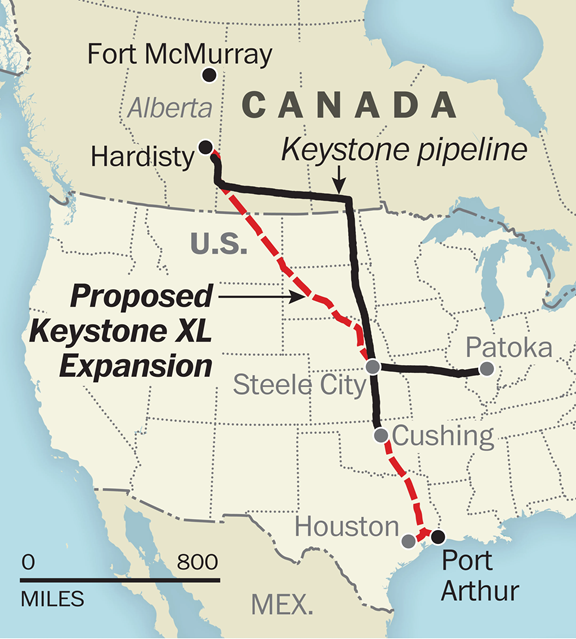
Keystone Pipeline Revival?

Background

In 2011, Congress forced then-President Barack Obama to make a decision on Keystone XL by including a provision in an unrelated tax bill that required him to decide the project’s fate within 60 days or determine it wasn’t in the national interest. After several years of turmoil, Obama finally rejected Keystone XL in 2015.

But when President Donald Trump took office in 2017, he invited parent company TC Energy to reapply for a new permit for Keystone XL. They did and were approved.

On the first day of Biden’s presidency, he issued an executive order canceling the Keystone XL pipeline — making good on his promise to the climate activists who helped get him elected, but inviting the lawsuit brought by 21 states who say they will be hurt economically by Biden’s decision.
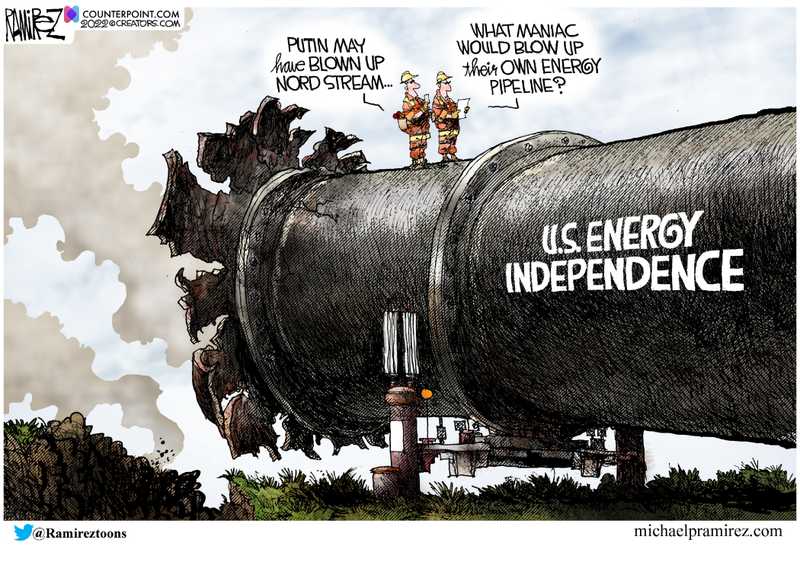
The Bigger Picture: Br’er Canada and the Tar Baby

Disney animation of “Br’er Rabbit and the Tar Baby” from Songs of the South, a collection of Uncle Remus American folk tales.

On Nov. 6, 2015, President Obama canceled the Keystone XL pipeline. Canada PM Trudeau, just installed and wanting not to offend, politely said he was “disappointed.” Here is the back story that you won’t hear in the media.
background
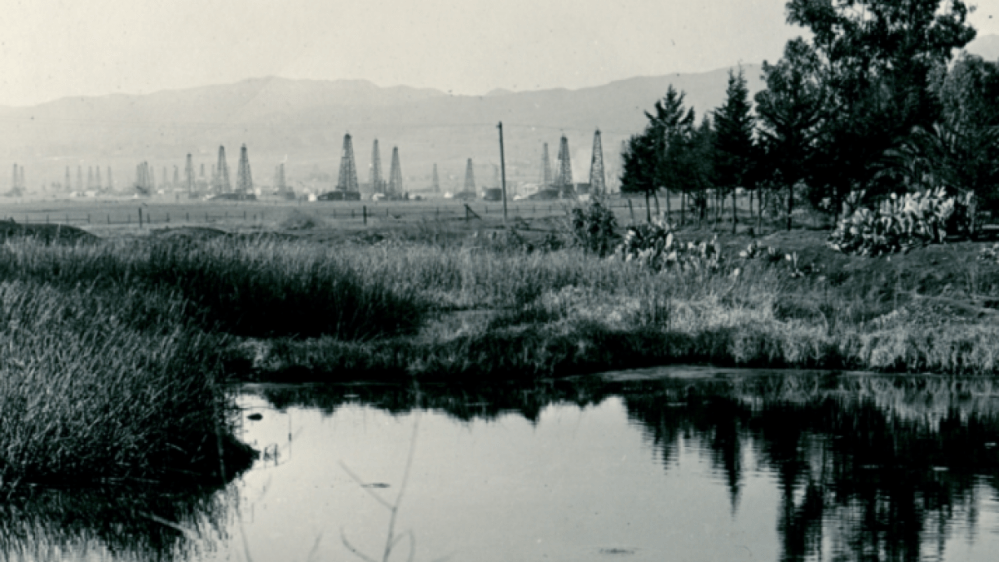
Americans should know all about tar pits. As the traditional folk tale suggests, there have been many tar pools across the US. A famous one is in Los Angeles: La Brea Tar Pit. Pictured above around 1910, it’s an oil spill produced by Nature.  Notice the many oil derricks nearby.

Tar pits are composed of heavy oil fractions called gilsonite, which seeped from the Earth as oil. In Hancock Park, crude oil seeps up along the 6th Street Fault from the Salt Lake Oil Field, which underlies much of the Fairfax District north of the park.[3] The oil reaches the surface and forms pools at several locations in the park, becoming asphalt as the lighter fractions of the petroleum biodegrade or evaporate.

This seepage has been happening for tens of thousands of years. From time to time, the asphalt would form a deposit thick enough to trap animals, and the surface would be covered with layers of water, dust, or leaves. Animals would wander in, become trapped, and eventually die. Predators would enter to eat the trapped animals and also become stuck.

https://en.wikipedia.org/wiki/La_Brea_Tar_Pits

La Brea Tar Pits and Museum today.

Canada’s Tar Baby

So, as you can see, tar pits are hazardous to animal and plant life. In Canada, we have a much greater problem bestowed on us: the Athabasca tar sands in Alberta. The oil deposits are much too large to put fences around it and open it as a museum, as was done in L.A. No, in Alberta the environmentally responsible thing is to clean up the mess Nature left behind.

The cleanup requires a massive effort, but costs can be offset by processing the tar into petroleum products and shipping them to markets who want to use them.  Using those products from syncrude oil liberates CO2 once trapped in bitumen, and in the air becomes available to plants who grow larger and faster from the increased concentration.  The Japanese would call this a “virtuous cycle.”

Br’er America is a neighbor with the facilities to help, but because of CO2 hysteria, the Obama and the Biden administrations were afraid of getting some tar on their hands. Actually a pipeline is the environmentally friendly way of transporting the crude oil, but now trains will be used instead of the pipeline.

The origin of the Alberta oil sands is a debated subject. Two primary theories are asserted:

1.) These sands are the remnants of a once vast reserve of crude oil that, over extremely long periods of time, has escaped or been destroyed microbiologically; thus leaving behind some bitumen and also converting the lighter crude oil into bitumen through bacterial processes.

2.) The bitumen evolved from highly organic cretaceous shales (similar to oil shale). Underground pressure forced the bitumen out of the kerogen rich shales where it soaked into existing silt grade sediments and sand bodies.

In the first theory, petroleum would be formed in the traditional manner, and then converted to bitumen by some additional process.  More description here.

Summary

So whether Nature created the tar mess by bacteria or by underground pressure, it’s up to us humans to clean it up. Canada is doing the heavy lifting, while the Dem administrations preferred posing as innocent bystanders.  Maybe a Keystone Pipeline Revival will be triggered by Trump to the benefit of energy dependent North Americans.

See Also:

Pipeline Facts vs. Fears

via Science Matters

https://ift.tt/o04vb19

February 25, 2025 at 12:53PM

LSE: “Why religion is fundamental to addressing climate change”

Essay by Eric Worrall

“… The climate crisis demands new ways of thinking … and religion is fundamental to achieving that. …”

Why religion is fundamental to addressing climate change

Published: February 25, 2025 12.25am AEDT
Hanane Benadi
Research Officer, Religion and Global Society, London School of Economics and Political Science

…

Building a global response to the climate crisis requires us to learn about the many ways people make sense of climate change and learn to live with its consequences. And for most of the world’s population, a purely scientific framing is unhelpful. 

…

With my team from the LSE Religion and Global Society research unit, I ran a climate change and religion workshop in Cairo with Muslim and Christian female and male faith leaders. Many of the 30 participants explained they felt frustrated that the climate science lens dominates. 

One member of a faith-based organisation told me during an interview after the workshop that: “We are often approached by western organisations and research institutions to collaborate. However, when we ask about the nature of these collaborations, it is often reduced to our logo and a couple of statements that tell people that they should care about climate change.” 

…

As Russian author Leo Tolstoy once wrote, “Science is meaningless because it has no answer to the only questions that matter to us: ‘What should we do and how shall we live?‘” The climate crisis demands new ways of thinking, new ways of perceiving reality, and religion is fundamental to achieving that.

…

Read more: https://theconversation.com/why-religion-is-fundamental-to-addressing-climate-change-248074

One thing I really like about the US Christians is their tolerance. Providing someone lives a decent life, there is room in the USA for everyone to find their own path.

But this advancing nexus between climate and religion in my opinion represents a descent back into Dark Ages thinking, in which oppressive religious figures dictated every aspect of people’s lives.

In a free society you can question religion, and you can question science. But when science becomes an apocalyptic end of world religion, questioning is heresy and blasphemy. And we’ve all seen what happens to people who question, when religious leaders assume the mantle of scientific authority.


Discover more from Watts Up With That?

Subscribe to get the latest posts sent to your email.

via Watts Up With That?

https://ift.tt/dJDunz6

February 25, 2025 at 12:03PM

Wednesday

0 out of 10 based on 0 rating

via JoNova

https://ift.tt/wS9D8Ay

February 25, 2025 at 08:28AM