BP (BP.L) will this week abandon plans to radically increase green energy generation and instead ramp up oil production, according to reports.
The British energy giant will ditch its plan to increase renewable generation 20-fold by 2030, Reuters reported.
The move is expected to be announced at an investor meeting on Wednesday and comes after Murray Auchincloss, the BP chief executive, promised a “fundamental reset” of the company’s strategy.
BP is expected to refocus on its lucrative fossil fuels business as it turns away from green energy.
Scrapping the generation target will represent a further gutting of former chief Bernard Looney’s plans. In 2020, Mr Looney pledged to grow BP’s renewable energy capacity to 50 gigawatts (GW) by the end of the decade, implying massive investment in wind and solar farms. Generation capacity currently stands at 8.2 GW.
Wind and solar sit at the heart of the net-zero CO2 emissions scam which, thanks to Donald J Trump, is in its terminal phase. Indeed, the climate cult and its beneficiaries are in more trouble the Ned Kelly and his bushranger brothers at Glenrowan.
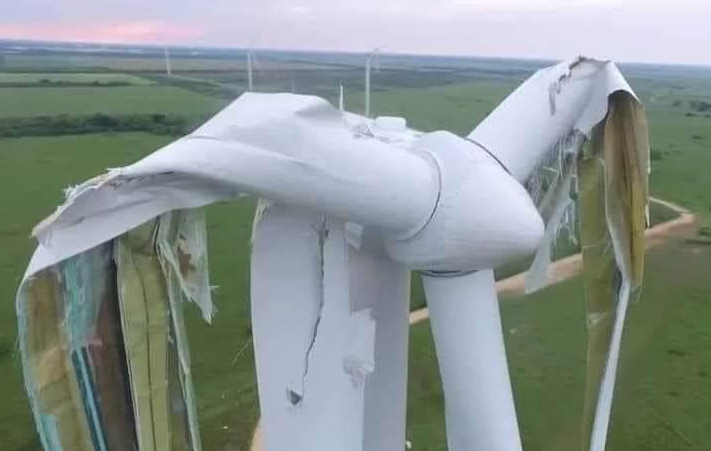
Kicking off this week’s roundup, Robert Bryce provides a delightful summary of the American wind industry’s mounting woes, where its onshore industry is following the offshore industry, which is already in full-scale collapse.
Steve Goreman provides a rather lengthy shopping list of every wind and solar scam, green subsidy and associated rort that faces the axe under Donald J Trump.
Where Donald J Trump is taking an axe to the subsidised wind and solar scam, Russ Schussler takes a sledgehammer to the grand ‘green’ energy narrative – the one that allows rent seekers to claim a perverse kind of moral authority to ply their subsidy-soaked trade.
Finally, Lance Johnson tackles wind industry’s wanton destruction of all manner of airborne creatures. Birds, bats, bees and bugs are being obliterated across the globe, with the growing carnage being measured in metric tonnes.
“Children just aren’t going to know what snow is.”
– David Viner, Climatic Research Unit, University of East Anglia (2000)
“Snowfalls are now Just a Thing of the Past,” announced a headline from The Independent (March 20, 2000). The prediction belonged to David Viner, a senior research scientist at the climatic research unit (CRU) of the University of East Anglia. (Yes, UEA of Climategate infamy).
The Independent has deleted this article, but plenty of secondary sources have captured its prose,
“Britain’s winter ends tomorrow with further indications of a striking environmental change: snow is starting to disappear from our lives,” the article began. Continuing:
Sledges, snowmen, snowballs and the excitement of waking to find that the stuff has settled outside are all a rapidly diminishing part of Britain’s culture, as warmer winters – which scientists are attributing to global climate change – produce not only fewer white Christmases, but fewer white Januaries and Februaries.
The first two months of 2000 were virtually free of significant snowfall in much of lowland Britain, and December brought only moderate snowfall in the South-east. It is the continuation of a trend that has been increasingly visible in the past 15 years: in the south of England, for instance, from 1970 to 1995 snow and sleet fell for an average of 3.7 days, while from 1988 to 1995 the average was 0.7 days. London’s last substantial snowfall was in February 1991.
Global warming, the heating of the atmosphere by increased amounts of industrial gases, is now accepted as a reality by the international community. Average temperatures in Britain were nearly 0.6°C higher in the Nineties than in 1960-90, and it is estimated that they will increase by 0.2C every decade over the coming century. Eight of the 10 hottest years on record occurred in the Nineties.
However, the warming is so far manifesting itself more in winters which are less cold than in much hotter summers. According to Dr David Viner, a senior research scientist at the climatic research unit (CRU) of the University of East Anglia, within a few years winter snowfall will become “a very rare and exciting event”.
“Children just aren’t going to know what snow is,” he said.
The effects of snow-free winter in Britain are already becoming apparent. This year, for the first time ever, Hamleys, Britain’s biggest toyshop, had no sledges on display in its Regent Street store. “It was a bit of a first,” a spokesperson said.
Fen skating, once a popular sport on the fields of East Anglia, now takes place on indoor artificial rinks. Malcolm Robinson, of the Fenland Indoor Speed Skating Club in Peterborough, says they have not skated outside since 1997. “As a boy, I can remember being on ice most winters. Now it’s few and far between,” he said.
Michael Jeacock, a Cambridgeshire local historian, added that a generation was growing up “without experiencing one of the greatest joys and privileges of living in this part of the world – open-air skating”.
Warmer winters have significant environmental and economic implications, and a wide range of research indicates that pests and plant diseases, usually killed back by sharp frosts, are likely to flourish. But very little research has been done on the cultural implications of climate change – into the possibility, for example, that our notion of Christmas might have to shift.
Professor Jarich Oosten, an anthropologist at the University of Leiden in the Netherlands, says that even if we no longer see snow, it will remain culturally important.
“We don’t really have wolves in Europe any more, but they are still an important part of our culture and everyone knows what they look like,” he said.
David Parker, at the Hadley Centre for Climate Prediction and Research in Berkshire, says ultimately, British children could have only virtual experience of snow. Via the internet, they might wonder at polar scenes – or eventually “feel” virtual cold.
Heavy snow will return occasionally, says Dr Viner, but when it does we will be unprepared. “We’re really going to get caught out. Snow will probably cause chaos in 20 years time,” he said.
The chances are certainly now stacked against the sort of heavy snowfall in cities that inspired Impressionist painters, such as Sisley, and the 19th century poet laureate Robert Bridges, who wrote in “London Snow” of it, “stealthily and perpetually settling and loosely lying”.
Not any more, it seems.
Like the Climategate emails, you cannot undo the words, sentences and paragraphs of this article. SkepticalScience apologized in this way:
The 2009/2010 winter saw a number of dramatic, record-breaking snowstorms. Early February saw two “once in a 100 years” snowstorms hit Philadelphia, now being dubbed “Snowmageddon”. Does record snowfall prove that global warming isn’t happening? What do observations say? 2009 was the second hottest year on record. January 2010 was the hottest January in the UAH satellite record. Satellites data indicates last month was the second hottest February in the satellite record. Observations tell us that rumours of global warming’s death have been greatly exaggerated.
Exaggeration Backfires
Now, with record chilling during the winters, we are told that “climate change” is the reason. Such a dodge is too little, too late. The problem of climate alarmism is exaggeration itself. Chronic exaggeration creates a credibility problem as documented in Michael Shellenberger’s Apocalypse Never, which referenced his Forbes column, Why Climate Alarmism Hurts Us All.
The last word belong to Fred Krupp, former head of the Environmental Defense Fund, who stated in 2011:
There has to be a lot of shrillness taken out of our language. In the environmental community, we have to be more humble. We can’t take the attitude that we have all the answers.”
“The opportunity now is to dismantle the US Department of Energy department by department, with the military nuclear functions transferred away. And the dissolution should be done in such a way as to not have the agency reappear. Reagan promised to do so but did not. Secretary Wright should do so.”
Spending other people’s money like a drunken sailor. Touting inferior energies as if they were good for consumers, investors and the environment. Creating artificial, wasteful political jobs in light of the $36 trillion deficit. And in the end, throwing gold bricks off the Titanic. In short, creating the mess that your successor has to now clean up, and hurting numerous people in the process.
But Jennifer Granholm, the former Secretary of Energy, is sad. She recently wrote on LinkedIn:
To my DOE colleagues: Like many of you, I’ve been sick about the news of the past month. I’ve been hearing about you DOEers whom we recruited for your brilliance and expertise, those of you who moved from your home state to take your skills to the nation, those of you with young children, those of you who took large pay cuts to come into public service, those of you who saw service to our nation as a mission. So many of you tossed into the unknown.
This is all made harder because many of you have been working on critical projects like reindustrializing the nation, restoring American manufacturing jobs, building up the supply chains that our economic adversaries had stolen.
Many have been shepherding our nuclear stockpile to keep us safe as a nation. Engineers keeping our electric grid secure, economic experts protecting the nation from unfriendly foreign control over US energy companies, market professionals ensuring that US jobs were created in communities across the nation. Nuclear physicists working on new reactors. Geologists enhancing geothermal power. Water specialists designing next generation hydropower. And so many more.
Both political parties say they want these things. Instead . . .
I am so sorry. I am sorry that the incredible work you did over the past years is in jeopardy. I am sorry that your lives and jobs are in chaos. Please know that I see you. I honor you. I am utterly grateful to your service.
As are millions of others, whether they know you or not. Even though you may feel abandoned, you are not alone. We, your DOE family, are with you, rooting for you, and working on the outside to make sure that we will serve together again in this fight someday.
Speaking for the silent majority, I commented:
Shame on you for being a puppet of false climate/energy thinking and for ballooning the federal debt. Chris Wright is a breach of fresh air that you should appreciate. Social justice = the best energies.
Many comments were from climate activists and subsidy recipients. Well wishes back. But some made the obvious point of government gone amuck.
Carrell Polston: “I wonder where the empathy was for workers sent packing from the Keystone XL pipeline. all at the stroke of the executive. Maybe the coal miners being pushed aside. all told they just need to ….. learn to code. Lots of others out there. but only seems to reverberate when Government workers feel the pain of reductions in force.”
Ronald Sanders: “Proof Positive that a DEI Hire for the U.S. Secretary of Energy was absolutely not a good idea and the Peter Principle is still alive and well.”
Patrick McGarry: “You told anybody associated with natural gas to go find another job and you took humor in doing so. Thanks for the reminder why we need less lawyers and more engineers in the DOE.”
Final Comment
The opportunity now is to dismantle the US Department of Energy department by department, with the military nuclear functions transferred away. And the dissolution should be done in such a way as to not have the agency reappear. Reagan promised to do so but did not. Secretary Wright should do so.