Guest “Heck yeah, I voted for this! And it’s better than I expected!” by David Middleton
ScienceInsider Science and Policy
Trump Tracker
Latest on firings: ““It’s bad, but I’m not gonna lay down and roll over.” 13 Feb 2025 By Science News Staff
Are you a federal scientist who took the recent buyout or have been fired? Contact us. Other story tips welcome. Latest story: “If you are going to fire us, let us know.”–National Science Foundation union
17 Feb 2025, 2:50 PM ET
NSF union asks for information on pending dismissals
In anticipation of mass firings this week, the union representing more than 1000 employees at the National Science Foundation (NSF) today asked the agency to explain how it is implementing the Trump’s administration order to shrink the federal workforce by dismissing those designated as probationary employees.
“Put us out of our agony,” says one NSF employee who received the 17 February letter sent by Local 3403 of the American Federation of Government Employees to NSF Director Sethuraman Panchanathan. “If you are going to fire us, let us know.”
The letter, shared with Science, asks Panchanathan for the criteria the agency used to draw up a pool of those eligible to be fired under a 20 January memo from the White House Office of Personnel Management.
There’s a single criterion for firing “probationary employees”…
“If you’re not the right person for the job, the employer can fire you at any point during the probationary period.” USAJOBS.gov
If you’re a probationary employee, you can be fired “at any point during the probationary period.” That’s how probationary employment works. If your job has been eliminated, you are no longer “the right person for the job.”
Now, let’s get back to the “Trump Tracker”…
14 Feb 2025, 6:30 PM ET
At Interior Department, layoffs shock new scientists hoping for a secure career of service
As the Trump administration unleashed a wave of firing today across U.S. research agencies, targeting mainly probationary workers, ScienceInsider spoke with two scientists at agencies in the U.S. Department of the Interior who are losing their jobs. A postdoc who started a position at the U.S. Geological Survey last year got a call from their center director today, telling them that they would be laid off by the end of the day. “He broke the news and wanted to do it himself,” they say. The ecologist says it was a shock, but not completely unexpected. They also consider themselves relatively lucky, because their spouse is employed and they didn’t have to relocate for their postdoc. “I’m aware of some others who moved cross-country and started positions only to have just gotten the news. … It’s really hard.”
One would think that the folks at the American Association for the Advancement of Science of America would be able to grasp the phrase “probationary workers.” And why the hell is the U.S. Geological Survey employing PhD ECOLOGISTS? Let’s ask Google AI:
Looks like another job for the DOGE boys.
Why were hundreds of millions of TAXPYERS’ dollars being spent on “education research”?
14 Feb 2025, 2:30 PM ET
Halted contracts threaten education research
Researchers warn that the sudden cancellation this week of hundreds of millions of dollars of government contracts to collect information on the state of U.S. education will blind the government to important trends from preschool to college and beyond.
Hundreds of “hundreds of millions of dollars of government contracts to collect information on the state of U.S. education”? Seriously? We we know all we need to know about the “the state of U.S. education.” It’s barely average in science and math.
5200
Estimated number of probationary workers at NIH, CDC, FDA and other Health and Human Services agencies who were scheduled to receive termination notices from the Trump administration.
Billionaire Elon Musk has been a lightning rod for criticism in the United States for anti-DEI posts on his social media platform X and his DOGE work for President Donald Trump, which may end up gutting U.S. science agencies and has disrupted foreign aid for global clinical research. But his actions also aren’t playing well across the pond.
The folks who want to protect every DEI PhD’s access to taxpayers’ money want to kick Elon Musk out of the Royal Society… Irony can be so ironic!
Why is the American Association for the Advancement of Science of America so obsessed with down-sizing the Federal government?
American Association for the Advancement of Science (AAAS)
The American Association for the Advancement of Science (AAAS) is a science advocacy organization based in the United States and the largest general science association in the world. It is publisher of the journal Science.
AAAS has been accused of promoting a broadly left-leaning policy agenda and associating with front groups for the Soviet Union during the Cold War. Many of its leaders have also been criticized for supporting environmentalist policies and promoting global population control measures.
In the modern era, the AAAS has become more involved in promoting left-wing “science-activism,” ideological activism performed in the guise of promoting science. Its involvement in the “March for Science,” which was organized in opposition to the election and policies of President Donald Trump.1
[…]
Funding
The AAAS had expenditures of $101.3 million in 2015, revenues exceeding $103 million, and assets of $156.6 million.36
[…]
The federal government is the largest identifiable source of funding for AAAS. Between 2008 and 2017, federal funding to AAAS averaged over $3.3 million annually. Data from the website USA Spending (managed by the Office of Management and Budget) shows AAAS received $27.9 million in 451 contracts between 2004 and March 2018. Of this sum, the largest contracts were given to AAAS by the Department of Health and Human Services (largely from a subsidiary agency, the National Institutes of Health) and the Department of Homeland Security. AAAS received another $41.5 million in 25 grants between 2011 and December 2017, of which an overwhelming majority ($35.5 million) came from the National Science Foundation. 38
My least favorite think tank is Shikha Dalmia’s Institute for the Study of Modern Authoritarianism, publisher of The UnPopulist. Left-funded and a pretend classical-liberal group, it promotes a vague ‘liberalism’. ISMA is a Trump-hate group of disaffected, politically homeless folk who have forgotten that statism is the enemy, not Donald Trump. Thus, they do not apply their metrics to the Progressive Left–just Trump. And their TDS has put them at odds with normal folk. [1]
This fringe group is a home to Left Libertarians who, among other things, play up climate alarmism and thus the Climate Industrial Complex’s forced energy transformation. Jonathan Adler, who I have taken to task (without his promised rebuttal), fits right in with Shikha’s group. Employing judicial activism, Adler assumes CO2 is a deleterious pollutant to argue for tort law for the ‘victims’ (fill in the blank) to sue the ‘guilty’ (everyone, really).
Sound crazy? It is!
Last summer, ISMA/The UnPopulist held its inaugural Liberalism for the 21st Century conference in Washington, DC. One session on climate featured Adler himself, with nary a person on the other side of the quite unsettled debate. The fix was in with the participants:
Climate Change: Liberal Solutions Jonathan Adler, Professor of Law, Case Western Reserve, University School of Law Nils Gilman, EVP & COO, Berggruen Institute Joseph Majkut, Director, Energy Security and Climate, CSIS Moderated by Matt Yglesias
The discussion was published as Climate Catastrophism Leads to Illiberalism but Doesn’t Solve the Problem with the subtitle (ahem), “There are liberal solutions available, but the right’s denialism and the left’s alarmism are getting in the way.” Denialism? As in those who think that carbon dioxide enrichment is not catastrophic but just the opposite? “Denialism” as in what is now U.S. climate policy with the world moving in our direction?
————————
Here are the transcript highlights with my comments interceded.
“Jonathan, you’re the expert in this. There is a ‘liberal’ way to think about climate change, right?”
Jonathan H. Adler: There certainly is, and a lot of folks who take at least the libertarian manifestations of liberal policy positions in a lot of other contexts abandon it in the context of climate change, which is a problem.
Comment: Incorrect. Classical liberalism 101 concludes that government (global government in this case) should not price or otherwise regulate carbon dioxide (CO2) or other man-made greenhouse gas emissions to “save” or “stabilize” the planet. This was true in the 1980s and is truer today, with the forcing effect of CO2 encountering diminishing returns (saturation effect) and natural adaptation in free societies internalizing the alleged negative externality. Time is on the side of classical liberalism’s “first, do no harm” and “naturally adapt” conclusion.
Alder: [When] we step back and think about environmental protection generally as something that we ask government to do, or what the liberal case for environmental protection is, it begins with the government protecting people and their property from harms caused by the misuse of other people’s property. One of my favorite old cases is William Aldred’s case from [1610]. A guy has a pig farm, and his neighbor’s like, “The pig stink, and I can’t sit at my table and have dinner because of the odors.” And this opinion sounds like something that some law and economics person would have written in the 1970s, because the farm owner is like, “Well, I’m producing valuable stuff for society. I am helping people be fed. If it weren’t for me, you wouldn’t have pork on your dinner plate. From a welfare-maximizing standpoint, I have to be allowed to do this, and your nose shouldn’t be so sensitive.” The court says, “No, that’s not how it works. You have the right to do things on your property. He has the right to do things on his. But when you start to intrude” … it’s the pollution version of the aphorism about my right to swing my hand ends at the tip of your nose. It’s the same principle.
Comment: What does this have to do with CO2, which was never thought to be a pollutant until politics made it so? CO2 is not a pollutant. CO2 is not pig stink but odorless. It is a trace gas with numerous benefits for plants and other forms of human life.
Adler: Historically, that was the beginnings of environmental policy, before we had big federal regulatory agencies. Over time, we realized that it’s often not this bilateral problem. It’s not one farmer and one homeowner; it’s lots of people, lots of activities—the accumulation of many activities in a particular area, so that the concentration of effects reaches a point where it actually becomes a problem. Again, the same principles would underlie the early zoning laws that were designed to deal with this. How do we prevent these sorts of conflicts ex ante rather than ex post? The Progressive Era smoke control movement [was] very much designed to make sure you can burn coal, but you can’t burn it in a place that’s going to make people nearby sick, and that resulted in moving a lot of these facilities outside of the cities.
Comment: Again, this is not applicable to CO2 but to real air and water pollution. CO2 does not produce smoke (it is colorless) , ruining the above analogy.
Adler: At a certain point, the politics of environmental issues, as the problems become more complicated, as the stakes become larger, make these coordination problems look more difficult, and they’ve produced this illiberal response of not merely saying, not just in terms of the policy measures, but the reaction of being involved, “the problem can’t be real.” The need to deny the problem so as to deny the rationale for government intervention. It’s this binary choice: if it’s a catastrophe, yes, we have to do terrible things. But if it’s not, we can ignore it. But of course, that’s not the traditional liberal way of thinking about these sorts of problems.
Comment: “The need to deny the problem so as to deny the rationale for government intervention” is a slight toward decades of classical liberal attention to this subject, from physical science to climate economics to public policy. “illiberal response of … ‘the problem can’t be real’” is a non sequitur. And certainly not a classical liberal position where the burden of proof is on those who declare a global emergency calling for global government intervention. ‘Liberal’ is Statism, as Adler uses it. Throw this vague term away.
Adler: I worked at the Competitive Enterprise Institute, which I guess is still today the leading don’t take action on climate change organization here in D.C.
Comment: Another vague, incorrect statement. The government should not take action. Free people and civil society should take action based on their opinion of the trustworthiness of physical climate science based on global climate models.
Adler: A few years after I left and went to academia, I wrote a paper saying, “Look, if we take these ideas about protecting property rights—not merely from the government but from others—seriously, you don’t have to be [a catastrophist] to think that climate change is a problem within this traditional, classical liberal framework.” You can take very modest, non-apocalyptic scenarios about things like sea level rise. And you can point out that just as there are old cases about pig farmers, there are old cases about land modifications that cause the flooding of a neighbor’s property, and it was recognized [that if] you do something on your property that causes standing water on your neighbor’s property, that’s a trespass, that’s a property rights violation.
We can have a discussion about when it’s not one landowner versus another landowner, it’s millions of people emitting stuff, and millions of people’s land being affected very far away, about what sort of institutional mechanisms we want to have to deal with that … but you don’t actually need to prove very much. You don’t need to prove we only have six years to show that that’s a problem.
Comment: Climate change as a tort? How problematic can this be from proving causality and assigning blame in a global, multi-billion-person world. A negative pig externality is one thing; indirect, unsettled causality involving countless business and consumers is quite another. And if the “problem” has been bandied about for several decades (it has), why should a speculative damage be entertained?
Adler: Similarly, if we just think about it as a risk problem, is it all that different from national defense? We don’t invest in national defense because we know with certainty that Russia, China, pick the country you want, is going to do x by a particular date. We know that the risk of them doing something sufficiently bad is such that prudent investments that can reduce the likelihood or the consequences of those actions are worthwhile.
You think of it kind of like an insurance problem. In terms of thinking about the problem, it is very useful to not think about climate change as this kind of separate category—apocalypse—that means all the rules are thrown out the window, but rather just a more complicated, more difficult version of the problem that we’ve been thinking about dealing with liberal institutions and liberal ideas about the role of government for a very long time. Part of the problem is that we’ve forgotten a lot of that, and we don’t talk about climate change in those kinds of terms.
Comment: Another bad analogy from lawyerlike make-your-best-case-for-one-side-of-the-debate. Is this scholarship or just advocacy?
Adler: When I worked at CEI, and I began there in 1991, there was this great quote from former Senator Tim Wirth that was always kind of fun to deploy about climate change. This is in the ’90s, and I’m paraphrasing, but it was basically, “We’ve got to ride this issue, because even if it’s not really a problem, we’ll still be doing the right things.”
So there’s this idea that’s very pervasive, that’s not wholly unfounded, that climate change creates an excuse to give government control over lots of things, energy in particular, and that if your view of government is that that’s threatening, that’s scary, something that’s ultimately very illiberal, in the sense that it’s hostile to innovation, hostile to market dynamism … that’s a really scary thing. It’s okay to be defending property rights, if you’re talking about defending the property owner from the farm next door—that’s just a little localized problem. But if you’re talking about energy use throughout the global economy, oh my gosh, that’s really scary.
Comment: It is scary–and an argument to separate government from climate/energy.
Adler: I think part of what feeds that is the only way we want to talk about climate policy is: How do we hit that target that Joe [Majkut] mentioned? How do we know that the policy we’ve adopted will hit that target? So even on the left and with the environmental community, there is a preference for regulation over pricing, because regulation at least gives you the illusion that you have a target that will be met by a particular day. I say “illusion” because it turns out environmental law does not work that way. It has never worked that way. We don’t meet targets.
Comment: Okay, so pricing CO2 is out….
Adler: I did a paper for Joe [Majkut] at Niskanen [Center] that actually points out that we pretend as if you say, “We should have regulations,” and you snap your fingers, and suddenly they’re in place and they’re complied with, and their targets are met. And that’s just not the world we live in. The throughput capacity for right environmental regulations is kind of like the throughput capacity for environmental impact statements—the government can’t do the volume that we need if that’s the way we’re going to decarbonize….
Comment: Why decarbonize? No intellectual case has been made, just vague assertions that CO2 is bad.
Adler: But the big point is that there’s this fear: Which am I afraid more of, climate change or climate change policy? And if climate change policy means the government is going to decide how much, and what sort of, energy each industry gets to use, and in what time frame, and what car you drive, and what kind of stove you have, what kind of house you live in, and so on … well, then, climate change has got to be really, really bad to justify that. And I would argue that not only is that not the choice we face—that in fact, going down the road is actually not even the best way to deal with climate change—but that’s what feeds the right side of the political spectrum’s fear of climate policy.
Comment: Correct: there is a competing fear of climate change vs. climate change policy. And a grand reason to get off The Road to Climate Serfdom.
Adler: There are ways of thinking about the collective action problem where we think about reciprocity of advantage, and where we’re all allowed to engage in equivalent types of conduct, and we engage in some sort of collective enterprise to make sure it’s not too excessive.
Comment: “Collective” as in global? “Collective action problem” as in guilty until proven innocent with the global greening gas of life? Adler is out on a limb with no tree.
Adler: On this issue of adaptation that was just brought up, though, I’ve been pointing this out to people for close to 20 years that the UN IPCC on issues like water rights is more liberal and more market oriented than pretty much any major environmental NGO in this town, and certainly than the U.S. government’s policy. Because for 20 years, the UN IPCC has noted that on the issue of water availability and access to water—which is a huge issue, and something that climate change is going to affect in a lot of unpredictable but significant ways—you’re not going to be able to build your way out of that with infrastructure, especially in the Global South, but not only in the Global South. You’re going to have to have ways of pricing and reallocating water in response to demands. And we know how to do that. We’ve shown how to do that.
Water markets are very robust where they’re allowed to operate. And … crickets. Policy-makers don’t want to talk about that. It feeds into the idea that it’s a watermelon thing, because here’s an example where we have clear empirical evidence, we know how to deal with dramatic changes in the availability and supply and timing of water, and we know what sorts of institutions can handle that sort of thing—and yet, we don’t want to talk about that. We want to tell you what shower-head you use.
Comment: A free market in water, yes. Adaptation, yes. Nothing here on the problem or solution to “climate change.”
Adler: There’s a lot of pressure to maintain what is ultimately a similar narrative. There’s a belief, and it’s a well-intentioned belief, that the nuts and bolts on climate change are complicated: It’s not immediate, so it’s a long-term problem, but it’s still very important. And the way you get—in a democratic society—people to act is simplifying it and scaring people.
Comment: This is a reason for the climate lobby to cease-and-desist, not for global government or a misapplication of tort law where it cannot possibly succeed except for judicial activism/statism. Complexity calls for markets and not government, and markets include Civil Society, not only profit/loss business.
Adler: So the folks [who] want to attribute every hurricane or whatever to climate change aren’t trying to … this isn’t a stalking horse for some broad liberal agenda. It’s, well, “We’re oversimplifying some, but this is the sort of thing we are worried about over the long term, and we don’t think the democratic process will be able to handle the complexity that what’s really going on is we’re increasing the upward potential of hurricane damage and hurricane storms and the likelihood over a longer period of time. But we can’t say it about a particular storm.”
And if you try to say that on the evening news, people are going to change the channel, or they’re going to fall asleep. Whereas, if you say, “Oh, my God. [Hurricane] Beryl or whatever is the result of climate change,” maybe that gets politics in action. The problem, of course, is that when someone goes and looks at the science, and they pull out the IPCC, and they talk about, “Okay, what are the different levels of attribution we can engage in with regard to different types of changes in weather?,” and they see the IPCC is saying, “Hurricanes? Yeah, we can’t really tie the knot yet,” well, it’s like we saw with Covid: “Well, now they’ve exaggerated. Climate change is still a problem, but the specific thing they led with wasn’t true, so maybe that’s an excuse that gives me permission now to say they’re lying about everything.”
Comment: Has Jonathan Adler contradicted the deep ecology belief that nature is optimal and fragile and that the human perturbation cannot be good but bad?
Adler: In a democratic polity, it’s undermined the ability of science to inform the policy process, because the way the science of climate is presented oversimplifies and glosses over a lot of complexity, and, in some cases, just says stuff that isn’t quite true.
Comment: Global climate models are science? Reliable and settled? And attribution models based on them (for tort claims) are not less so? Remember Climategate?
Adler: Yes, it’s true that we are not good at building some Grand Cathedral that takes 150 years to build, but we do a lot of other things much, much better. China’s gonna be able to build lots of stuff if they wanna do it. The evidence that we have so far … and there’s some research coming out soon that, actually, when you look at it qualitatively as opposed to quantitatively, they obtain far more patents for clean energy products, but the patents they’re obtaining are very low value patents. All the high value patents are still here. They’re not in China, they’re not in Europe. The problem we have here is that we make it too difficult to do stuff. The discussion we’ve been having about permitting for transmission lines is a very salient example of a problem that is endemic of that we’ve made it too hard to do stuff, and part of what we’ve made it too hard to do are the natural things that make problems like climate easier to solve.
Comment: This excursion into energy policy is a reason for a separation of government and climate/energy. Nothing more,
Adler: So the least talked about and yet most important environmental trend of the 21st century in countries like the United States is net dematerialization—using less stuff that’s physical material year over year. The United States will use fewer molecules of physical stuff next year than this year. That’s mind blowing. That wasn’t planned. That wasn’t designed. That wasn’t programmed. That wasn’t scheduled. It was because stuff costs. We pay for stuff. We pay to get it, we pay to manipulate it. We pay to deploy it. We pay, unless we can figure out a way to turn it into smoke, to dispose of it. In a world in which you can innovate, that over time leads to these trends. We don’t do that with energy because we don’t fully integrate it into those market processes, those very liberal processes that encourage all of us, collectively, to try to make more with less tomorrow than we did today.
Comment: Yes, and a reason, again, to separate government from climate/energy policy.
Adler: So if we want these bigger, longer term trends, we know what the institutional framework needs to look like to decarbonize. And we don’t do that. China’s not doing it either. Now, if we figure stuff out, China will build a ton of it, and I’m not sure that’s bad if they build a ton of it, and it’s less expensive for us, so then it’s even easier for us to deploy it. The real challenge for an issue like climate change that’s global is: Are we able to be the engine of figuring out how to how to decarbonize? And we’re kind of failing at that.
Comment: Alder’s premise “to decarbonize” is a fatal one both in the “problem” and the “solution.”
Adler: And it’s not clear it’s democratic, right? Because the people who show up at the planning meeting to complain about the wind turbine that’s going to go on the other side of the hill that they heard about, and they’re afraid they’re going to see when they drive to work, are not necessarily representative of the people as a whole. And I should just note: the more you dig into it, [when] we talk about NEPA and environmental impact statements, especially for energy infrastructure, state and local barriers are probably greater than federal barriers for everything but large transmission projects that have to go across federal land, and perhaps across tribal lands. Otherwise, the state and local barriers are greater. We have things in federal law that magnify those state and local impacts. And I’ll say, as someone who loves decentralizing political authority, that’s a hard fact to wrestle with. Because I like letting different communities make different choices. But letting different communities make different choices means it’s really hard to build linear infrastructure. And you can’t electrify and decarbonize through electrification if you can’t build linear infrastructure.
Comment: Again, Adler poses an issue that he has not defended as a problem. CO2 enrichment is positive from the most settled science of all: CO2 science under laboratory conditions. He arbitrarily puts his faith climate models that cannot be tested and have no way of knowing that their physics are right. No convincing case here!
—————
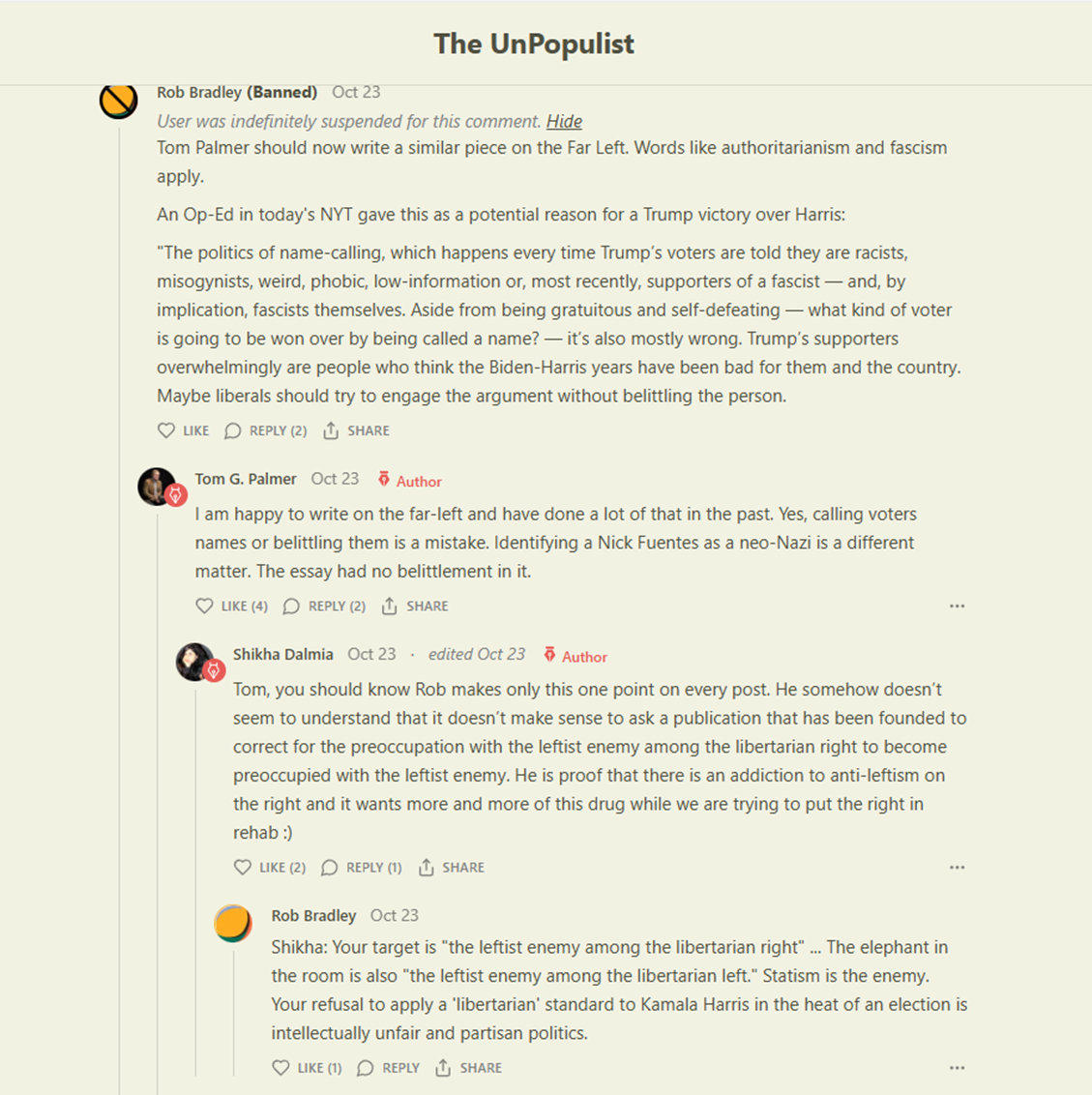
[1] Here is my exchange with Tom Palmer (Shikha Dalmia joined in) who has not taken a deep dive into Progressive Left authoritarianism. (Note how I was ‘indefinitely suspended’ for my comment. How authoritarian, ISMA!)
To get an idea of ISMA head Shikha Dalmia, a “left liberal” and Kamala Harris supporter, consider this rant:
So, these low information [Trump] voters, voting based on what their media ecosystem is telling them rather than what the truth is, it bothers me that all of us, including the Kamala Harris operatives, just kind of gave up on informing those voters and trying to at least win some of them over, or at least take the edge off their cynicism of the establishment. If we keep giving up on those voters, that’s just going to deepen. Elections are a great moment to educate voters—at least the informative function that it serves is highly important to keep both sides somewhat in line. (The UnPopulist, November 10, 2024)
The November election results inspired these reactors from the TDS bunch:
Shikha Dalmia: To me, it was a gut punch. Obviously we all knew going in that it was 50-50. But I was hoping it wouldn’t be Trump. And it was. So I spent the first day completely in shock. And if I could have my way I would curl into a fetal position and wake up in four years. But there’s work to be done, a country to be saved, our republic’s fate is on the line—so here I am.
Andy Craig: Yeah, I share a lot of that. Not necessarily shock as in surprise, but shock as in, “Wow, this is really happening.” We’d still had the hope that it wouldn’t. I think a lot of people are still, understandably, taking the time to emotionally process it. I think it’s not wrong that people are feeling it as a gut punch. I mean, it is. I did.
Belvedere: The gut punch, for me, is that there was no shortage of coverage about Trump’s manifold barbarisms. And yet Americans saw all of that, processed it, and in the end said, “This is the guy we want.”
In denial and out of touch. The real world must be a strange place for this cult.
In early 2024 I obtained under Freedom of Information Request the Met Office list of weather stations by CIMO classification for temperature and humidity. The original list can be found here. It became apparent that this listing was no longer up to date with a number of stations appearing to be closed (e.g. Malham Tarn and Ringmer) and new sites appearing on the list of Climate and Synoptic Stations such as Tealing and Bratton Fleming:Haxton.
I was supplied with a new listing which I have screen captured onto my laptop screen below for others to view.
Some notable alterations are:
Hastings downgraded from Class 1 to Class 4 subsequent to my challenge here.
Edenbridge Similarly challenged as above, amended from Class 1 to Class 4 but omitted from latest listing. I have confirmed it is still an operational site.
Bramham Reviewed here subsequent to downgrade from Class 1 to Class 4 – no specific reason known though possibly originally a default error as Met Office system assumes Class 1 unless manually amended.
Fair Isle Reviewed here again possibly a default error causing downgrade from Class 1 to Class 4.
Thorney Island Downgraded from Class 1 to Class 3 – not yet reviewed, however, preliminary investigation suggests possible encroachment of Solar Farm as part of Project Prometheus. This is a project to build solar farms at various military complexes (see Leconfield review) with “Baker Barracks” a known site at Thorney Island.
There are some other smaller downgrades from 1 to 2 at Benson and Manston (an ongoing story to be shortly updated) and upgrades from 2 to 1 as at Thomastown. Some new Channel Islands sites have been added plus some additional Scottish sites.
Pride of place, however, must go to the downgrade from Class 1 to Class 4 at RAF Wittering.
In my site review and Tim Channon’s original report there were two separate weather stations found to be operating simultaneously. Tim identified one as Class 4 whilst the other I studied appeared to be Class 1.
Has this apparent major downgrade come about from a former default error,…or a reassessment of the site…..or mistaken identity of which site was operational….or are both still being used….. or ???
Now for those wishing to view my laptop screen……..
The purpose of this article is to summarize and debunk many of the issues in the narrative surrounding the proposed green energy transition as applies to the electric grid. The issues are so numerous that this piece is at once both too long and too short. A full unraveling deserves a book or series of books. This posting however challenges the narrative through summary comments with links to previous posts and articles which can be read for a more detailed explanation or for greater depth.
The Narrative
Efforts to hasten a “green transition” find support in a powerful and compelling narrative. The following statements are widely believed, embraced and supported by various “experts”, a large part of the public and far too many policy makers:
Renewable Energy can meet the electric demand of the United States and World
Renewable Energy is economic
Renewable Energy sources can provide reliable electric service to consumers and support the grid
Renewable energy sources are inexhaustible and widely available
Clean Energy resources don’t produce carbon and are environmentally neutral
Renewable Energy Costs are decreasing over time
It will become easier to add renewables as we become more familiar with the technologies
The intermittency problems associated with wind and solar can be addressed through batteries.
Inverter based generation from wind, solar and batteries can be made to perform like conventional rotating generator technology
Battery improvements will enable the green transition
We are at a tipping point for renewables
Wind, Solar, and Battery technologies collectively contribute to a cleaner environment, economic growth, energy security, and a sustainable future
The world is facing severe consequences from increased CO2 emissions.
There will be an inevitable and necessary transition to clean economic renewables
Green Energy will allow independence from world energy markets
The clean grid will facilitate clean buses, trucks, tanks, planes
The third world will bypass fossil fuels and promote global equity
Replacing fossil fuels with green energy will have huge health benefits
It’s all about Urgency and Action
This narrative is compelling to many consumers and major policy makers. Unqualified acceptance of this powerful narrative makes it clear we should all be behind the movement to increase wind and solar generation along with other efforts to expand renewable resources. Most all of the above statements making up the narrative are “somewhat” true. Unfortunately, the collective narrative as frequently adopted is at odds with the economics and physical realities of providing electric power and supporting civilization.
How did this narrative become so widely accepted despite dismal real-world results? A previous posting discussed, “How the Green Energy Narrative Confuses Things” by using misleading language and distraction (#44). Additionally, tribal loyalties enable distortions and suppress more realistic assessments (#18, #10,#22, #42, '). While others should chime in on the social psychology supporting this movement, astute observers can’t miss the power of fear-based narratives, groupthink, demonization of dissenters and misplaced altruism (#39, #18,& #10). Incentives and their impact on key actors play a major role (#38 & #29). The media overblowing trivialities and focusing on continually emerging “good news” helps cement undeserved optimism. The great many failures are conveniently forgotten. Finally, it should be noted that the electric grid has been very robust. In the short run you can make a lot of “bad decisions” before negative consequences emerge to challenge the narrative. At that point it may be too late.
The next section will explore and critically examine various elements of the narrative in a very brief fashion, with links in many cases providing more detailed explanations and information.
Unraveling the Narrative
Renewable Energy can meet the electric demand of the United States and World
“Renewable Energy” is not a coherent category and allows for a lot of confusion. #40
The green energy narrative began with simple calculations which found that the energy which could be derived from renewable resources like hydro, solar and wind matched or exceeded the energy consumed as electric energy. It is not a particularly meaningful observation. #28
It does not consider what may be involved in making that energy available when needed, where needed, with the proper characteristics needed.
Demonstrating that sufficient energy exists does not say anything about our ability to harness such resources. Large amounts of various “renewable” energy sources, such as those listed below. But even though the energy is there, and small amounts can be harnessed, most know enough not say the energy presence itself makes an energy transition feasible soon.
Tidal Energy
Ocean Thermal Energy Conversion
Earths rotational energy
Earth’s magnetic field
Nuclear Fusion
Unconventional geothermal energy (Hot Dry Rock or Enhanced Geothermal Systems)
Using just sunlight and/or wind exclusively to power large motors, variable speed drives, non-linear loads, arc furnaces or power a modern civilization is not feasible at this time.
Projecting feasibility based only such “studies” or calculations may be from either a serious misunderstanding of the challenges to be faced or unconstrained infantile optimism around future breakthroughs.
2.Renewable Energy is Economic
In limited cases, yes. In many cases, only in a trivial sense for a limited set of costs associated with these resources.
While the marginal cost of production for wind and solar is low, approaching zero:
Total cost including backup and system needs tells a different story. #8 , #9, #2, & #20
Costly investments in grid improvements and backup generation are needed to accommodate and support any significant amount of intermittent asynchronous generation . #3 & #17
Operationally there are significant dispatch costs for backing up wind and solar.
Wind and solar projects typically are in service for far shorter periods than projected.
The more wind and solar added to the system, the more costly they become.
Work best at low generation levels when they allow more costly resources to back down.
The lower their generation level, the more the system can accommodate them without additional costs. #2 & #26
It is demonstrated worldwide that increased levels of these resources are associated with higher electric costs for consumers and taxpayers.
While home solar can be subsidized to appear low cost, it is misleading for the big picture, especially as applications increase. #6 & #5
Average costs are misleading and cost measures such as LCOE are flawed as they do not reflect real world requirements. #8, #3, & #9
Undoubtedly premature to advocate that that a resource is economic, without considerations of reliability, deliverability and its potential operation in conjunction within a resource mix as part of a grid.
3.Renewable energy sources can provide reliable electric service to consumers and support the grid.
Statement may be trivially true, but is generally inaccurate.
Generally, it is an accurate assessment for hydro, biomass and geothermal. #3 & #12
These involve traditional rotating machines in synch with the grid. They inherently supply essential reliability services for grid support.
These resources have flexibility for dispatch and ramping.
Geothermal and biomass are greatly restricted by local geography.
New applications of these resources face especially significant environmental challenges.
Not so true for wind and solar generation. #12 & #26
They provide energy intermittently and do not match demand patterns. #2, #3, & #41
They do not spin in synchronism with the grid which has seriously inhibits their ability to support the grid. #7
They depend on the grid and synchronous rotating machines. #17
Problems associated with these resources increase as their penetration levels increase. #7
Supposed “proofs” that wind and solar support the system generally come from cherrypicked brief off-peak periods when renewable generation exceeded demand (not really a good thing.)
Grid support must be 24 hours/day during peak and extreme conditions. Configurations should ensure that the grid can go ten years with one loss of load expectation (LOLE).
Coasting through an off-peak period does not imply sustainability.
Where wind and solar match load, it is near certain that considerable spinning rotational machines (hydro or fossil fuel) are on the interconnected grid backing up these resources either serving other load not counted, or on-line spinning ready to take on load. #21
They may just come from accounting efforts, with no attention to flows or time periods.
Cost comparisons without considering reliability differences are worthless.
4.Renewable resources are inexhaustible and widely available.
The resources needed to construct and maintain such facilities as well as resources needed to back them up are not inexhaustible. #40
Geothermal is rarely available and some geothermal can be depleted.
Further hydro development is problematic in most of the developed world. In the US some dams are being eliminated to return to a more “natural” state.
Suitability for wind and solar varies considerably by region.
All resource needs for using generation resources should be considered. #40
Scarce resources are needed in the production of wind and solar power.
Expected sustainability before depletion may be higher for nuclear power and some fossil fuel generating resources, than for resources needed for wind, solar and battery facilities. Of course, emerging developments may change expectations for any resource.
5.Clean Energy resources don’t produce carbon and are environmentally neutral. #40
Adverse impacts from “green” resources have typically received considerably less attention from the media, policy makers and advocates than similar impacts from conventional generation.
Although when it’s in their backyard, the problems of wind, hydro and large solar emerge and they become targets of local environmental groups.
Over time, the adverse impacts related to their operation and disposal become more and more evident. Recycling is challenging to impossible for the large structural components and also the scarce resources needed for energy conversion.
The construction, maintenance and operation of such resources produce significant environmental impact including CO2 emissions.
Geothermal generation produces CO2.
Backup generators are often run inefficiently to allow for wind and solar generation.
Cases of fossil fuel, wind and solar generation may have higher emissions than similar cases with only fossil fuel generation running more efficiently.
6.Renewable Energy Costs are decreasing over time
Some components are dropping – but total costs are more questionable as there is considerable data showing costs are rising.
Often cost data refers only to specific components that are decreasing, not the full cost for the installed facilities needed to generate energy and power.
In particular, land and labor push up costs associated with wind and solar.
Increasing penetration levels raise overall costs for solar, wind and batteries. #26
7.It will become easier to add renewables as we become more familiar with the technologies.
Only easier in limited ways attributable to things like experience and benefits of scope.
Exponentially harder to add increasing levels of wind, solar and batteries. #26 & #2
Asynchronous and intermittent resources are harder to integrate as their levels increase.
Prime renewable locations will already be exploited, and less desirable locations remain.
Continued developments entails the need to move energy longer and longer distances.
As wind and solar increase, early adopters will be less able to lean on neighboring systems.
8.The intermittency problems associated with wind and solar can be addressed through batteries.
Possibly, but at a great cost and added complexity. #2, #41, & #43
This assertion is extremely misleading when it implies that intermittency is the main problem.
Compared to the problems associated with asynchronism and the capabilities of inverter-based generation, intermittency is a much smaller problem.
Hiding/ignoring misleading points in the green narrative. #44
Asynchronism is the problem more so than intermittency.
9.Inverter based generation from wind, solar and batteries can be made to perform like conventional rotating generator technology. #43, #41, #3, & #19
Note – most people are not aware of the asynchronous problems associated with wind, solar and batteries.
When these elements let the grid down, the cry is “make the grid more resilient” as if that has some real meaning.
When that problem can’t get ignored, the green narrative is to back up and have someone say with technological improvements, inverters can perform “like” synchronous generation without any recognition of the drawbacks.
When inverters are made to provide extra functionality, it raises the installed costs and entails a significant reduction in energy output and reliability.
Three phases of Inverter development, none have achieved widespread use
Phases are more goal oriented or aspirational than accomplishment based.
Each is intended to do more than the previous “development” phase to “mimic” rotating generators.
Research and applications are largely on paper, in laboratories and pilot programs. Few if any working plants are gaining needed operational experience.
The early phases were sold as “the way” to allow higher penetration of inverter-based generation but were found not be able to deliver as promised.
The insufficiency of these approaches was recognized long before any large-scale implementations were undertaken (Note-generally phased development follows a widespread deployment of earlier phases prior to successive improved phases. In this area, the task is so far beyond the capabilities that prior phases can’t really show much proof of concept in the field.)
Why should we expect the latest grid forming phase to do better than predecessors?
Overwhelmingly, most wind and solar applications on the grid do not have functioning special inverter capabilities of any sort.
Enhanced inverters may perform “like” rotating elements in limited environments, but this “like” way is radically inferior to the performance of rotating generators. #30, #29
Inverter performance may improve with technological advances. However, they have an extremely long way to go.
Theoretically they can do a lot rotating machines cannot, but the complexity of taking advantage of that while coordinating with other changing elements across the grid so they all perform well together across all potential contingency conditions is immense.
Similar optimism exists for superconductors to improve the grids reliability and efficiency, but it would be extremely foolish to depend on either to support a planned energy transition. They are far from being judged as feasible.
This is the biggest problem the green narrative overlooks and is the major stumbling block to widespread integration of wind, solar and batteries.
10.Battery improvements will enable the green energy transition.
As discussed previously, batteries may address intermittency, but not the major problem of inverter-based generation.
Batteries suffer from the same inverter based problems as wind and solar.
Their inability to adequately provided needed system reliability services is usually not addressed. #29
Much is made of continual reports on improvements in battery technology
Many breakthroughs in research but they take development in differing directions and are not compatible with most of the other breakthroughs. “Breakthroughs” are typically not cumulative, corroborative or generally able to be combined.
Inverter-based improvements needed for wind, solar and batteries suffer from similar development challenges.
Consider the path of high temperature superconductors which were projected in the near term, but hit a wall before widespread practical applications could be employed.)
To control for extreme weather events (e.g. Dunkelflaute) might require that batteries completely ignore wind and solar capacity. Leaving tremendous amounts of unused capacity most of the time.
Tipping point is not defined and only weak evidence is cited. – #44
12.Wind Solar and Battery technologies collectively contribute to a cleaner environment, economic growth, energy security, and a sustainable future. #40 & #42
They might contribute small amounts at low penetration, but they are dwarfed by huge drawbacks at higher penetration levels.
In delicate environments, small compact fossil fuel-based energy sources may be superior to renewable resources with more intrusive footprints. #14
See v above.
13.The world is facing severe consequences from increased CO2 emissions.
The greater the risks from increasing CO2, the less we can afford to favor wind, solar and battery technology over more pragmatic approaches. #32
This is the most dangerous component to be incorporated into this narrative.
Because of this fear, it is argued we must chase bad ideas. #18
Because of this fear, dissent from these bad ideas is demonized. #18
Because of this fear, we must move to a panic mode and do counterproductive things. #1
The greater the risk from climate change:
The smarter we need to be.
The less we can tolerate bad ideas and wasted efforts.
Climate concerns do not change the physics of the grid nor the functioning of resources.
However, extreme weather will make “green” resources less suitable.
While the need for reliable, affordable power will be greater.
Green plans misdirect a lot of resources and weaken energy policy approaches. #42
If situation is that grim as regards CO2 emissions:
Perhaps that should outweigh any concerns around nuclear energy.
Perhaps environmental damage from new hydro is warranted as well to address climate.
If new nuclear and hydro are out, changing civilization is an option that needs to be on the table, frequently discussed and fully considered.
False appeals to questionable technologies will not help us.
False hopes of improving technology will only hurt us.
14.There will be an inevitable and necessary transition to clean economic renewables
When? It is very unlikely to be in the foreseeable future and certainly not in a planning time frame.
15.Green Energy will allow independence from world energy markets
We depend on other countries for material and components needed to construct renewable facilities.
Wind, solar and batteries cannot run steel mills and industrial processes needed for a “green” energy transition, not sustain civilization after (unless you call nuclear and hydro green)..
How is the fear of “foreign oil” so much more of concern than dependence on rare earth metals and other foreign imports.
16.The clean grid will facilitate clean buses, trucks, tanks, and planes
Not if it doesn’t work.
Wind, solar and batteries alone clearly cannot provide for such growth in electric consumption.
17.The third world will bypass fossil fuels and promote global equity
Nonsense
18.Replacing fossil fuels with green energy will have huge health benefits
More costly energy is associated with alternative use of dirty fuels creates hazardous pollution in many third world areas.
Rising costs of electricity generally encourages less clean alternatives that are more difficult to monitor.
19.It’s all about Urgency and Action
If urgency and action could dependably solve hard problems, years ago we’d have a cure for cancer and the common cold, flying cars, jet packs and ended world hunger.
It might be argued that the above refutations (even with citations) are too quick and lack detailed substantial evidence. While there is quite a bit out there that can be referenced, it should be pointed out that the arguments supporting a green transition are asserted without with much serious reasoning and far flimsier support than provided here. That which is easily asserted without foundation should not require overly demanding refutations. Clearly when and if more detailed claims supporting a green energy transition are made, they can be answered with more detailed rebuttals.
Academics are a key part of the problem of a sustained false narrative. Much of the “evidence” out there comes from small studies of single variables with academic models which are stretched far behind what was analyzed. Additionally, expert opinions come from many “experts” who “preach” far outside their fields of expertise and training. There are rewards in academia for furthering optimism on the green transition. There are not so many incentives for nay-sayers. Academics who understand the problems and would offer caution, generally do not have the reach of those who promote optimism by clouding the facts. The many half-truths presented from different sources cannot be summed up to imply a credible narrative, even though many have the impression this makes a strong case. #44
Clearly there are many discontinuities between theory and what is observed in the real world as regards the potential for wind, solar and batteries. Milton Friedman said, “One of the great mistakes is to judge policies and programs by their intentions rather than their results.” I’d add, “What happens in the field should be more convincing what you calculated on paper”. The next section will cover truths that need to be added to any considerations around our energy future.
Truths that need to be part of Energy Transition Narrative
These truths don’t get near as much attention as the above. Sometimes they are hidden and sometimes they are summarily denied rather than given the attention they deserve.
1)Adequately addressing the energy future requires we understand the true costs and benefits of ALL available and potentially available technologies. #1 & #3
2)Large grids are dependent upon and run on rotating machines. #3, #7, #11, #26 & #12
3)No Grids run on asynchronous generation only (or majority asynchronous) without significant backup.
Despite reports that wind, solar and batteries power a system – real world cases always involve significant conventional generation backing them up somewhere on the interconnected grid.
Asynchronous wind, solar and batteries without rotating backup resources are not feasible power supply element for large power systems.
4)Hydro, biomass and geothermal are fine for grid support, but are problematic and/or not available in many areas.
5)Wind and solar face major challenges in achieving significant penetration levels and have many underdiscussed issues.
Wind and solar resources have more limited lifespans and greater costs than typically modeled. #8 & #9 Batteries may be worse.
Expected performance during and after disasters is often over-exaggerated.
6)Costs of Wind and solar resources are often hidden and assigned to others. #5, #6, & #31
7)If Nuclear is the right direction, current efforts at wind and solar are misguided. Nuclear plants run best full out with low incremental cost. Displacing nuclear with intermittent wind and solar makes little to no sense.
8)It’s possible to subsidize a few things that have small costs to support development of green resources, but small costs multiplied by orders of magnitude are crushing. #6
9)Utility costs are regressive, dis-proportionally hitting those less well-off and least able to afford rising costs. These costs are more regressive than taxation schemes. #5#6, & #31
10)If we must cut carbon emissions without nuclear and hydro, drastically changing civilization is an option that needs to be on the table, openly and frequently discussed and given full considered.
11)Energy Markets are not working well. My take is energy provision cannot effectively and efficiently be broken into separated independent components. Utilities used to provide an amalgamation of goods and services for their customers. Separating out distribution, and transmission services increase complexity, but still doesn’t set up energy or its components as commodities. Separate commodities for hourly energy, capacity, emergency power, reliability services, backup power, and spinning reserve eliminate many of the efficiencies available from full-service power supply. For example: daily energy markets don’t support long term emergency power. Who pays for facilities needed for only once in a decade extreme weather, and when and how do they pay for it? Daily markets drive those resources which have emergency value out of business. Perhaps I am wrong, but experience tells us markets uncharacteristically are not working well for energy and energy services. #45
12)Credible plans for any electric energy future, let alone a major transition, will need to integrate studies of both supply and deliverability while balancing economics, costs and public responsibility. No conclusions about what may be worthwhile is possible without such considerations. #16 & #39
Other Topics that need to be considered
A)China and India’s CO2 emissions will likely dwarf emissions from western nations soon. Which is a more effective role for the US:
As a leader developing, promoting and sharing clean fossil-based technologies to be emulated by developing and third world nations. #36
As a leader among advanced nations promoting green technologies largely overlooked by most of the planet as they use less clean resources and their emissions grow exponentially?
B)What about developing countries in the third world? How we can hold them back by requiring they use a path that we can’t make work. Their burdens are more significant than ours.
Economic barriers – high initial investment or crushing burdens from foreign loans.
Human capital -technical skill needs.
These resources work even less well without an established strong grid.
Often more extreme climates increase challenges.
Specialized problems such as theft, waste management, and cultural acceptance.
C)Can effective regulation, as opposed to current regulatory practices revive nuclear construction significantly?
D)Energy density problem (EROEI) – Can solar and wind provide enough energy to be self-perpetuating considering full lifetime needs?
There is no significant production of “green” infrastructure with wind and solar energy.
Wind and solar infrastructure depend today on fossil fuel-based energy for their construction and operation.
E)Grid and energy prices are globally critical to healthy economies and a reasonable quality of life.
F)How do we incentivize policy makers to prioritize long term goals versus what’s expedient the next few years. #38 & #1
Imprudent short-term boosts (ignoring maintenance, depleting reserves) provide temporary advantages while building for the future initially entails greater costs.
For job evaluations, it’s easier to see what was done, rather than evaluate the long-term benefits of such programs
Engineers professionally suffer for not supporting green goals
Supporting green goals has rewards for practicing engineers.
I have never seen anyone recognized & rewarded for standing up for the grid ten years ago.
Bad incentives and the hope that technology or policy changes will arrive on time before things have gotten too bad, keeps most of those who might speak out in check.
G)How do we combat feel-good narratives? Energy is much more complex than recycling. Despite great under-achievement, renewable hopes have persisted for long time periods. Will the false hopes of wind, solar and batteries be just as intractable despite real world experience?
How Does the Green Energy Narrative Remain Strong Despite the Big Picture?
It’s hard to argue against the “green energy“ agenda. “There’s always something just around the corner that’s going to change everything”, we’re often told (#34, #43 & #24 ). It’s seductive, “Somebody is investing a lot of money now in the next great thing and we should be part of that as well.” But those things don’t pan out. There is broad support and rewards for going along with the “green” narrative, even for projects as ridiculous as “electric roadways” ( #42) and especially for projects as big and bold as the German Energiewende. A decade ago, when warning of emerging problems, countless times I was told that Germany had proved it could be done. In this piece (#21) in 2017, a coauthor and I tried to point out the problems with that representation. Despite voices like ours, the world remained largely impervious to criticisms of the German experiment. By the time Germany’s huge failure became apparent for all to see, the argument moved on to Australia where “it’s now being proved it can be done”. Chris Morris and I did a series (#33, #34, #35) on Australia in 2023 highlighting our understandings of those efforts and our expectations for underperformance. It’s not looking good for Australia, or England or for any who have raced to have high penetrations of wind and solar. But dismal real-world results so far have not been much of a brake on the movement. Renewable “experts” remain undeterred and unmoved by failed ideas.( #37)
Prior to the green energy narratives, there had been near continuous progress with engineers building and maintaining stronger and more robust grids that held up well across varied challenging conditions. The trend was that widespread grid outages (not the same as distribution outages) were becoming increasingly rare as grids became more robust and resilient. The beginnings of the “green transition” served to slow and reverse that progress. Most grids are sufficiently strong such that significant degradations do not show up as system problems for quite some time. The likelihood that problems won’t manifest for some years down the road makes it hard for defenders of the grid to stand up to short term pressures to go greener. (#38)
The strong robustness of the grid makes it hard to clearly identify and point out emerging problems with the grid. As I wrote here (#27)
The power system is the largest, most complicated wonderful machine ever made. At any given time, it must deal with multiple problems and remain stable. No resources are perfect; in a large system you will regularly find numerous problems occurring across the system. Generally, a power system can handle multiple problems and continue to provide reliable service. However, when a system lacks supportive generation sources, it becomes much more likely it will not be able function reliably when problems occur.
When an outage occurs, you can always choose to point a finger at any of the multiple things that went wrong. (#44, #26) Some traditional fossil fuel technology will always be included in the set of things that were not right. (Loss of just renewables doesn’t usually cause big problems because apart from energy, they don’t support the system while in service.) For various reasons, advocates insist the finger should be pointed away from renewables (and the gap in needed system support) and at the conventional technology that was not perfect when the outage occurred. It’s critical to note that conventional technology is never perfect across a large system, however we were able to make reliable robust systems that could easily accommodate such imperfections. But now the presence of less dependable resources and inverter-based energy makes systems far less robust, even during times when those problematic resources are working well. It’s a near sure bet the next large grid outage will be largely caused by problems associated with high levels of wind and solar penetration, whether those resources are available during the outage or not. That bet can’t be made, because no referee acceptable to both sides can be found.
Conclusions
The case for an energy transition based on wind, solar and batteries is grossly incomplete and stands against evidence and reason. The green narratives sub-propositions in isolation contain some truths, but they are extended in misleading ways. A collection of 200, 800, or ten million studies showing that isolated challenges around renewable resources can be addressed cannot make a case for reliable, affordable deliverable energy. When the resources are ready, proponents can make a case by operating a small system without connection to conventional generation that experiences varied load conditions and real-world challenges. When a case for large scale penetration of wind, solar, and batteries has been made with adequate considerations of costs, reliability and deliverability, it can then be reviewed and challenged with detail.
Planning must balance economics, reliability and environmental responsibility using real workable technology which conforms with the physics of the grid and meets the needs of society (#15,#16, #25, #23 & #32). Electric supply and the grid are too important to base policies upon poor narratives and incomplete understandings. Hope for future improvements must be based on realistic expectations. Going a short way down the “green” path is easy. Adding a bit more “renewables: isn’t that expensive and the gird is plenty robust for incremental hits. For most involved, it’s easier to go with that flow than to stand up for long-term concerns. But we are getting closer to the cliff as costs continue to increase and reliability problems become more prevalent.
Policy makers need to consider a fuller and more complete array of truths around renewables and the grid. Rigorous considerations of many complex and interlinking issues between generation and transmission are needed to build and support modern grids. No-one, even those with a lifetime in the business, fully understands everything involved. Experience and incremental changes have served the development and operation of the grid well. Many outside “experts”, have next to no real knowledge of the complexities involved and propose dramatic changes. Without serious and time-consuming efforts from policy makers, real grid experts can’t compete with proposals that are basically founded upon tee-shirt slogans. Spending money, altering systems, and hoping for the best based on the green narrative alone is a recipe for disaster.
Notes
Thanks to Meridith Angwin, Roger Caiazza and Chris Morris for reviewing drafts and providing useful comments. I’ve tried to do a lot here in a limited space and the treatment is somewhat uneven across the broad range of topics. I welcome others to improve and build upon these ideas and structures. I would be glad to assist in such efforts as long as it is not tied to other political, religious, or social issues. My focus is on energy and encouraging reasonable energy policies and regulations.