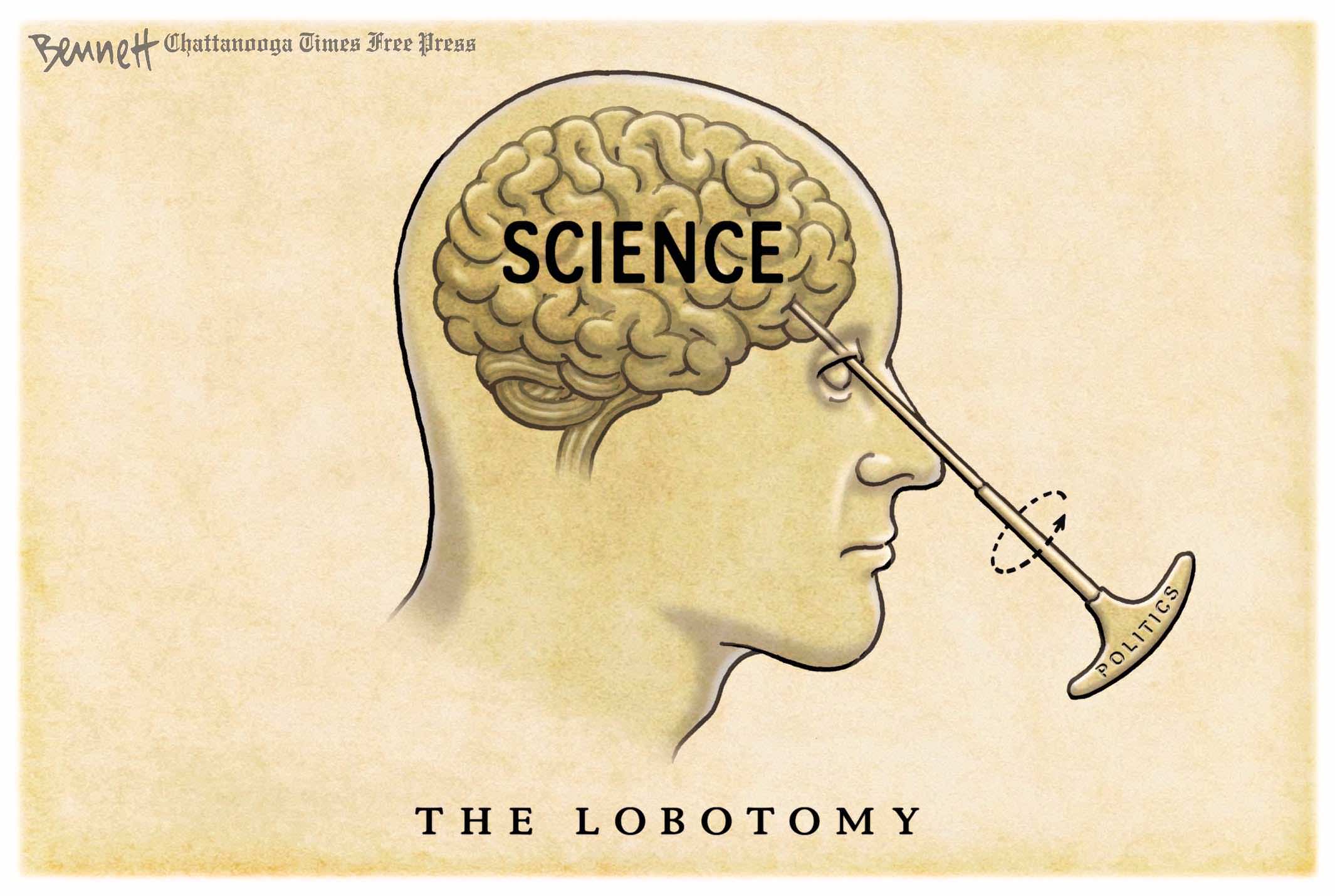
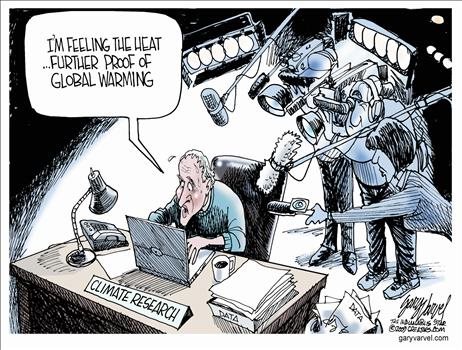
Trump effect spreads: The first Australian bank abandons the Climate Banker Club sending “shockwaves”

Banker rats jump ship. Net Zero.sinks.

By Jo Nova

If it was the end of a Big Green Bubble, it would look a lot like this…

Australia is still launching itself to Net Zero Land at the top of the Magic Faraway Tree. There was no election in Australia, and no change to the green policies. Yet, a month after the US banks quietly peeled themselves away from the Globalist Banker Blob, the first Australian bank starts backing away slowly too. They don’t explain why in any convincing fashion. Have they just lost the faith that renewables are going to work, or is this just the end of the subsidy train?

Kyle Robertson, Senior banking analyst, Australian Financial Review

This decision by Macquarie makes little sense, prioritising political expediency and short-term financial interests over the longer-term viability of its business and the economy.

Macquarie Bank has sent shockwaves around the world by quietly announcing it has quit the Net Zero Banking Alliance (NZBA) this week, taking the dubious honour of being the first major Australian financial institution to pull out of a global climate initiative.

The senior banking analyst is baffled after Macquarie spent years pumping up renewables:

It is hard to understand this sudden backslide after Macquarie spent years building up its reputation as a green bank. Macquarie chief executive Shemara Wikramanayake has been a feature of global climate conferences for years, promoting the need for large-scale public and private sector investment into renewable energy and climate adaptation initiatives.

The CEO was even recognized as “Time’s 100 Most Influential Climate Leaders in Business for 2023” ferrgoodnesssake!

Yet look at the power of bully bankers…

Robertson speaks in approving tones about the Australian bankers that are hobbling law abiding companies from providing a service consenting adults want to pay for.

ANZ and Westpac are still using corporate finance and bonds to finance companies expanding oil and gas. In contrast, the country’s largest bank, Commonwealth Bank, has ended finance for oil and gas producers without a credible Paris-aligned transition plan. At its 2024 AGM, NAB chairman Philip Chronican indicated that by October this year, the bank would end finance for companies pursuing oil and gas field expansion.

Who voted for the bankers to set Australian energy policy anyway?

If fossil fuels are so awful Robertson (or the bankers) could always try persuading people not to use them. Until then Australians allow the bankers to hold banking licences and make squillions of dollars in profits. But in a free market, a new banker could turn up and offer loans to all the unfashionable fossil fuel companies that the precious banker club eschew. Instead, citizens pay for regulatory watchdogs and police that protect these smug banker bullies against newcomers and competition.

Shh — it’s just a moment of backsliding

The announcement was made in muted tones, probably printed in grey ink, and filled with soothing words about how boring and normal it was to adjust the settings. Since Macquarie is still a significant investor in renewables projects — it probably doesn’t want to crash renewable share prices, and the CEO and the board don’t want to actually rub salt into the wounds of Labor Party policies either. So unlike the fanfare when the bankers united, the dissolution of the same banker club will be dressed up to look as boring as possible.

Does anyone believe this rot? Net Zero is all sorted now so they can step back “like many others” have?

“The NZBA helped develop global frameworks and assisted member banks as they established their initial decarbonisation plans. With those building blocks now in place, like many peers Macquarie will no longer be a member of NZBA, as we focus on updating and delivering our plans and reporting in line with regulatory requirements,” Macquarie said in a statement. — The Australian

Only the occasional “shock” from a die hard believer giving away what a radical change in direction this is.

Macquarie said it would provide a further update on its net zero ambitions in May (probably right after the election).

PS:  Yet again we see how The US Government de facto sets the policies of so many other nations all around the world.


0 out of 10 based on 0 rating

via JoNova

https://ift.tt/lT42rG6

February 12, 2025 at 02:40PM

Funding for University Wokism Cut

William M Briggs explains in his blog article Trump Slashing The Cancerous “The Science” Bloat: Cut Cut Cut! Excerpts in italics with my bolds and added images.
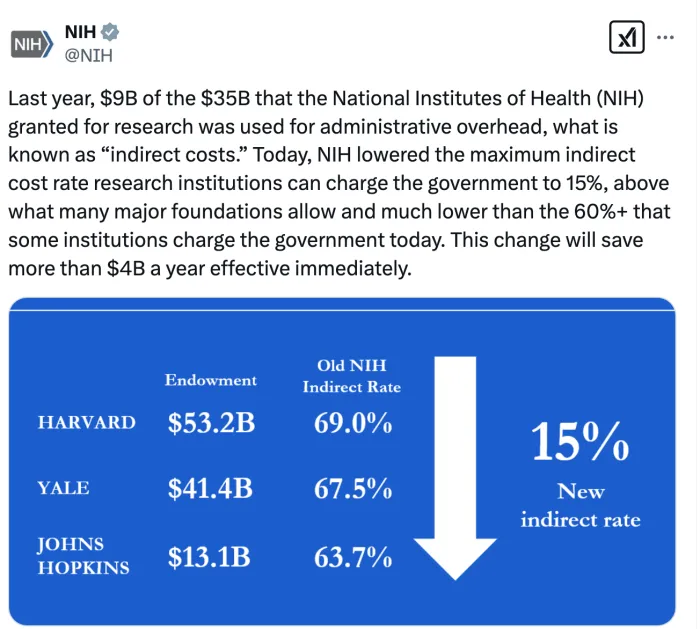
I responded on Twitter (follow me): “You might not know it, but this is a MAJOR VICTORY of outstanding proportions. Overhead is what fed the administrative beast. Overhead paid for DIE. Overhead paid for assistants to the assistants to the assistant Deans for development. Kill the Beast by starving it.”

For those new to grants, the overhead is the amount tacked on by the researchers’ institution to a researcher’s grant. If a Harvard grant is for, say, $1 million, an amount already bloated for all the usual reasons of excess, then the amount NIH pays to Harvard is $1,690,000. That extra $690,000 feeds the Beast. The Beast grows and causes the original grant totals to swell, for reasons not directly related to the research, like increased salaries for all and such like. Bureaucrats are spawned from the overhead funds. They emerge from their pods with gaping maws mewing to be fed—fed—fed! Overhead is a slow-motion monster movie.

(If you want more detail on overhead, this is a good article.)

Now I know this next part will make no sense to you, but not all are taking well the splendiferous news overhead will be treated like a bikinied teenager in a Wes Craven movie. The far-left politics journal Science screamed “NIH slashes overhead payments for research, sparking outrage“.

“Outrage”, as we have said many times, is the second of only
two emotions a woke can express. The first being smug self-satisfaction.
They don’t get the first anymore, though.

Or take as representative lead covid panicker Eric Fing-Ding. Through sweet, sweet tears, he tweeted (among other things) that the cuts will “COMPLETELY DECIMATE MEDICAL & PUBLIC HEALTH RESEARCH”.

Bad news, because we’d like the effect to be greater than a mere measly ten percent. We need to whack, with pitiless remorseless brutality, at least half of governmental science funding. The Science article was more hopeful. They said “‘This is a surefire way to cripple lifesaving research and innovation,’ said a statement from the Council on Governmental Relations (COGR)”.

Crippling is much better than decimating.

Bring on the pain. Their pain. Universities have had it good too long. And we’ve had it bad.  It’s not only your old Uncle Sergeant Briggs saying this.

Here’s a ripe pull from “The natural selection of bad science” by Paul E Smaldino and Richard McElreath. These fellas are not critiquing cellar-dwelling simulacra of science, like say sociology, but what’s taken as the good stuff, like medicine.

These are not the only ones on the inside saying these things. The word is out. Science has gone bad: “A 2015 British Academy of Medical Sciences report suggested that the false discovery rate in some areas of biomedicine could be as high as 69 percent.”

Data Republican says: “Universities are among the largest drains on taxpayer money in my dataset. They receive massive funding from NGOs and USAID, and they take more government grants on top of that. Meanwhile, anonymous professors have reported to me that true scientific research is stagnating due to DEI mandates and administrative bloat.”

Understand: universities were ground zero for the DIE zombie invasion. And much worse. A tsunami of bad ideas flowed from universities over the last century. Many of those responsible are still employed there. These people need to be made to go. It’s not only DIE, but the base bloat caused by government micro-managing science. It is government, almost completely, that decided what got funded, and funded to ridiculous levels. This forced consensus-based science upon us. This has stifled much innovation, as we have seen time and again. It must be made to change, for change won’t come from within.

Now that 15% might eventually rise, given the wounded howling coming from universities (an AFMR email said “We have also launched an E-Action Alert to engage the broader scientific community and mobilize support for advocacy efforts to reverse or mitigate these changes.”).  But the rate must fall. The NIH and NSF budgets need to treated like the mess they are.

The only way to rid ourselves of this stuff is to stop feeding those producing it. We need to force a restructuring and rethinking. The old ways need to go. The only way to do this is to cause pain. Minor course corrections are not enough. Cut, cut, and cut some more. Make it sting.

See Also:

Examples of Debased Government Science

Trust Me, I’m a Scientist. Really?

Why Federalized Science is Rotten

via Science Matters

https://ift.tt/gkwn0G3

February 12, 2025 at 02:38PM

Climate Trends In The Congo

Another video showing how traditional AI is largely useless at gathering scientific information. In order to get the right answer, you need to use analytic AI.

About Tony Heller

Just having fun

This entry was posted in Uncategorized. Bookmark the permalink.

via Real Climate Science

https://ift.tt/qbkmMKN

February 12, 2025 at 02:12PM

Underestimating Clouds: A Climate Mistake We Cannot Afford

By Vijay Jayaraj

Carbon dioxide (CO₂) has been predominantly portrayed as the chief culprit driving global warming. For decades, this misconception has guided international policies, prompted ambitious targets for reducing CO2 emissions and driven a shift from reliable and affordable energy resources like coal, oil, and natural gas toward problematic wind and solar sources.

However, this theory overlooks important factors that influence Earth’s climate system, including a critical variable in the climate system – the role of clouds, which remains woefully underestimated.

Recent work by physicists W. A. van Wijngaarden and William Happer challenges this prevailing paradigm: Their new paper, Radiation Transport in Clouds, suggest clouds affect atmospheric temperature more than CO2 because they have a greater impact on the comparative amounts of solar energy entering Earth’s atmosphere and escaping to outer space.

The Overshadowed Influence of Clouds

Clouds simultaneously reflect incoming sunlight back to space (cooling the Earth) and trap outgoing heat (warming the Earth). This dual nature makes clouds both powerful and perplexing players in our climate system. The net effect of clouds on climate is a balance between these opposing influences, thus a central component of the Earth’s energy budget.

A recent study by van Wijngaarden and Happer, titled “Radiation Transport in Clouds,” delves into this complexity. The 2025 paper says the radiation effects of clouds can easily negate or amplify the impact of CO2. The researchers highlight that clouds have a more pronounced effect on Earth’s radiation budget than greenhouse gases like CO₂.

For instance, their research reveals that a modest decrease in low cloud cover could significantly increase solar heating of the Earth’s surface. In comparison, a doubling of atmospheric CO2 concentrations reduces radiation to space by a mere 1%: “Instantaneously doubling CO₂ concentrations, a 100% increase, only decreases radiation to space by about 1%. To increase solar heating of the Earth by a few percent, low cloud cover only needs to decrease by a few percent.”

This stark contrast highlights the disproportionate influence of cloud dynamics compared to CO2 fluctuations. Most state-of-art climate models are still in their infancy. We need more accurate measurements of clouds’ properties and their influence on the electromagnetic components of solar radiation if they are to be useful inputs for climate models.

Implications for Energy Policy and Reliability

Current strategies assume a direct and dominant link between CO2 emissions and global temperatures to justify aggressive “decarbonization” efforts and an increase in the use of solar and wind energy.

However, solar and wind are inherently intermittent, rendering them unreliable and very expensive as components of a power grid. The infrastructure required to support these technologies entails substantial upfront investments, higher operating costs and increasing utility bills for consumers.

Blackouts, energy shortages and price spikes are becoming increasingly common in regions that have prematurely decommissioned fossil fuel plants without adequate backup solutions. This trend disproportionately affects vulnerable populations, exacerbating energy poverty and hindering economic development.

The major justification for using solar and wind has been that they counter global warming by reducing CO2 emissions from burning fossil fuels. If small variations in cloud cover actually overwhelm the effects of CO2, then the climate’s sensitivity to greenhouse gases is being significantly overestimated. This has profound implications for policy.

Attributing global warming predominantly to CO₂ emissions from the use of fossil fuels is a gross oversimplification. While CO2 undoubtedly has a warming effect, it is relatively modest and beneficial, mainly moderating the difference between daytime and nighttime temperatures. On the other hand, clouds, with their multifaceted interactions and feedbacks, represent a critical and underappreciated component of this puzzle.

The findings of van Wijngaarden and Happer highlight a broader issue within climate science: the tendency to oversimplify complex systems for the sake of political expediency. As the global energy landscape continues to evolve, it is imperative that decisions be based on sound science rather than political dogma.

The time has come to reassess our approach to both climate science and energy policy. The stakes are too high to continue down a path of destructive policies based on erroneous analyses. We must prioritize reliable, affordable energy sources and grid stability over useless reductions in emissions of a harmless gas.

Click here to access the entire Radiation Transport in Clouds paper.

This commentary was first published at BizPac Review on February 10, 2025.

Vijay Jayaraj is a Science and Research Associate at the CO2 Coalition, Arlington, Virginia. He holds an M.S. in environmental sciences from the University of East Anglia and a postgraduate degree in energy management from Robert Gordon University, both in the U.K., and a bachelor’s in engineering from Anna University, India.


Discover more from Watts Up With That?

Subscribe to get the latest posts sent to your email.

via Watts Up With That?

https://ift.tt/ZaBtU9J

February 12, 2025 at 12:03PM