Data source: U.S. Energy Information Administration, Hourly Electric Grid Monitor Note: EST=eastern standard time
Below average temperatures in the eastern United States during the week of January 19, 2025, resulted in high demand for electricity. On January 21 at 6:00 p.m. eastern time, ISO-New England (ISO-NE), the organization operating an integrated grid in Maine, Vermont, New Hampshire, Massachusetts, Rhode Island, and Connecticut, recorded peak hourly demand of 19,600 megawatts (MW). Although demand was elevated, it was lower than the 20,308 MW that ISO-NE forecast peak demand would be in its 2024/2025 winter assessment published on November 7, 2024. Temperatures were more moderate in New England than in the Midwest, which tempered electricity demand somewhat in New England.
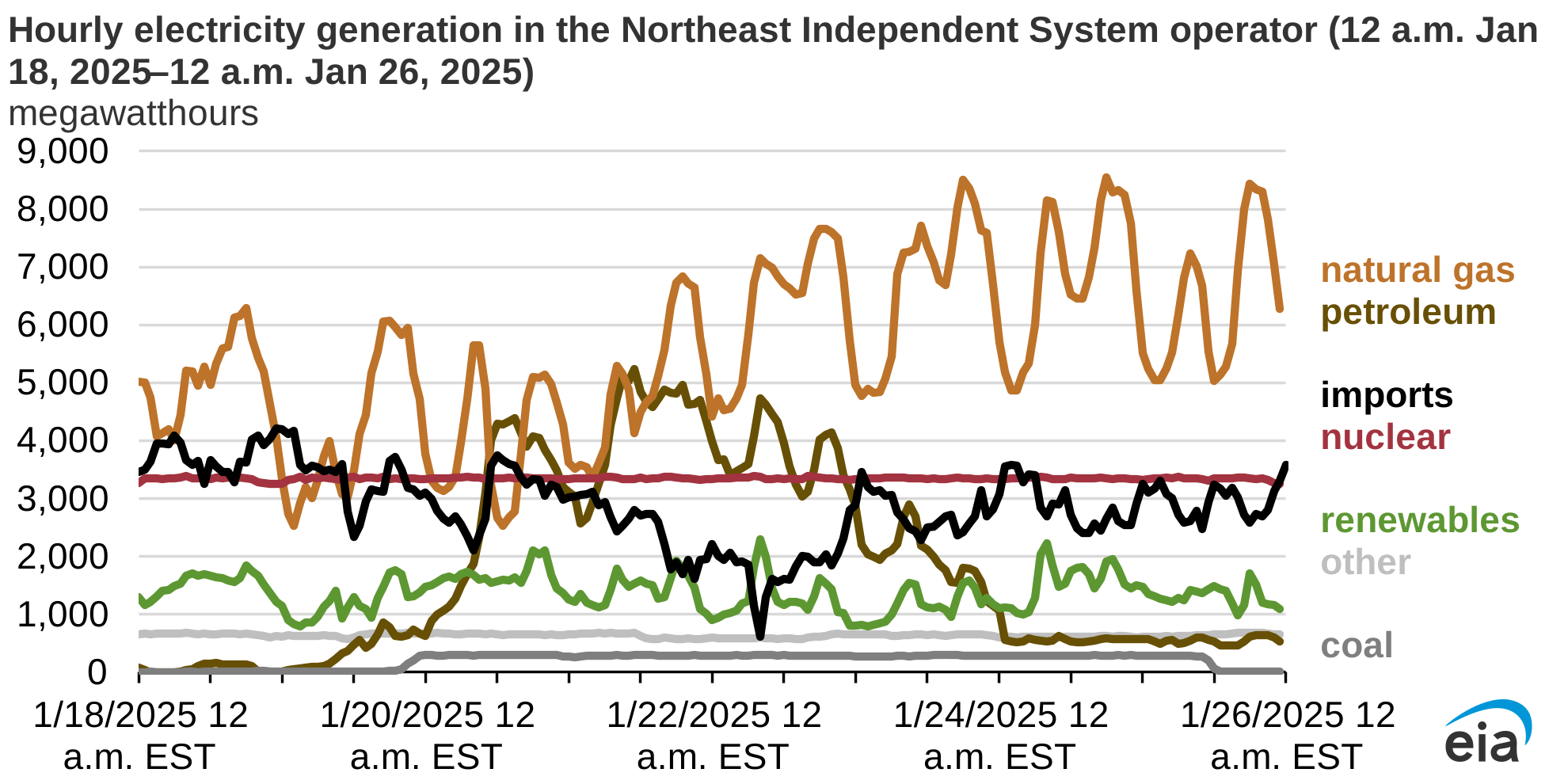
Although the grid had sufficient generating capacity to satisfy demand, a significant share of that supply came from sources that rarely operate. The grid required running older thermal generating plants that burn oil and coal. Between the hours of 11:00 a.m. and 4:00 p.m. eastern time on January 20, 2025, and between the hours of 10:00 a.m. and 1:00 p.m. on January 21, 2025, thermal plants that burn oil provided more electricity to the ISO-NE electricity grid than plants that burn natural gas, which is relatively uncommon. On January 21, 2025, the same group of thermal plants in ISO-NE provided more than 4,000 MW of electricity per hour to the grid between 7:00 a.m. and 11:00 p.m. At the same time, one of the two remaining coal-fired plants that burns coal in the region, the Merrimack facility in New Hampshire, supplied close to 300 MW to the grid from the evening of January 19 to the morning of January 25.
Oil and coal offset curtailed generation from natural gas-fired power plants from January 18 to January 22. Prices for natural gas were high, and supplies were short during this period because of more demand for natural gas from other consumers, such as homes and businesses. Later in the week, more natural gas was made available, including supply received from a liquefied natural gas (LNG) import terminal in Everett, Massachusetts. This supply helped boost generation from natural gas-fired power plants beginning on January 22.
Two other major sources of electricity in New England were steady suppliers during the cold snap. The region’s three nuclear reactors steadily provided 3,350 MW of power throughout the period, joined by consistent imports of power from Canada. At 11:00 p.m. on January 18, imports of electricity from Canada surpassed 4,200 MW and averaged 2,886 MW per hour between midnight on January 18 and midnight on January 26.
Principal contributors: Kimberly Peterson, Sue Smith
I prefer to use stacked area plots to evaluate the contributions of different generation sources.
Figure 1. ISO New England electricity generation by source 1/18/2025 – 1/26/2025. US EIA
Nuclear power provided a stable baseload. Coal ramped up to reinforce that baseload. Natural gas ramped up and down with demand. Petroleum-fired power plants ramped up to cover the demand gas couldn’t keep up with. Hydroelectric and pumped storage wallowed on top of the waves. While solar, wind and battery power remained largely invisible.
How many ways to count the irony?
Irony #1
The first irony is the fact that New England had to import foreign liquified natural gas (LNG) because they steadfastly resist the construction of natural gas pipelines.
Even with New England’s relative proximity to the Marcellus and Utica shale gas basins in Pennsylvania, West Virginia, and Ohio, the rise in production from these areas has not been matched by pipeline infrastructure to deliver fuel supplies to the region. Complicating matters for New England is a lack of underground storage that could be used to help smooth out seasonal demand spikes.[3]
The Northeast is also effectively cut off from domestic LNG supplies. While the US exports LNG from terminals on the Gulf Coast and Cove Point, Maryland, cargoes from these locations and other US ports cannot be delivered to New England as a result of the Jones Act, which restricts maritime commerce between US ports. (The Jones Act is discussed in greater depth later in this piece.)
Demand for natural gas in the region has grown over the last decade as a result of new, gas-fired power plants, coal and nuclear plant retirements, and residential users switching from heating oil to natural gas.[4] Nearly half of New England’s power plants now use natural gas as their primary fuel (about 15,000 MW)[5] and 46 percent of homes in the region use natural gas for heating.[6]
The region is served by two LNG import terminals in Massachusetts: the Everett and the Northeast Gateway terminals. In addition, Maryland’s Cove Point Terminal and Georgia’s Elba Terminal can import additional supplies to make up regional shortfalls when they occur.
Oil and coal offset curtailed generation from natural gas-fired power plants from January 18 to January 22. Prices for natural gas were high, and supplies were short during this period because of more demand for natural gas from other consumers, such as homes and businesses. Later in the week, more natural gas was made available, including supply received from a liquefied natural gas (LNG) import terminal in Everett, Massachusetts. This supply helped boost generation from natural gas-fired power plants beginning on January 22.
Nuclear, oil, and coal generators are critical on the coldest winter days when natural gas supply is constrained (as shown below). Coal- and oil-fired resources also make valuable contributions on the hottest days of summer when demand is very high or major resources are unavailable. As more and more conventional, thermal generation facilities that store fuel on site retire, the system is increasingly made up of generating facilities that run on “just-in-time” energy sources: natural gas (from pipelines and LNG deliveries), wind, and solar energy.
With limited options for storing natural gas, most natural-gas-fired plants rely on just-in-time fuel delivered to New England through interstate pipelines. However, interstate pipeline infrastructure has only expanded incrementally over the last several decades, even as reliance on natural gas for home heating and for power generation has grown significantly. During cold weather, most natural gas is committed to local utilities for residential, commercial, and industrial heating. As a result, during severe winter weather many power plants in New England cannot obtain fuel to generate electricity. Liquefied natural gas (LNG), brought to New England by ship from overseas, can help fill the gap—but regional LNG storage and sendout capability is limited, and its timely arrival depends on long-term weather forecasts, global market prices, and other logistical challenges.
New England’s largely left-wing enviro-nitwit governments are betting big on wind and solar power.
New England states move forward with three giant offshore wind farms
By Reuters
September 6, 2024
NEW YORK, Sept 6 (Reuters) – Massachusetts and Rhode Island are moving ahead with three offshore wind projects totaling 2.9 gigawatts (GW), or enough electricity to power about 1.6 million homes, government officials announced on Friday.
The project selections, following a joint solicitation in March for wind farms to be built off of New England’s shores, move Massachusetts and Rhode Island closer to state renewable energy goals aimed at combating the effects of climate change.
[…]
Federal and state climate pledges have largely centered around decarbonizing electrical grids by replacing fossil-fired power with renewable wind and solar. Massachusetts aims to slash its power sector’s carbon emissions by 50% by 2030 and 100% by 2050. The much smaller Rhode Island has set a goal to use all renewables by 2033.
Winter also poses the greatest challenges for solar output in New England due to snow, clouds, and shortened daylight hours. In addition, shortened winter days means consumers use the most electricity after sunset, and therefore solar doesn’t reduce winter peak demand. While offshore wind experiences its highest production during winter, winter storms that limit solar power can also significantly limit the output of wind generation if high wind speeds force plant operators to shut down in order to protect equipment. This type of variability is a n understandable challenge in meeting the states’ decarbonization goals through greater renewable, weather-dependent technologies, and it poses new technical challenges to the grid’s reliability.
Solar power works best when it’s lease needed in New England.
Irony #3
During the recent cold snap, peak demand occurred at 0800 on January 22.
Figure 3. ISO New England electricity generation by source 1/18/2025 – 1/26/2025, with peak demand highlighted.
Fossil fuels and nuclear power provided 83% of the power generation. Hydroelectric and pumped storage covered 13%. Wind accounted for 1%, Solar and battery storage delivered zero-point-zero percent of the generation.
Figure 4. ISO New England electricity generation by source 0800 1/22/2025.
Irony #4
The final irony is that I was born (1958), raised, went to college and earned a geoscience degree (1980) in Connecticut back during The Ice Age Cometh era.
I had just finished my sophomore year of college when this In Search Of episode aired in May 1978.
Since 1981, I’ve been a geophysicist/geologist in the oil & gas industry in Texas… Helping provide the oil & gas that keeps New Englanders from freezing in the dark… And, I guess, also contributing to some degree to the global warming, that saved them from The Ice Age Cometh.
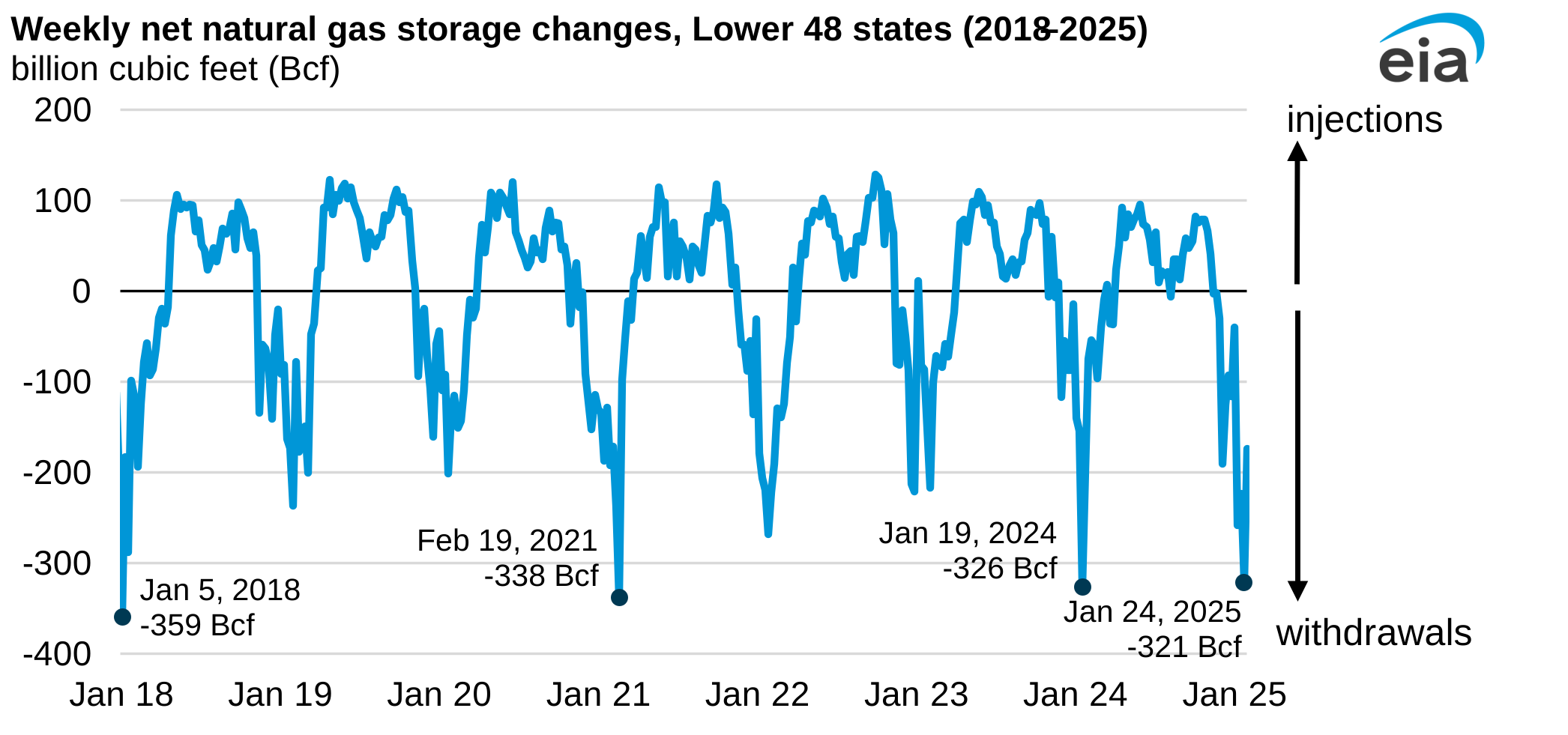
Fortunately for those affected by adverse weather (like really cold nights), the oil & gas industry produces natural gas, with very few exceptions, 24/7/365. We inject it into subsurface storage facilities when production exceeds demand, so that it can be withdrawn when demand exceeds production.
Crazy Ed Miliband wants to cover the countryside with hundreds of industrial scale solar farms.
Yesterday the combined 18 GW of solar capacity which we already have produced the princely total 3.1 GWh, having peaked at 0.7 GW at midday. That meant they were running on average at just 0.7% of their capacity.
Last week, the Government gave its response to a petition calling for the repeal of the Climate Change Act and for Net Zero targets to be rolled back. The response could have been written by a Just Stop Oil activist and can be summarised as “the earth is warming, build more windmills.” I was going to draft an article rebutting their claims, but as luck would have it, the video of the talk I gave for Sacred Cows last month is now available and goes into more detail than I could in a single article. I would be grateful if you could share this article and video far and wide.
The slides accompanying the talk can be downloaded on the link below.
Sacred Cows: Net Zero Worse Than Climate Change 1.21MB ∙ PDF file
What if the Net Zero cure is worse than the Climate Change disease?
My argument can be summarised as follows.
Climate Change Exaggerated
Although people like Antonio Guterres have made the foolish claim we have entered the era of global boiling, we have to acknowledge that the world has warmed a bit since pre-industrial times. The alarmist response to this is Net Zero which is an example of a so-called mitigation strategy that calls for everyone to reduce their emissions of carbon dioxide to save the planet.
Mitigation Can Never Work
The trouble with this approach is that it can only work if two conditions are met. First, mitigation can only work if CO2 is the only climate control knob. But we know this to be wrong, because the IPCC’s first report showed marked temperature fluctuations over thousand-, ten thousand- and million-year timescales when CO2 levels in the atmosphere were pretty constant. Second, mitigation can only work if everyone else follows the same strategy. But we know that global emissions of greenhouse gases are rising sharply even though ours have fallen into insignificance. Global consumption of coal, oil and gas are at record levels. Neither condition is met, so the UK’s Net Zero mitigation strategy can never work.
Impact of Net Zero Policies
Nevertheless this has not stopped politicians and policymakers rushing headlong into Net Zero policies that have resulted in the UK having the most expensive industrial electricity costs in the IEA, some 4X those of the US and 2.6X Korean prices. This is leading to energy austerity with UK primary energy consumption down 23% since 1990 while global energy consumption is up 72% over the same period. Our National Energy System Operator, NESO wants to double down on energy austerity and halve our energy consumption per capita from 2023 levels by 2050.
High energy prices coupled with energy austerity have led to economic stagnation. There is a strong correlation between reduced energy use and slow growth, with the EU27 and US growing faster than the UK because they have had smaller cuts to energy use. Korea, India China and the rest of the world are using much more energy and their economies are powering ahead.
Myths Created to Promote Renewables
Despite the obvious economic and social costs of Net Zero, a series of myths have been created to support the renewables agenda. They claim renewables are cheap, but we pay £11bn/yr in renewables subsidies, £2.5bn for grid balancing and a further £1bn for the capacity market. National Grid have announced £112bn in spending on grid expansion by 2035 which will also find its way on to our bills. Moreover, the cost of renewables is rising and projects like Norfolk Boreas and Hornsea Project Four have been cancelled because the developers cannot make money at the prices they agreed. Ed Miliband wants to spend £260-290bn by 2030 on his Clean Power plan to save only around £7bn/yr of the money we spend on gas-fired generation.
The second myth is that Net Zero will create jobs and growth. But the truth is expensive energy costs are destroying high-productivity industries like chemicals, petrochemicals, ceramics and steel that are growing more slowly than the rest of the economy or outright shrinking. Instead we are growing less energy intensive low-productivity sectors that are damaging productivity and growth for the whole economy. Green energy jobs are destroying real jobs and cost around £250K/yr per job.
The third myth is that renewables increase energy security. But intermittent sources like wind and solar can never deliver security because we cannot control the weather. As a result we came close to blackouts last month as NESO suffered a margin call. We cannot rely upon interconnectors either, because the Norwegian Government fell because of the impact interconnectors are having on their electricity prices.
Finally, it is claimed that wind and solar renewables are green and kind to the environment. But both have very high mineral intensity, meaning massive mines will be scarring the landscape to produce the copper, silver, cobalt and rare earth metals required. They also take up a lot of land, land that would be better utilised to grow food.
Adaptation is a Superior Strategy
By contrast, adaptation is a far superior strategy. Deaths from natural disasters and weather events have fallen more than 10-fold over the past century as we have used cheap, abundant energy to tame nature. Global life expectancy has doubled since 1850 and cereal yields are up three times since 1961. These remarkable achievements have come despite, some might argue because of, the rise in temperatures and global CO2 levels.
Nuclear Power is the Answer
Turning now to the answer. For humanity to thrive, we need cheap, abundant and reliable energy. This will give us the surplus energy that we need to continue to adapt by building flood defences, improving irrigation developing new crop varieties and so on. Adaptation has the big advantage is that it works regardless of the cause of global warming or climate change. The only technology that is proven to work at scale is nuclear power. This will take time, so we need gas as a transition technology. Nuclear power has the added advantage of being energy dense, reliable and requires very little mining so has the smallest overall environmental footprint. We need nuclear power everywhere all at once.
In conclusion, Net Zero is ineffective in achieving its primary goal and can never stop the weather changing. The impact of Net Zero policies is devastating for the economy and high productivity, energy intensive industries in particular. Renewables are not kind to the environment and the lies being told to promote them are untenable. The Net Zero cure is worse than the climate change disease.
Many thanks to Will and the team at Sacred Cows for giving me the opportunity to speak. The venue was sold out and judging by the conversations I had afterwards, the event went down very well on the night.
The talk is now also available as a podcast on Spotify.
Discover more from Watts Up With That?
Subscribe to get the latest posts sent to your email.