Germany may have to rely on standby coal-fired power generation longer than previously expected, to keep its power system stable and power prices from spikes when renewable output is low.
The German plans to build new natural gas-fired power plants are behind schedule while the reserve margins on the system have shrunk since Europe’s biggest economy shut down its last nuclear power plant in 2023.
The EU says it must ‘adapt to new realities’. The actual climate isn’t new, but the political and economic climate obviously is, with the arrival of Donald Trump in US power again. Suddenly EU bureaucrats notice that their ‘decarbonisation’ policies (aka net zero) are greatly hindering the economies of the member countries for no measureable result, as global carbon dioxide levels continue their long rise anyway. Now they want to have their net zero cake and eat it.
– – –
BRUSSELS — The European Union’s new economic “compass” has a north star the burgeoning movement to revoke stringent green rules will love, says Politico.
A leaked draft of the European Commission’s competitiveness compass — an economic doctrine to guide the EU executive’s work for the coming five years — points toward widespread deregulation targeting the European Green Deal in particular.
“This Commission will deliver an unprecedented simplification effort,” the document reads, singling out new rules governing financial and corporate sustainability efforts. [Talkshop comment – unprecedented is an overused word].
A law to streamline these rules is expected in February, but the compass suggests more is to come, describing next month’s proposal as merely the “first” simplification bill.
“In some areas, existing policies will have to be accelerated and upgraded, in others a change of approach is needed to adapt to new realities,” the draft document says.
Still, the compass vows the EU will “stay the course” on its climate targets. But the document’s focus on slashing environmental red tape to boost the European economy fits neatly into growing calls to revise or repeal large parts of the Green Deal — the slate of rules designed to get the EU to net zero emissions by 2050.
The loudest demands for a green rethink have come from the center-right European People’s Party (EPP), the political family of Commission President Ursula von der Leyen, whose leaders ramped up their attacks on the Green Deal this week.
. . .
But the EU’s new economic doctrine appears to put deregulation before decarbonization, with climate efforts taking a backseat to the Commission’s newfound focus on competitiveness.
“The transition to a decarbonised economy must be competitiveness-friendly and technology neutral,” the draft document reads. “The Compass goal is a Europe where tomorrow’s technologies and clean products are invented, manufactured and marketed, as we stay the course to carbon neutrality.”
Full article here.
– – –
Image: European Commission HQ, Brussels [credit: Em_Dee @ Wikipedia]
The endangerment finding is the linchpin of much of the EPA’s climate-related regulatory authority. Issued during the Obama administration, this finding declared greenhouse gases such as carbon dioxide, methane, and nitrous oxide as pollutants that endanger public health and welfare. By initiating this review, President Trump has taken the first step toward unraveling the faulty rationale that has fueled countless overzealous climate policies.
“Trump’s executive order bomb, followed by Congressional action to limit funds from the IRA and IIJA, promise to gut, or profoundly reshape, the U.S. green energy movement. January 2025 may begin a long decline for green energy and a return to sensible energy policy.”
President Trump has long been a supporter of traditional, consumer-driven energy. During his campaign, he spoke negatively about electric vehicles, wind, and other renewable energy sources. But in his first day in office, the new president began a historic shift in US energy policy, away from “green” energy and back to hydrocarbon energy.
On January 20, 2025, President Trump signed five wide-ranging executive orders that radically change United States energy and climate policy. These actions restore efforts to promote coal, natural gas, oil, hydropower, nuclear, and biofuels, while curtailing support for wind and electric vehicles. The Trump executive orders also rescinded orders issued by President Biden and closed federal departments established to promote climate change policies and green energy.
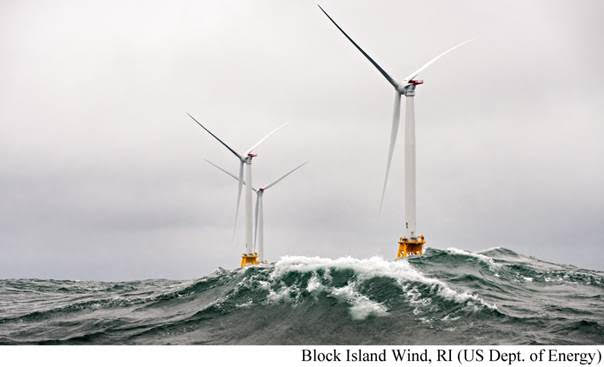
The executive order regarding “offshore wind” and “wind projects” immediately impacted the world wind industry. The US government owns all land from three miles to 200 miles offshore, so wind companies require a federal lease to build offshore systems. The order withdrew “all areas within the Offshore Continental Shelf” from wind leasing. The order also requires that the new Secretary of the Interior, Doug Burgum, “conduct a comprehensive review” to determine the necessity for “terminating or amending any existing wind energy leases” and to submit a report to the President. The order also put a hold on the Lava Ridge Wind Project in Idaho, pending a review by the Secretary of the Interior, a project which was approved by the Biden Administration in December.
Wind energy markets were shocked by Trump’s order. The stock price of Orsted, a Danish wind system supplier, dropped 17% to its lowest price in seven years. Orsted proposed to build Sunrise Wind, the largest planned US offshore wind system, to be located southeast of New York City. The company immediately took a $1.69 billion impairment charge on US wind projects.
Wind suppliers RWE of Germany, Equinor of Norway, Renovaveis of Portugal, and Vestas of Denmark also suffered stock price declines. Italy’s Prysmian announced that it would abandon a plan to build a plant in the US to make cables for offshore wind systems.
Wind energy plans for several states have been crippled. California planned to install 25 gigawatts of offshore wind energy by 2045, with initial projects at Morro Bay and Humbolt Bay, but these plans are on hold for at least the next four years. Maryland, Massachusetts, New Jersey, New York, North Carolina, South Carolina, Rhode Island, and Virginia are constructing or planning east coast offshore systems, but these programs will be reviewed, limited, or halted if not yet started.
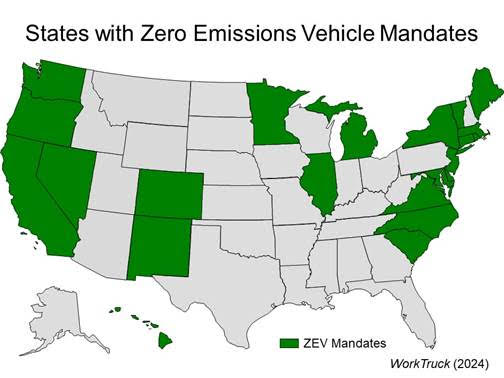
The “Unleashing American Energy (UAE)” executive order calls for elimination of the “electric vehicle (EV) mandate” to promote consumer choice and access to gasoline-powered automobiles. It’s true that we have no formal EV mandate, but 22 states have zero-emissions vehicle laws or executive orders prohibiting sales of gasoline cars by a future date, typically 2035. On March 20 of last year, the Environmental Protection Agency (EPA) issued updated emissions standards that would force auto manufacturers to sell an increasing number of EVs, rising from about 8% last year to about 56% of new light vehicle purchases by 2032.
The Trump orders also call for termination of state emissions waivers “that function to limit sales of gasoline powered automobiles.” The 1970 Clean Air Act established the federal government as responsible for regulating pollution, except where a waiver is granted by the EPA to a state. For years, California has set emissions standards, receiving EPA waivers to do so, with other states following California’s lead. The orders seek to terminate these waivers to California and restore emissions control to the EPA. Earlier this month, California withdrew their request for a waiver for regulations to electrify heavy trucks and locomotives because it appeared that Trump’s EPA would not grant that request.
The order also calls for the “elimination of unfair subsidies and other ill-conceived government-imposed market distortions that favor EVs.” This probably refers to coming efforts to eliminate the $7500 tax credit on new EV sales and also efforts to eliminate the Corporate Average Fuel Economy standards issued by the Department of Transportation, which force auto manufacturers to sell a larger share of EVs.
The US economy today includes several green energy industries which probably would not exist without the vast array of federal and state subsidies and tax credits. Wind, solar, EV charging, carbon dioxide (CO2) capture, and green hydrogen receive a limitless stream of subsidies and tax credits from the Inflation Reduction Act (IRA) and the Infrastructure Investment and Jobs Act (IIJA), both of which were passed during the Biden Presidency. The CATO institute estimates that renewable energy will receive about $80 billion in federal funds during fiscal year 2025.
During his campaign, Mr. Trump vowed to eliminate the money flow from these two acts, and his first-day executive orders reflect this. The UAE order calls for “termination of the Green New Deal,” and a halt to the disbursement of funds from the IRA and IIJA. President Trump will probably need to pass Congressional legislation to permanently reduce the flow of IRA and IIJA funds.
Wind and solar systems are intermittent, use 100 times the land area, and require at least double the transmission infrastructure compared to traditional coal, gas, or nuclear power plants. Few utilities would build wind and solar systems if not for the fear of human-caused global warming. But the new executive orders make it clear that the US will no longer pursue efforts to “mitigate” climate change.
In the executive order titled “Putting America First in International Environmental Agreements,” the President directs the US Ambassador to the United Nations, nominee Elise Stefanik, to notify the UN in writing that the US withdraws from the Paris Climate Agreement, effective immediately. The order also states that the US will immediately cease financial payments under the Framework Convention on Climate Change.
The orders direct executive branch officials to cancel at least five Biden executive orders on climate change, and to disband the Climate Change Support Office, the American Climate Corps, and The Working Group on the Social Cost of Greenhouse Gases. The orders also call for the EPA to review the 2009 Endangerment Finding for “continuing applicability.” That finding concluded that carbon dioxide endangered US citizens and is the basis for regulating CO2 emissions in the US.
The Trump actions also seek to boost the development of hydrocarbon energy in the spirit of “drill, baby, drill.” Key actions include re-opening the licensing of liquified natural gas terminals, opening federal lands for onshore and offshore oil and gas production, reopening Alaska lands for energy production, and reducing efficiency regulations on dishwashers, stoves, and furnaces. The President also declared a national energy emergency to speed the deployment of pipelines and other energy infrastructure. The Trump EPA and Department of Energy will roll back regulations on oil and gas to expand US production.
Trump’s executive order bomb, followed by Congressional action to limit funds from the IRA and IIJA, promise to gut, or profoundly reshape, the U.S. green energy movement. January 2025 may begin a long decline for green energy and a return to sensible energy policy.
——————————-
Steve Goreham is a speaker on energy, the environment, and public policy and author of the bestselling bookGreen Breakdown: The Coming Renewable Energy Failure. His previous posts at MasterResource can be found here.