
Accurately measuring the sea level with a satellite is highly complex and fraught with uncertainty. Even the slightest equipment miscalibrations can produce inaccurate results.
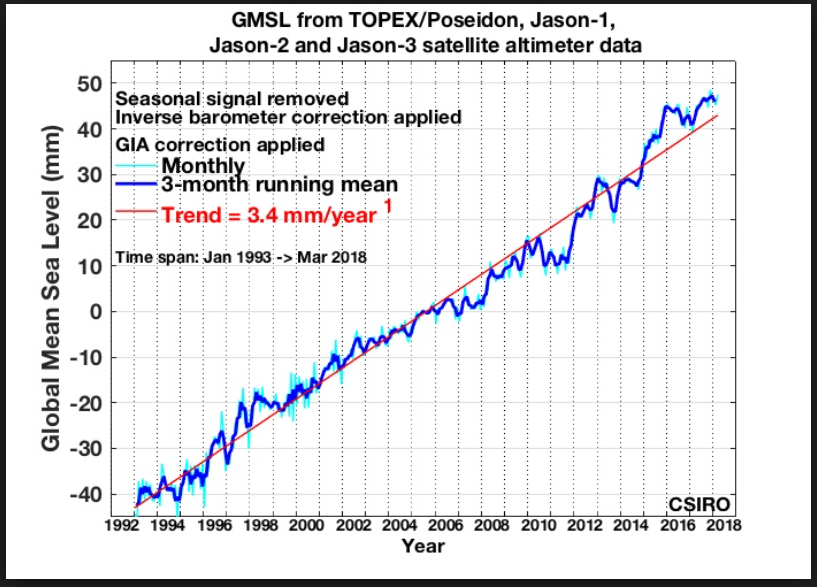
Huge discrepancy exists between satellite measurements and observed coastal tide gauge readings. Source: CSIRO.
For sea level rise, the figures that are often cited come from namely two sources: satellite measurement, which go back 25 years and so do not properly account for multidecadal variations, and tide gauges placed along the coastlines where people actually live.
Satellite data may be overstating sea level rise
The assumed current global sea level rise from the satellite data TOPEX/Poseidon spacecraft and its successors, which began collecting data in late 1992, is reported by NASA’s Jet Propulsion Laboratory (JPL) to be 2.8 inches (7 centimeters).
Some experts recently warned however — after having made adjustments to the satellite measurements — that sea level rise has accelerated and thus could rise some 75 centimetres over the century, which would be in line with projections made by the Intergovernmental Panel on Climate Change (IPCC) in 2013.
Other sources say that sea level rise could be as much as 3.4 mm per year, and thus accelerating (e.g. see chart above).
Indeed if these high-end projections were accurate, then coastal areas would be facing serious challenges. But those alarmist claims have been met critically, and at times even with derision.
There remains lots of uncertainty, and so the question today is: How much are coastal areas (where it really matters) at risk really?
Tide gauges: “most extensive, accurate and significant” datasets
One way to check what’s really going on is to examine the tide gauges along the coasts worldwide. Since the early 1800’s, NOAA and its predecessor organizations have been measuring tide levels.
According to the NOAA, “This database has become one of the most extensive, accurate and significant geophysical data sets in existence.”
To do this the NOAA keeps a coastal station tide list for tracking global linear relative sea level (RSL). Manually I counted 358 stations. A number of them stopped measurement some years ago, while others were put in operation in the 20th century.
The data and charts can be looked at country-by-country here.
Less than 1% on track to meet IPCC’s 75 cm sea level rise by 2100
Examining the data to get a general idea how the sea level is behaving at these tide stations. A number of points were observed:
1) Only 3 stations show a RSL rise of 7.5 mm/year or more, meaning that only three stations (0.08%) are on track to reach the IPCC’s alarmist 75 cm sea level rise projection by 2100. And if we use the more conservative 60 cm rise, only 5 stations (1.4%) are on track!
Only 14% show a rise equal to or greater than satellite global rate
2) Only 51 tide gauges (14%) are measuring 3.2 mm/year or more, which is approximately equivalent to about what the satellites are said to be measuring globally. That figure would need to be near 50% if the satellites were true.
3) 54 coastal tide gauges (15%) show that relative sea level has in in fact been falling.
4) The mean relative sea level rise as to the tide gauges is about one third less than what is measured by the satellites, i.e. approx. 2.3 mm per year, or less than 10 inches per century.
This is only a rough overview. Naturally a more detailed look recent tide gauge trends of the last 2 or 3 decades would tell us more about accelerating sea level rise. Or maybe not: rate changes over such short time periods have more to do with natural variations.
So in general? If you’re living and working at the institutes who operate the satellites, then you might be showing concern about the figures from your getting (it’ll help with funding, in any case).
But if you’re the average person living near the coast, then in most places there’s not much to be alarmed about. There’s a good chance the satellites are overstating sea level rise just a bit and so you can better rely on what your local tide gauge has been showing.
=============================================
Follow NTZ at Twitter.
via NoTricksZone
June 23, 2018 at 07:02AM
 Iowa Climate Science Education