Month: June 2018

Another Warming ‘Hole’? Observations Show The North Atlantic COOLED By -0.8°C/Century Since 1800s


In a new paper, scientists document another long-term cooling trend, this time in the North Atlantic’s sea surface temperatures.  Characterized as yet another stubborn “warming hole” in the anthropogenic “global” warming (AGW) narrative, the cooling trend amounts to “0.8 K century-1” and does not follow expectations outlined in models of  global-scale warming.


The portrayal of a globally-synchronous warming of the Earth with only small pockets of “warming hole” anomalies  is not supported by local and regional data reported in scientific papers.

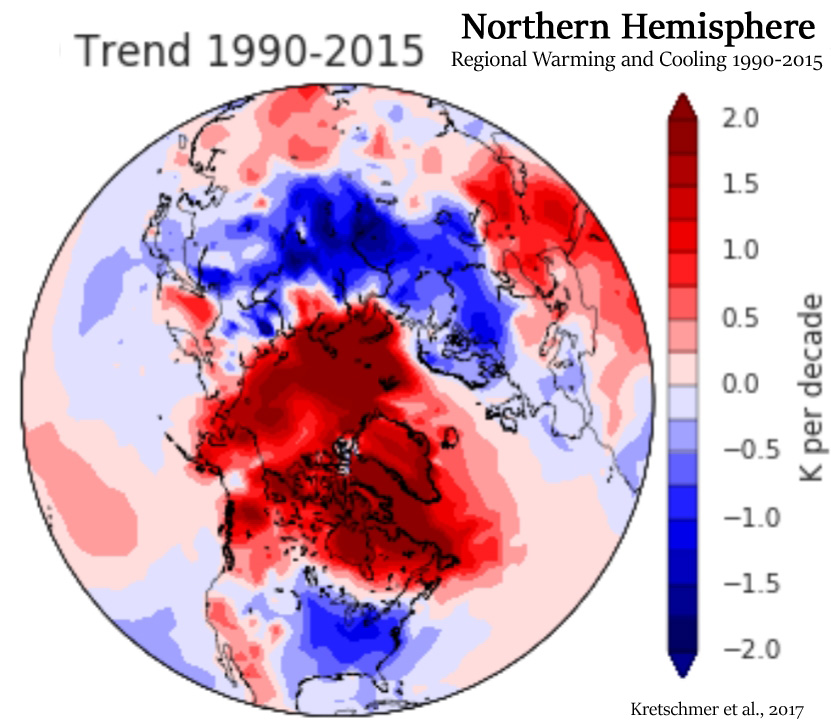
In the Northern Hemisphere, for example, scientists (Kretschmer et al., 2018) have identified other “warming holes” in the temperature data for the 1990-2015 period.  About 80% of the contiguous U.S., Europe and much of Asia, including parts of the Arctic (Eastern Siberia), cooled during the 1990-2015 period, as shown here.

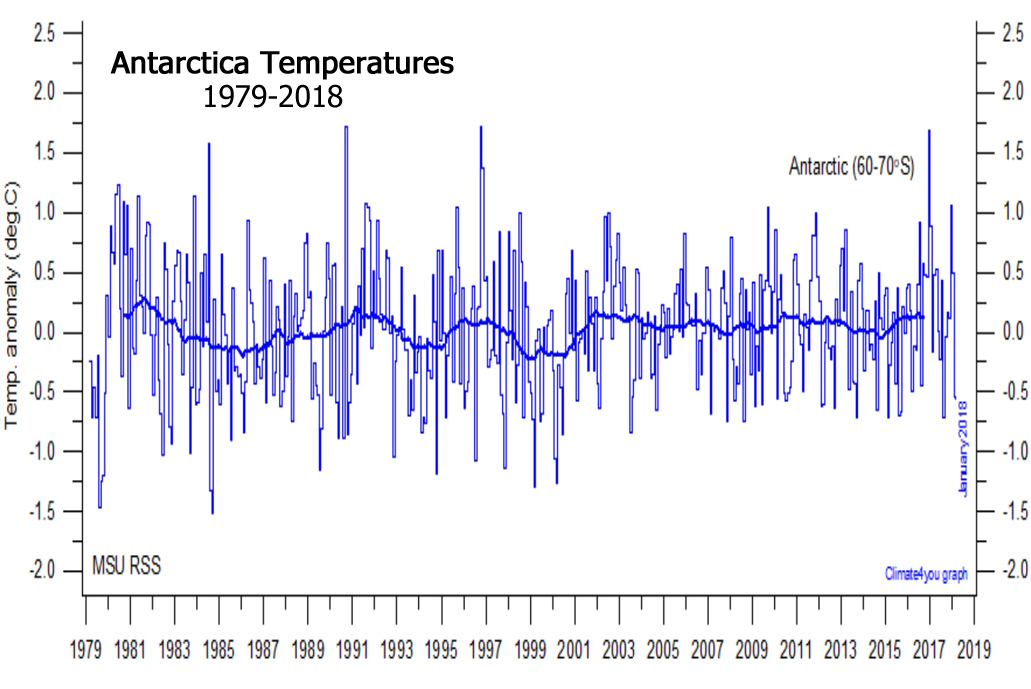
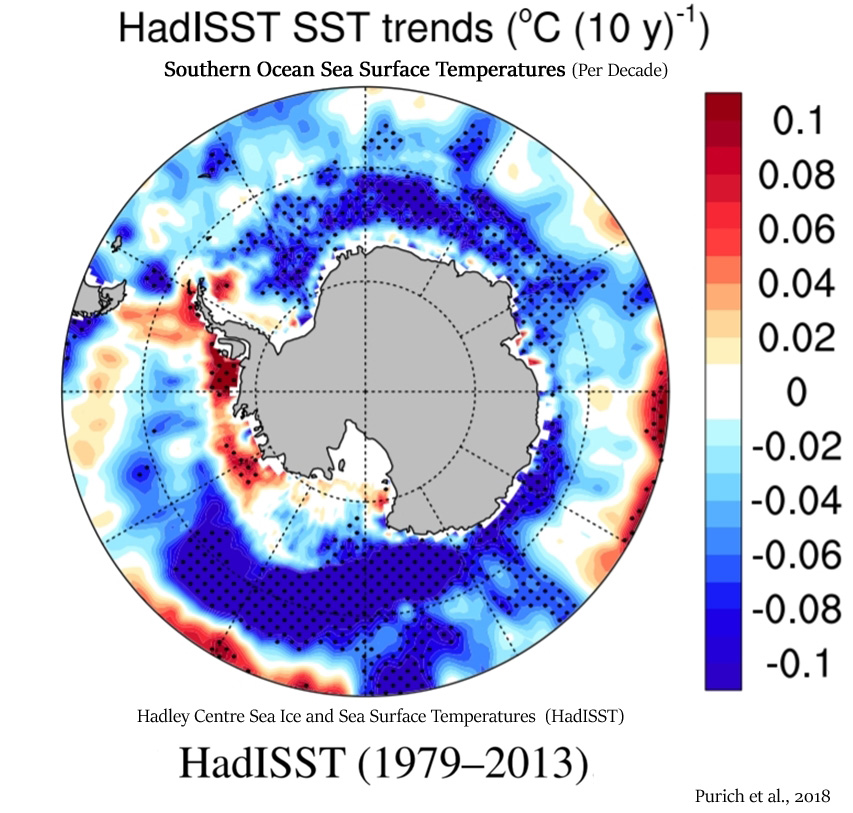
In the Southern Hemisphere, Antarctica has not warmed in the last 38 years.   And according to Purich et al., 2018, most of the Southern Ocean has been cooling since the late 1970s as well (as shown here).

There are not tiny, isolated holes of cooling in an otherwise uniformly-warming world.  These are gaping expanses of cooling…or non-warming.

Yes, some regions of the globe have been warming.  Some regions have been cooling.  And some regions remain trendless.

But in recent decades, the warming has not been global in scope.


Mechanisms Governing the Development of the North Atlantic

Warming Hole in the CESM-LE Future Climate Simulations

“Recent studies have documented the development of a warming deficit in North Atlantic sea surface temperatures (SST) both in observations of the current climate (Rahmstorf et al. 2015; Drijfhout et al. 2012) and in future climate simulations (Drijfhout et al. 2012; Marshall et al. 2015; Woollings et al. 2012). This ‘North Atlantic warming hole’ (NAWH) is characterized in the observed record as a region south of Greenland with negative trends in SSTs of 0.8 K century-1 (Rahmstorf et al. 2015). In fully coupled global climate model (GCM) future simulations, the NAWH is seen as a significant deficit in warming within the North Atlantic subpolar gyre (Marshall et al. 2015; Winton et al. 2013; Gervais et al. 2016).  This local reduction in future warming is communicated to the overlying atmosphere and may impact atmospheric circulation (Gervais et al. 2016), including the North Atlantic storm track (Woollings et al. 2012).”

5 Other New Papers Also Document A Warming “Hole” In the North Atlantic

  1. Grieman et al., 2018

2. Nicolle et al., 2018

3.  Thornalley et al., 2018

4. Smeed et al., 2018

5. Piecuch et al., 2017


via NoTricksZone

https://ift.tt/2Mu0yvk

June 14, 2018 at 09:48AM

Good News! 99.989% of the Antarctic Ice Sheet Didn’t Melt!

Guest lampooning by David Middleton

99.989% rounds up to 100%.  This is fantastic news… Unless you’re a Warmunist.  Fortunately for Warmunists, Science News tailors their headlines to your preferences…

NEWS
CLIMATE,EARTH,OCEANS

Antarctica has lost about 3 trillion metric tons of ice since 1992

Ice loss is accelerating and that’s helped raise the global sea level by about 8 millimeters

BY LAUREL HAMERS 1:23PM, JUNE 13, 2018

Antarctica is losing ice at an increasingly rapid pace. In just the last five years, the frozen continent has shed ice nearly three times faster on average than it did over the previous 20 years.

An international team of scientists has combined data from two dozen satellite surveys in the most comprehensive assessment of Antarctica’s ice sheet mass yet. The conclusion: The frozen continent lost an estimated 2,720 billion metric tons of ice from 1992 to 2017, and most of that loss occurred in recent years, particularly in West Antarctica. Before 2012, the continent shed ice at a rate of 76 billion tons each year on average, but from 2012 to 2017, the rate increased to 219 billion tons annually.

Combined, all that water raised the global sea level by an average of 7.6 millimeters, the researchers report in the June 14 Nature. About two-fifths of that rise occurred in the last five years, an increase in severity that is helping scientists understand how the ice sheet is responding to climate change.

“When we place that against the [Intergovernmental Panel on Climate Change’s] sea level projections, prior to this Antarctica was tracking the low end of sea-level-rise projections,” says study coauthor Andrew Shepherd, an earth scientist at the University of Leeds in England. “Now it’s tracking the upper end.”

[…]

Science Snooze

Is context a violation of the Warmunist Manifesto?

Area (km2) Volume (km3)  Mass (Gt) Significance of 3 trillion metric tons
East Antarctica   10,153,170 75%     26,039,200 86%   23,870,135 0.013%
West Antarctica    1,918,170 14%       3,262,000 11%    2,990,275 0.100%
Antarctic Peninsula       446,690 3%         227,100 1%       208,183 1.441%
Ross Ice Shelf       536,070 4%         229,600 1%       210,474 1.425%
Ronne-Filchner ice shelves       532,200 4%         351,900 1%       322,587 0.930%
Antarctic ice sheet   13,586,400 100%     30,109,800 100%   27,601,654 0.011%

Ice sheet areas and volumes are from USGS Professional Paper 1386–A–2: State of the Earth’s Cryosphere at the Beginning of the 21st Century: Glaciers, Global Snow Cover, Floating Ice, and Permafrost and Periglacial Environments.

I obtained the mass by multiplying the volume by 0.9167.

The total mass of the Antarctic Ice Sheet is about 27,601,654 BILLION metric tons… 27,602 TRILLION metric tons… 3 is 0.011% of 27,602.  Zero-point-zero-one-one percent is indistinguishable from Mr. Blutarski’s grade point average…


Even if all of the melting was from the only place in Antarctica that’s actually losing ice (only slightly sarcastic), the Antarctic Peninsula, it would only be 1.441%… Leaving 99.559% of the ice on the Antarctic Peninsula un-melted, along with 100% of the ice on the other 99% of the Antarctic Ice Sheet.

I thought about putting some sort of clever graphics for this like I did with Greenland, but I couldn’t figure out how to put something so small (the ice loss) and something so big (the Antarctic Ice Sheet) in the same image at the same scale and still be able to see the ice loss.  I think Dean Wormer suffices.

But, but, but… What about the 8 millimeters of sea level rise?


Sorry.

via Watts Up With That?

https://ift.tt/2JM2T3l

June 14, 2018 at 08:53AM

Green Nightmare: Germany’s Clean Energy Flops While Global Fossil Fuels Boom…

By Paul Homewood

Dellers reports from Breitbart:

image

Germany, epicentre of global environmentalism, is losing faith in the green dream. Its energy minister has admitted that it will fall some way short of its 2020 climate targets and that voters are weary of the renewable energy projects which in Germany alone cost taxpayers around €25 billion per year.

EurActiv reports:

Voters across Europe have lost faith in politics partly because of “unachievable targets” on renewable energy, said German Energy Minister Peter Altmaier, who rejected calls from a group of other EU countries to boost the share of renewables to 33-35% of the bloc’s energy mix by 2030. […]

“Germany supports responsible but achievable targets,” Altmaier said from the outset, underlining Berlin’s efforts to raise the share of renewables to 15% of the country’s overall energy mix.

But he said those efforts also carried a cost for the German taxpayer, which he put at €25 billion per year. “And if we are setting targets that are definitely above 30%, that means that within a decade, our share has to be more than doubled – clearly more than doubled,” Altmaier pointed out.

Meanwhile, France24 reports:

Rather than cutting emissions of the greenhouse gas by 40 percent compared with 1990 levels, Europe’s largest economy will manage reductions of just 32 percent, said the annual climate report for 2017 signed off by Chancellor Angela Merkel’s cabinet.

The shortfall of eight percentage points translates into around 100 million tonnes of carbon dioxide (CO2) pumped into the air annually.

These are shocking admissions from the country which has probably done more than any other to advocate for “clean energy”. Germany had set itself the ambitious target of becoming completely independent of fossil fuels in a scheme known as Energiewende.

Last year, the German Federal Ministry of Economics and Energy published a brochure claiming Energiewende had been a huge success story. But this was a lie according to this German research document, published in English under the name Compendium for a Sensible Energy Policy.

It says:

The Energiewende has the goal of making Germany independent of fossil fuels in the long term. Coal, oil and gas were to be phased out, allowing drastic reductions in carbon dioxide emissions. However, these goals have not even begun to be achieved.

The Energiewende was only driven forward in the electricity sector, which, accounts for only one-fifth of energy consumption. There were hardly any successes in the heating/cooling and transport sectors. And so carbon dioxide emissions in Germany have been rising since 2009, even though well over a hundred billion euros have been spent on the expansion of solar and wind energy over the same period.

The financial obligations undertaken in the process will continue to burden taxpayers for another two decades and will end up costing German consumers a total sum of around 550 billion euros. Despite this enormous effort, security of supply is increasingly under threat.

At the same time, people and the biosphere are suffering; wildlife protection has become subordinated to climate mitigation, even though the possibility of achieving the goals of reducing carbon dioxide emissions is becoming increasingly distant and the measures for the energy transition seem to become more and more questionable from a constitutional point of view.

This news is the latest in a series of disasters for the renewables industry. It follows a crash in the price of solar energy (after China decided to cut subsidies) and the failure of Britain’s wind turbines to produce energy for over a week.

Meanwhile, fossil fuels – especially the most hated one of all, coal – are experiencing an unlikely boom.

According to the Financial Times:

Thermal coal, tagged the least-loved major commodity by analysts, is defying sceptics, with prices rising to the highest level since 2012 thanks to strong Asian demand.

High-grade Australian thermal coal, the benchmark for the vast Asia market, was quoted at $112.60 a tonne on Monday by Argus Media.

The fuel, which is burnt in power stations to generate electricity, has now jumped 130 per cent from its 2016 lows, boosting the profits of big producers such as Glencore and Peabody. The price of South African thermal coal has also hit a six-year high as consumers in Asia scramble for supplies.

While thermal coal is being phased out in Europe on environmental grounds, it still accounts for about 40 per cent of energy consumption in emerging markets, especially Asia.

Demand from India, Japan and South Korea has been robust in the first five months of the year, while an early summer heatwave has lifted imports into China despite Beijing’s efforts to keep a lid on domestic coal prices.

http://www.breitbart.com/london/2018/06/14/german-energiewende-flop-coal-sales-boom/

via NOT A LOT OF PEOPLE KNOW THAT

https://ift.tt/2ydpkwS

June 14, 2018 at 07:24AM

“Antarctica loses three trillion tonnes of ice in 25 years”–BBC

By Paul Homewood


A really quite disgracefully misleading and emotive headline from the BBC:


image

Antarctica is shedding ice at an accelerating rate.

Satellites monitoring the state of the White Continent indicate some 200 billion tonnes a year are now being lost to the ocean as a result of melting.

This is pushing up global sea levels by 0.6mm annually – a three-fold increase since 2012 when the last such assessment was undertaken.

Scientists report the new numbers in the journal Nature.

Governments will need to take account of the information and its accelerating trend as they plan future defences to protect low-lying coastal communities.

The researchers say the losses are occurring predominantly in the West of the continent, where warm waters are getting under and melting the fronts of glaciers that terminate in the ocean.

"We can’t say when it started – we didn’t collect measurements in the sea back then," explained Prof Andrew Shepherd, who leads the Ice sheet Mass Balance Inter-comparison Exercise (Imbie).

"But what we can say is that it’s too warm for Antarctica today. It’s about half a degree Celsius warmer than the continent can withstand and it’s melting about five metres of ice from its base each year, and that’s what’s triggering the sea-level contribution that we’re seeing," he told BBC News.

Space agencies have been flying satellites over Antarctica since the early 1990s. Europe, in particular, has an unbroken observation record going back to 1992.

These spacecraft can tell how much ice is present by measuring changes in the height of the ice sheet and the speed at which it moves towards the sea. Specific missions also have the ability to weigh the ice sheet by sensing changes in the pull of gravity as they pass overhead.

Imbie’s job has been to condense all this information into a single narrative that best describes what is happening on the White Continent.

Glaciologists usually talk of three distinct regions because they behave slightly differently from each other. In West Antarctica, which is dominated by those marine-terminating glaciers, the assessed losses have climbed from 53 billion to 159 billion tonnes per year over the full period from 1992 to 2017.

On the Antarctic Peninsula, the finger of land that points up to South America, the losses have risen from seven billion to 33 billion tonnes annually. This is largely, say scientists, because the floating ice platforms sitting in front of some glaciers have collapsed, allowing the ice behind to flow faster.

East Antarctica, the greater part of the continent, is the only region to have shown some growth. Much of this region essentially sits out of the ocean and collects its snows over time and is not subject to the same melting forces seen elsewhere. But the gains are likely quite small, running at about five billion tonnes per year.

And the Imbie team stresses that the growth cannot counterbalance what is happening in the West and on the Peninsula. Indeed, it is probable that an unusually big dump of snow in the East just before the last assessment in 2012 made Antarctica as a whole look less negative than the reality.

Globally, sea levels are rising by about 3mm a year. This figure is driven by several factors, including the expansion of the oceans as they warm. But what is clear from the latest Imbie assessment is that Antarctica is becoming a significant player.

"A three-fold increase now puts Antarctica in the frame as one of the largest contributors to sea-level rise," said Prof Shepherd, who is affiliated to Leeds University, UK.

"The last time we looked at the polar ice sheets, Greenland was the dominant contributor. That’s no longer the case."

In total, Antarctica has shed some 2.7 trillion tonnes of ice since 1992, corresponding to an increase in global sea level of more than 7.5mm.

The latest edition of the journal Nature has a number of studies looking at the state of the continent and how it might change in a warming world.

One of these papers, led by US and German scientists, examines the possible reaction of the bedrock as the great mass of ice above it thins. It should lift up – something scientists call isostatic readjustment.

New evidence suggests where this process has occurred in the past, it can actually constrain ice losses – as the land rises, it snags on the floating fronts of marine-terminating glaciers.

"It’s like applying the brakes on a bike," said Dr Pippa Whitehouse from Durham University. "Friction on the bottom of the ice, which was floating but has now grounded again, slows everything and changes the whole dynamic upstream. We do think the rebound (in the future) will be fast, but not fast enough to stop the retreat we’ve kicked off with today’s warming.

"Ocean warming is going to make the ice too thin for this process to help."

In Imbie’s last assessment, the contribution of Antarctica to global sea-levels was considered to be tracking at the lower end of the projections that computer simulations had made of the possible height of the oceans at the end of the century. The new assessment sees the contribution track the upper end of these projections.

"At the moment, we have projections going through to 2100, which is sort of on a lifetime of what we can envisage, and actually the sea-level rise we will see is 50/60cm," said Dr Whitehouse. "And that is not only going to impact people who live close to the coast, but actually when we have storms – the repeat time of major storms and flooding events is going to be exacerbated," she told BBC News.

https://www.bbc.co.uk/news/science-environment-44470208


Despite the apocalyptic headline, ice loss has only been contributing about 0.3mm a year to sea level rise, about an inch per century. Given that sea levels have been rising at around 8 inches a century since the 19thC, there is no evidence that this is not a long term phenomenon we are seeing.

image

https://notalotofpeopleknowthat.wordpress.com/2018/05/20/woods-hole-climatologist-gives-false-evidence-to-congress/


Indeed as Shephard himself is forced to admit, we did not start collecting data until 1992. This sort of melting could have been going on for centuries or longer. In fact, another paper published this month by Kingslake et al finds that there has been  extensive retreat and re-advance of the West Antarctic Ice Sheet during the Holocene.

As Shephard also remarks, the melting in West Antarctica is due to the intrusion of warmer water, and therefore nothing at all to do with GHGs or “global warming”. It is highly unlikely that such changes in ocean currents have not happened many times before.


Then there is the question of the accuracy of measurements. A major study by NASA in 2015 discovered that Antarctic ice mass has actually been increasing since 1992, basically because of greater snowfall, and not decreasing as this new study claims.

In reality, measurements of ice mass are not exact and are subject to huge margins of error.

But anybody reading the BBC’s headline would be entitled to think we’re all going to drown soon!

via NOT A LOT OF PEOPLE KNOW THAT

https://ift.tt/2JJdsUx

June 14, 2018 at 06:55AM