Month: June 2018

Global Warming Hole Found: Minus 144 F

What is the coldest place on Earth? It is a high ridge in Antarctica on the East Antarctic Plateau where temperatures in several hollows can dip down to minus 144 F.

National Geographic Coldest Place on Earth Found—Here’s How
“It’s a place where Earth is so close to its limit, it’s almost like another planet.”

Just how cold can it get on Earth’s surface? About minus 144°F, according to recent satellite measurements of the coldest known place on the planet.

Scientists recorded this extreme temperature on the ice sheet deep in the middle of Antarctica during the long, dark polar winter. As they report this week in Geophysical Research Letters, the team thinks this is about as cold as it can possibly get in our corner of the solar system.

“It’s a place where Earth is so close to its limit, it’s almost like another planet,” says study leader Ted Scambos, a researcher at the National Snow and Ice Data Center at the University of Colorado, Boulder.

The measurement smashes the previous record for the coldest known air temperature in the natural world: a frigid minus 128.6°F felt in 1983 at the Russian Vostok Station, not far from the South Pole. Humans can’t inhale air that cold for more than a few breaths—it would cause our lungs to hemorrhage. Russian scientists ducking out to check on the weather station would wear masks that warmed the air before they breathed it in.

DEATHLY HOLLOWS
While the East Antarctic ice sheet looks flat at the surface, it actually domes ever so slightly from center to edge like a vast, icy turtle shell. Vostok is perched near the top of the dome, on about 2.2 miles of ice, but it’s not quite at the apex. Scambos’s team suspected that it could get even colder at the very highest parts of the ice sheet.

There aren’t any weather stations perched at the peak of the ice sheet, and there isn’t anyone there to check on them in the dead of Antarctic winter. But satellites can sense the temperature at the surface of the ice as they pass overhead. So Scambos and his colleagues sifted through several years of satellite data, mapping out when and where temperatures dipped low.

Sure enough, they found about a hundred little pockets of exceptional cold scattered across the highest parts of the ice sheet. The coldest spots were in shallow depressions in the ice, little hollows where the surface isn’t perfectly smooth. That’s probably because cold air sinks into these depressions like it sinks into a river valley or a canyon, says John Turner, a polar scientist with the British Antarctic Survey who was not involved in the study.

“They’re such shallow dips, you probably couldn’t even see them with your eyes,” he says.

The air warms up by a few degrees right above the surface, which is where the scientists at Vostok had recorded the previous coldest temperature. By comparing the satellite measurements to data from the nearest weather stations, Scambos and his team figured out that the air temperatures in this region would be a little warmer near human-head height, about minus 137°F. But right at the surface, where your feet would touch the snow, they saw temperatures of minus 144°F.

“But you hope your feet wouldn’t ever touch the snow,” Scambos says. “That would not be fun at all.”

OBSCURING THE VIEW
Only very special conditions lead to such extreme cold. First, it has to be the dead of winter, long after the midnight sun sets for the season. Then, the air needs to be still for a few days, and the sky needs to be perfectly clear, without a wisp of a cloud or a shimmer of diamond dust above the ice sheet.

As cold as it may be, ice radiates a tiny amount of heat. Normally, most of that heat is captured by water vapor in the atmosphere and gets beamed back down to Earth’s surface, trapping warmth in the lower atmosphere.

But during dry spells in Antarctica, when most of the water vapor has been wrung out of the atmosphere, “it starts to open a window that isn’t usually open anywhere else on Earth,” Scambos says. Then, faint heat emitted by the ice sheet can escape all the way to space, leaving the ice surface even colder.

The ultra-clear conditions that enable these chilly events are also ideal for looking out into space, which is why scientists placed a telescope just a few miles from the extreme cold spots Scambos’ team pinpointed.

“Water vapor is our nemesis,” says Craig Kulesa, an astronomer from the University of Arizona who runs the High Elevation Antarctic Terahertz Telescope, or, somewhat satirically, HEAT. “We put our telescope at this superbly dry site, but if we put it 10 miles away, would it be any better?”

It may be a question worth considering as the climate changes around the globe, though there’s nowhere else on this planet they could go where conditions would be better. Water vapor concentrations in the atmosphere are increasing, which in turn means more of the ice-emitted heat gets trapped near the surface—keeping it warmer. So, the perfectly clear conditions that are ideal for looking into space will become less frequent—and any scientists hoping to break the record for sensing extreme cold on Earth may be running out of time.

“As we see increases in greenhouse gas and water vapor concentrations, we’re expecting warming across the Antarctic of about 3 to 4°C,” says Turner. “Seeing any new temperature lows will be more and more unlikely. The odds are just getting smaller.”


via Science Matters

https://ift.tt/2MuQOjY

June 27, 2018 at 02:22PM

Has a new volcano formed in Hawaii?

Story by David Rothery Professor of Planetary Geosciences, The Open University

The ‘fissure 8’ cone. Photo: US Geological Survey

Kilauea, the most active volcano on Hawaii, has been in continual eruption since 1983. It entered a new phase in early May when fractures along a rift on the eastern side of the volcano opened during a series of earthquakes – some of which became volcanic fissures from which lava was erupted.

These fissures allowed magma that had been ponded in a summit lake to drain onto the ground surface as lava flows lower down the mountain. This was close to a residential subdivision known as Leilani Estates, where a new volcanic cone has since developed.

Kilauea is buttressed on its north-west side by the enormous mass of Mauna Loa volcano, but its south-east slopes face the ocean and are unsupported. The magma from beneath the  usually erupts from the summit of the volcano, and there was a spectacular lava lake there in March. However two rift zones (areas where the volcano is splitting apart), extending east and south-west from the summit, can make it possible for lava to erupts from Kilauea’s flanks too.

The current activity is based along the east rift zone. According to the US Geological Survey, 23 separate new fractures there became volcanic fissures from which lava was erupted. By the end of May, “fissure 8” (the eighth new fissure to have announced itself) had become dominant – with activity at the others ceasing or subsiding. This was the source of the lava that by June 4 was flowing into the sea several miles away near the Vacationland resort, where it completely filled what had previously been Kapoho Bay.

The lava lake in Kilauea’s summit crater (Halemaumau) as it appeared on March 19 2018. Photo: US Geological Survey

By mid-June, the coagulated spatter around the persistently active part of fissure 8 had built a cone approaching 200ft high as seen in the photo below.

The ‘fissure 8’ cone as it appeared on June 15 2018. Photo: US Geological Survey

Separate plumbing

The question naturally arises as to whether this new hill and source of all that lava is a volcano in its own right. If you look on the internet you will typically find “volcano” defined as something like “a landscape feature produced at a site where magma is erupted”. Such a simplistic definition would qualify the “fissure 8” cone as a volcano, but I think just about every professional volcanologist would reject this, on the grounds that it is merely a subsidiary vent belonging to Kilauea.

This is because it is fed by magma from the source that supplies Kilauea as a whole, and could equally well have erupted elsewhere on Kilauea. The new cone at fissure 8 is not significantly more substantial than numerous older subsidiary cones elsewhere on Kilauea.

However, you would search in vain for a formally sanctioned definition of the term “volcano” to quantify the degree of connectedness or mutual size relationships in a way that could settle this issue. On the positive side, the lack of such a definition enables volcanologists to avoid the sometimes bitter controversy over the formal definition of the term “planet” that has plagued astronomers since 2006, when Pluto was demoted to being a “dwarf planet”. But it does leave them open to people arguing that, if the fissure 8 cone is just part of Kilauea, then why don’t we count Kilauea as just part of Mauna Loa?

There is some logic in this, because Kilauea and Mauna Loa both draw their magma from the same source in the Earth’s mantle (the Hawaiian hotspot plume). But in this case professional volcanologists generally agree that these are best regarded as separate systems, and the US Geological Survey rightly regards the situation that way. That’s because activity at Kīlauea has no discernible effect on Mauna Loa’s magmatic system.

A name?

Although I would agree that the fissure 8 vent is not a volcano in its own right, it does surely deserve to be referred to by a suitably memorable designation. The stance of the US Geological Survey is that bestowing names is not up to them.

This, they say, is the right of the local community, which includes the many people who have lost their homes to the new . It could end up being known as Pu’u Leilani (Hawaiian for “Leilani Hill”, after its location), or maybe as something more poetic. But the time for this will be when this phase of the eruption has ended, which might not be for several more weeks.


Originally published in The Conversation

via Watts Up With That?

https://ift.tt/2lA0bmS

June 27, 2018 at 01:37PM

‘Colossus is awakening’

The Sierra Negra volcano on the Galapagos island of Isabela is spewing fountains of lava and plumes of ash.

At least 250 people have been evacuated from the vicinity of the volcano after two strong earthquakes opened up fissures in the 1,124m-high (3688ft) volcano.

“The colossus is awakening,” Environment Minister Tarsicio Hail said, announcing that Ecuador’s authorities are closely watching  seismic and geological activity in the area.

The volcano has the largest caldera of all of the Galapagos volcanoes, measuring seven by nine km (4.2 by 5.4 miles). The last time it erupted was in 2005.

https://www.rt.com/news/430984-ecuador-galapagos-volcano-eruption/

https://www.bbc.com/news/world-latin-america-44627725

Thanks to Sonya Porter and Laurel for these links

“And Little Krakatoa is muttering also,” says Laurel. “Combined volcanic emissions adds to cooling. Looking grim futurewise.”


The post ‘Colossus is awakening’ appeared first on Ice Age Now.

via Ice Age Now

https://ift.tt/2lFATnu

June 27, 2018 at 12:46PM

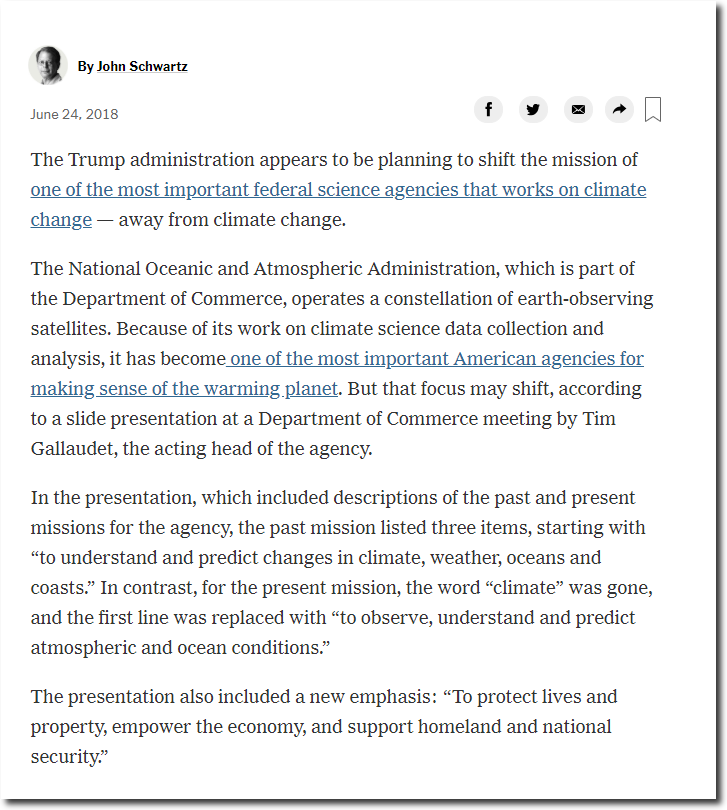
The Global Warming Scam Winds Down

The global warming scam officially ended on election day 2016.  But the bitter clingers are hanging on as long as they can, and our fake news agencies (like the New York Times) are crying about it.

A Leading Climate Agency May Lose Its Climate Focus – The New York Times

via The Deplorable Climate Science Blog

https://ift.tt/2KscX1H

June 27, 2018 at 12:43PM