Month: June 2018

Happy 30th Birthday Gorebal Warming!

Guest drive-by by David Middleton

Well… Happy 30th birthday, 3 days early…

AP Was There: The age of climate change begins

By GUY DARST, ASSOCIATED PRESS WASHINGTON — Jun 18, 2018

On June 23, 1988, a top NASA scientist told Congress and the world that global warming had arrived. NASA scientist James Hansen predicted that 1988 would be the world’s hottest year on record, thanks to the burning of fossil fuels that released heat-trapping gases.

The Associated Press is republishing a version of its report on the testimony to mark the 30th anniversary.

———

WASHINGTON (AP) — The “greenhouse effect” global warming of the earth is here, but the current drought and heat wave over much of the United States can’t be blamed on it, a scientist told a Senate panel Thursday.

However, similar heat waves and droughts can be expected much more often as a result of future warming, said James E. Hansen, a climatologist at the National Aeronautics and Space Administration’s Goddard Institute for Space Studies in New York City.

Hansen told the Senate Energy and Natural Resources Committee there is only a 1 percent chance that he is wrong in blaming rising temperatures around the world on the buildup of manmade gases in the atmosphere.

Blah, blah, blah…

[…]

ABC Snooze

Hansen’s fabulously wrong 1988 climate model.

Scenario A is “business as usual.” Scenario C is where humans basically undiscover fire.


Reference

Hansen, J., I. Fung, A. Lacis, D. Rind, S. Lebedeff, R. Ruedy, G. Russell, and P. Stone, 1988: Global climate changes as forecast by Goddard Institute for Space Studies three-dimensional model. J. Geophys. Res., 93, 9341-9364, doi:10.1029/JD093iD08p09341

Reverence

None.

via Watts Up With That?

https://ift.tt/2JZ89R8

June 19, 2018 at 07:26AM

Pope Francis’s Misguided War on Fossil Fuels

A world without fossil fuels would be a much more brutal place. Until Pope Francis understands the vital role fossil fuels have and should continue to play around the world, he should stick to saving souls rather than pontificating over peoples’ energy choices.

It seems that Pope Francis has learned little since his 2015 papal encyclical calling on the world to fight climate change by limiting the use of modern technologies and fossil fuels. At a recent Vatican meeting he called many of the world’s leading oil company executives to the carpet. Francis told the executives they should shift from fossil fuels to renewable energy sources to fight “global warming.”

Pope Francis has myriad misguided beliefs about climate science, almost all of which he holds based on faith alone, as if they were holy writ. Even worse, his belief that society can transition from fossil fuels while reducing hunger and poverty is downright dangerous.

Despite the false claims of climate alarmists, fossil fuels have been a boon to the world. They supply affordable and abundant power for lighting, transportation, refrigeration, clean water, modern agriculture (including food delivery, storage, and protection from early decay and pests), indoor air-conditioning and heating, cooking, and the multitude of other technologies upon which modern societies are based. In attacking fossil fuels, Pope Francis is undermining the very resources and technologies most responsible for raising literally billions of people out of poverty. Coal, natural gas, and oil remain vital to increasing lifespans, decreasing infant mortality, and helping humans generally flourish.

In his brilliant book The Moral Case for Fossil Fuels, Alex Epstein wrote, “Climate is no longer a major cause of death, thanks in large part to fossil fuels… Not only are we ignoring the big picture by making the fight against climate danger the fixation of our culture, we are ‘fighting’ climate change by opposing the weapon that has made it dozens of times less dangerous. The popular climate discussion… looks at man as a destructive force for climate livability, one who makes the climate dangerous because we use fossil fuels. In fact, the truth is… we don’t take a safe climate and make it dangerous; we take a dangerous climate and make it safe.”

Pope Francis and many other world leaders ignore this important fact, putting the lives of the world’s most impoverished people at risk.

Full post

via The Global Warming Policy Forum (GWPF)

https://ift.tt/2I28yQW

June 19, 2018 at 06:14AM

Forget Paris: Not A Single EU State Is Meeting Paris Climate Targets

Not a single EU state is meeting Paris climate targets, a new analysis finds.

It’s been close to three years since countries worldwide signed the Paris Agreement, which obligates nations pledge to commit themselves to intending (or something like that) to reduce their greenhouse gas emissions in order to “safeguard the planet’s future”.

The language of the Agreement is in fact non-binding, and so one wouldn’t be surprised to learn that some signatories might not be living up to the agreement’s spirit.

“Relevant hoax”… all EU states “off-target”

Well, here’s the real shocker: According to a new analysis by NGO CAN Europe, all! EU countries are missing the Paris Agreement targets, as assessed by CAN Europe.

So now it’s crystal clear: Europe was never really serious about implementing the Paris Agreement from the very start. It was nothing more than a New Year’s resolution which no one ever intended to stick to.

Little wonder ex-NASA GISS director James Hansen just told the Guardian: “…the relevant hoax today is perpetrated by those leaders claiming to be addressing the problem.” Hansen is right.

CAN Europe: dismal results

The aim of the CAN Europe report was to examine “which EU Member States are willing to increase their climate action and tackle the gap between the goals of the Paris Agreement and current greenhouse gas emission reduction efforts in the EU.”

The final results? According to the CAN Europe:

The ranking shows that all EU countries are off targetthey are failing to increase their climate action in line with the Paris Agreement goal. No single EU country is performing sufficiently in both ambition and progress in reducing carbon emissions.”

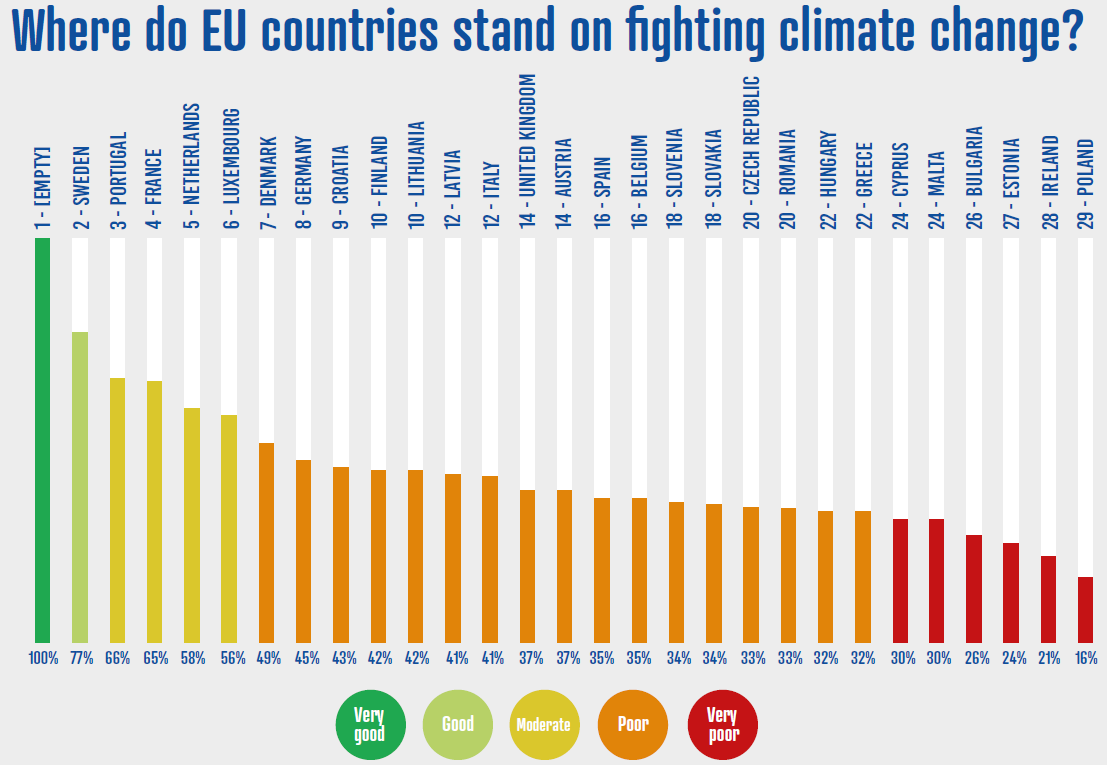
23 of 28 countries rated “poor” or “very poor”

The chart on page 5 of the CAN Europe report shows us that a whopping 23 of 28 European countries are in fact performing poorly or even very poorly.

Source: CAN Europe.

The nongovernmental organization assessed the European countries according to a variety of factors, especially pro capita emissions and progress on expanding renewable energies. For example leader Sweden met 77% of the CAN measures, while Poland met only 16%.

Full post

via The Global Warming Policy Forum (GWPF)

https://ift.tt/2I21p3g

June 19, 2018 at 06:14AM

A Conversation with Prof. Richard Lindzen

Richard Siegmund Lindzen is an American atmospheric physicist known for his work in the dynamics of the atmosphere, atmospheric tides, and ozone photochemistry. He has published more than 200 scientific papers and books.

Prof. Richard Lindzen (in the middle), and his wife Nadine, in the company of Grégoire Canlorbe, in Paris in May 2018

From 1983 until his retirement in 2013, he was Alfred P. Sloan Professor of Meteorology at the Massachusetts Institute of Technology. He was a lead author of Chapter 7, “Physical Climate Processes and Feedbacks,” of the Intergovernmental Panel on Climate Change’s Third Assessment Report on climate change. He has criticized the scientific consensus about climate change and what he has called “climate alarmism.”

A short while ago, Prof. Lindzen had a conversation with Mr. Grégoire Canlorbe, who interviewed him on behalf on the French Association des climato-réalistes—the only climate-realist organization in France.


Grégoire Canlorbe: Your early work dealt with ozone photochemistry, the aerodynamics of the middle atmosphere, the theory of atmospheric tides, and planetary waves. How do you present to the layman the several scientific discoveries you were responsible for in these areas?

Richard Lindzen: My work is mostly about ‘explaining’ rather than ‘discovering’, and I doubt that my achievements would mean much to laymen. With respect to my early work, I provided the explanation for the Quasi-biennial Oscillation of the tropical stratosphere. This phenomenon refers to the fact that the wind between 16 and about 30 km in the tropics blows from east to west for approximately a year, and then reverses and blows from west to east for about another year.

I also provided the solution to an old question about tidal oscillations in surface pressure. For tides that are forced by the gravitational force of the moon, it has been known since Newton that the dominant period should be 12 lunar hours. However, at the surface, the pressure oscillates primarily at 12 solar hours though solar forcing is primarily thermal in origin and dominated by 24 hours. The question was why the observed tide was semidiurnal rather than diurnal. I showed that diurnal tides were trapped over much of the earth and suppressed.

There was also the interesting fact that at the mesopause (ca 85 km) the winter pole is the warmest place and the summer pole is the coldest place. I showed that this was caused by the breaking of small-scale waves from below. The behavior of the atmosphere and oceans provides many interesting puzzles and I always enjoyed these puzzles.

Grégoire Canlorbe: You have sparked vehement reactions, in highlighting how futile the popular claims on increasing droughts, floods, hurricanes, tornadoes, sea level rise, and other extremes. Even modest warming, you say, should not be considered a genuine threat to human health and agriculture. Could you remind us of the data invalidating climate doomsday scenarios?

Richard Lindzen: I should point out that I don’t personally do much work in these areas, nor do I think that the ‘vehement’ reaction is primarily to my statements concerning extreme events. The time history of such matters as droughts, floods, hurricanes, tornadoes and temperature extremes is well recorded by official bodies like NOAA, and display no systematic increase. Indeed, some, like hurricanes, appear to be decreasing. These trends have been documented by R. Pielke, Jr. (https://www.amazon.com/Rightful-Place-Science-Disasters-Climate/dp/0692297510/ref=sr_1_fkmr0_1?ie=UTF8&qid=1492721355&sr=8-1-fkmr0&keywords=pielke+jr+in+books), and even the IPCC has acknowledged the absence of significant associations with warming.

I have occasionally noted that theoretically, warmer climates should be characterized by reduced temperature extremes. The attempt to associate present weather extremes and other matters ranging from obesity to the Syrian Civil War, with climate change is frequently hilarious (http://www.numberwatch.co.uk/warmlist.htm). The mostly non-scientist proponents of climate hysteria realize that distant forecasts of remote problems by inadequate models are unlikely to motivate people to shut down modern industrial society. They, therefore, attempt to claim that we are seeing the problems right now. Of course, the warming that has occurred over the past 200 years or so, has been too small to have been a major factor. However, objective reality matters little when it comes to propaganda – where repetition can effectively counter reality.

The issue of sea level rise is slightly different. The proponents of climate alarm have for almost 40 years recognized that massive sea level rise and coastal flooding provide excellent graphic examples of dangers that people can react to. Such things as a couple of degrees of warming are much less effective in frightening people. Of course, carefully analyzed tide gauge data shows sea-level increasing about 20 cm per century for at least 2 centuries – with no sign of acceleration to the present. The claim that this increase is accelerating is very peculiar. Tide gauges don’t actually measure sea-level. Rather, they measure the difference between land level and sea level. At many stations, the former is much more important. In order to estimate sea level, one has to restrict oneself to tectonically stable sites.

Since 1979 we have been able to measure sea level itself with satellites. However, the accuracy of such measurements depends critically on such factors as the precise shape of the earth. While the satellites show slightly greater rates of sea level rise, the inaccuracy of the measurement renders the difference uncertain. What the proponents of alarm have done is to accept the tide gauge data until 1979, but assume that the satellite data is correct after that date, and that the difference in rates constitutes ‘acceleration.’ They then assume acceleration will continue leading to large sea level rises by the end of this century. It is hard to imagine that such illogical arguments would be tolerated in other fields.

Full interview

via The Global Warming Policy Forum (GWPF)

https://ift.tt/2JTabXa

June 19, 2018 at 05:43AM