Month: June 2018

Spectacular flyover video of Kilauea eruption shows massive devastation

Spectacular flyover video of Kilauea eruption shows massive devastation

Aerial Survey of River of Lava as it Flows Down Valley in Hawaii

Footage from an Hawaii Army National Guard survey of the Kilauea eruption. Starting with fissure eight, that has developed a sizable cone around it and is sending channelized lava down to Kapoho. The lava river is at this time well over 100 foot across a moves quickly. (U.S. AIR National Guard video by Tech. Sgt Andrew Jackson) Source: USDOD

Earlier this week, USGS did a flyover:

A helicopter overflight video of the lower East Rift Zone on June 14, 2018, around 6:00 AM, shows lava fountaining at fissure 8 feeding channelized lava flows that flow into the ocean. Lava is still flowing out of fissure 8 unabated and the channel is full. At the start of the video, standing waves in the lava channel can be seen near the vent exit.

The channel appears crust-free from vent to the bend around Kapoho Crater. A surface crust forms over the channel as it spreads out during its approach to the ocean. The overflight along the ocean entry is from north to south along the coastline. The ocean entry is active along the whole length – approximately 1 mile. Small litoral explosions are occurring and there are several plumes of laze.

via Watts Up With That?

https://ift.tt/2yjmzKn

June 17, 2018 at 02:25PM

Claimed Antarctic Ice Loss In Doubt

On June 13 Chris Mooney of the Washington Post wrote how Antarctica’s ice sheet was “melting at a rapidly increasing rate” and “pouring more than 200 billion tons of ice into the ocean annually” — all this according to “a team of 80 scientists”. The doomsday media response was immediate.

Mooney of course blamed CO2 for the speculated ice melt change, and renewed the calls for a cut in greenhouse gas emissions in order to save ourselves.

Firstly the CO2 ice-melt logic here is extremely flimsy and even preposterous: An already hugely uncertain 200 billion ton figure gets adventurously blamed on Co2 through a long, uncertain and highly complex chain of physical processes — one that ignores an array of natural factors.

Secondly, Mooney’s language sounds dramatic, but the reality isn’t dramatic at all. A worker with an annual salary of $100,000 who gets a raise of $100 this year compared to $50 a year earlier also sees “a rapidly increasing” pay raise “rate” (100%). In reality the raise was meaningless.

Mooney and the media here are using trick language to purvey fake images of significant activity.

Only 0.001% of the total mass

Though the (hugely uncertain) 200 billion ton ice melt figure may sound impressive, it is in fact very tiny compared to the entire Antarctic total ice volume, which according to Dr. Don Easterbrook’s book “Evidence-Based Climate Science: Data Opposing CO2 Emissions as the Primary Source of Global Warming Evidence-Based Climate Science” is estimated at 26.5 million cubic kilometers.

Artefact of statistical torture

200 cubic kilometers of 26.5 million cubic kilometers is in reality only about an estimated paltry 0.001% of the total Antarctic ice mass. And (if it were true) would have only a minor effect on overall sea level rise.

The scientists themselves admit there’s much uncertainty involved and that the calculated 200 billion ton ice loss depends in part on model assumptions. Read more here.

The 200 billion ton figure is indeed more an artefact of statistical torture and modelling. When it comes to complex Antarctic ice mass, you can make the paltry data that’s available say whatever you want.

In this case 80 scientists participated in the waterboarding of the data.

One decade is not climate, but rather weather variability

What is more, the authors compared the last decade to the one before. Well, changes seen in one decade and compared to the one earlier is what we call weather changes, not climate change. Just because one decade is wetter than the one before it, it doesn’t mean the next will be wetter as well. Junk science.

Reality: Antarctic ice area growing rapidly

The satellite imagery and data concerning Antarctic ice area, which go back almost 40 years, in fact show an increasing long-term trend, according to one recently published peer-reviewed study…

Moreover NASA glaciologist Jay Zwally published a paper in 2015 showing ice sheet growth in eastern Antarctica had outweighed the losses in the western ice sheet, and so ice mass was growing and not shrinking.

And today Zwally is set to release a new study that will show that the eastern Antarctic ice sheet continues to gain enough ice to offset the losses in the west. “Basically, we agree about West Antarctica,” Zwally told The Daily Caller. “East Antarctica is still gaining mass. That’s where we disagree.”

Full post

via The Global Warming Policy Forum (GWPF)

https://ift.tt/2JRKVfB

June 17, 2018 at 12:27PM

Antarctic Ice Sheet Collapses, Nobel Prizes, and the Psychology of Catastrophism

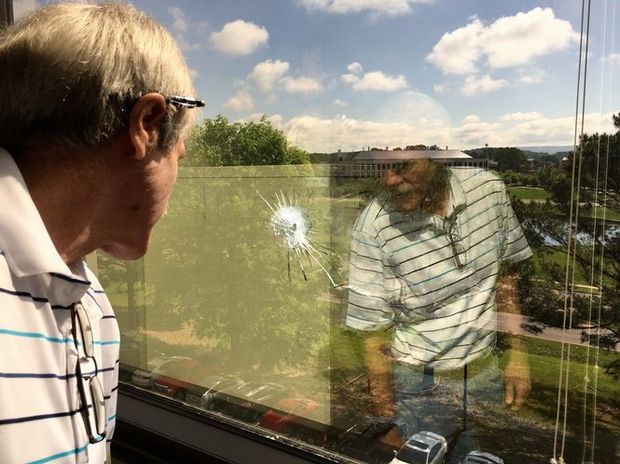
John Christy examines one of the seven bullet holes in our NSSTC building, fired on the weekend of the 2017 March for Science.

Last week I had the privilege of being invited to present a talk at a small conference of world experts in a variety of disciplines. The venue was spectacular, on the French Riviera, and we had an entire late-1800s hotel to ourselves, right on the Mediterranean. For me, it was a once-in-a-lifetime experience. I had the feeling that the organizers wanted the event to have a low profile, and so I won’t mention names.

I had about 12 minutes to lay out the case for climate skepticism. My talk was generally well-received and led to many follow-up discussions over the following days.

One of the attendees was an elderly particle physicist who was also a Nobel Prize winner. During Q&A, he mentioned how he had been teaching a climate class at his university for several years, and that he thought my skepticism was unwarranted. He was convinced that the Antarctic ice sheet was headed for collapse and we would have to deal with a 30 m rise in sea level as a result.

What was more than a little disturbing was that he openly declared that climate policy would not be able to move forward like it needs to until old skeptics like me die out. Part of my talk was about the fact that credentialed and published skeptical climate researchers are indeed slowly dying out, with an average age of around 70 now, and that governmental bias in climate funding will basically kill off skeptical research if things don’t change.

I approached him afterward and politely said I didn’t think either one of us was going to change our minds, and hoped we could just enjoy the nice dinner that was planned for us. He politely smiled and agreed to that.

I guess what was interesting to me is that the “belief” (his word) in catastrophic climate change, like religion, exists at all education levels. One also can’t help but notice how Nobel Prize winners tend to also be experts in all disciplines after they win their prize. Stephen Hawking comes to mind.

The whole experience was quite fascinating.

via Roy Spencer, PhD.

https://ift.tt/2yf3Pf4

June 17, 2018 at 12:06PM

Cobalt & Lithium Prices Rising Fast

By Paul Homewood


One of the new additions to the BP Energy Review this year is a section on rare earths, both prices and output.


BP show that prices for both cobalt and lithium have risen sharply in the last year or two, although cobalt is still cheaper than it was in 2008.


image

image


When we look at output, we can see that it is only rising slowly, suggesting that increased demand is forcing up prices rather than supply.


image

image


Whether the supply side can increase in line with future demand remains to be seen, but it does not bode well for the battery market.

via NOT A LOT OF PEOPLE KNOW THAT

https://ift.tt/2JU0Gmc

June 17, 2018 at 12:03PM