
Winter has arrived much earlier than normal this year, particularly across North America, where cold records have been shattered.
This Thanksgiving is in fact going down as one of the coldest ever on record across the Northeast. The Washington Post here, for example, reports that Thanksgiving and Black Friday 2018 will be remembered for a record-shattering cold snap across the Northeast United States.”
Also WeatherNation tweeted some impressive record low temperatures being set:
Brrrr! #Record cold low temperatures were observed this morning throughout the Northeast. pic.twitter.com/kjffiAyWRY
— WeatherNation (@WeatherNation) November 22, 2018
For example, Binghamton, New York smashed its earlier record set 10 years earlier by a whopping 12°F!
It was another #record-breaking cold morning throughout the Northeast! Check out some of these temperatures. #NYwx #NJwx #CTwx #RIwx #MAwx pic.twitter.com/dRdWc9JXFC
— WeatherNation (@WeatherNation) November 23, 2018
The Today Show reported that this year’s traditional Macy’s Thanksgiving Day Parade was “the coldest on record”.
Arctic sea ice, snow and ice cover rebound
Arctic sea ice volume has rebounded and is near normal levels. The sea ice trend has remained stable over the past decade and thus defy all the climate alarmist predictions of an Arctic meltdown.
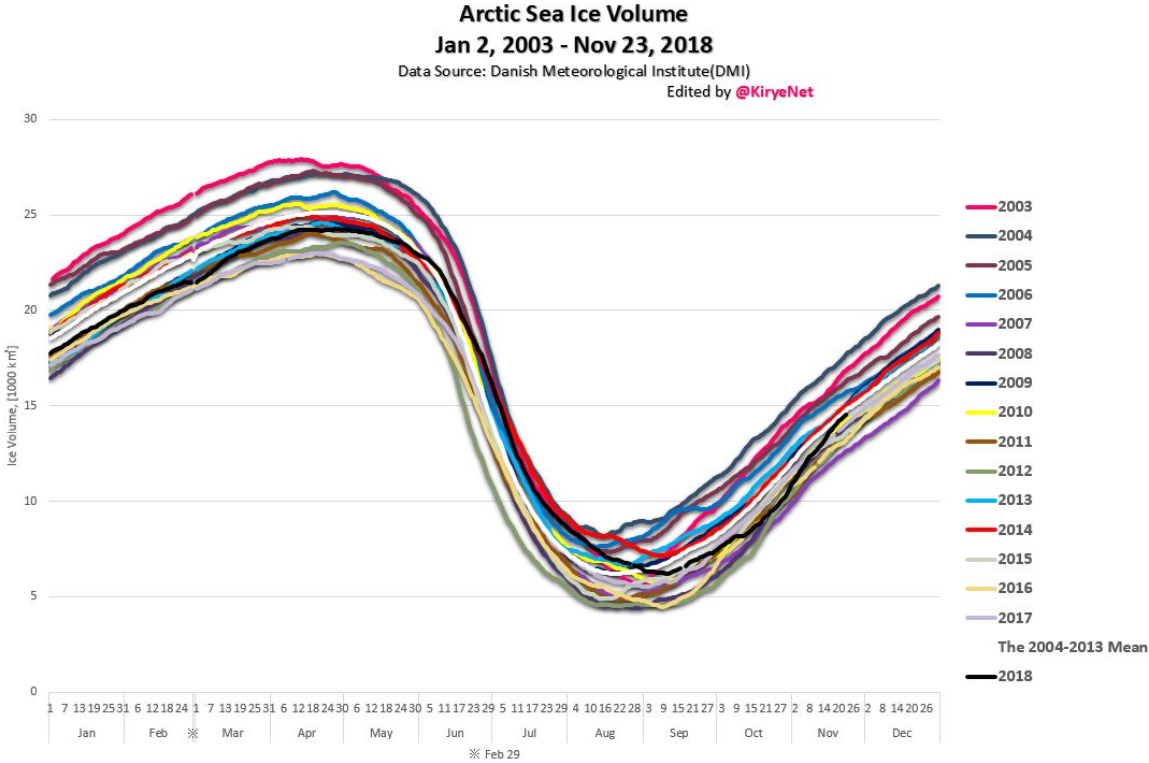
Chart made by Kirye. Data Source: Danish Meteorological Institute.
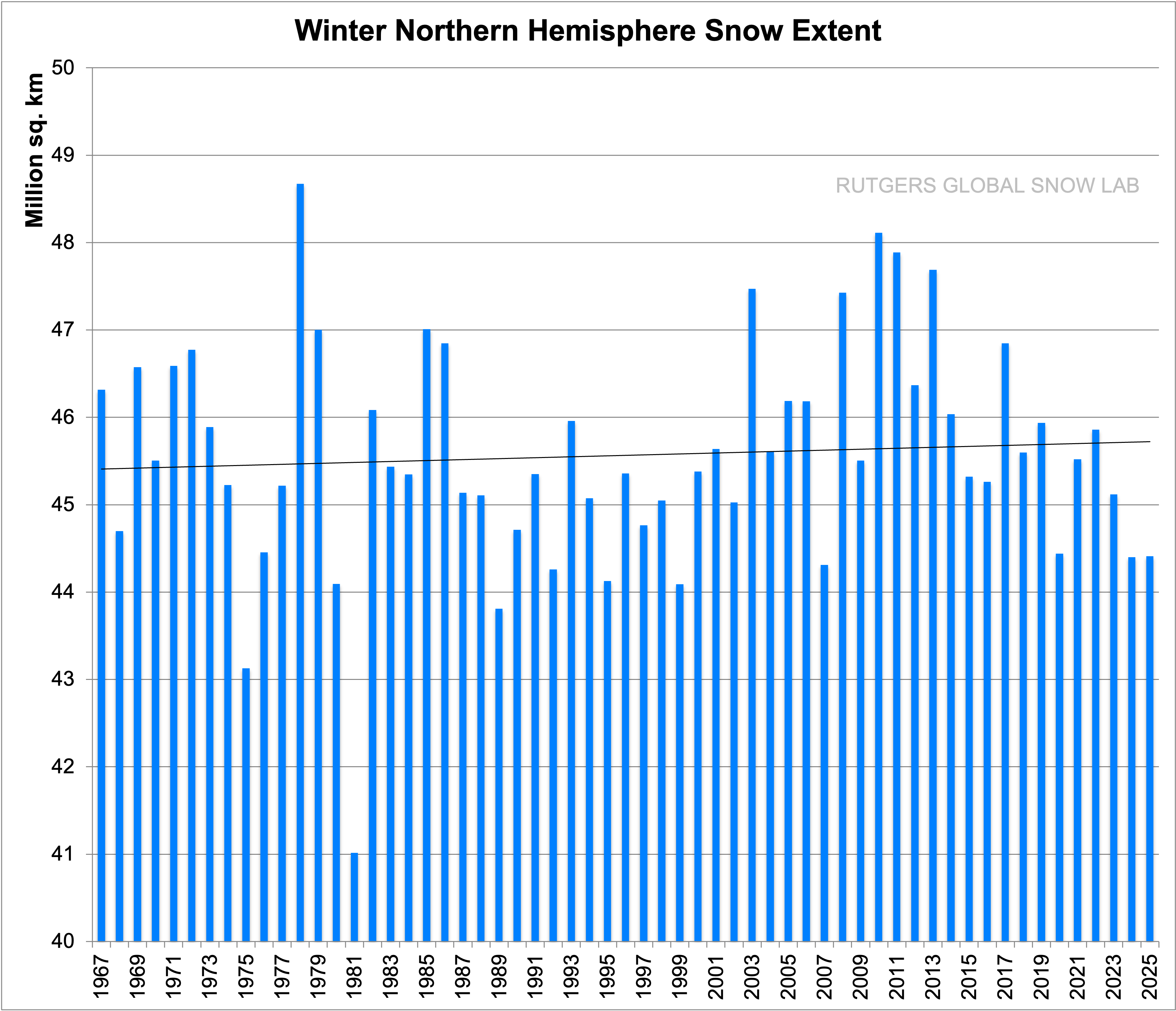
Also, according to the University of Rutgers, winter northern hemisphere snow extent has been trending upwards over the past 50 years:
Solar activity lowest level in near 200 years
So what could be behind all the surprising record-setting cold and early wintry weather?
A huge volume of scientific literature suggests that low solar activity is playing a major role. The 20th century saw especially strong solar activity, but it has quieted down substantially since the mid 2000s.
The last solar cycle (no. 24) is now all but officially the weakest in close to 200 years, since Solar Cycle 6.

The plot of Solar Cycle 24, red curve, compared to the mean of the previous 23 solar cycles (blue curve) and the similar Solar Cycle 5, which occurred around the year 1800. Chart: Frank Bosse and Prof. Fritz Vahrenholt.

The above bar chart compares the solar cycles in terms of sunspot number 119 months into the respective cycles. So far the current Solar Cycle 24 has seen an anomaly of -4360 from the mean. Chart: Frank Bosse and Prof. Fritz Vahrenholt
Most researchers believe that the coming solar cycle 25 will also be weaker than normal, meaning the planet is likely now well into a period of low solar cycle activity, which means a cooling climate ahead – as was the case of the Dalton Minimum some 200 years ago.
Little wonder the Arctic has not cooperated with the doomsday, ice-free Arctic scenarios, and instead has stabilized. A cooling North Atlantic will also further enhance the trend towards an Arctic sea ice rebound. The next 10 years will likely settle the dispute of what mostly drove the 20th century warming: The sun or manmade trace gas CO2.
via NoTricksZone
November 24, 2018 at 10:57AM

