

Image credit: interactivestars.com
It turns out that the previous post was only one half of the lunar evection story, so this post is the other half.
There are two variations to lunar evection, namely evection in longitude (the subject of the previous post) and evection in latitude, which ‘generates a perturbation in the lunar ecliptic latitude’ (source).
It’s found that the first is tied to the full moon cycle and the second to the draconic year.
The lunar evection in latitude is the beat period of the synodic month and the draconic year. The result is that it should average about 32.280777 days (46484.32 minutes).
Comparing synodic months (SM), draconic months (AM), and lunar evections in latitude (LE2) with the draconic year (DY) we find:
1 DY = 11.737662 SM
1 DY = 11.737662 + 1 = 12.737662 DM
1 DY = 11.737662 – 1 = 10.737662 LE2
Since 0.737662 * 385 = 283.99987 (284), we can say for our model:
3850 + 284 = 4134 LE2 (55*75, +9)
4235 + 284 = 4519 SM (55*82, +9)
4620 + 284 = 4904 DM (55*89, +9)
385 DY = 55*7 and 89-82 = 7 and 82-75 = 7
55 and 89 are Fibonacci numbers.
A very near-equivalent is: 61 DY = 655 LE2 = 716 DM = 777 DM.
That should probably be accurate enough (> 99.999%) for most purposes.
Analysis
The lunar evection in latitude is the beat period of the draconic year and the synodic month.
(Alternatively, DY = the beat period of LE2 and SM).
The difference between the the number of evections in longitude (LE) and evections in latitude in any given period = the difference between the number of draconic years and full moon cycles in the same period i.e.:
(Number of) LE – LE2 = (Number of) DY – FMC
The key period is the ‘lunar wobble’, approx. 2190.35 days, where both differences = 1.
This is the ‘axial’ period of the lunar nodal and apsidal cycles, i.e. the time taken for the sum of their occurrences to equal 1.
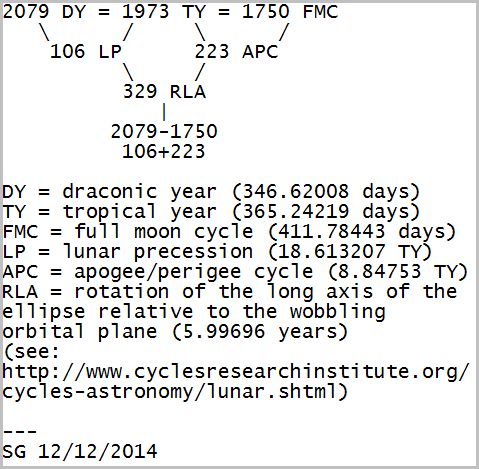
This model from an earlier post shows how some of these lunar periods fit together.
Note: ‘lunar wobble’ is shown as RLA in the chart.
The numbers of DY, FMC and RLA are divisible by 7, so:
297 DY – 250 FMC = 47 RLA.
LE – LE2 will also equal 47 in that period.
Source: Two long-term models of lunar cycles
via Tallbloke’s Talkshop
December 2, 2018 at 04:42AM
 Iowa Climate Science Education