
Guest AEUHHH???? by David Middleton
A Terrifying Sea-Level Prediction Now Looks Far Less Likely
But experts warn that our overall picture of sea-level rise looks far scarier today than it did even five years ago.
ROBINSON MEYER
JAN 4, 2019One of the scariest scenarios for near-term, disastrous sea-level rise may be off the table for now, according to a new study previewed at a recent scientific conference.
Two years ago, the glaciologists Robert DeConto and David Pollard rocked their field with a paper arguing that several massive glaciers in Antarctica were much more unstable than previously thought. Those key glaciers—which include Thwaites Glacier and Pine Island Glacier, both in the frigid continent’s west—could increase global sea levels by more than three feet by 2100, the paper warned. Such a rise could destroy the homes of more than 150 million people worldwide.
[…]
It is a reassuring constraint placed on one of the most alarming scientific hypotheses advanced this decade. The press had described DeConto and Pollard’s original work as an “ice apocalypse” spawned by a “doomsday glacier.” Now their worst-case skyrocketing sea-level scenario seems extremely unlikely, at least within our own lifetimes.
[…]
Yet their work—and the work of other sea-level-rise scientists—still warns of potential catastrophe for our children and grandchildren. If every country meets its current commitment under the Paris Agreement, the Earth will warm about 2.7 degrees Celsius by the end of the century compared with its pre-industrial average. In their new research, DeConto and his colleagues say that there’s a tipping point, somewhere between 2 and 3 degrees Celsius of temperature rise, after which the West Antarctic Ice Sheet will slip into rapid and shattering collapse.
[…]
The new results inform one of the biggest outstanding questions—and most fervent debates—concerning how climate change will reshape our world: How much will the seas rise, and how fast will that upheaval occur? DeConto and several other American glaciologists—including Richard Alley, a professor at Penn State and a co-author of the new research—represent something like the vanguard of that discussion. They champion an idea called “marine ice-cliff instability,” or MICI, which maintains that West Antarctic glaciers will eventually crumble under their own weight. By the middle of next century, they warn, this mechanism could send ocean levels soaring at a rate of several feet per decade. For reference: Along the U.S. East Coast, the Atlantic Ocean has risen by only about a foot over the last 12 decades.
While “marine ice-cliff instability” might be clunky, the idea is cinematic.
[…]
Other researchers find this possible future somewhat fantastic. “We, as European modelers, are slightly more skeptical of the marine-cliff idea,” Frank Pattyn, a glaciologist at the Free University of Brussels, told me. “It has not been observed, not at such a scale.”
[…]
There is only one place in the world where MICI is definitely happening: Jakobshavn Glacier, on the west coast of Greenland.
[…]
Alley, the Penn State glaciologist, addressed the sapphire-colored elephant in the room immediately after taking the dais. As he sees it, it’s just common sense that Antarctic glaciers will develop problematic ice cliffs.
[…]
In this scenario, he warned, “We will not have analogues … We are going to move outside the instrumental data that we use to calibrate our models.”
Then came the skeptics. Dan Martin, a computational scientist at Lawrence Berkeley National Lab, argued that his and his colleagues’ work showed that ice cliffs might simply be a product of running a computer model of ice physics at a too-low resolution. Eric Larour, a physicist at NASA, presented the possibility that the physics of the Earth itself might slightly counteract some rapid ice-cliff collapse. As the ice sitting on West Antarctica melts, the bedrock below it will bounce back up.
“When ice melts or thins, you can think that the Earth [below it] is going to rebound,” he said. That bedrock will rise, lifting the glacier partly out of the water. Such a mechanism could buy humanity some time, he said, giving us a “23 to 30 year delay” in the total collapse of West Antarctica. This effect might hold off the collapse of West Antarctica until 2250 or 2300, but then the ice sheet would disintegrate as fast as ever.
The meeting arrived at no clear conclusion.
[…]
MICI remains a young idea, first proposed only six years ago. It need not be rejected simply because scientists haven’t arrived at hard conclusions yet, Fricker, the Scripps glaciologist, said.
[…]
“It might not happen,” Fricker said. “But if there’s a chance that it could happen, then shouldn’t you involve that in your planning? If you’re hosting a picnic and it might rain, you don’t necessarily move the whole event, but you probably do make a Plan B. If you’re planning a city … you might as well keep this in the back of your mind.”
We want to hear what you think about this article. Submit a letter to the editor or write to letters@theatlantic.com.
I love this bit: “Then came the skeptics.” Why were they even invited? I thought they had all been banished from the AGU. How dare they throw cold water on a perfectly good model-derived catastrophe… /Sarc.
Marine ice cliff instability (MICI) “has not been observed, not at such a scale,” “might simply be a product of running a computer model of ice physics at a too-low resolution,” ignores post glacial rebound, couldn’t occur before ” until 2250 or 2300″… Yet “the idea is cinematic,” “it’s just common sense that Antarctic glaciers will develop problematic ice cliffs” and something we should plan for…

Figure 1. AEUHHH????
How can you plan for something that’s never been observed? May not ever happen? Won’t happen for 200-300 years, if it does happen? What’s the point in even keeping “this in the back of your mind.” No one with this in the back of their mind today will be alive in 2250. Their children won’t be alive. Their grandchildren probably won’t be alive. In 2250, we can just let Star Fleet take care of this.
This comment was most reassuring…
“We will not have analogues … We are going to move outside the instrumental data that we use to calibrate our models.”
–Richard B. Alley, Penn State University
That will certainly be a relief to climate modelers, Their models will no longer have to be constrained by reality… Which won’t be much of a change. RCP8.5 is already unconstrained by reality.
Speaking of RCP8.5 and DeConto & Pollard, that’s how all of this got started…
Polar temperatures over the last several million years have, at times, been slightly warmer than today, yet global mean sea level has been 6–9 metres higher as recently as the Last Interglacial (130,000 to 115,000 years ago) and possibly higher during the Pliocene epoch (about three million years ago). In both cases the Antarctic ice sheet has been implicated as the primary contributor, hinting at its future vulnerability. Here we use a model coupling ice sheet and climate dynamics— including previously underappreciated processes linking atmospheric warming with hydrofracturing of buttressing ice shelves and structural collapse of marine-terminating ice cliffs—that is calibrated against Pliocene and Last Interglacial sea-level estimates and applied to future greenhouse gas emission scenarios. Antarctica has the potential to contribute more than a metre of sea-level rise by 2100 and more than 15 metres by 2500, if emissions continue unabated. In this case atmospheric warming will soon become the dominant driver of ice loss, but prolonged ocean warming will delay its recovery for thousands of years.
The “
more than a metre of sea-level rise by 2100 and more than 15 metres by 2500″ is based on bad science fiction (RCP8.5)…

Figure 2. Figure 5 from DeConto & Pollard, 2016. “Large Ensemble model analyses of future Antarctic contributions to GMSL. a, RCP ensembles to 2500. b, RCP ensembles to 2100. Changes in GMSL are shown relative to 2000, although the simulations begin in 1950. Ensemble members use combinations of model parameters (Methods) filtered according to their ability to satisfy two geologic criteria: a Pliocene target of 10–20 m GMSL and a LIG target of 3.6–7.4 m. c and d are the same as a and b, but use a lower Pliocene GMSL target of 5–15 m. Solid lines are ensemble means, and the shaded areas show the standard deviation (1σ) of the ensemble members. The 1σ ranges represent the model’s parametric uncertainty, while the alternate Pliocene targets (a and b versus c and d) illustrate the uncertainty related to poorly constrained Pliocene sea-level targets. Mean values and 1σ uncertainties at 2500 and 2100 are shown.”
DeConto & Pollard essentially asserted that we are headed back to the Pliocene over the next few hundred years.
Not likely.

Figure 3. High Latitude SST (°C) From Benthic Foram δ18O (Zachos, et al., 2001) and HadSST3 ( Hadley Centre / UEA CRU via http://www.woodfortrees.org) plotted at same scale, tied in at 1950 AD.
We’ve already experienced nearly 1 ºC of warming since pre-industrial time. Another 0.5 to 1.0 ºC between now and the end of the century doesn’t even put us into Eemian climate territory, much less the Pliocene. Beyond that, who knows what will happen? While fossil fuels will dominate the energy mix for much of this century, does anyone really believe that better source of energy won’t be added to the mix between 2100 and 2250?
There is only one place in the world where MICI is definitely happening: Jakobshavn Glacier, on the west coast of Greenland.
Jakobshavn Glacier is not an MICI analogy for Antarctica. It’s not even an analogy for any other glaciers in Greenland.
Jakobshavn Glacier Calving Front Recession from 1850 to 2006
Visualizations by Cindy Starr Released on January 5, 2007
Jakobshavn Isbrae is located on the west coast of Greenland at Latitude 69 N. The ice front, where the glacier calves into the sea, receded more than 40 km between 1850 and 2006. Between 1850 and 1964 the ice front retreated at a steady rate of about 0.3 km/yr, after which it occupied approximately the same location until 2001, when the ice front began to recede again, but far more rapidly at about 3 km/yr. After 2004, the glacier began retreating up its two main tributaries: one to the north, and a more rapid one to the southeast.
These changes are important for many reasons. As more ice moves from glaciers on land into the ocean, it causes a rise in sea level. Jakobshavn Isbrae is Greenland’s largest outlet glacier, draining 6.5 percent of Greenland’s ice sheet area. The ice stream’s speed-up and near-doubling of the ice flow from land into the ocean has increased the rate of sea level rise by about .06 millimeters (about .002 inches) per year, or roughly 4 percent of the 20th century rate of sea level increase.
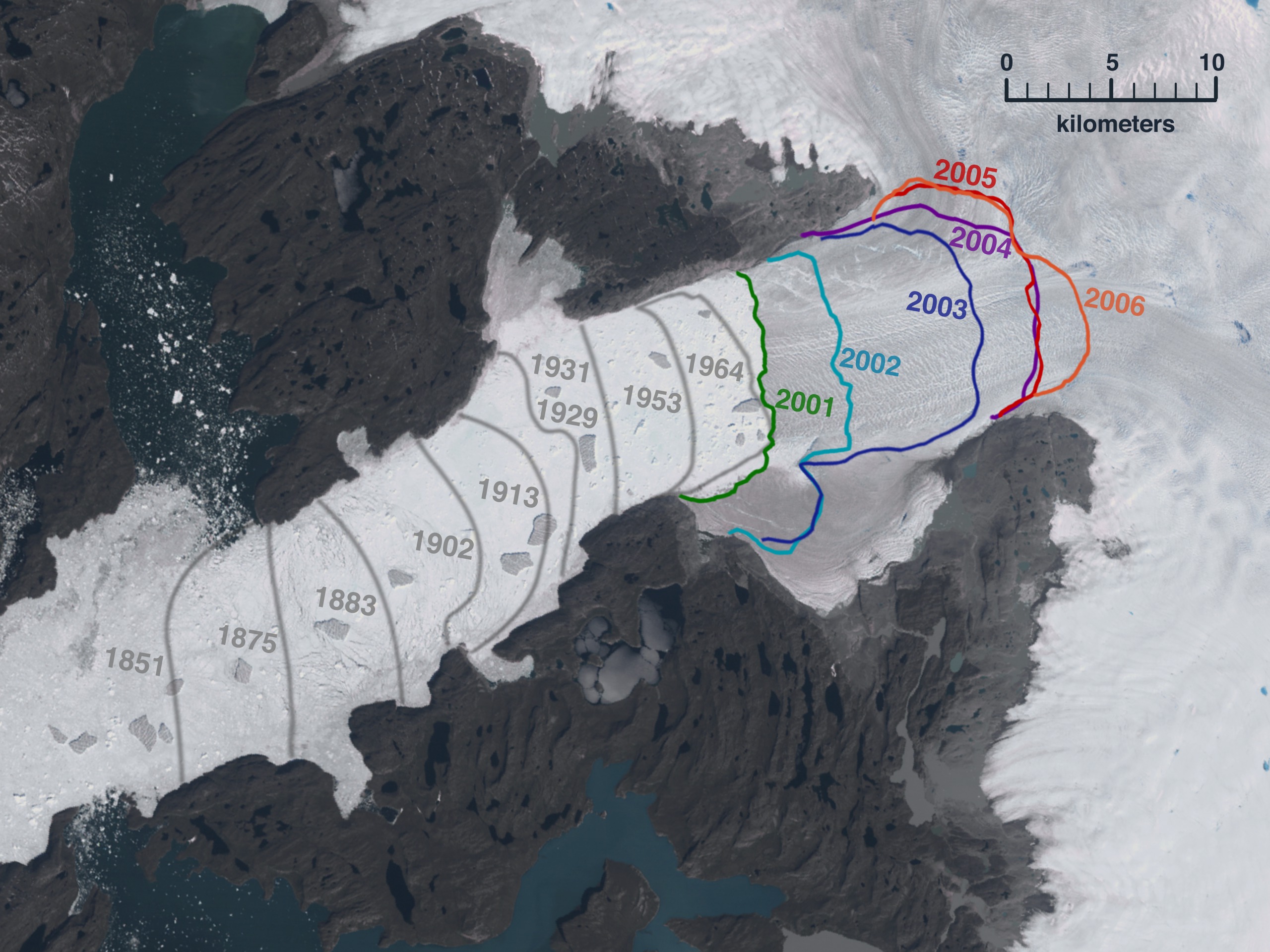
This image of the Jakobshavn glacier on 07/07/2001 shows the changes in the glacier’s calving front between 1851 and 2006. Historic calving front locations, 1851 through 1964, were compiled by Anker Weidick and Ole Bennike and are shown here in gray. Recent calving front locations, 2001 through 2006, derived from satellite imagery are show in colors. A distance scale is provided.
[…]
The calving lines were overlaid on a 2001 Landsat image.
This article was updated in July 2007 with a new image…
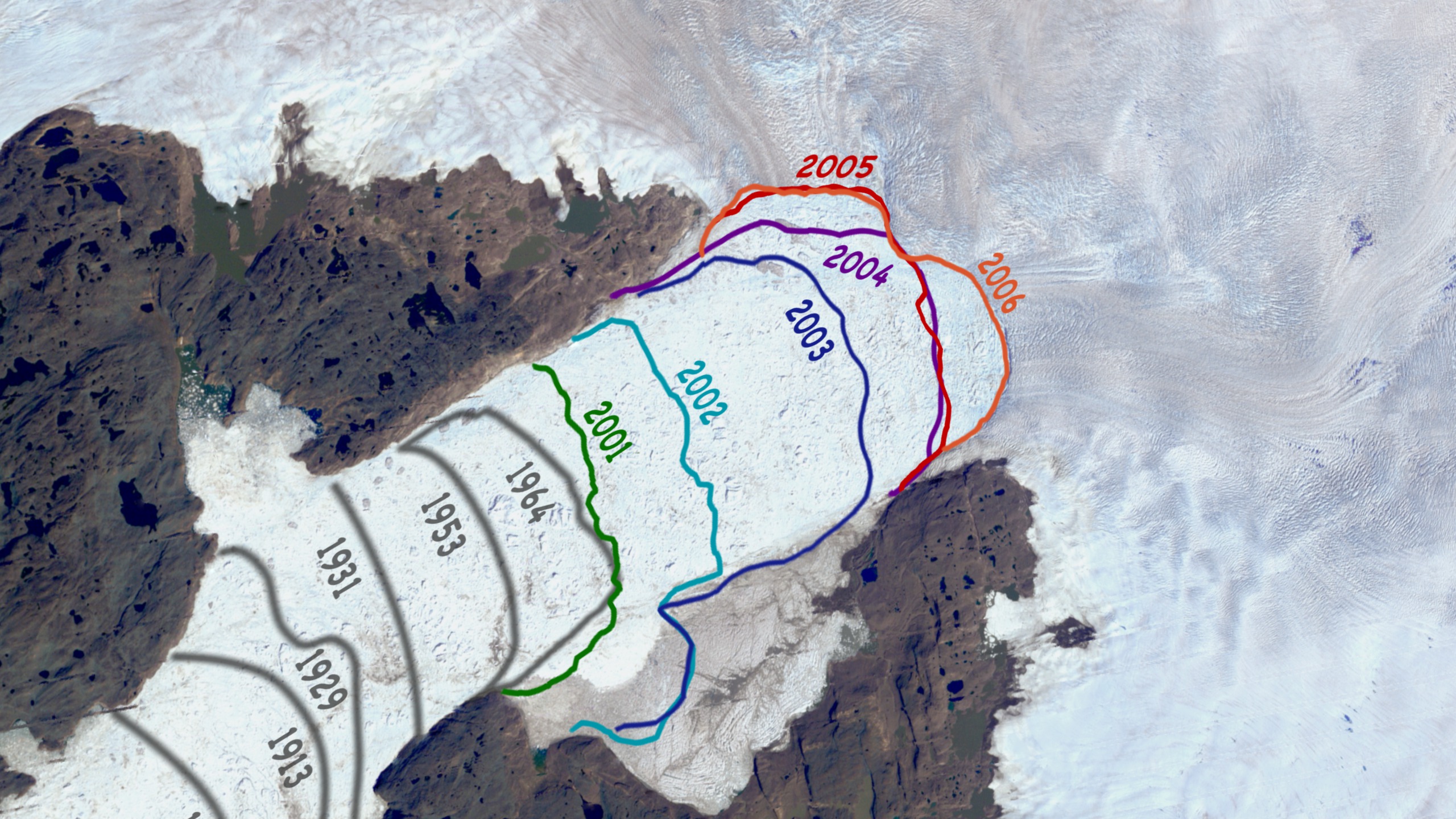
Figure 4. “The recession of calving front locations is shown over an image of the Jakobshavn glacier on 08/06/2006. Historic calving front locations from 1851 through 1964, compiled by Anker Weidick and Ole Bennike, are shown here in gray. Recent calving front locations, 2001 through 2006, derived from satellite imagery are show in colors.”
The glacier had indeed retreated from 2001-2006 after nearly 40 years of little movement. However, all of the retreat has occurred on the “floating ice tongue”…
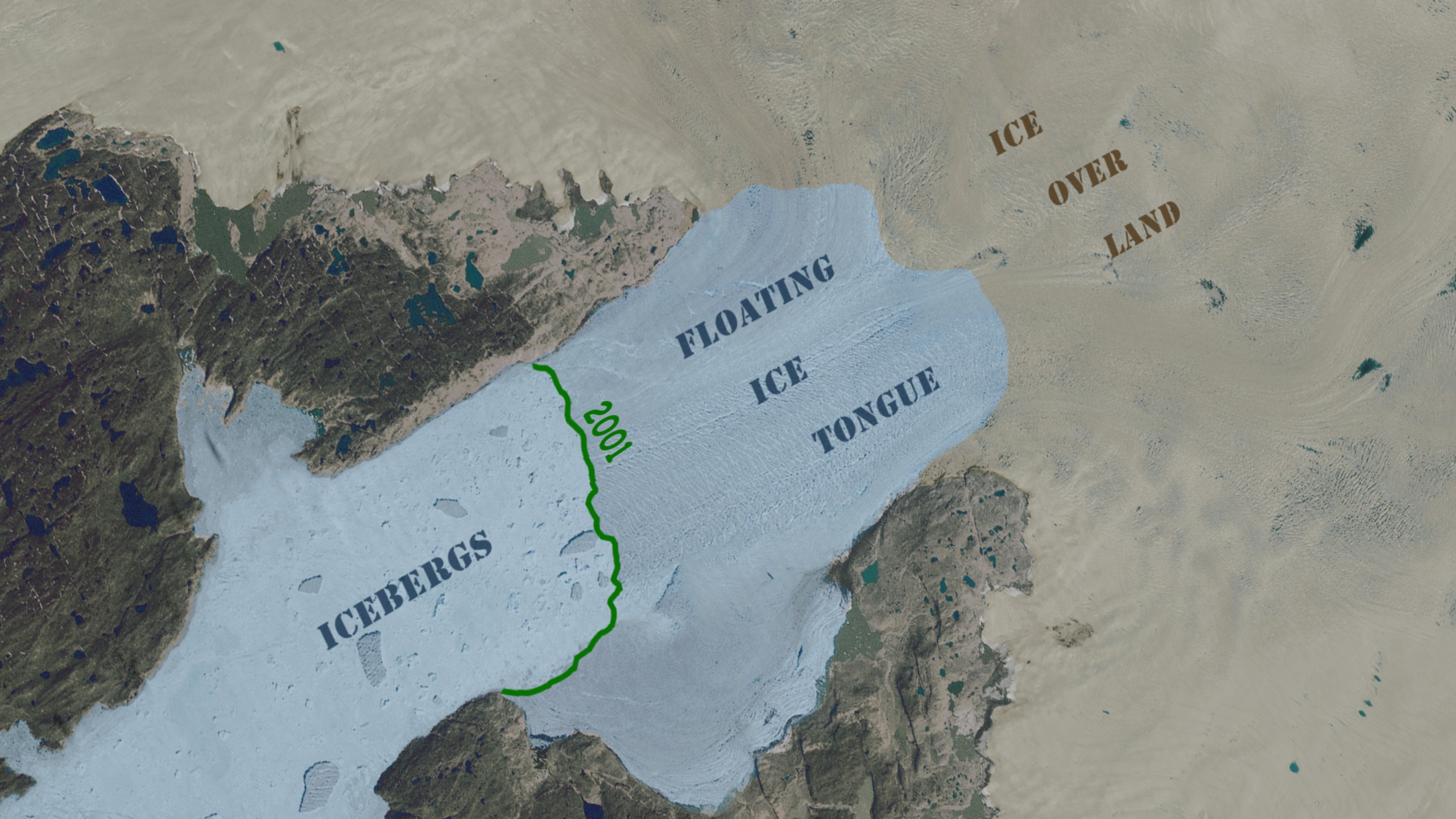
Figure 5. “The calving front line from 07/07/2001 deliniates the area of floating icebergs from the solid glacial ice. Semi-transparent overlays identify the portion of the glacier which is over water (blue) and over land (tan).”
Jakobshavn Isbrae – Greenland Glacier Has Always Changed With The Climate
By News Staff | July 16th 2011
New research on Jakobshavn Isbrae, a tongue of ice extending out to sea from Greenland’s west coast, shows that large, marine-calving glaciers don’t just shrink rapidly in response to global warming, they also grow at a remarkable pace during periods of global cooling. *Glaciers change.
[…]
Jakobshavn Isbrae has been the focus of intense scientific interest because it is one of the world’s fastest-flowing glaciers, releasing enormous quantities of Greenland’s ice into the ocean. It is believed that changes in the rate at which icebergs calve off from the glacier could influence global sea level rise. The decline of Jakobshavn Isbrae between 1850 and 2010 has been documented, mostly recently through aerial photographs and satellite photographs.
“We know that Jakobshavn Isbrae has retreated at this incredible rate in recent years, and our study suggests that it advanced that fast, also,” said Jason Briner, the associate professor of geology at the University of Buffalo, who led the research. “Our results support growing evidence that calving glaciers are particularly sensitive to climate change.”
[…]

Figure 6. Jakobshavn Isbrae.
(Wikipedia and Google Earth)
“Our results support growing evidence that calving glaciers are particularly sensitive to climate change.” Greenland’s climate is always changing… Always has and always will change… And the climate changes observed over the last few decades are not unprecedented. The Greenland ice sheet is no more disappearing this year than it was last year and it is physically impossible for the ice sheet to “collapse” into the ocean.
Each and every [fill-in-the-blank]-sized iceberg to calve off Greenland or Antarctica triggers the same alarmist nonsense and glacial junk science journalism. Glaciers are rivers of ice. They flow downhill. Downhill is generally toward the ocean, where they calve icebergs. Increased calving of icebergs is indicative of excess ice accumulation, not melting. Past glacial stages and stadials are associated with an increase in dropstones in marine sediment cores because icebergs calve more frequently when the source of ice is expanding.
From 1850 through 2006, Jakobshavn Isbrae’s floating ice tongue has calved into the ocean. Prior to 1850, glaciers had mostly been advancing since the end of the Holocene Climatic Optimum, a period known as “Neoglaciation.” While the retreat of Jakobshavn Isbrae’s floating ice tongue was punctuated with a prolonged hiatus associated with the mid-20th century cooling period, this process began at the end of Neoglaciation. The end of Neoglaciation was a “good thing”…

Figure 7. The Ice Age Cometh? Science News, March 1, 1975. Had Neoglaciation not ended, the “Ice Age” might just have “cometh,”
References
DeConto, Robert & Pollard, David. (2016). Contribution of Antarctica to past and future sea-level rise. Nature. 531. 591-597. 10.1038/nature17145.
Zachos, J. C., Pagani, M., Sloan, L. C., Thomas, E. & Billups, K. Trends, rhythms, and aberrations in global climate 65 Ma to present. Science 292, 686–-693 (2001).
via Watts Up With That?
January 5, 2019 at 11:29AM
 Iowa Climate Science Education